Traeger Flatrock vs. Blackstone: Which Flat Top Griddle to Buy
Traeger Flatrock vs. Blackstone 36-inch: even heat vs. cooking space, wind protection, grease handling, assembly and how to season a new flat top griddle.
Every gas griddle looks the same from across the yard: a steel plate over a row of burners. The differences show up once it is lit. Some tops run within a few degrees from end to end, others have a scorching middle and pale corners. Wind and grease handling matter more than most buyers expect.
The Traeger Flatrock and the Blackstone 36-inch are the two names most shoppers end up choosing between. Here is how they differ on heat, wind, grease and space, what other griddles add, and how to season a new top.
As an Amazon Associate, Best Utah Real Estate earns from qualifying purchases.
Quick verdict
- More even heat and better wind protection: the Traeger Flatrock 3 Zone Flat Top Grill. The top sits recessed inside the frame, the heat stays even across the plate, and the grease catch is the biggest in the group. It costs more, and its grease opening sits where a right-handed cook naturally scrapes.
- The most cooking room for the money: the Blackstone 36 Inch 4 Burner Griddle Cooking Station. Four burners and 60,000 BTU over a 36-inch top give room for a crowd. Expect a hotter center and cooler corners.
The griddles side by side
| Griddle | Shop | Burners | Cooking surface | Heat evenness | Wind protection | Grease |
|---|---|---|---|---|---|---|
| Traeger Flatrock 3 Zone Flat Top Grill |  Buy on Amazon | 3 U-shaped (horseshoe), 3 zones | 18 x 33 in | Very even; about 20°F spread on low | Top recessed inside the frame | Front opening, large covered catch underneath |
| Blackstone 36 Inch 4 Burner Griddle Cooking Station |  Buy on Amazon | 4 straight, 60,000 BTU total | 36 in wide | Middle hottest, corners cooler | Check the listing | Grease pan |
| Blackstone Pro Series 1901 | 3 single | 21.5 x 28 in | Even, helped by wind baffles | Side dampeners plus a lip over the burners | Rear, hook-on catch | |
| Weber 28 in griddle (original) | 3, 36,000 BTU | 28 in wide | The most even on low | None | Long, lightweight tray | |
| Camp Chef 4-burner | 4 straight, heat diffuser plate | 19 x 31.5 in | Very even | Not noted | Front trough |
Heat: even plate or hot center?
This is the biggest difference between flat tops, and it decides how forgiving a griddle is. With every burner on low, the Flatrock settles at about 375°F to 395°F across the plate, a spread of roughly 20°F, with one edge a little cooler. Set a temperature and the whole top cooks at it. It runs 30°F to 50°F hotter on low than the original Weber, so eggs may need the knobs nudged down.
Blackstones lean the other way. On the 36-inch Omnivore model with all four burners on low, readings run about 405°F, 450°F, 445°F and 430°F across the middle and drop to about 320°F at one end, a spread near 100°F. Front to back, the same top reads only 280°F to 330°F. Bread laid across it toasts dark in the center and barely colors along the edge. On another 36-inch Blackstone, an air fryer combo, the center reaches about 450°F on medium while the corners sit around 250°F to 300°F. The sweet spot is a strip down the middle.
The Blackstone 36 Inch 4 Burner Griddle Cooking Station shows the same pattern, with less drama. After 15 minutes on high on a 60°F day with a light breeze, it reads about 470°F. Across six spots, its plate runs from about 360°F to 440°F, the corners cooler than the middle. That unit had five or six years of use, so treat these as real-world numbers.
A hotter middle isn't all bad: cooler edges give food a place to rest. The catch is that a dial set to low can still put 450°F under the eggs.
Wind and grease
A breeze steals heat from an open burner and can blow a low flame out. The Flatrock's plate drops into a recessed frame, so the flames are shielded on every side; it doesn't roar or go out in wind. Blackstone's answer varies by model: the Pro Series 1901 has dampeners on each side and a lip under the plate covering the burners, and the Omnivore top has guards built in underneath. The original Weber 28-inch has nothing and needs aftermarket guards. For homeowners who cook on an open deck where afternoon gusts are routine, as in much of the Mountain West, this is worth weighing.
Grease placement splits buyers. The Flatrock drains through an opening at the front into the largest, sturdiest catch of the group, tucked under the griddle and out of the way. Two complaints: heat rises hard through that opening, so a hand or plate near it gets hot fast, and it sits right where right-handed cooks tend to scoop food.
On the Blackstone Omnivore and Pro Series models, the grease trap sits at the back, which keeps hot grease away from the cook but brings its own problems. The Pro Series 1901's catch hooks on loosely and is flimsy; if it isn't seated just right, grease drips onto the bottom shelf. With only the hood on, a rear trap sits open, so rain fills it and critters can get in.
What to check before buying
- Burner count vs. BTU: more BTU doesn't mean more heat on the plate. The original Weber, at 36,000 BTU, read 585°F after 15 minutes on high while the 60,000 BTU Blackstone 36-inch read about 470°F. A smaller plate has less steel to heat, so it also responds faster when the knobs change. Horseshoe and D-shaped burners also spread flame over more of the plate.
- Surface size and shape: the Flatrock's 18 x 33 inch top is longer and shallower than the Pro Series 1901's 21.5 x 28, about the same area. A four-burner 36-inch top is the one to pick for big gatherings.
- Wind guards: built-in protection beats clip-on guards. Check whether the plate is recessed or the burners are covered.
- The grease path: front or back, and how the catch attaches. A solid catch that locks in place beats a hook-on cup.
- Shelves and storage: the Flatrock has large side shelves with rails for clip-on accessories but no storage underneath. Blackstone's Pro Series has magnetic shelves for tools; the original Weber's small fixed shelves leave little room.
- Wheels and leveling: four locking casters make a griddle easy to move. The original Weber has two wheels, and the Camp Chef has leveling feet for uneven decks.
- The lid: the Flatrock's manual says to keep the lid open whenever a burner is on, so it is a cover, not a dome. Blackstone's Omnivore manual allows the hood closed as a dome for up to 10 minutes.
The picks in detail
Traeger Flatrock 3 Zone Flat Top Grill
The Flatrock runs three U-shaped burners under an 18 x 33 inch plate, split into three zones, and sits inside a recessed frame that blocks wind. It holds the more even heat of the two, and once seasoned, its top performs flawlessly. The factory surface comes noticeably rough, evenly so, and it takes more coats of oil than the manual suggests before it is ready. Assembly is easier than on the Blackstone Pro Series 1901: parts boxes are labeled and the pieces line up. Ignition runs on a 9-volt battery; the LED propane level sensor uses power, but the burners don't need it to light. All four casters swivel and lock.
The side handles have openings that food falls through when scraped toward the edge, and the tank bracket in back is fiddly because it weighs the tank to read the fuel level. The lid lifts smoothly, but removing it means undoing bolts, and accessories like a paper towel holder are extra. If a pellet smoker is also on the list, see the pellet grill comparison.
Traeger Flatrock 3 Zone Flat Top GrillCheck today’s price on Amazon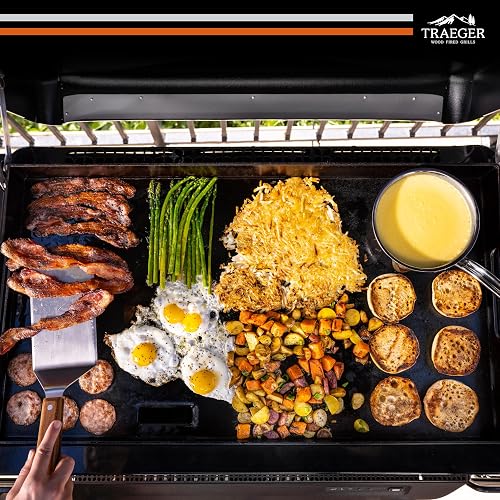

 Buy on Amazon →
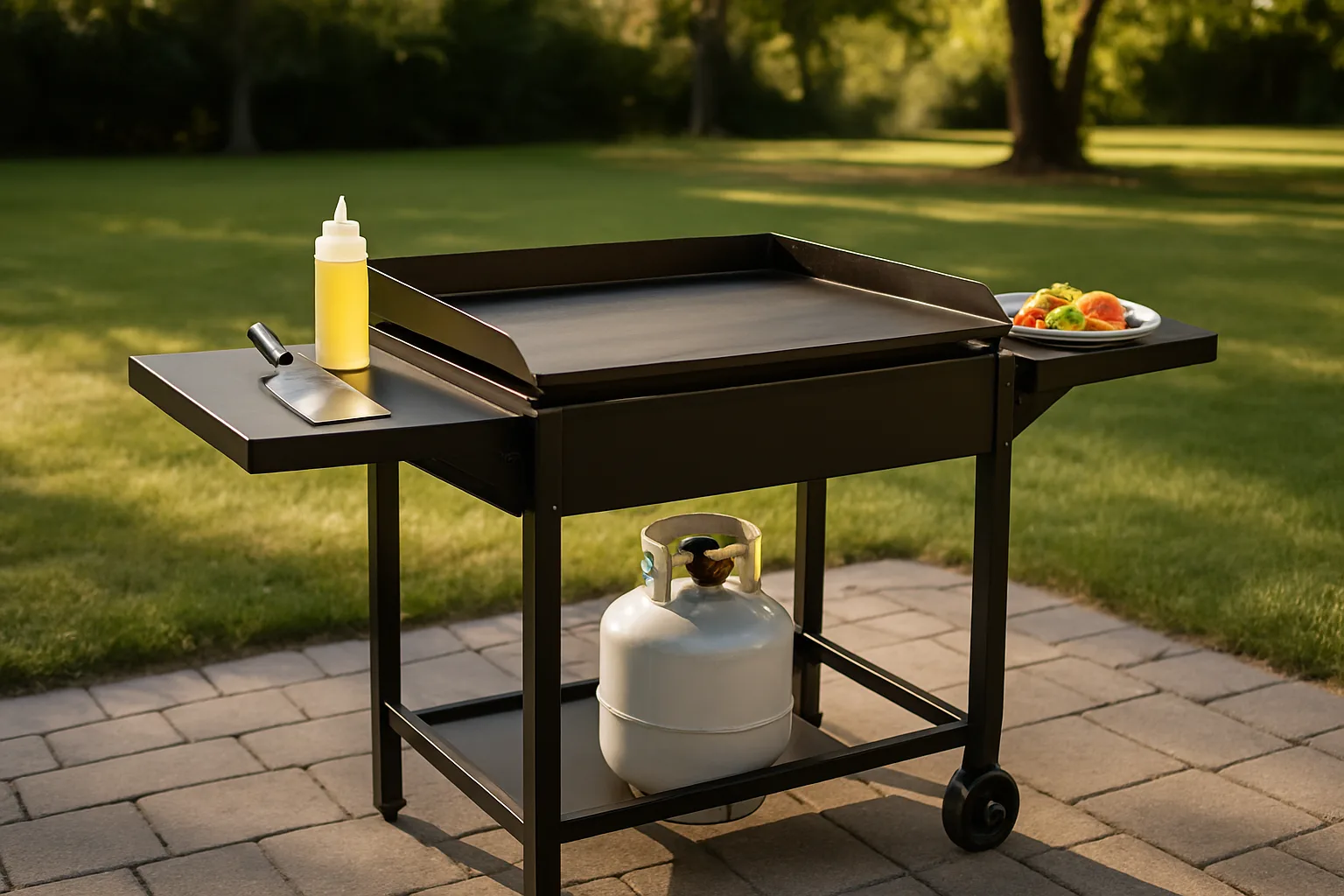
Blackstone 36 Inch 4 Burner Griddle Cooking Station
The classic four-burner Blackstone: four independent burners, 60,000 BTU in total, a 36-inch cooking top, foldable legs, a grease pan and a storage rack underneath. Its strength is room. Steaks, chops, potatoes and vegetables fit at once, with space to move food off the heat. Heat climbs more slowly than on a smaller top and the center runs hottest, so sear in the middle and park finished food at the edges.
Blackstone also sells a wide range of models and accessories, from small griddles to cabinet units.
Blackstone 36 Inch 4 Burner Griddle Cooking StationCheck today’s price on Amazon

 Buy on Amazon →
Others worth knowing about
- Blackstone 36 in with the Omnivore top: the smoothest factory surface of the group and one of the easiest to season, with eggs sliding off even on sections not yet seasoned. The hood comes off without tools. Heat is the weak spot, with the near-100°F spread on low.
- Blackstone Pro Series 1901: priced like the Flatrock, with wind baffles that keep it lit and temperatures balanced. Assembly can fight back; a leg bolt may not line up.
- Weber 28 in griddle (original): the version that came before Weber's current Slate line. It is the most even griddle here on low, at about 360°F across most of the plate, and its top almost seems pre-seasoned. It is light and thin, with no wind protection and a long grease tray that takes two hands when full.
- Camp Chef 4-burner: a heat diffuser plate under the top evens out temperatures and helps it recover heat after cold food lands. Its front grease trough runs cooler than the plate, so watch it for rust. A lid is not included.
- Pit Boss 3-burner: a ceramic-coated top that needs no seasoning (the manual calls for wood or silicone tools), and the cooktop lifts off its stand to travel.
Seasoning a new top and avoiding warping
Every rolled-steel top needs seasoning before the first cook. Wipe on a thin coat of oil, heat it until it smokes off, and repeat five or six times, then let it cool. The middle turns dark first because it is the hottest part of the plate. Rough tops like the Flatrock's need more coats than smooth ones.
Warped plates happen on every brand. A common precaution is to light all the burners on low and let the plate heat evenly before turning anything up. Before the first light of the season, check the gas tank for leaks; the NFPA's grilling safety guidance covers it. For thick steaks and chops, an instant-read thermometer takes the guessing out of a plate with hot and cool zones.
Who should buy which
- Even heat, a windy spot and easy grease cleanup: the Traeger Flatrock 3 Zone.
- Feeding a crowd on a budget: the Blackstone 36 Inch 4 Burner.
- Cooks who would rather never scrape grease toward themselves: a Blackstone Pro Series 1901 or Omnivore model, with the grease trap at the back.
Posted by Kristopher Larson
Frequently asked questions
Is the Traeger Flatrock better than a Blackstone?
It depends on what matters more. The Flatrock holds a much more even temperature across its plate, shields its burners from wind and has a large grease catch. The Blackstone 36-inch four-burner gives more room for big gatherings at a lower price, with a hotter center and cooler corners.
Why is the middle of my Blackstone hotter than the edges?
The firebox design concentrates heat in the center of the plate, and the corners and edges run cooler on most griddles. On some 36-inch Blackstones the middle reaches about 450°F while the corners sit 100°F or more cooler. Use the edges as a resting zone, and preheat on low before cooking eggs or pancakes.
Can you cook with the lid closed on a Traeger Flatrock?
Traeger's manual says the lid must be open whenever a burner is running, so treat it as a cover. Some Blackstone hoods, such as the one on the Omnivore model, are rated for use as a dome for up to 10 minutes; check the manual for your model.
Is a front or rear grease trap better on a griddle?
A front trap lets you scrape grease toward you, which many cooks find natural, but heat rises through the opening. A rear trap keeps hot grease away from you, but it can be hard to reach when the griddle sits against a wall, and an open rear trap fills with rain if only the hood covers it.
How do you season a new flat top griddle?
Wipe on a thin layer of cooking oil, heat the plate until the oil smokes off, and repeat about five or six times before letting it cool. A rough factory surface, like the Flatrock's, needs more coats than a smooth one. Ceramic-coated tops, like the Pit Boss, skip seasoning entirely.
Do more BTUs make a griddle hotter?
Not necessarily. A 36,000 BTU, 28-inch Weber griddle read 585°F after 15 minutes on high, while a 60,000 BTU, 36-inch Blackstone read about 470°F. Plate size and burner layout matter as much as the BTU rating.
Keep reading
More from the blog
Best Pizza Oven: Gozney Arc XL vs. Arc Lite vs. Solo Stove Pi Prime vs. Roccbox
How to Store Rolex and Omega Watches: Watch Winders, Watch Boxes, Safes and the Right Settings
Best Furnace Filter: MERV 8 vs MERV 13, Filtrete vs Honeywell