Emergency Weather Radio: Kaito KA900 vs. Midland WR120B vs. FosPower A1
Crank radio for outages or bedside county alerts? How the Kaito KA900, Midland WR120B and FosPower A1 charge, tune and alert.
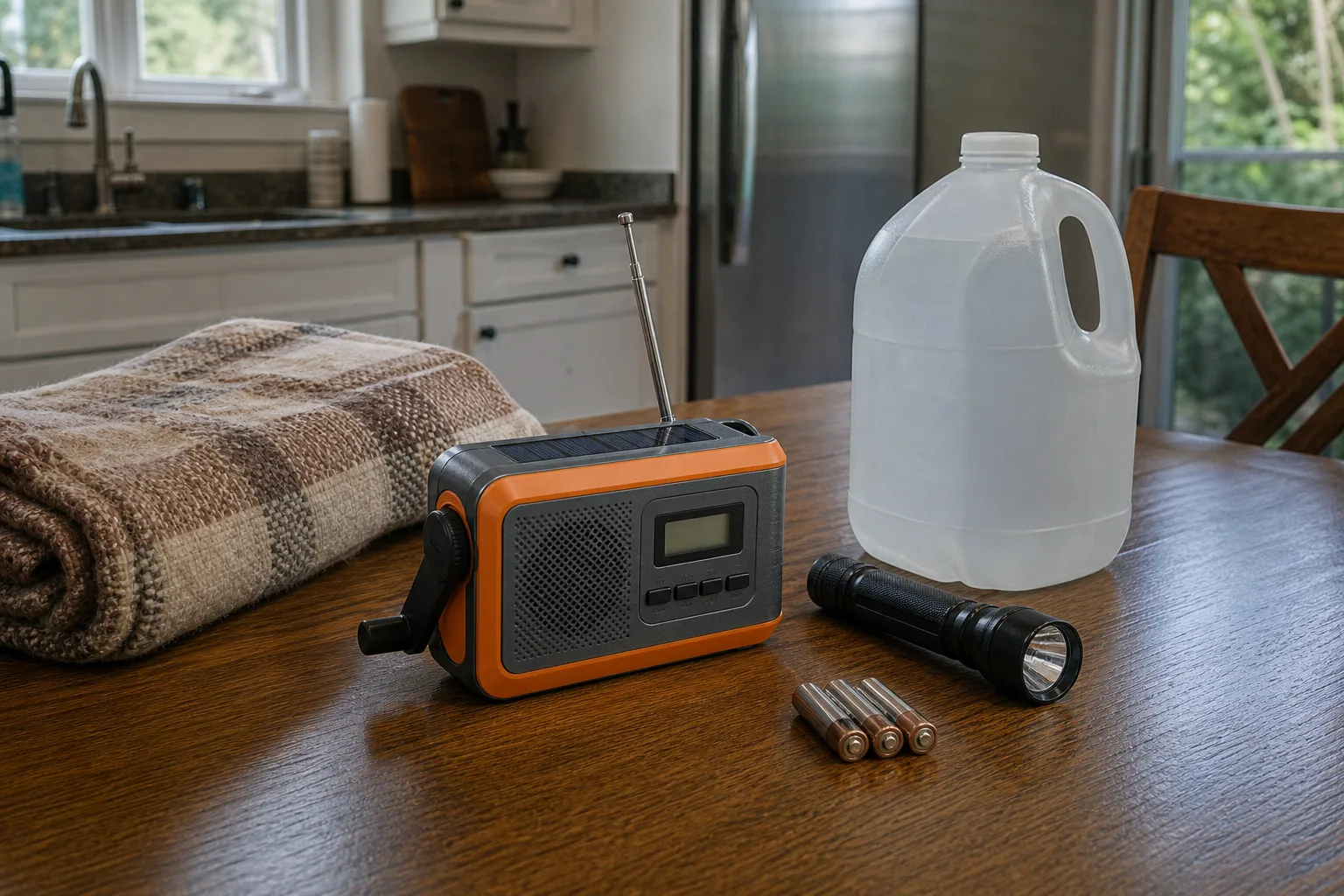
When the power goes out in a storm, the phone is the first thing to run low. A weather radio covers the gap. It picks up NOAA Weather Radio, the National Weather Service's own broadcast, and keeps working when the cell network is down. Most households need one of two kinds: a crank radio that charges from a hand crank, sunlight or a USB cable and carries the news through a long outage, and a plug-in alert radio that sits by the bed and wakes the house for a warning in its own county.
This guide compares three radios that cover those jobs: the Kaito KA900 Voyager Max, a large crank radio with shortwave and Bluetooth, the Midland WR120B county alert radio, and the compact FosPower A1.
Quick verdict
- For the home emergency kit and everyday listening: the Kaito KA900 Voyager Max. AM, FM, shortwave and the weather channels, strong stereo FM, a keypad, Bluetooth and a reading lamp under a tilting solar panel. Its alert turns the radio on with the broadcast rather than a siren, so it is not the radio to count on for waking you.
- For warnings that wake you at night: the Midland WR120B. It plugs into the wall, keeps three AA batteries as backup and uses S.A.M.E. county codes, so it sounds only for the counties and alert types you choose.
- For a go-bag, the car or a second room: the FosPower A1, a compact AM, FM and weather-band radio with a crank, a solar panel, AAA backup, a flashlight and a reading light. It has no weather alert, so it is for listening, not for waking you.
Many homes do well with two: a plug-in alert radio by the bed and a crank radio in the kit.
The three radios side by side
| Radio | Shop | Type | Bands | Power | Alerts | Extras |
|---|---|---|---|---|---|---|
| Kaito KA900 Voyager Max |  View on Amazon | Large portable crank radio | AM, FM, shortwave (3 to 23 MHz), 7 NOAA weather channels | 2,000 mAh rechargeable lithium battery, solar, crank, USB, optional 6V adapter | Turns on with the broadcast when an alert is sent; no siren | Two speakers, Bluetooth, MP3 player and recorder (microSD up to 32 GB), keypad, flashlight, 5-LED reading lamp, USB output |
| Midland WR120B |  View on Amazon | Plug-in alert radio | 7 NOAA weather channels | AC adapter, 3 AA backup (not included) | S.A.M.E. county codes, up to 25 locations, 90 dB siren, voice or display-only modes | Warning, watch and advisory lights, alarm clock, jack for an external alert |
| FosPower A1 |  View on Amazon | Compact crank radio | AM, FM, 7 NOAA weather channels | 2,000 mAh lithium-ion battery, AAA backup (not included), solar, crank, USB | None (listening only) | 1W zoom flashlight, 4-LED reading light, SOS alarm, USB output, IPX3 splash rating |
Full-featured kit radio
Kaito KA900 Voyager Max
AM, FM, shortwave and weather channels with a keypad, strong stereo FM, Bluetooth, a tilting solar panel with a reading lamp, a flashlight and a crank.
- AM, FM, SW and 7 NOAA channels
- 2,000 mAh 18650 battery
- Bluetooth and microSD
Good for
- Long outages and everyday listening
- Shortwave with a wire antenna at night
Skip it if
- You need a siren to wake you
- You want AA or AAA backup
How emergency radios actually perform
Solar and crank charging are backups, not a power plan
Small panels and cranks recover far less than the boxes suggest. Run flat, then given about four hours of cloudy fall sun on its own panel, a Raynic crank radio with a 5,000 mAh battery played for about 1 hour 25 minutes, and three minutes of steady cranking bought about 23 minutes. A Midland ER310 run the same way did better, with about three hours from the sun and 47 minutes from the crank.
Kaito calls solar charging of the KA900 a very slow process, rates the radio at about 10 hours of play on a full battery and lists 5 to 8 hours for a full charge. Its panel needs no power-source switch: the charge light comes on as soon as the panel is in strong light. FosPower describes the A1's panel as being for maintaining and extending battery life and rates a minute of cranking at 10 to 15 minutes of radio at medium volume. The reliable way to keep a crank radio ready is to charge it from USB, store it full, and treat the crank and panel as backups.
The phone-charging port is for an emergency call
The crank radios here both have a USB output, and both are poor power banks. With a fully charged Kaito KA500, fifteen minutes on a phone added about two percent. Kaito notes that the KA900's ability to charge other devices is limited by its own battery, and FosPower's manual says the A1's port is meant for emergency use, not as a normal power bank. Keep phones on a power bank, a portable power station or a generator in a long outage.
Three kinds of weather alert
Weather radios fall into three groups, and the difference matters more than any other feature.
- Listening only. You hear the forecast only while the radio is on. The FosPower A1 is in this group.
- Tone alert. With the alert armed, the radio waits silently on the weather channel and switches on when the National Weather Service sends its alert tone. The Kaito KA900 works this way. It plays the broadcast at whatever volume was last set, with no siren, so a low volume can mean a missed warning. Tone-alert radios also cannot tell whose county an alert is for, so a warning 50 miles away on the same transmitter sets them off too.
- S.A.M.E. The radio reads the county codes the Weather Service attaches to each alert and sounds only for the places and alert types you programmed. The Midland WR120B works this way. NOAA's NWR S.A.M.E. page lists the county codes, and a transmitter typically reaches about 40 miles over level ground, less in mountains.
Battery life on alert standby is the other catch. A Kaito KA500 left monitoring the weather channel on its own battery was dead within a day, and Kaito recommends running the KA900 from an AC adapter whenever its alert is on. A radio that listens every night should be plugged in, as the WR120B is.
Tuning and reception
FM is where the KA900 is strongest: one unit picked up 79 FM stations, and the two speakers give it real stereo sound. AM is good for local stations but weak for distant ones, especially toward the top of the dial above about 1200 kHz. Shortwave covers 3 to 23 MHz in twelve bands; daytime listening on the built-in antenna is thin, but at night with Kaito's clip-on T1 wire antenna (up to 23 feet) stations came in that the built-in antenna alone missed. Spinning its tuning knob quickly makes the display overshoot, so the keypad is the faster way to a frequency.
The FosPower A1 tunes with an analog dial and a green indicator that lights when a station is fully tuned. In a basement it needed its antenna raised.
How to choose and set one up
- Decide whether it is for waking you or for listening. A plug-in S.A.M.E. radio is for getting a warning at 2 a.m. A crank radio is for news and light during an outage. Ready.gov's basic supply kit list includes both a battery or hand-crank radio and a NOAA Weather Radio with tone alert.
- Find your channel before you need it. NOAA's county coverage listing shows which of the seven weather channels serves your area.
- Program a S.A.M.E. radio on a quiet afternoon. Picking counties and alert levels through the menus is far easier before a storm.
- Check what the backup power is. The WR120B and FosPower A1 take ordinary AA or AAA batteries when their main power is gone. The KA900 runs only on its rechargeable lithium battery, solar, the crank or an adapter, so keep it charged.
- Store a crank radio charged, with spare batteries. Keep it next to the flashlights with a pack of AAs or AAAs to match. FosPower's manual says to crank the A1 for three to five minutes if it has sat unused for more than 60 days.
Bedside county alerts
Midland WR120B
A plug-in alert radio that uses S.A.M.E. county codes to sound only for the places and alert types you pick, with three AA batteries as backup.
- S.A.M.E., 25 locations
- 90 dB siren
- 3 AA backup
Good for
- Overnight tornado, flood and storm warnings
- Homes that want fewer false alarms
Skip it if
- You need a portable radio
- You want AM and FM news
The picks in detail
Kaito KA900 Voyager Max: the full-featured home kit radio
The Kaito KA900 Voyager Max is the radio to listen to through a long outage. It is large, about 9.5 by 5.5 by 2.5 inches and 1 pound 11 ounces. It receives AM, FM, twelve shortwave bands and the seven weather channels, which Kaito numbers 1 to 7 so there is no frequency to look up. The 2,000 mAh lithium battery is a replaceable 18650 cell that charges over USB, from the crank, from the solar panel or from an optional 6V adapter; a micro-USB cable comes in the box. The panel lifts, tilts toward the sun and stays where it is set, with a bright five-LED reading lamp underneath, and the side flashlight throws a strong beam. There is no SOS light or siren.
It doubles as an everyday speaker. Bluetooth streamed from a phone without noticeable lag, the built-in MP3 player reads microSD cards up to 32 GB, and the radio can record a broadcast to the card. The firmware is the weak spot: on one unit the text-file reader would not open a file and the radio froze until its battery was pulled. The crank sits on the left side, which feels awkward for right-handed users, though it turns quietly. With no siren on its alert, pair it with a S.A.M.E. radio for overnight warnings.
Full-featured kit radio
Kaito KA900 Voyager Max
AM, FM, shortwave and weather channels with a keypad, strong stereo FM, Bluetooth, a tilting solar panel with a reading lamp, a flashlight and a crank.
- AM, FM, SW and 7 NOAA channels
- 2,000 mAh 18650 battery
- Bluetooth and microSD
Good for
- Long outages and everyday listening
- Shortwave with a wire antenna at night
Skip it if
- You need a siren to wake you
- You want AA or AAA backup
Midland WR120B: county alerts by the bed
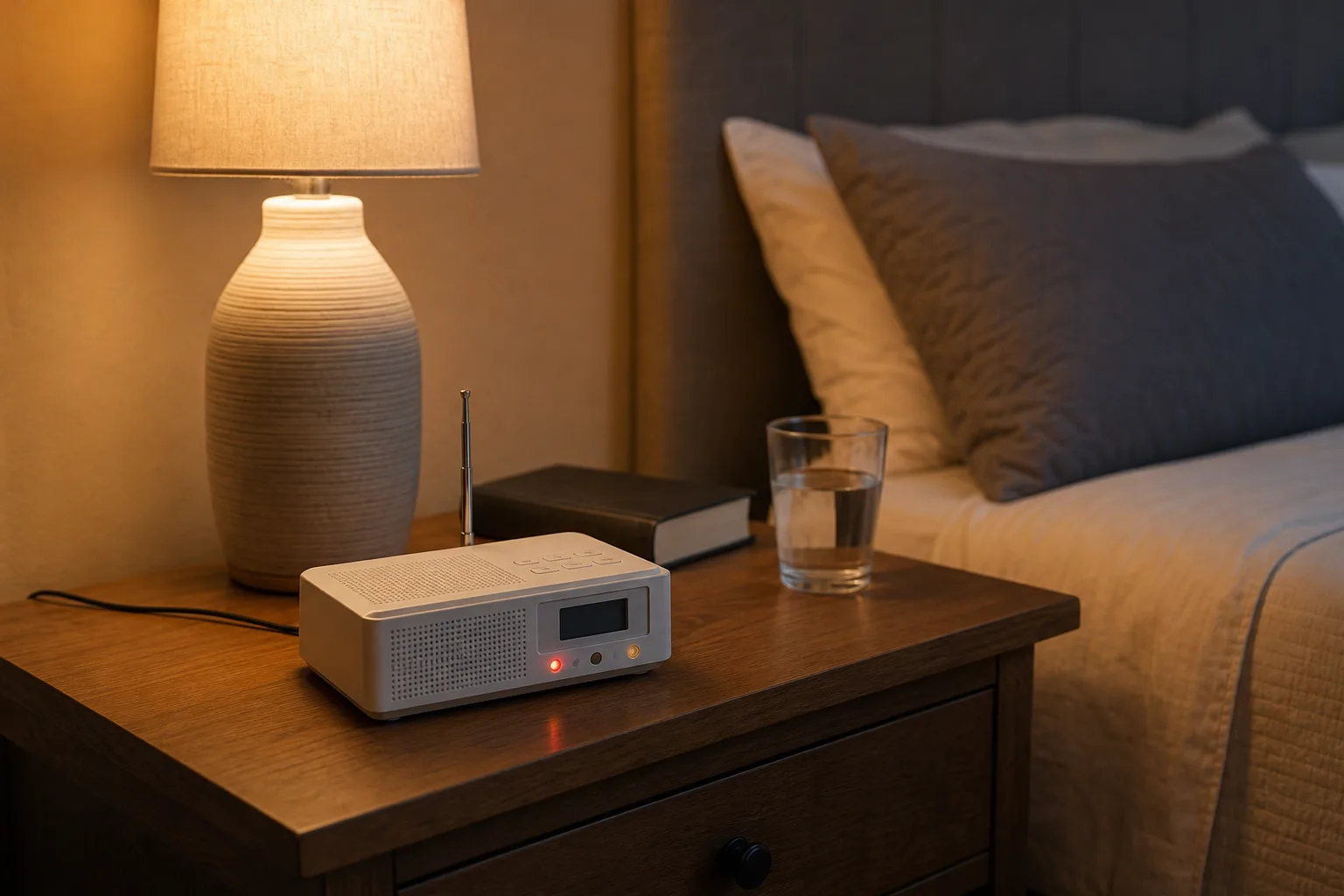
The Midland WR120B is a plug-in desk radio that does one job: listen to NOAA Weather Radio day and night and react to alerts for your area. Colored lights show whether a warning, watch or advisory is in effect, and the display spells out the alert. With S.A.M.E. it stores up to 25 county codes, and each alert type can be switched on or off, so a flood advisory for a county upstream does not wake the house. Alerts can come as a 90 dB siren, a tone followed by the broadcast, or lights and text only, and an external alarm can be connected for heavy sleepers. It runs on the included AC adapter and keeps three AA batteries (not included) as backup when the power goes out. With no crank, solar, AM or FM, it pairs with a crank radio rather than replacing one.
Bedside county alerts
Midland WR120B
A plug-in alert radio that uses S.A.M.E. county codes to sound only for the places and alert types you pick, with three AA batteries as backup.
- S.A.M.E., 25 locations
- 90 dB siren
- 3 AA backup
Good for
- Overnight tornado, flood and storm warnings
- Homes that want fewer false alarms
Skip it if
- You need a portable radio
- You want AM and FM news
FosPower A1: the compact listening radio
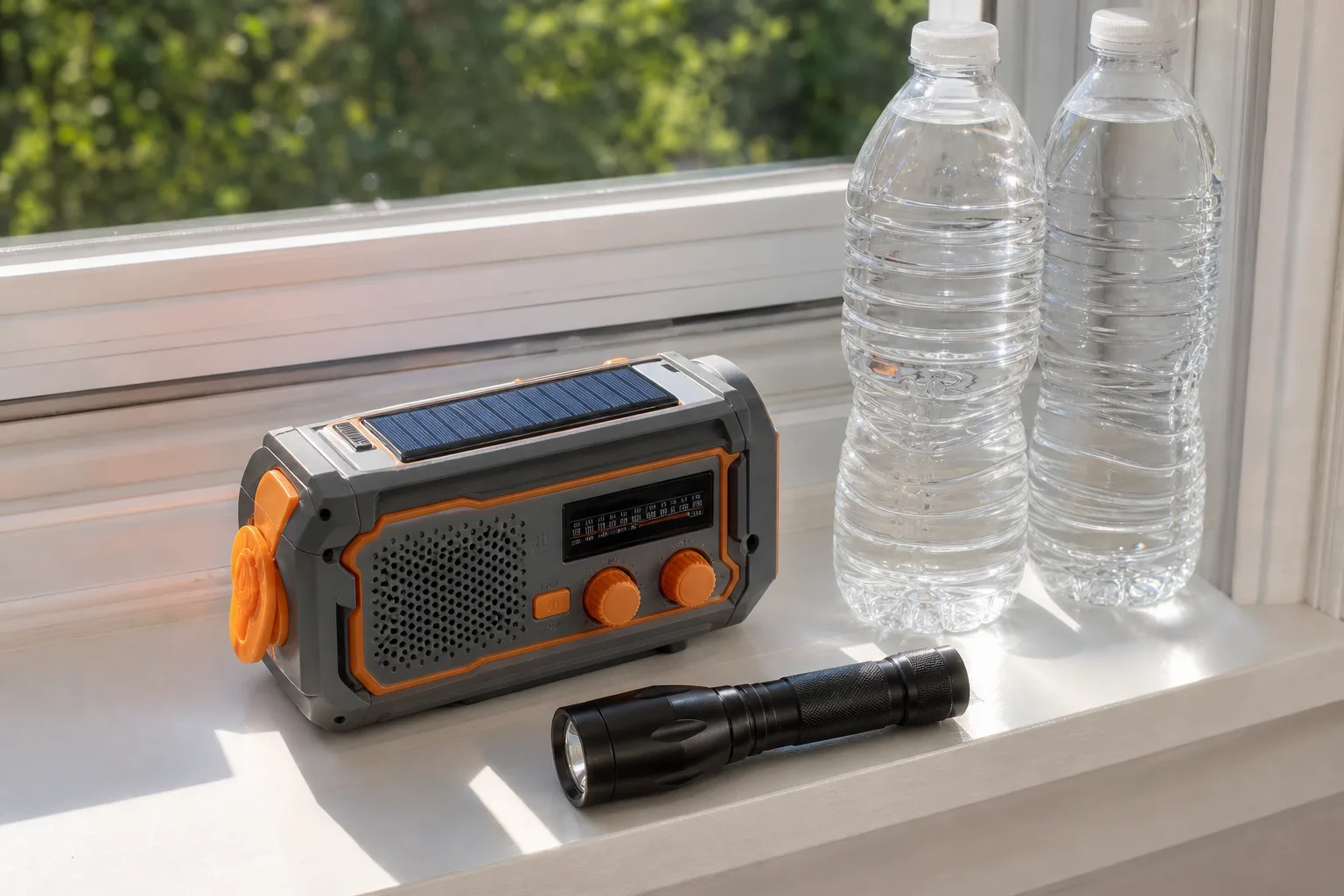
The FosPower A1 is the small one, about 6.2 by 2.9 by 2.1 inches and 10.9 ounces, with a carabiner for a pack. It receives AM, FM and the seven weather channels on an analog dial. Power comes from a 2,000 mAh lithium-ion battery charged over USB, the solar panel, the crank or AAA batteries, picked with a switch. Lifting the solar panel switches on a bright four-LED reading light underneath, and the front has a 1W flashlight with a zoom bezel. There is also an SOS alarm. The crank folds neatly away, though the plastic feels light rather than rugged. FosPower rates it IPX3, which covers splashes and light rain, not submersion. The main limit is that it has no weather alert at all, so it will not wake you for a warning.
Compact go-bag radio
FosPower A1
A small AM, FM and weather-band radio with a crank, a solar panel, AAA backup, a zoom flashlight and a reading light under the panel.
- AM, FM and 7 NOAA channels
- 2,000 mAh battery
- IPX3 splash rating
Good for
- A go-bag, the car or camping
- A second radio for another room
Skip it if
- You need any weather alert
- You want shortwave
Who should buy which
- One radio for the household kit, with shortwave, strong FM and a speaker for the phone: the Kaito KA900 Voyager Max.
- Warnings that wake you at night, without false alarms: the Midland WR120B, ideally alongside a crank radio.
- A small radio for a go-bag, the car or a second bedroom: the FosPower A1.
Store the radio in a simple kit with water, an emergency water filter, light and spare batteries, where everyone in the house can find it.
This guide is part of our home emergency checklist, which covers water, food, power, light, communication and first aid in one place.
Posted by Kristopher Larson
Frequently asked questions
What is the difference between a crank radio and a NOAA weather alert radio?
A crank radio is a portable receiver for AM, FM and the NOAA weather channels that can recharge from a hand crank, a small solar panel or USB, so it keeps working through a long outage. A plug-in weather alert radio such as the Midland WR120B sits on a nightstand, listens to NOAA Weather Radio around the clock and sounds when a warning is issued. Many households keep one of each.
What does S.A.M.E. mean on a weather radio?
S.A.M.E. stands for Specific Area Message Encoding. The National Weather Service tags each alert with county codes, and a S.A.M.E. radio sounds only for the counties you program into it, which cuts out alarms for storms in other counties served by the same transmitter. The Midland WR120B stores up to 25 locations. A tone-alert crank radio such as the Kaito KA900 switches on for any alert on the channel.
How do you find the right NOAA weather radio channel?
NOAA's county coverage listing at weather.gov/nwr/counties shows which transmitter and which of the seven weather frequencies (162.400 to 162.550 MHz) serve each county. On a portable radio, step through the seven channels until a clear broadcast comes in. Coverage typically reaches about 40 miles from a transmitter over level ground and less in hilly or mountainous areas.
Can a hand-crank radio charge a phone?
Yes, but only a little. The USB output on a crank radio is meant for an emergency call or text, not a full charge, and it drains the radio's own battery. FosPower says the A1's port is for emergency use, not as a normal power bank, and Kaito notes the KA900's output is limited by its own battery. For keeping phones charged through a long outage, a power bank, power station or generator is the right tool.
Does solar charging work on an emergency radio?
It works, but slowly. The small panels on these radios are for topping up the battery, not filling it: about four hours of cloudy sun gave one 5,000 mAh crank radio less than an hour and a half of play, and Kaito calls solar charging of the KA900 a very slow process. Keep the radio charged from USB and treat solar and the crank as backups.
Will the Kaito KA900 wake you up for a weather warning?
Not reliably. With its alert armed, the KA900 switches on and plays the Weather Service broadcast at the volume that was last set, with no siren of its own, so a low volume can mean a missed warning. Kaito also recommends running it from an AC adapter while the alert is on. For overnight warnings, a plug-in S.A.M.E. radio like the Midland WR120B, with its 90 dB siren and AA battery backup, is the dependable choice.
Keep reading
More from the blog
Headlamps for Power Outages and Trails: Petzl NAO RL vs. Fenix HM65R-T V2.0 vs. Nitecore UT27 MCT vs. Milwaukee 2115
Best At-Home Cold Plunge: Ice Barrel vs. The Cold Pod vs. a Stock Tank and Chiller
LED Video Lights for Real Estate Video: Zhiyun MOLUS X100 vs. X200 vs. Godox ML100Bi vs. SmallRig RC 100B