Headlamps for Power Outages and Trails: Petzl NAO RL vs. Fenix HM65R-T V2.0 vs. Nitecore UT27 MCT vs. Milwaukee 2115
Petzl NAO RL, Fenix HM65R-T V2.0, Nitecore UT27 MCT and Milwaukee 2115 compared for outages, winter storms and trails, and why 20,000-lumen claims fail.
A headlamp is the light that earns its place when the power goes out. It keeps both hands free to reset a breaker, check the sump pit, carry water or clear the steps after a winter storm, and it does the same job on a dark trail or under a car. The catch is that the number on the box often has little to do with how much light reaches the ground, or for how long.
Here is what separates a good headlamp from a bright box, what matters in an outage, and four headlamps for different jobs: long nights outdoors, foul weather, AAA backup power, and work around the house.
Quick verdict
- For long nights and the most automatic light: the Petzl NAO RL. A balanced rear battery, a sensor that adjusts the beam on its own to save power, and enough charge for a full night.
- For rain, fog and mist: the Fenix HM65R-T V2.0. A cool white spot and a separate warm light on two big buttons, in an IP68-rated body.
- For spare power from any store: the Nitecore UT27 MCT Pro kit. Its UT27 MCT headlamp runs on a rechargeable pack or three AAA batteries, weighs about 75 grams, and has three white color temperatures plus red.
- For the garage, attic and hard hats: the Milwaukee 2115-21 REDLITHIUM USB Low-Profile Headlamp. A wide, natural-color flood beam and quick charging, with a clunky fit on a bare head.
The headlamps side by side
| Headlamp | Shop | Rated output | Power | Light colors | Water rating | Suits |
|---|---|---|---|---|---|---|
| Petzl NAO RL |  View on Amazon | 1,500 lumens | 3,200 mAh rechargeable pack, USB-C; can charge a phone | White (wide or mixed beam), rear red | IPX4 | Long nights, trails, outages |
| Fenix HM65R-T V2.0 |  View on Amazon | 1,600 lumens | 3,400 mAh 18650 cell, USB-C; or 2 CR123A | Cool white, warm white | IP68 | Rain, fog, night runs |
| Nitecore UT27 MCT Pro kit |  View on Amazon | 800 lumens | 1,500 mAh rechargeable pack, USB-C; or 3 AAA | Cool, neutral and warm white, red | IP66 | Emergency kits, running, camping |
| Milwaukee 2115-21 REDLITHIUM USB Low-Profile Headlamp |  See options | 600 lumens (measured about 516) | Swappable REDLITHIUM USB pack, USB-C | White flood | IP54 | Garage, attic, hard hats |
Long nights and trails
Petzl NAO RL
A sensor that dims and brightens the beam on its own to save charge, a balanced rear battery and enough run time for a full night.
- 1,500 lumens
- 145 g
- 3,200 mAh, USB-C
Good for
- Long outages and all-night use
- Running and hiking after dark
Skip it if
- Gloved hands (small, stiff button)
- Simple one-button use
What actually separates headlamps
Lumen claims on no-name headlamps are fiction
Measured with a light-integrating sphere, generic headlamps advertised at 20,000, 100,000 and even 900,000 lumens put out between about 240 and 1,600. Several also shipped with weak 18650 cells, one rated at only 1,200 mAh. Most established brands came much closer to their ratings, though some, including the Milwaukee here, fell a bit short. Treat any five- or six-figure lumen claim as a reason to skip the listing.
Heat cuts the brightness within minutes
LEDs lose output as they heat up, so nearly every bright headlamp steps itself down to protect the electronics. Lamps that opened above 2,000 lumens were often down to between 200 and 500 lumens after 15 minutes on their highest setting. Fenix, for example, states that the HM65R-T V2.0 lowers its output once it reaches 60°C (140°F). The ANSI FL1 output figure is taken 30 seconds after switch-on, so it doesn't show this drop. A steady medium setting is worth more in a long outage than a turbo that fades.
Lumens are not the same as usable light
Lumens measure light leaving the lamp, not light landing where it is needed. Nitecore rates the UT27 MCT's beam at 168 meters, but on a dark forest road a person in a reflective hat disappeared at about 100 meters. The battery matters too: one 1,000-lumen-rated headlamp had a cell so weak it spent most of its run near 100 lumens.
Warm light cuts through fog, rain and snow
Cool white light bounces off mist, rain and falling snow and can wash out the view. A warm white mode reflects less glare, shows ground detail more clearly and is easier on tired eyes. Both the Fenix and the Nitecore have one. On the Fenix it cut through sea mist and fog; on the Nitecore it worked best in fog and snow.
Fit matters more than specs on a long night
A heavy lamp on the forehead slides and bounces. A rear battery spreads the weight if the strap is well designed. Grippy silicone strips inside the band stop the lamp from creeping up, and on the UT27 MCT the strip also kept sweat out of the eyes. In drops of 4 to 6 feet onto concrete, all but one of nearly 20 headlamps came through fine, so durability rarely separates them.
Choosing a headlamp for power outages and winter storms
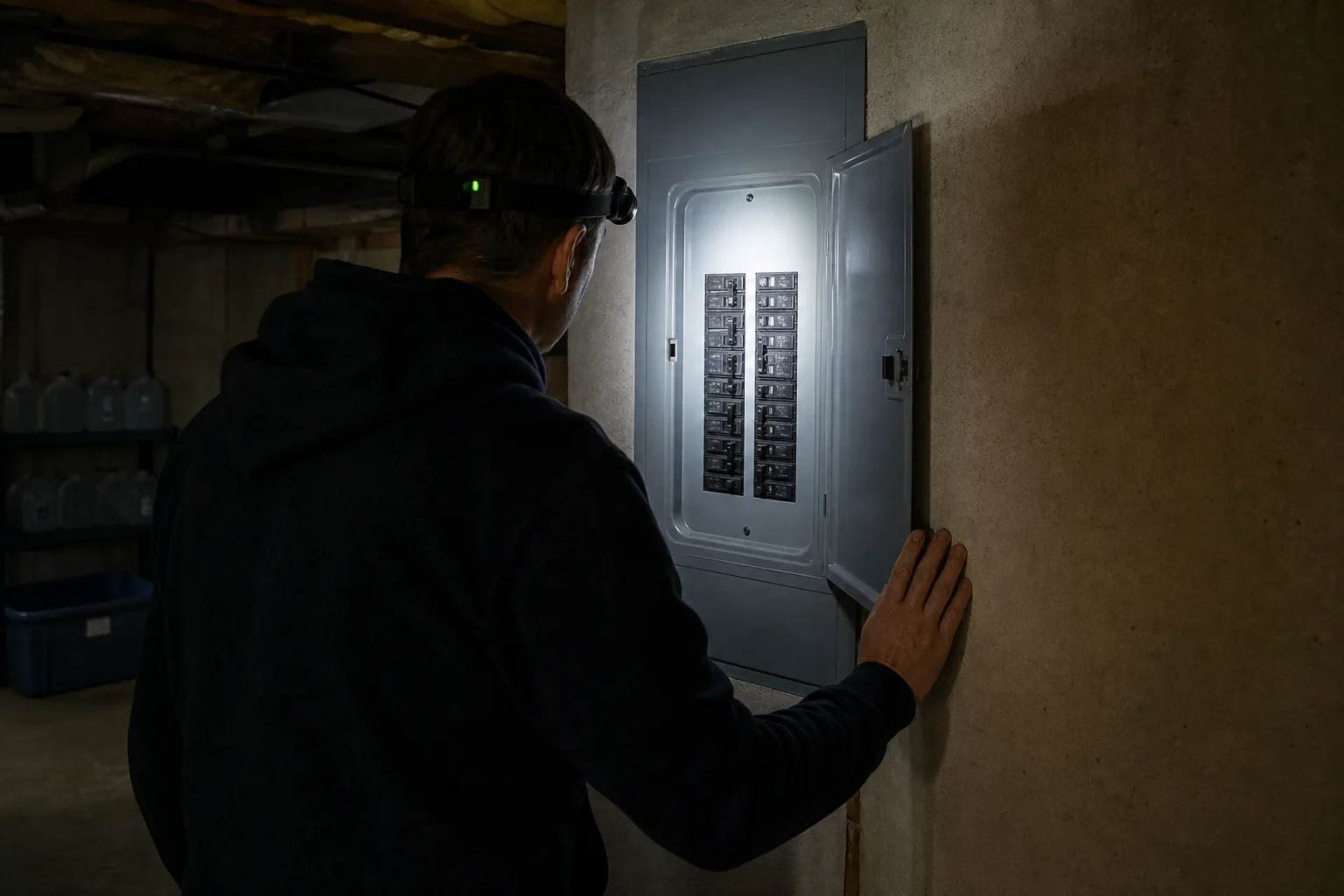
- Keep one per person. Ready.gov's power outage checklist calls for a flashlight for every household member and a plan for batteries or a power bank. For a long-throw beam, pair it with a handheld from the flashlight guide.
- Plan two ways to power it. A headlamp that also takes AAA batteries, like the UT27 MCT in the Nitecore UT27 MCT Pro kit, keeps working after its own pack is flat, though output is lower on AAAs. USB-C rechargeables can be topped up from a power bank, a portable power station or an inverter generator.
- Use medium, not turbo. Around the house, 100 to 400 lumens covers almost every task.
- Use red light at night. It is enough to move through a dark house without waking anyone.
- Lock it in the kit. The Fenix and the Nitecore both have a lockout so they can't drain in a drawer.
- Check them twice a year. Charge the packs, swap old alkalines, and keep the headlamps with the rest of the outage kit, next to the water and an emergency water filter.
Rain, fog and mist
Fenix HM65R-T V2.0
The highest rated output of the four, with a separate warm light for mist and fog, two big buttons that are easy to find on the move and an IP68 rating.
- 1,600 lumens
- 140 g
- IP68, 18650 cell
Good for
- Rain, fog and mist
- Long night runs and hikes
Skip it if
- A rear red light
- The lightest possible headlamp
The picks in detail
Petzl NAO RL: for long nights and trails
The Petzl NAO RL is rated at 1,500 lumens and weighs 145 grams. Its 3,200 mAh lithium-ion pack sits at the back of the head to balance the front, a top strap adds support, and the pack charges over USB-C in about 3.5 hours. The pack can also charge a phone or watch.
The standout feature is Reactive Lighting: an ambient light sensor adjusts brightness and beam pattern on its own. Look down at the trail or a workbench and it dims; look up toward the distance and it brightens. Through a 100-mile overnight race it served as the main light and still had about half its charge at the finish. The sensor is sometimes hit or miss and can be switched off. A red light on the rear pack, continuous or strobe, has its own button.
The trade-offs: the beam is fairly narrow in reactive mode, the small front button is stiff and hard to work in gloves, and the low, medium and high steps feel close together. It isn't always obvious which mode it is in, or whether the rear light is on. A spare battery is sold separately, and the IPX4 rating covers rain, not submersion.
Long nights and trails
Petzl NAO RL
A sensor that dims and brightens the beam on its own to save charge, a balanced rear battery and enough run time for a full night.
- 1,500 lumens
- 145 g
- 3,200 mAh, USB-C
Good for
- Long outages and all-night use
- Running and hiking after dark
Skip it if
- Gloved hands (small, stiff button)
- Simple one-button use
Fenix HM65R-T V2.0: for rain, fog and mist
The Fenix HM65R-T V2.0 has the highest rated output here at 1,600 lumens, with a 170-meter beam. It carries two separate LEDs: a cool white spot for distance and a warm white light (about 3000K) for fog, mist and heavy rain. Each has its own large button on top, easy to find on the move, and a press on either lights a battery gauge. Fenix lists three white levels and four warm levels, plus SOS, and rates the warm Eco setting at up to 300 hours.
The 400-lumen medium setting is bright enough for almost any terrain, and switching up or down as the ground changed gave about 8 to 10 hours between charges. The warm light is the standout: it cuts the glare that white light throws back in sea mist, fog and heavy rain, and it makes bumps and dips in a rough trail easier to see. The body is magnesium alloy, and Fenix rates it IP68 with 2-meter impact resistance.
The 3,400 mAh 18650 cell sits under a screw cap, so a spare swaps in quickly. It weighs 140 grams with battery and band. There is no rear red light, and a lockout stops it switching on in a bag.
What changed from the HM65R-T
The V2.0 swaps the earlier floodlight for the warm white light. The strap now comes off for washing, has a built-in whistle, and its dial loosens by turning back instead of pulling up. The lamp sits flatter, so it feels better balanced at about the same weight.
Rain, fog and mist
Fenix HM65R-T V2.0
The highest rated output of the four, with a separate warm light for mist and fog, two big buttons that are easy to find on the move and an IP68 rating.
- 1,600 lumens
- 140 g
- IP68, 18650 cell
Good for
- Rain, fog and mist
- Long night runs and hikes
Skip it if
- A rear red light
- The lightest possible headlamp
Nitecore UT27 MCT Pro kit: for AAA backup power
The Nitecore UT27 MCT Pro kit is built around the UT27 MCT, a light running headlamp rated at 800 lumens and IP66. Its 1,500 mAh pack charges over USB-C, but the lamp also runs on three AAA batteries, which is why it suits a home emergency kit: when the packs are flat and there's nowhere to charge, a box of AAAs keeps it going. Nitecore also sells the HLB1500 pack on its own, and a charged spare gives more light than AAAs.
It weighs about 75 grams with its pack. Two buttons split the light: one runs the cool and neutral whites, the other the warm white, and each color has its own low, medium and high steps plus an 800-lumen turbo. On high it ran about 3 hours and 45 to 50 minutes at room temperature, and after a night outside at -5°C (23°F) it still ran 3 hours and 36 minutes, so it doesn't need to be kept warm. The glow-in-the-dark battery compartment makes AAAs easy to fit in the dark, and the beam pairs a wide flood with a brighter center.
The weak points are small but real. Red light needs a very fast double press that often fails with gloves, the battery gauge is tiny and sits underneath, and the back cover over the USB-C port is fiddly with gloves on.
AAA backup power
Nitecore UT27 MCT Pro kit
Runs on its own rechargeable pack or three AAA batteries, weighs about 75 grams and offers three white color temperatures plus red.
- 800 lumens
- Pack or 3 AAA
- IP66
Good for
- Emergency kits
- Running and camping
Skip it if
- Switching to red with gloves on
- Maximum brightness
Milwaukee 2115-21: for the garage, attic and hard hats
The Milwaukee 2115-21 is a low-profile flood lamp built for job sites. Its 1-inch-thin head throws a wide 125-degree beam with clean, natural TRUEVIEW color. Milwaukee rates it at 600 lumens; it measured about 516 on high, with 300 on medium and 112 on low. On high it ran about 2 hours and 18 minutes, beating Milwaukee's 2-hour rating.
Milwaukee rates the pack half full in under 30 minutes and full in about 2 hours over USB-C. The pack swaps out, and four hard hat clips are in the box.
The downside is fit on a bare head: the rear battery is very noticeable and the strap can feel loose even when tightened. On a hard hat it sits well. IP54 covers splashes, not heavy rain.
Work and hard hats
Milwaukee 2115-21 REDLITHIUM USB Low-Profile Headlamp
A wide, natural-color flood beam for close work, quick charging and a swappable battery, with hard hat clips in the box.
- 600 lumens rated
- Swappable pack
- IP54
Good for
- Garage, attic and breaker-panel work
- Hard hats
Skip it if
- A snug fit on a bare head
- Seeing far down a trail
Another headlamp worth knowing
Petzl Actik Core. The 450-lumen version measured 412 to 414 lumens, ran about 2 hours and 40 minutes on high and took three AAAs in place of its pack. Petzl now sells a 625-lumen Actik Core, which isn't compared here yet.
AAA backup power
Nitecore UT27 MCT Pro kit
Runs on its own rechargeable pack or three AAA batteries, weighs about 75 grams and offers three white color temperatures plus red.
- 800 lumens
- Pack or 3 AAA
- IP66
Good for
- Emergency kits
- Running and camping
Skip it if
- Switching to red with gloves on
- Maximum brightness
Who should buy which
- Want one headlamp for outages, camping and night hikes? The Petzl NAO RL.
- Often out in rain, fog or snow, or hard on gear? The Fenix HM65R-T V2.0.
- Building a family emergency kit where power may be scarce? The Nitecore UT27 MCT Pro kit, with a box of AAA batteries beside it.
- Mostly working in the garage, attic or under the sink? The Milwaukee 2115-21.
- Tempted by a 20,000-lumen listing? Skip it.
This guide is part of our home emergency checklist, which covers water, food, power, light, communication and first aid in one place.
Posted by Kristopher Larson
Frequently asked questions
How many lumens does a headlamp need for a power outage?
Around the house, 100 to 400 lumens covers almost every task, from reading a breaker panel to carrying water up the stairs. Higher settings drain the battery fast, and most headlamps step down from them within minutes anyway. A rating of 600 to 1,600 lumens leaves plenty of headroom for outdoor jobs.
Is a rechargeable or AAA headlamp better for emergencies?
One that does both. A rechargeable pack is handy for everyday use, and AAA batteries keep the light going when the packs are flat and there is no way to charge them. The Nitecore UT27 MCT takes either, though output is lower on AAAs. USB-C rechargeables like the Petzl NAO RL and Fenix HM65R-T V2.0 can also be topped up from a power bank or power station.
Are 20,000-lumen headlamps real?
No. Generic headlamps advertised at 20,000 to 900,000 lumens measured roughly 240 to 1,600 lumens in a light sphere. Headlamps from established makers usually land close to their rated output, which is a far better guide than the number on a no-name listing.
Why does a headlamp get dimmer after a few minutes?
LEDs lose efficiency as they heat up, so most bright headlamps lower their own output to avoid overheating. Many lamps that start above 2,000 lumens settle at a few hundred within 15 minutes. That is normal, which is why sustained output and run time matter more than the peak figure.
Is warm light or white light better on a headlamp?
White light gives the most reach and contrast on a clear night. Warm light reflects less off fog, rain and falling snow, shows ground detail more clearly and is easier on tired eyes. Headlamps such as the Fenix HM65R-T V2.0 and Nitecore UT27 MCT offer both, so the beam can match the weather.
How should headlamps be stored in an emergency kit?
Keep one per person in a known spot with the rest of the outage supplies, along with spare batteries. Use the lockout if the headlamp has one, so it can't switch on and drain in a drawer, and charge packs and check alkaline batteries about twice a year.
Keep reading
More from the blog
Best At-Home Cold Plunge: Ice Barrel vs. The Cold Pod vs. a Stock Tank and Chiller
LED Video Lights for Real Estate Video: Zhiyun MOLUS X100 vs. X200 vs. Godox ML100Bi vs. SmallRig RC 100B
Emergency Weather Radio: Kaito KA900 vs. Midland WR120B vs. FosPower A1