
Best Garage Fan: Wall Mounted vs. High-Velocity vs. Ceiling Fans
Compare the best garage fans: Amico and VEVOR wall mounted fans, the Lasko high-velocity fan and the MULE ceiling garage fan. Airflow, noise and mounting.
A garage holds heat like an oven. The door faces the sun, the roof bakes all afternoon, and a small desk fan only cools the one spot it points at. The best garage fan moves air through the whole space, mounts out of the way of cars and benches, and can be switched on without climbing a ladder.
This guide compares four fans that take different approaches: two wall-mounted fans with remotes, a classic high-velocity fan that hangs on a bracket, and a garage fan that hangs from the ceiling on a down rod. It covers airflow, noise, where to put a fan, mounting and cords, and the controls that matter once the fan is up high.
As an Amazon Associate, Best Utah Real Estate earns from qualifying purchases.
Quick verdict
- Best wall mounted garage fan overall: the Amico 20 in Wall Mount Fan. Six speeds, side-to-side oscillation, a remote with a speed readout and a timer, and it runs at about 45 dB on its lowest setting.
- Simple, tough and movable: the Lasko 20 in High Velocity Fan. All-metal build, three speeds, and it lifts off its wall bracket to work as a floor fan.
- Metal wall fan on a pull cord: the VEVOR 18 in Wall Mounted Fan, with a metal housing, aluminum blades and a 3,450 to 4,150 CFM rating.
- Best for a tall garage ceiling: the MULE Garage Fan with Remote. It hangs from a down rod like a ceiling fan, plugs into a regular outlet and pushes risen heat back down in winter.
The garage fans side by side
| Fan | Shop | Type | Airflow | Speeds | Controls | Cord |
|---|---|---|---|---|---|---|
| Amico 20 in Wall Mount Fan |  Buy on Amazon | Wall-mounted, oscillating, DC brushless motor | 5,000 CFM (20 in, per listing) | 6 plus auto | Remote with timer, backup switch on cord | About 5.5 ft |
| Lasko 20 in High Velocity Fan |  Buy on Amazon | High-velocity fan on a lift-off wall bracket | 2,750 CFM (per listing) | 3 | Side control panel on a short lead | 6 ft |
| VEVOR 18 in Wall Mounted Fan |  Buy on Amazon | Wall-mounted, fixed (oscillating version sold) | 3,450 to 4,150 CFM | 3 | Pull cord, about 26 in with extension | About 5 ft |
| MULE Garage Fan with Remote | Ceiling-hung on a 6 or 12 in down rod | 3,000 CFM on high | 3 | Dial on fan, optional remote | Standard plug, clips for extra cord |
Oscillating wall fan vs. high-velocity vs. ceiling-hung garage fan
Oscillating wall fans sweep side to side, so one fan covers a work bench, a car bay and a weight bench in turn. The Amico adds tilt and auto oscillation, and its round guard and remote feel closer to a home fan. The trade-off is a plastic motor housing and more parts to go wrong than a plain metal fan.
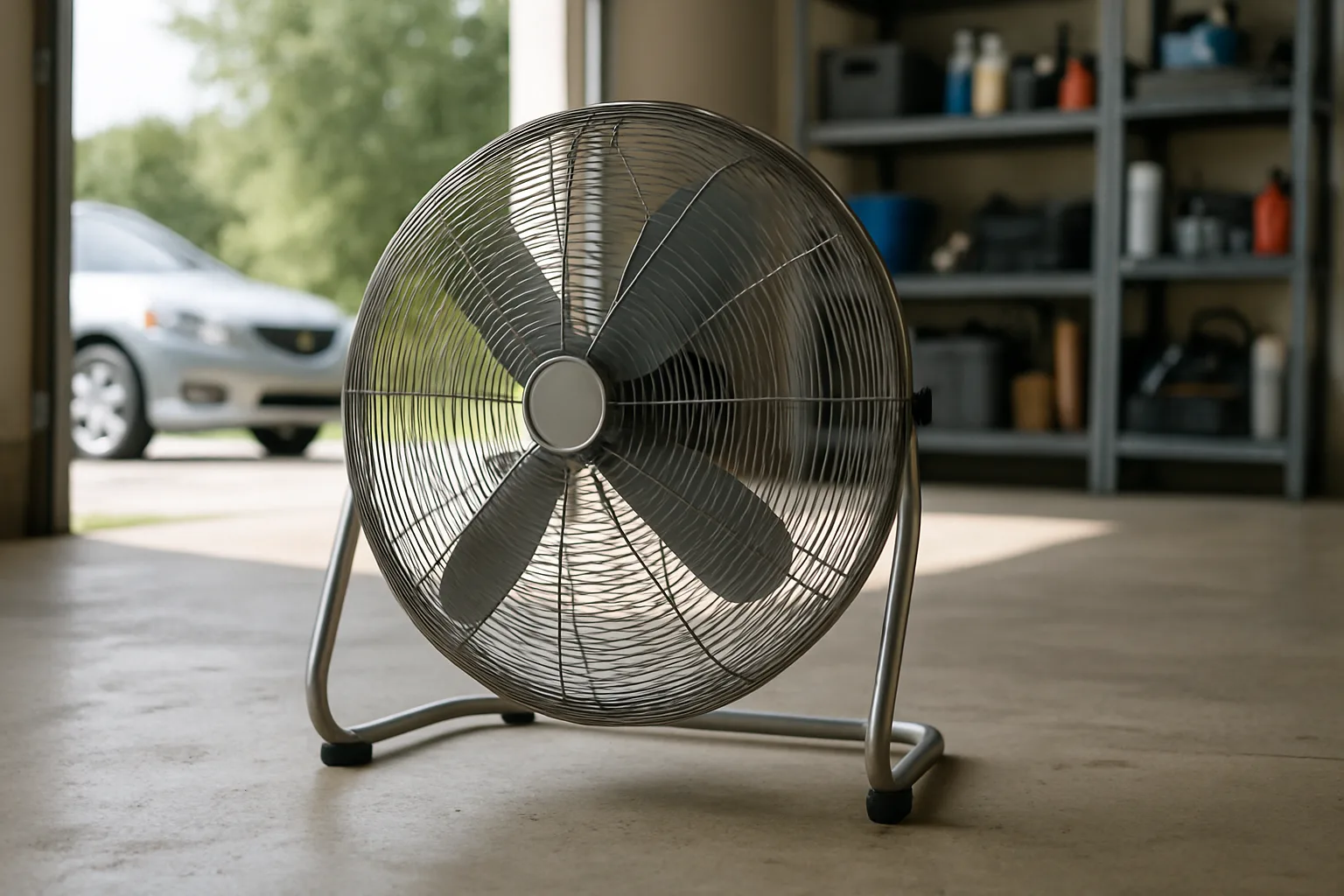
High-velocity fans like the Lasko don't oscillate. They push a strong, steady column of air in one direction, which is what moves hot air out of a garage. The Lasko tilts up and down but will not turn side to side. Its strength is simplicity: metal blades, metal hardware and a guard that opens for cleaning. It is not rated for wet locations, so keep it out of the rain.
Ceiling-hung garage fans like the MULE mount the way a house ceiling fan does, then aim with tilt knobs and a handle. They keep the walls clear and sit where heat collects. They take the most work to install, because the bracket has to go into a ceiling joist.
Airflow and noise
CFM (cubic feet per minute) is the rating to compare, but read it carefully. The Amico line is quoted at up to 9,600 CFM, but that figure belongs to the biggest sizes; the 20 inch model lists 5,000 CFM. VEVOR lists a range of 3,450 to 4,150 CFM for its 18 inch fan, and MULE rates its fan at 3,000 CFM on high. Lasko lists 2,750 CFM for its 20 inch high-velocity fan.
Handheld airflow meters read only a small slice of a fan's air, so they show far less than the rating and are useful only for comparing fans against each other.
Noise varies more than the specs suggest. The Amico runs at about 45 dB on speed one, which is close to silent, and still blows hard on its top setting. The Lasko is quiet for the amount of air it moves. The VEVOR is fairly quiet. The MULE moves plenty of air but is loud on high, so expect to talk over it.
Where to put a garage fan
A fan at the back of the garage, aimed toward the open door, pushes hot air out instead of stirring it around. That is how the Lasko works best: mounted on the back wall of a single-car garage and aimed down and out toward the front. A small desk fan only cools whoever stands in front of it, while a 20 inch high-velocity fan gets air moving through the whole room.
The same idea works under a carport or patio cover. A fan mounted high and angled out pushes grill smoke out from under the roof, or it can be turned toward a treadmill or guests.
In winter, flip the thinking. Heat rises, and in a garage with a 12 ft ceiling a heater's warmth ends up overhead. A ceiling-hung fan like the MULE, or a wall fan tilted up, pushes that warm air back down to where you work. If you are still choosing a heat source, see the garage heater buying guide.
Mounting and cords
Every fan here needs solid wood behind it. Find the studs or ceiling joists first with a stud finder. The MULE's included screws are short for going through drywall and deep into a stud, so buy longer screws. Large plastic anchors work in drywall but are hard to remove later. Anchors with a built-in washer leave a smaller hole.
Cord length is the most common surprise. The Amico's cord is about 5.5 ft and feels short when the fan sits high. The Lasko's 6 ft cord means you need an outlet near the top of the wall or the garage ceiling. The VEVOR's is about 5 ft. Some wall fans ship with cords of 8 to 9 ft, which makes high mounting much easier. Plan the outlet before you drill, and leave some slack in the cord on an oscillating fan so it can sweep and tilt without pulling.
Remotes, speeds and timers
A fan near the ceiling is only useful if you can reach the controls. The Amico's remote shows the current speed, runs the timer and oscillation, and comes with batteries, a wall holder and tape. A backup switch on the cord also shows the speed if the remote goes missing. The MULE's remote is optional. It works through a plug-in receiver that sits between the outlet and the fan, and the remote sticks to a magnetic wall plate. Without the remote, the MULE has a three-speed dial on the unit, which has to stay on high when the remote is in use.
The VEVOR uses a pull cord. Its short cord grows to about 26 in with the included extension, which can be reached from the floor on a high mount. The Lasko's control panel sits on a short lead, so it can hang beside the fan or mount lower on the wall.
The picks in detail
Amico 20 in Wall Mount Fan
This is the most feature-packed fan of the group. It has a DC brushless motor, six speeds, an auto mode and side-to-side oscillation with tilt. It is quiet enough at low speed that you can barely hear it, and on high it blows a lot of air. The blade sets onto a flat spot on the motor shaft and locks with a screw. The line also comes in 18, 24 and 30 inch sizes, with a two-year warranty.
The downsides: the motor housing is plastic, the cord is short, and the bracket angle leaves part of the arm in view in front of the fan instead of hidden behind it.
Amico 20 in Wall Mount FanCheck today’s price on Amazon

 Buy on Amazon →
Lasko 20 in High Velocity Fan
This is the no-fuss pick for moving hot air out. It has all-metal hardware and metal blades, and the guard opens for cleaning. It has three speeds and tilts up and down but doesn't swivel. The bracket isn't permanent: the fan simply hangs on a V-shaped piece that doubles as its floor stand, so it lifts off and goes on the ground. After a few months it can pick up dust and cobwebs and develop a slight wobble, so clean the blades now and then. It comes in black or silver with the same airflow.
Lasko 20 in High Velocity FanCheck today’s price on Amazon

 Buy on Amazon →
VEVOR 18 in Wall Mounted Fan
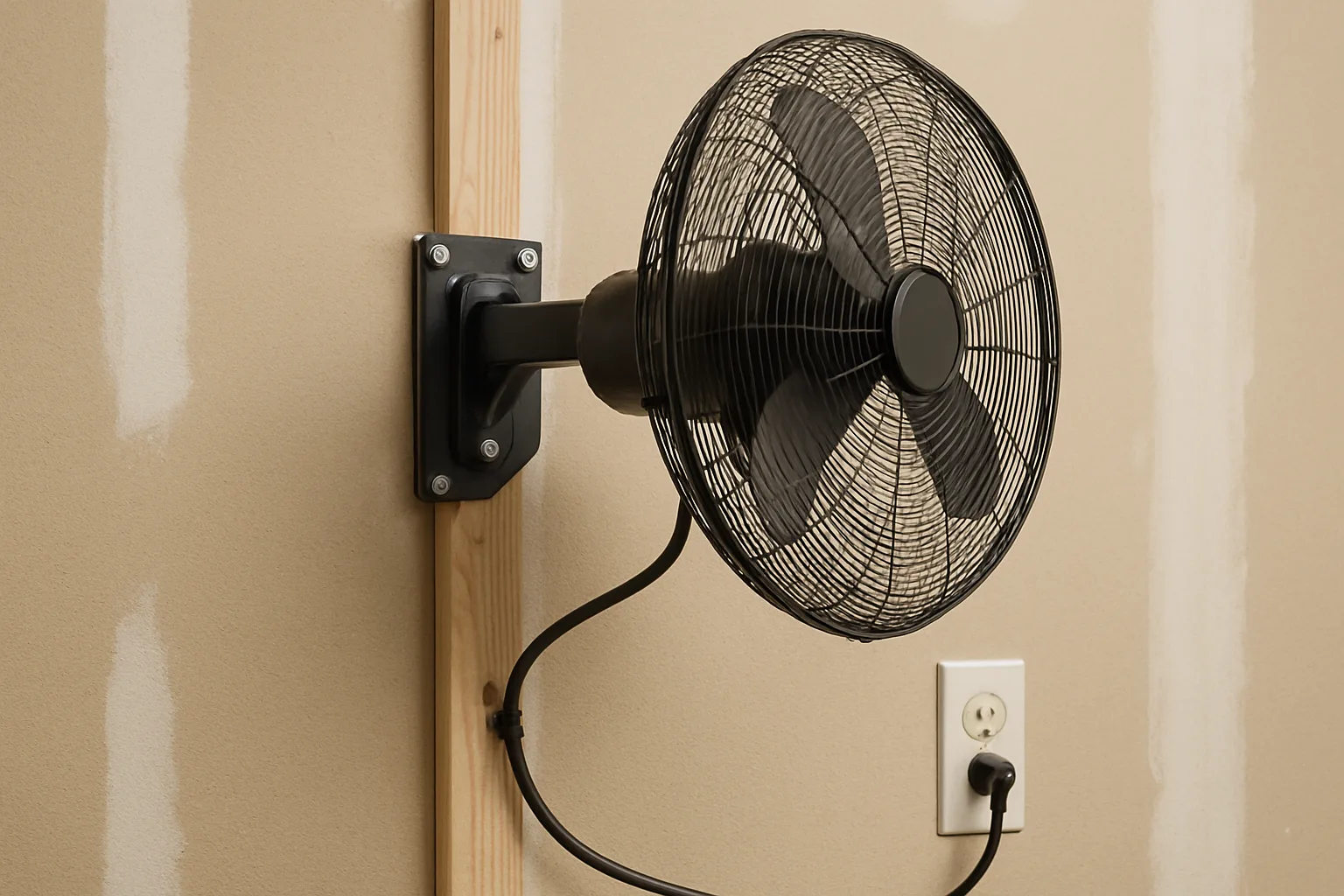
The VEVOR has a sturdy metal housing and aluminum blades, with three speeds on a pull cord. The bracket screws to the wall through three holes, then the fan bolts on with a rubber spacer, washers, a nut and a cotter pin. It still turns on the bolt, and two side knobs hold the tilt. Expansion bolts are included, but wood screws work fine into a stud. It is fairly quiet. It is sold in other sizes and as an oscillating version.
VEVOR 18 in Wall Mounted FanCheck today’s price on Amazon

 Buy on Amazon →
MULE Garage Fan with Remote
The MULE goes up like a house ceiling fan: a ceiling bracket, a 6 or 12 inch down rod, a canopy and a yoke cover. It plugs into a standard outlet, so no hardwiring, and it is damp rated. The build is solid, with a thick shell, sturdy front and back guards and a heavy hanger. Clips on the back hold extra power cord, and side knobs plus a handle let you tilt and turn it to aim the air. One person can install it. It is loud on high, but it moves air all year, cooling in summer and pushing heat down in winter.
Install and safety notes
- Mount into wood: screw brackets into studs or joists, and use screws long enough to pass the drywall and bite deep.
- Keep it dry: the Lasko isn't made to get wet. Check the wet or damp rating on any fan used under a carport or by an open door.
- Lock the hardware: fit cotter pins and set screws where the instructions call for them.
- Manage the cord: run it neatly to the outlet, leave slack for oscillation and tilt, and keep it clear of car doors and tools.
- Clean the blades: garage dust builds up and throws a fan out of balance. Unplug the fan before opening the guard.
Who should buy which
- One fan to cover a whole garage, quietly: the Amico 20 in, for oscillation, six speeds and a remote.
- Pushing hot air out the door, or a fan that also works on the floor: the Lasko 20 in High Velocity.
- A plain metal wall fan with simple pull-cord controls: the VEVOR 18 in.
- A tall ceiling, clear walls or a heated garage in winter: the MULE.
Posted by Kristopher Larson
Frequently asked questions
What is the best garage fan?
For most garages, a 20 inch wall-mounted oscillating fan with a remote, such as the Amico 20 in, covers the most ground. It sweeps the room, has six speeds and runs quietly on low. To push hot air out the door, a high-velocity fan like the Lasko 20 in is the simpler choice. For a tall ceiling, a down-rod garage fan like the MULE keeps the walls clear.
Is a wall mounted garage fan better than a floor fan?
A wall mounted fan stays out of the way of cars, tools and feet, and it can aim air across or out of the whole garage from up high. A floor fan is easier to move. The Lasko 20 in High Velocity fan does both: it hangs on a wall bracket and lifts off to stand on the floor.
Where should I put a fan in a hot garage?
Mount it at the back of the garage and aim it toward the open door, so it pushes hot air out instead of just stirring it. Tilt it down and out for cooling. In winter, a ceiling-hung fan or a fan tilted upward pushes the heat that collects near the ceiling back down to the work area.
How many CFM does a garage fan need?
The fans in this guide range from 3,000 CFM on high for the MULE to 3,450 to 4,150 CFM for the VEVOR 18 in, the Lasko 20 in lists 2,750 CFM and the Amico 20 in lists 5,000 CFM. Compare CFM within the same size class, and check the rating for the exact size you buy.
Do I need an outlet high on the wall for a wall mounted fan?
Often, yes. Many wall fans have cords of only 5 to 6 ft, so a fan mounted high needs an outlet near the top of the wall or ceiling, or a neatly run extension. Leave slack in the cord on an oscillating fan so it can sweep and tilt freely.
Are garage fans loud?
It depends on the fan and the speed. The Amico 20 in runs at about 45 dB on its lowest setting and is barely audible. The Lasko and VEVOR are fairly quiet for their size. The MULE is loud on high but moves a lot of air.
Keep reading
More from the blog
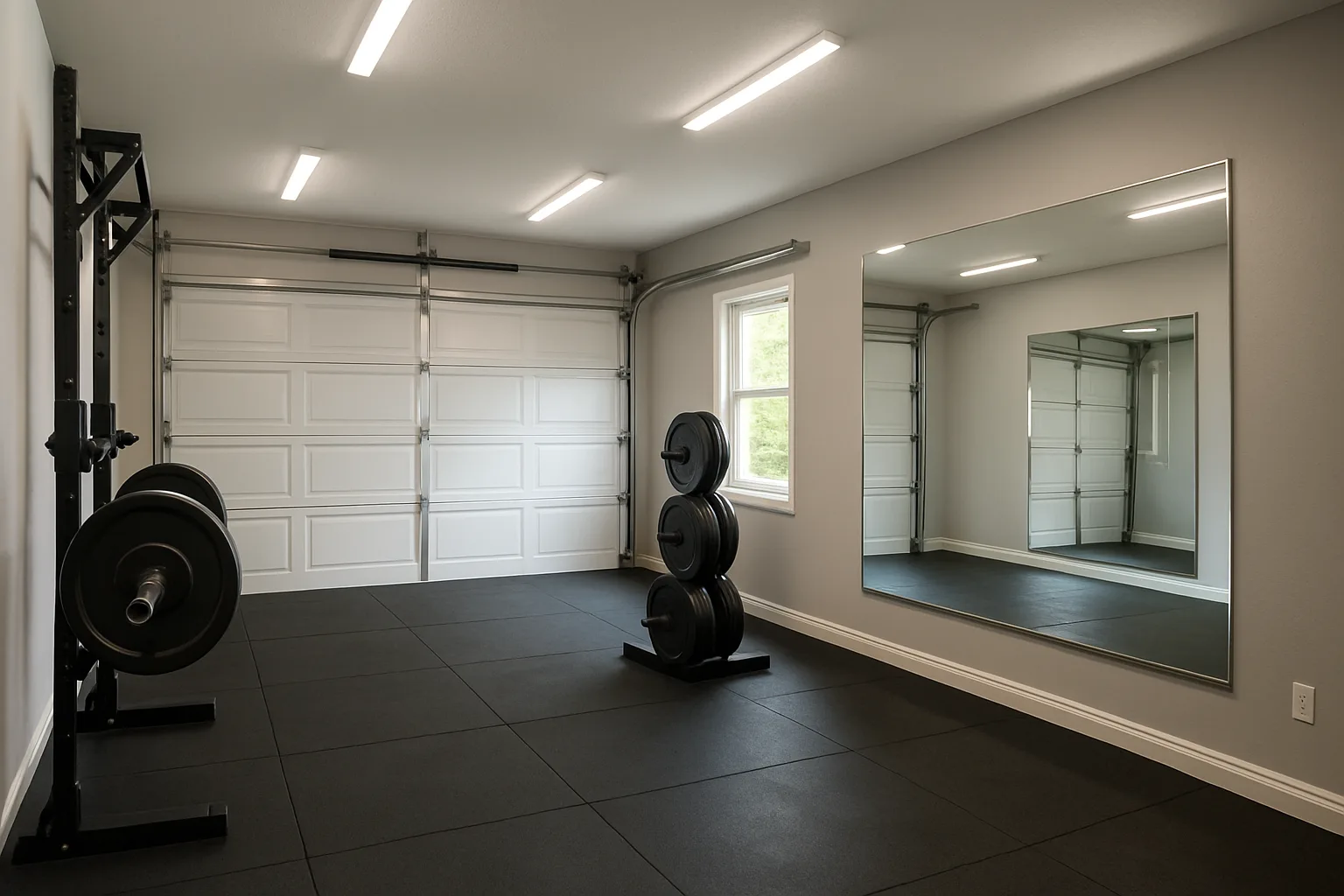
How to Turn Your Garage Into a Home Gym or Personal Training Studio: Flooring, Racks and Local Rules

How to Turn a Spare Room Into a Home Podcast Studio: Mic, Interface and Acoustic Treatment

Home Dog Grooming Setup: Shernbao vs Shelandy Dryers and the Right Table