How Many Utah Homes Have an Assumable Loan? MLS Data
We read two years of Utah MLS listings to see how many homes offer an assumable loan, what rates they carry, how much they save, and how often buyers actually take one over.

An assumable mortgage in Utah can cut the payment on a $400,000 balance by about $1,000 a month, but few homes have one, and in our MLS data the homes marketed with one did not sell for more. From November 2024 through October 2026, 656 of 83,809 Utah home sales (0.8%) were marketed with an assumable loan. The listings that stated a rate had a median of 3.0%, against a 30-year average of 7.26% on November 25, 2026. On a $400,000 balance, that is about $1,686 a month in principal and interest instead of $2,731.
The catch is the gap between the loan balance and the price, which the buyer covers in cash or with a second loan. In matched groups of similar homes, the ones marketed as assumable sold for a median 2.5% less per square foot and took longer to go under contract (45 days against 32). Where the MLS records how the buyer paid, about 1 in 5 of these homes was actually sold by assuming the loan. Right now about 1.7% of Utah homes for sale mention one; you can browse them on our Utah assumable homes page.
What We Compared
We looked at Utah home sales (single-family homes, townhomes and condos) that closed between November 1, 2024 and October 31, 2026, from both MLS feeds we carry (the Wasatch Front MLS and the Washington County MLS), plus the homes for sale on November 26, 2026. Each home counts once, even when it appeared in both feeds. Fractional-ownership listings and manufactured or mobile homes were left out.
A home counted as assumable when the listing remarks mention an assumable loan or the listing agent marked "Assumable" in the listing terms. The rate, loan type and balance come from the remarks, when the agent wrote them in. We counted a rate only when it sat next to the word "assumable" and wasn't a seller-financing or down-payment figure. Southern Utah here means Washington, Iron and Kane counties; Northern Utah means the rest of the state.
How Many Utah Homes Have an Assumable Loan?
| Group | Sales, Nov. 2024 to Oct. 2026 | Marketed as assumable | Share |
|---|---|---|---|
| All Utah home sales | 83,809 | 656 | 0.8% |
| Single-family homes | 60,515 | 500 | 0.8% |
| Townhomes | 15,535 | 117 | 0.8% |
| Condos | 6,577 | 31 | 0.5% |
| Northern Utah | 72,868 | 605 | 0.8% |
| Southern Utah | 10,941 | 51 | 0.5% |
| Built 2019 or later (resale) | 9,310 | 153 | 1.6% |
| New construction | 19,487 | 29 | 0.1% |
| Sold for $400,000 to $599,999 | 34,710 | 348 | 1.0% |
| Sold for $1 million or more | 8,609 | 24 | 0.3% |
New construction means built in the year of sale or the year before.
Assumable loans show up most often on resale homes built from 2019 on, a group many owners financed when rates were low, and on homes selling for $400,000 to $600,000. They are rarer in Southern Utah, where 0.5% of sales and 0.9% of current listings mention one, against 0.8% and 1.8% in Northern Utah. The share has been rising: 0.6% to 0.8% of sales in each half-year through June 2026, then 1.2% of sales from July through October 2026. On November 26, 2026, 258 of 15,296 Utah homes for sale (1.7%) mentioned an assumable loan, with the most in Eagle Mountain, Nibley, Syracuse, Tooele and Layton.
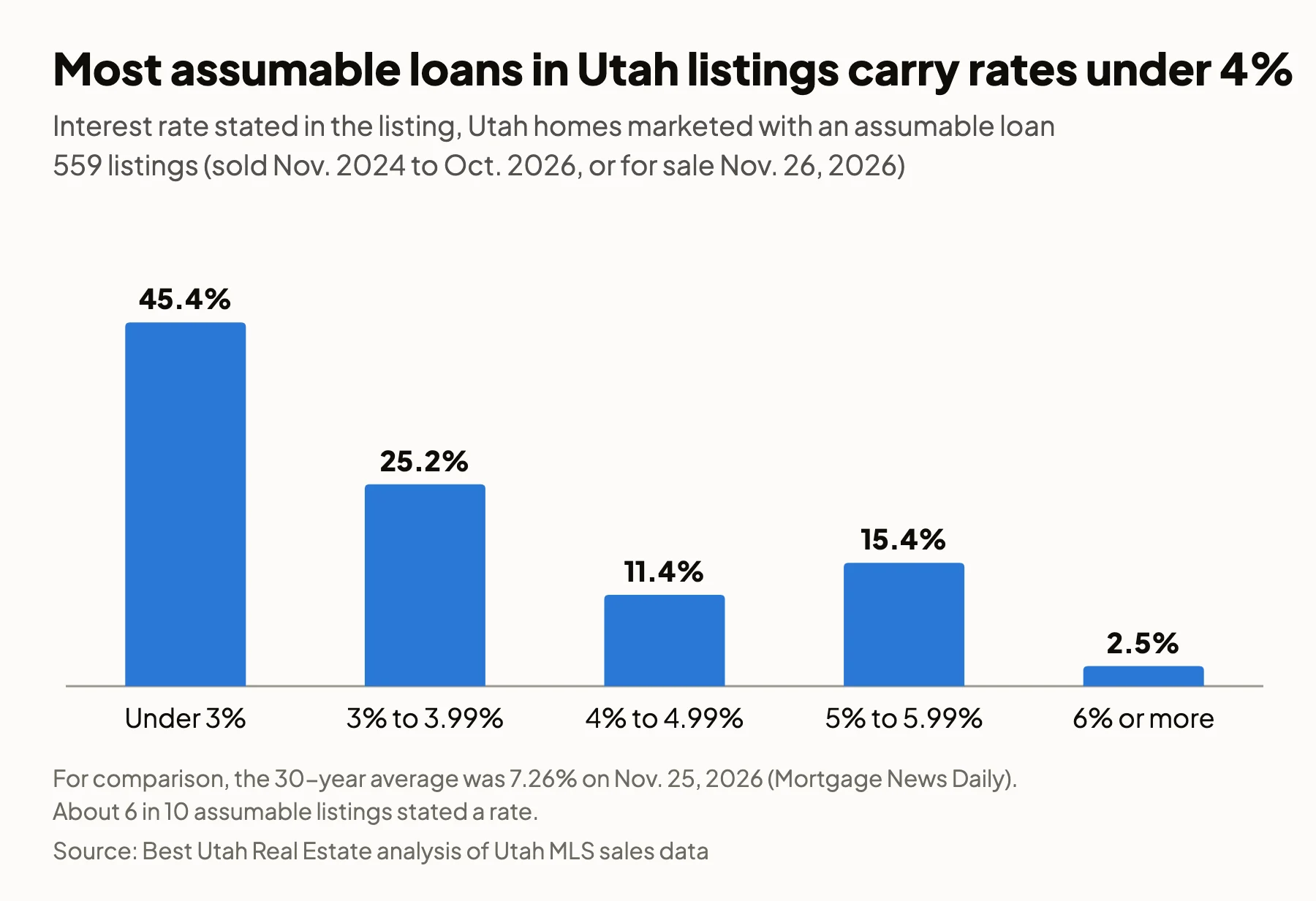
What Interest Rates Do Assumable Loans in Utah Carry?
| Listings marketed as assumable | Listings | Stated a rate | Median stated rate | Middle half of rates |
|---|---|---|---|---|
| Sold, Nov. 2024 to Oct. 2026 | 656 | 414 (63%) | 2.99% | 2.70% to 3.60% |
| For sale, Nov. 26, 2026 | 258 | 145 (56%) | 4.375% | 2.875% to 5.499% |
| Both together | 914 | 559 (61%) | 3.00% | 2.75% to 4.50% |
Rates on today's listings run higher, and newer homes account for much of that. Among homes for sale now that were built in 2022 or later, the median stated rate was 5.5%, against 3.5% for older homes.
About half of the assumable listings named the loan type. Of those, 62% were VA loans and 37% were FHA loans, with a handful of USDA loans. The median stated rate was 2.875% on VA loans and about 3.16% on FHA loans. That fits federal guidance: the Consumer Financial Protection Bureau notes that most FHA, VA and USDA loans can be assumed.
How Much Can an Assumable Mortgage Save?
| Example: $400,000 loan balance | Rate | Monthly principal and interest |
|---|---|---|
| New 30-year loan at today's average | 7.26% | $2,731 |
| Assumed loan at the median stated rate, 30 years left | 3.00% | $1,686 |
| Assumed loan at 3.00%, 25 years left | 3.00% | $1,897 |
| Assumed loan at 5.50% (typical of 2022-and-newer homes) | 5.50% | $2,271 |
The $400,000 balance is an illustration, not a figure from the data: only about 1 in 20 assumable listings stated the balance. Today's rate is the Mortgage News Daily 30-year average on November 25, 2026. An assumed loan keeps its original payoff date, so a loan with 25 years left has a higher payment than the same balance spread over 30. Taxes, insurance, mortgage insurance and HOA dues are not included.
The bigger number for most buyers is the equity gap. The loan balance is usually well below the price, and the buyer pays the difference at closing in cash or with a second loan, usually at a higher rate. In the 49 listings that stated a balance, it was a median of about 64% of the list price. At that ratio, a $480,000 home (the median sale price of homes marketed as assumable) would carry a loan of about $307,000, leaving a gap of about $173,000 plus closing costs. Our guide to rate buydowns, assumable loans and ARMs works through payment examples with a second loan.
Do Homes With an Assumable Loan Sell for More?
Not in this data. We compared homes marketed as assumable with homes that weren't, inside groups of the same county, home type, size range and year-built range, with at least 5 sales on each side.
| Matched comparison | Groups | Sales compared | Price per sq. ft., assumable vs. other | Groups where assumable sold higher | Days to contract | Sale price vs. final list |
|---|---|---|---|---|---|---|
| Nov. 2024 to Oct. 2026 | 32 | 237 vs. 19,835 | −2.5% (about $10,500) | 9 of 32 | 45 vs. 32 | 99.7% vs. 99.9% |
| Last 12 months (Nov. 2025 to Oct. 2026) | 13 | 77 vs. 4,243 | −3.8% | 1 of 13 | 41 vs. 33 | 99.8% vs. 99.8% |
Days to contract run from the first listing date to the accepted offer, averaged across groups and weighted by the number of assumable sales in each. Nearly all matched groups are in Northern Utah; Southern Utah had too few assumable sales to compare on its own. Matching by city instead of county left only 6 groups, so we don't report it.
The middle half of groups ran from −5.0% to +0.3%, so the gap is small and the data can't say why it exists. Before matching, homes marketed as assumable sold for a median $480,000 ($226 per square foot), against $519,000 ($236) for other Utah homes. A low rate didn't go with a higher price here, and these homes took about two weeks longer to reach an accepted offer.
How Often Do Buyers Actually Assume the Loan?
The Wasatch Front MLS records how the buyer paid. Of the 436 homes marketed as assumable where that field was filled in, 80 (18%) were sold by assuming the loan. Most of the rest closed with a new conventional loan (170), FHA loan (98), VA loan (34), cash (25) or seller financing (19). Another 44 homes were sold by assumption without the listing mentioning it. The Washington County MLS had no sales recorded as assumptions, so Southern Utah isn't part of this count.
Homes that did sell by assumption went under contract in a median 39 days and closed at a median 99.3% of the final list price, with 10% selling above list. Homes marketed as assumable that sold with other financing took a median 51 days, closed at 100% of list, and 30% sold above it. Buyers who assumed the loan rarely paid over asking; buyers with a new loan more often did.
In our experience, the equity gap is the main reason a low-rate loan doesn't change hands: many buyers can't cover it, and a second loan at today's rates eats into the savings. The process can also take longer than a regular purchase: a Consumer Financial Protection Bureau report on assumption requests by heirs and divorcing owners found complaints of servicer delays lasting months. Ask the servicer about their timeline before you write an offer.
What Buyers and Sellers Should Know Before an Assumption
- The buyer has to qualify. For FHA loans closed on or after December 15, 1989, the lender must check that the buyer qualifies before the assumption, and must release the seller from liability once a creditworthy buyer assumes the loan (HUD Handbook 4155.1).
- VA sellers: your entitlement may stay tied up. Anyone who qualifies can assume a VA loan, including a buyer who isn't a veteran, with the servicer's approval (VA Buyer's Guide). But VA restores a seller's entitlement after an assumption only when the buyer is a qualified veteran who substitutes their own entitlement. Otherwise it stays tied to the loan until the loan is paid off, which can limit the seller's next VA purchase (VA eligibility). Our VA loan assumption guide covers this step by step.
- There is a fee. The VA funding fee on a loan assumption is 0.5% of the loan balance (VA funding fee table), and servicers charge their own processing fees.
- Plan for the gap. Get a written payoff balance from the seller's servicer early, and line up the cash or second loan before you count on the lower payment.
- Read the purchase contract terms. An assumption changes the financing section of the Utah purchase contract; our guide to FHA and VA offers covers what the loan addenda commit each side to.
This post shares market data, not financial advice. Talk with a lender about your own numbers before choosing a loan.
Where to Find Assumable Homes in Utah
Our Utah assumable homes page lists every home for sale whose listing mentions an assumable loan, updated from the MLS. You can also narrow it by city, for example Eagle Mountain, Syracuse, Layton, Ogden or St. George. Some sellers offer seller financing instead of, or alongside, an assumable loan. For more of our MLS studies, including which price cuts sell Utah homes, see the Utah real estate guide.
About the data: Utah MLS sales of single-family homes, townhomes and condos from both regional feeds, closed November 1, 2024 through October 31, 2026, plus homes for sale on November 26, 2026. One row per parcel and close date across the two feeds (the Washington County MLS copy kept in Washington, Iron and Kane counties); fractional-ownership and manufactured or mobile home listings excluded; sales under 20% of list price dropped. "Assumable" means the remarks mention an assumable loan or the listing terms include "Assumable"; rates, loan types and balances were read from the remarks, and many listings didn't state them. The buyer's financing type comes from the Wasatch Front MLS only. Matched groups needed at least 5 sales on each side; gaps are medians across groups. Payment figures are principal and interest only. Figures are aggregates; no single sale is shown.
Frequently asked questions
How much does an assumable mortgage save in Utah?
It depends on the rate and balance. Utah listings that stated an assumable rate had a median of 3.0% (November 2024 to November 2026), against a 30-year average of 7.26% on November 25, 2026. On a $400,000 balance, that is about $1,686 a month in principal and interest instead of $2,731, or about $1,045 less. A loan with fewer years left, or at a higher rate like the 5.5% typical of homes built since 2022, saves less.
How many homes in Utah have an assumable loan?
Few. From November 2024 through October 2026, 656 of 83,809 Utah home sales (0.8%) were marketed with an assumable loan. On November 26, 2026, 258 of 15,296 homes for sale (1.7%) mentioned one. The share is higher in Northern Utah (1.8% of listings) than in Southern Utah (0.9%). Our Utah assumable homes page lists the current ones.
Do homes with an assumable mortgage sell for more?
Not in our data. In 32 matched groups of similar homes (same county, home type, size range and year-built range), homes marketed as assumable sold for a median 2.5% less per square foot and took longer to reach an accepted offer, 45 days against 32. The sale price as a share of list price was about the same.
What is the equity gap on an assumable loan?
It is the difference between the price and the loan balance, which the buyer pays at closing in cash or with a second loan. In the 49 Utah listings that stated a balance, it was a median of about 64% of the list price. At that ratio, a $480,000 home would leave a gap of about $173,000, plus closing costs.
Can anyone assume a VA loan in Utah?
The buyer must be approved by the loan servicer. A buyer who isn't a veteran can assume a VA loan, but VA restores the seller's entitlement only when the buyer is a qualified veteran who substitutes their own entitlement; otherwise it stays tied to the loan until it is paid off. The VA funding fee on an assumption is 0.5% of the loan balance. Our VA loan assumption guide covers the steps.
How often do Utah buyers actually assume the seller's loan?
Less often than the listings suggest. In the Wasatch Front MLS, which records how the buyer paid, 80 of 436 homes marketed as assumable (18%) were sold by assuming the loan. Most of the rest closed with a new conventional, FHA or VA loan, or cash.
Kristopher Larson
Realtor® · Air Force veteran · Licensed in Utah & Nevada · Real Broker, LLC
Kris is an Air Force veteran who started in real estate in 2011, has been part of more than 350 transactions and once ran 20 luxury vacation rentals in Copper Rock and Paradise Village. He writes this site's guides from MLS data and public records, and says where every number comes from.
Keep reading
More from the blog
Builder Rate Buydown or Price Cut? Utah MLS Data
Do Newer Homes Sell for More? Utah Home Value by Year Built
Which Price Cuts Sell Utah Homes? What Our MLS Data Shows