Builder Rate Buydown or Price Cut? Utah MLS Data
Should you take a builder rate buydown or the same money off the price? We ran the payment math and checked 19,419 Utah new-construction sales to see whether incentive homes cost more.

A builder rate buydown is usually worth less than the same money taken as a price cut, unless you keep the loan for many years and the buydown is permanent. On a $525,000 new home at today's 30-year rate, $20,000 off the price came out ahead of a 2-1 buydown at every point we checked, and ahead of a permanent buydown for roughly the first five years. Our MLS data also found no sign that new homes advertising a rate incentive sold at higher prices: they sold for about 4% less per square foot than similar new homes in the same city, and 43% of them had also had a price cut.
This post compares the two ways a builder can spend the same incentive and tests what actually happened on 19,419 new-construction sales in Utah. For how discount points and 2-1 buydowns work, the rules lenders follow and how seller contribution limits apply, see our guide to rate buydowns, assumable loans and ARMs. This is general information, not financial advice; get written quotes from a lender for your own loan.
Builder Buydown or Price Cut: The Math
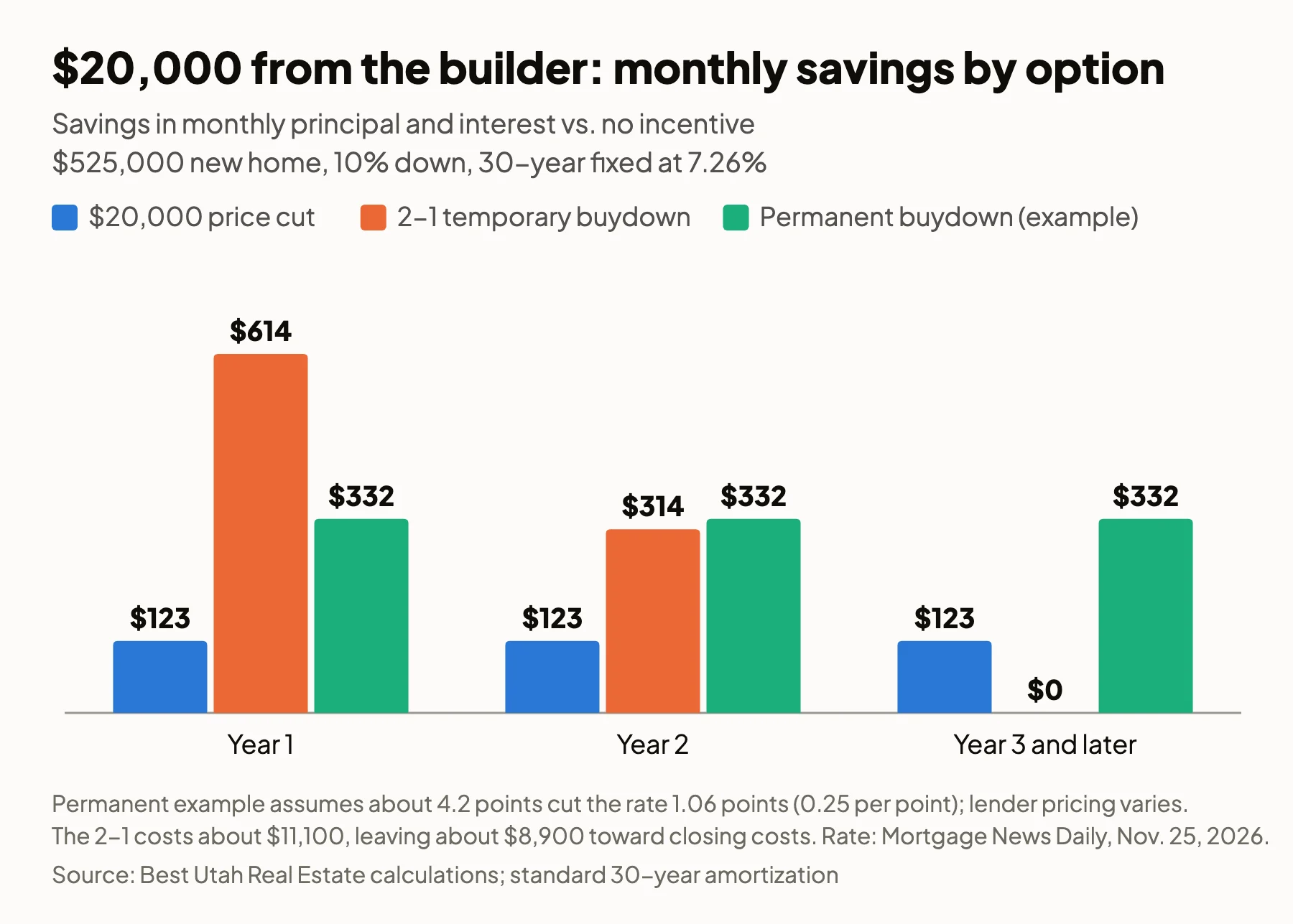
The example below uses a $525,000 new home, 10% down and a 30-year fixed rate of 7.26%, the Mortgage News Daily 30-year average on November 25, 2026. The builder offers $20,000, and the buyer can take it one of three ways. Taxes, insurance, HOA dues and mortgage insurance are left out so the financing effect is easy to see.
| $20,000 used as | Loan | Down payment | Year 1 payment | Year 2 payment | Year 3 on |
|---|---|---|---|---|---|
| No incentive | $472,500 | $52,500 | $3,226 | $3,226 | $3,226 |
| Price cut to $505,000 | $454,500 | $50,500 | $3,104 | $3,104 | $3,104 |
| 2-1 temporary buydown (about $11,100), rest toward closing costs (about $8,900) | $472,500 | $52,500 | $2,612 | $2,912 | $3,226 |
| Permanent buydown, about 4.2 points, if each point cuts 0.25 (rate 6.20%) | $472,500 | $52,500 | $2,894 | $2,894 | $2,894 |
| Same points, if each point cuts 0.125 (rate 6.73%) | $472,500 | $52,500 | $3,059 | $3,059 | $3,059 |
Payments are principal and interest only. How far a point lowers the rate depends on the lender, the loan and the market that day, the Consumer Financial Protection Bureau says, so the two permanent rows are labeled examples, not quotes.
The monthly payment only tells part of the story. A price cut also means a smaller loan, so you owe less every month after closing. To compare the options fairly, we added up what each one costs over time: payments made, plus the loan balance still owed, plus the down payment, minus any money left over for closing costs.
| Extra cost compared with the $20,000 price cut | After 2 years | After 5 years | After 10 years |
|---|---|---|---|
| 2-1 buydown plus about $8,900 toward closing costs | +$2,600 | +$6,400 | +$12,300 |
| Permanent buydown, 0.25 per point | +$12,600 | +$1,200 | −$17,900 |
| Permanent buydown, 0.125 per point | +$17,600 | +$13,800 | +$7,100 |
A plus sign means that option cost more than the price cut by that point. In this example:
- The 2-1 buydown never caught up. It saves the most in the first two years, about $614 and then $314 a month, but from year three the payment is higher than with the price cut, and the loan balance stays about $18,000 larger.
- A permanent buydown can win if you keep the loan a long time. At 0.25 per point, it passed the price cut after about 64 months. At 0.125 per point, it took about 15 years.
- Refinancing ends the race early. If rates fall and you refinance in the first few years, a permanent buydown stops saving anything, while a price cut stays with you as a smaller balance. Under Fannie Mae's rules, unused 2-1 buydown money is credited toward the payoff or returned as the buydown agreement says.
What a price cut doesn't change
A lower price doesn't directly lower your property tax. Utah counties tax homes on the assessor's estimate of market value, and a primary residence is taxed on 55% of that value, according to the Salt Lake County Assessor. A price cut does lower what the sale records as the price, which is one reason builders often prefer buydowns: in our experience, they protect the prices that later appraisals in the neighborhood are compared against.
Do New Homes With a Rate Incentive Sell for More?
A common worry is that builders add the cost of the buydown to the price. To test it, we matched new homes whose listings advertised a rate buydown or special rate against similar new homes whose listings mentioned no incentive at all, in the same city, home type, size range and half-year of sale.
| New-construction sales, Nov. 2024 to Oct. 2026 | Matched groups | Sales compared | Price per sq. ft., incentive vs. none | Groups where the incentive home sold higher |
|---|---|---|---|---|
| Rate buydown or special rate advertised | 146 | 1,954 vs. 3,074 | −4.1% (about $22,900) | 40 of 146 |
| Same, original list price per sq. ft. | 133 | 1,807 vs. 2,821 | −4.1% | 40 of 133 |
| Houses only | 89 | 1,146 vs. 2,127 | −7.2% | 14 of 89 |
| Townhomes only | 55 | 797 vs. 925 | −0.3% | 26 of 55 |
| Any builder incentive advertised (rate, closing costs or credits) | 241 | 3,965 vs. 4,513 | −3.2% | 75 of 241 |
Groups are matched on city, home type, size range and half-year of sale, with at least 5 sales on each side. The price gap is the median across groups; the middle half of groups ran from −11.3% to +0.5%. Without the half-year match, the gap was −2.1%.
Homes advertising a rate incentive did not sell at higher prices than similar new homes without one. They sold for a little less per square foot, they were listed for a little less to begin with, and the home with the incentive came out higher in fewer than a third of the groups. Townhomes came out about even; houses with an incentive sold for about 7% less. The data can't say why. Builders may put incentives, and lower prices, on homes they want to move, such as finished spec homes, and a listing remark doesn't show whether the buyer used the offer. The MLS close price is also generally recorded before seller concessions, and incentive homes recorded concessions more often (below), so the gap after concessions may be a little wider. Looking only at homes whose list price was never lowered, on either side, incentive homes still sold for a median 3.4% less per square foot (76 groups).
Do You Get the Buydown or the Price Cut, Not Both?
In the MLS, many homes got both. Among matched new homes advertising a rate incentive, 43% had their list price lowered before they sold, compared with 29% of similar homes with no incentive. They also went under contract sooner after being listed, in about 41 days against roughly 68 (many builder homes enter the MLS already under contract, so the day counts are rough), and sold at about the same share of their final list price (99.9% vs. 99.6%).
A list price cut is the builder's own move, though, and it isn't the same as a discount negotiated at the table. The MLS can't see what a buyer was offered and turned down. A few listings spell the trade-off out: about 2% of new-construction listings offered a set amount the buyer could put toward closing costs, a rate buydown or a lower price, letting the buyer pick how to use it.
In our experience, that is how most builder negotiations go. The incentive is already part of the builder's budget for that home, and the builder will let you use it as a buydown, as closing-cost help or as a lower price, but rarely all at once. Ask for the price with and without the incentive in writing, and ask what the same dollars would do as a price cut.
In the Wasatch Front MLS, a seller concession amount was recorded on 58% of rate-incentive sales and 46% of new homes that advertised no incentive. When recorded, the median was about $10,000 and $11,300, around 2% of the price. A blank field can mean no concession or one that wasn't entered, so treat those shares as a floor.
Where Builders Advertise Rate Buydowns
About 19% of Utah new-construction sales over the two years had a listing that advertised a rate buydown or special rate, and 38% mentioned some builder incentive. Southern Utah here means Washington, Iron and Kane counties; Northern Utah is the rest of the state.
- By region: 20.6% of new-construction sales in Northern Utah advertised a rate incentive, against 10.8% in Southern Utah.
- By home type: 24% of new townhomes, 17.5% of new houses and 5% of new condos.
- Over time: the share fell from 23.7% of new sales in November and December 2024 to 14.9% from July to October 2026.
- By city: among cities with 100 or more new sales, Salem (53%), Provo (50%) and Spanish Fork (37%) were highest, followed by Eagle Mountain and Magna (35% each). Saratoga Springs was at 26%, Washington 19%, Lehi 15%, St. George 8% and Cedar City 2%.
You can browse new construction homes in Utah, or narrow it to Salem, Eagle Mountain, Saratoga Springs or Spanish Fork.
Which Should You Take?
- Plan to move or refinance within about five years: the price cut usually comes out ahead, and it keeps working after a refinance.
- Need a lower payment in the first year or two: a 2-1 buydown helps most early, but lenders qualify you at the full rate, so it doesn't stretch how much you can borrow.
- Plan to keep the loan well past five years: a permanent buydown can win, but only if the points buy a meaningful rate cut. Ask the lender how much each point lowers the rate before you choose.
Our new construction vs. resale study covers how builder homes are priced against resale homes, and closing costs in Utah covers what the leftover incentive money can pay for. For listings that have been sitting, see which price cuts sell Utah homes.
About the data: Utah MLS sales from both regional feeds, closed November 1, 2024 through October 31, 2026, of single-family homes, townhomes and condos built in the year of sale or the year before (19,419 sales). One row per parcel and close date across the two feeds; fractional-ownership and manufactured or mobile home listings excluded; sales under 20% of list price dropped. Incentives were identified from listing remarks: "rate buydown or special rate" covers buydowns, 2-1 and 1-0 offers, builder forward commitments, "rates as low as" and "lower rate" offers, and advertised rates; "any incentive" adds closing-cost help, builder credits and preferred-lender incentives. Listings offering seller financing were left out of the rate group. Remarks don't always describe the offer fully, and a remark doesn't show whether the buyer used it. Each matched group needed at least 5 sales on each side; gaps are medians across groups, and days, price-cut shares and sale-to-list figures are weighted by incentive sales. Concession amounts come from the Wasatch Front MLS field, which is blank on about half of new sales. Payment math uses standard 30-year amortization at 7.26%. Figures are aggregates; no single sale is shown. This is general information, not financial advice.
Frequently asked questions
Is a builder rate buydown worth it?
Usually less than the same money as a price cut, unless the buydown is permanent and you keep the loan for years. On a $525,000 new home at 7.26%, $20,000 off the price beat a 2-1 buydown at every point we checked, and beat a permanent buydown for about the first five years. A permanent buydown came out ahead after about 64 months if each point cut the rate 0.25, or about 15 years if each point cut it 0.125.
Is a 2-1 buydown or a price cut better on a new home?
In our example the price cut came out ahead. A 2-1 buydown funded with $20,000 saves about $614 a month in year 1 and $314 in year 2, then ends, while a $20,000 price cut saves about $123 a month for the life of the loan and leaves an $18,000 smaller balance. Counting payments, balance and the leftover closing-cost money, the 2-1 still cost about $2,600 more after two years and $12,300 more after ten.
Do builders raise the price when they offer a rate buydown?
Our MLS data didn't show it. Across 146 matched groups of Utah new-construction sales from November 2024 to October 2026, homes advertising a rate buydown or special rate sold for a median 4.1% less per square foot than similar new homes with no incentive, and were listed about 4% lower to begin with. Builders may put incentives, and lower prices, on homes they want to move, so treat that as what went together, not proof of how builders set prices.
Can I get a rate buydown and a price reduction from a builder?
Sometimes. In the MLS, 43% of matched new homes advertising a rate incentive had their list price lowered before they sold, compared with 29% of similar homes without one. In our experience, though, at the negotiating table builders treat the incentive as one budget you can spend on a buydown, closing costs or a lower price, rarely all at once. Ask for each option in writing.
How common are builder rate buydowns in Utah?
About 19% of Utah new-construction sales from November 2024 to October 2026 had a listing that advertised a rate buydown or special rate, and 38% mentioned some builder incentive. The share was 20.6% in Northern Utah and 10.8% in Southern Utah, and it fell from about 24% of new sales in late 2024 to about 15% in mid-to-late 2026. Salem (53%), Provo (50%) and Spanish Fork (37%) had the highest shares among cities with 100 or more new sales.
What happens to a buydown if I refinance?
A permanent buydown stops saving you money once the loan is refinanced, so points only pay off if you keep the loan past the break-even point. With a temporary buydown, Fannie Mae's rules say any buydown money not yet used is credited toward the payoff or returned as the buydown agreement specifies. A price cut stays with you after a refinance as a smaller loan balance.
Kristopher Larson
Realtor® · Air Force veteran · Licensed in Utah & Nevada · Real Broker, LLC
Kris is an Air Force veteran who started in real estate in 2011, has been part of more than 350 transactions and once ran 20 luxury vacation rentals in Copper Rock and Paradise Village. He writes this site's guides from MLS data and public records, and says where every number comes from.
Keep reading
More from the blog
How Many Utah Homes Have an Assumable Loan? MLS Data
Do Newer Homes Sell for More? Utah Home Value by Year Built
Which Price Cuts Sell Utah Homes? What Our MLS Data Shows