Where Utah's New Homes Are Being Built in 2026: Wasatch Front and Utah County Permits Ranked by City
Census permit data shows Saratoga Springs, Eagle Mountain and Lehi issue more new-home permits than any other Wasatch Front suburbs, while 2026 activity is rising in Salem, Spanish Fork and Herriman. Here is the city ranking and what buyers should check before buying where everything is new.

Mostly in northwest Utah County. Saratoga Springs, Eagle Mountain and Lehi issued 3,499 permits for houses and townhomes in 2025, more than the next ten Wasatch Front suburbs combined, according to the Census Bureau's Building Permits Survey. Through September 2026 their pace has slowed by 28% to 42%, while permits in Salem, Spanish Fork and Payson in south Utah County are rising.
A buyer who wants a brand-new home in northern Utah has a narrower map than it first appears. Where permits are issued is where model homes, builder incentives and choice of floor plans will be over the following year, so the permit counts are a practical shopping tool.
The numbers below come from the U.S. Census Bureau's Building Permits Survey and its July 1, 2025 city population estimates, checked against the Kem C. Gardner Policy Institute's Ivory-Boyer Construction Database.
Which Utah Cities Issue the Most New-Home Permits?
Suburbs are ranked by permits for single-unit structures in 2025. The Census Bureau counts a townhome as a single-unit structure when a wall runs from the ground to the roof between it and its neighbor, so this column is houses plus townhomes: the homes most buyers can actually purchase. The multi-unit column is mostly apartments and stacked condos.
| City | County | Single-unit permits, 2025 | Multi-unit units, 2025 | Single-unit permits, Jan.-Sept. 2026 (same months of 2025) | Population, July 2025 | Change since April 2020 |
|---|---|---|---|---|---|---|
| Saratoga Springs | Utah | 1,522 | 60 | 816 (1,141) | 61,397 | +62.8% |
| Eagle Mountain | Utah | 1,148 | 20 | 551 (864) | 66,557 | +52.6% |
| Lehi | Utah | 829 | 304 | 300 (516) | 95,313 | +25.6% |
| South Jordan | Salt Lake | 525 | 229 | 364 (416) | 87,614 | +13.1% |
| West Jordan | Salt Lake | 424 | 336 | 427 (342) | 116,812 | -0.1% |
| Herriman | Salt Lake | 401 | 220 | 343 (258) | 63,282 | +14.7% |
| Salem | Utah | 388 | 314 | 437 (263) | 12,234 | +31.6% |
| Draper | Salt Lake | 222 | 58 | 103 (190) | 50,652 | -0.7% |
| West Haven | Weber | 215 | 0 | 70 (180) | 25,627 | +53.2% |
| Tooele | Tooele | 208 | 84 | 74 (151) | 42,270 | +18.3% |
| Mapleton | Utah | 191 | 341 | 119 (144) | 16,275 | +43.3% |
| American Fork | Utah | 190 | 0 | 131 (147) | 41,020 | +22.9% |
| Syracuse | Davis | 186 | 48 | 104 (150) | 39,909 | +24.2% |
| Payson | Utah | 166 | 28 | 147 (116) | 24,630 | +16.5% |
Salt Lake City is left out because its building is a different product: 2,837 of the 3,217 units it permitted in 2025 were in multi-unit buildings. The 2026 figures are preliminary monthly reports that cities can revise, and Draper's cover eight months. The Gardner Institute collects its own reports from city permit offices and its totals differ for some cities, but both sources put the same three cities on top.
What the Numbers Say
- Northwest Utah County is the center of it. Saratoga Springs, Eagle Mountain and Lehi added about 66,000 residents between the 2020 census and July 2025. Eagle Mountain alone gained 5,195 people in the latest year, the most of any Utah city.
- The pace there has cooled in 2026. Through September, single-unit permits were down 28% in Saratoga Springs, 36% in Eagle Mountain and 42% in Lehi from the same months of 2025. There is still more building there than anywhere else, but fewer new phases are starting.
- South Utah County is picking up. Salem issued more single-unit permits in nine months of 2026 than in all of 2025. Spanish Fork went from 119 to 248 over the same nine-month comparison, and Payson rose too.
- Salt Lake County's southwest corner is steady. West Jordan and Herriman are both ahead of last year, and South Jordan is close to it.
- Statewide, 2026 is running slightly behind 2025. The Gardner database shows 26,053 dwelling units permitted in Utah in 2025, up from 21,966 in 2024, and 18,159 through September 2026 compared with 19,026 a year earlier.
What Each Cluster Offers
Prices below are the latest full month of MLS sales for all homes in the city, new and resale, and update automatically.
| City | Median sale price | Median days on market |
|---|---|---|
| Eagle Mountain | $508,000 | 39 days |
| Saratoga Springs | $490,000 | 37 days |
| Lehi | $607,000 | 45 days |
| South Jordan | $596,570 | 38 days |
| Herriman | $565,000 | 51 days |
| West Jordan | $560,000 | 24 days |
| Spanish Fork | $529,900 | 21 days |
| Tooele | $425,950 | 44 days |
Northwest Utah County: the most choice
This is where a buyer can compare the most builders and floor plans in one afternoon. Nearly all of what Saratoga Springs and Eagle Mountain permit is houses and townhomes, while Lehi adds apartments near its job centers. Current listings are on the Saratoga Springs new construction, Eagle Mountain new construction and Lehi new construction pages.
The commute has been the trade-off, and it is changing. A four-mile freeway segment of the Mountain View Corridor between Herriman and 2100 North in Lehi opened in December 2025, and the Utah Department of Transportation began building a 2.8-mile freeway link along 2100 North to I-15 in March 2026, with work expected to run through late 2028. The details are in what the new northwest Utah County freeways mean for homebuyers. For daily life in one of these cities, see the Saratoga Springs guide.
Southwest Salt Lake County: master plans with years left to run
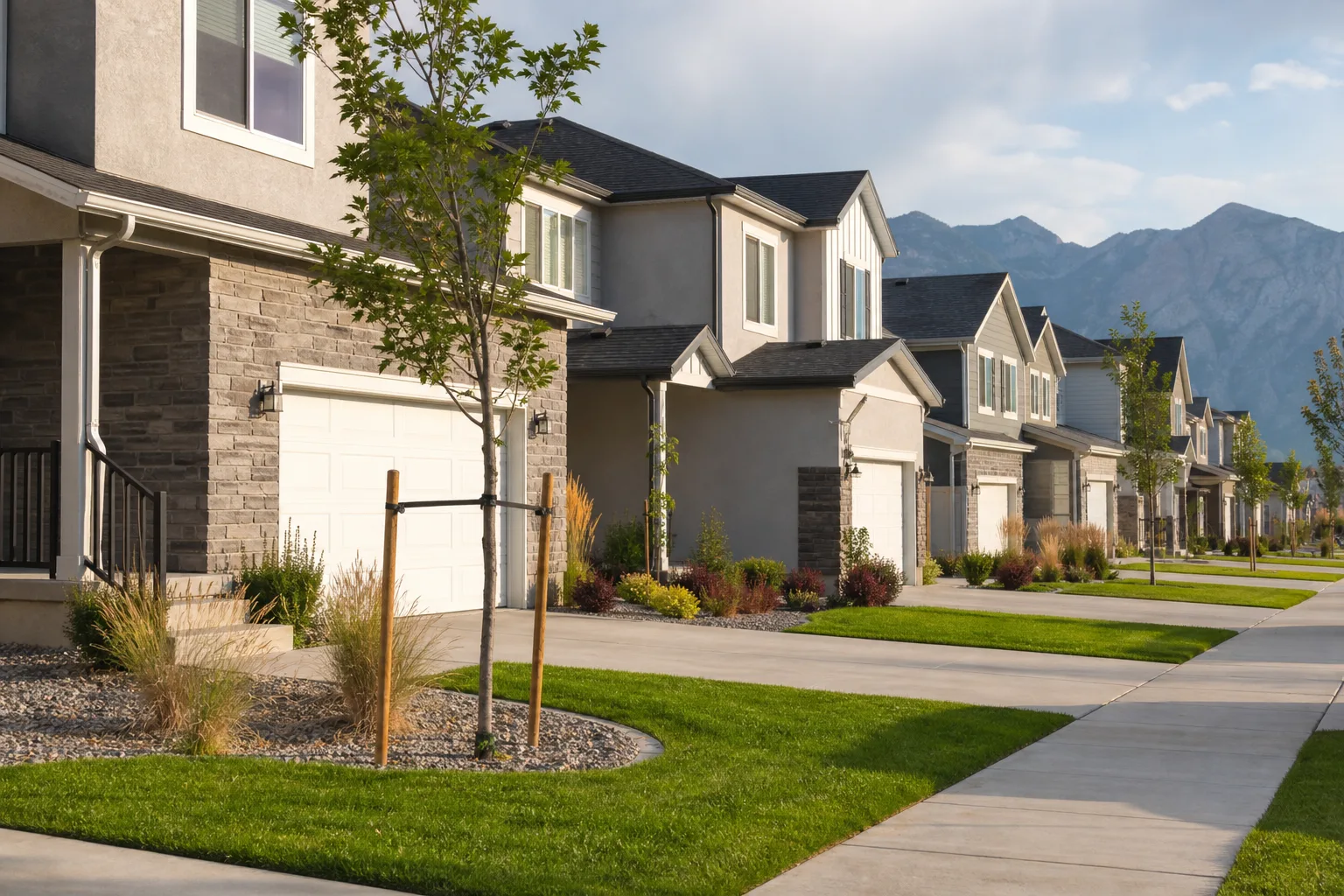
In South Jordan, the best-known new-home area is Daybreak, a Larry H. Miller Real Estate community that includes a 55-plus village and a downtown district with the Salt Lake Bees ballpark. In Herriman, the 933-acre Olympia development was annexed in 2021 under an agreement that allows up to 6,330 homes, at least 30% of them detached houses and no more than 37% apartments. On Herriman's southern hillside, the city approved updated agreements in November 2024 for three more developments: Rosecrest, Panorama and South Hills. West Jordan's permits are split between single-unit homes and apartments.
These cities sit closer to Salt Lake City jobs than Utah County does. The medians above show what that costs.
South Utah County: larger lots, longer drive
Salem, Spanish Fork, Payson, Santaquin and Mapleton are where permit counts are rising in 2026. Salem stands out: a city of about 12,000 people issued 437 single-unit permits in nine months. A buyer who works in Provo or Orem, or from home, will find the newest phases here. A buyer commuting to Lehi or Salt Lake City should drive it at rush hour first. The best Utah Valley suburbs for families and commuters compares these cities in more depth.
Tooele Valley, Davis and Weber counties: smaller numbers
Tooele and Grantsville together issued 326 single-unit permits in 2025. Syracuse and West Point in west Davis County issued 322, and West Haven in Weber County 215. Close-in cities with little open land barely register: Woods Cross permitted 19 single-unit homes in 2025. New homes exist there, but in subdivisions of a few lots at a time, so selection is thin and a buyer may wait for the right plan.
What Are the Downsides of Buying Where Everything Is New?
Construction lasts longer than the sales office suggests
A master plan with thousands of approved homes builds out over many years. Herriman describes Olympia as being built in phases over several years, and the south hillside park is not due until the end of 2028. Expect truck traffic, dust and road work, and ask which phases around the lot are still to come.
Schools and parks follow the rooftops
School boundaries move as new buildings open. In Eagle Mountain and Saratoga Springs the district itself is changing: the new Lake Mountain School District, which also covers Cedar Fort and Fairfield, takes over from Alpine School District on July 1, 2027. Eagle Mountain says a new high school is planned for its City Center area. Buyers should confirm the assigned schools for the specific address and ask what is funded, not just planned.
The first property tax bill is not the real one
Utah values property as it stands on January 1 of each year. A home that was a bare lot or a frame on that date is taxed on that value, so the first bill can be much lower than the bill for the finished house a year later. If the lender's first escrow estimate is based on that lot-only bill, the monthly payment rises after the first full assessment.
The 45% primary residential exemption is the other thing to watch. According to the Utah State Tax Commission, the exemption does not transfer automatically to a new owner, and starting January 1, 2027, a change of ownership requires the new owner to file form TC-473A with the county. Owners building a primary residence can file form PT-24 instead. The deadline is September 15. Without the exemption, a home is taxed on 100% of its value instead of 55%. City rates matter as well; see the 2026 property tax rate increases in Eagle Mountain and Roy.
Public infrastructure districts
Many large Utah developments now pay for roads and pipes through a public infrastructure district, or PID. A briefing by the Utah Division of Finance to a legislative committee in August 2026 described the common version: bonds repaid over 30 years by future homeowners through an added property tax, with a maximum rate of up to 15 mills set before any residents live there. It noted that buyers are often unaware of the levy until the first tax bill arrives.
Not every PID works that way. Herriman's agreement for Olympia says its districts are funded by a one-time fee paid by the builder, not a recurring property tax. The only way to know is to ask in writing whether the lot is in a PID, what the levy is, and how long it lasts.
Landscaping rules and a bare back yard
State water-efficiency standards for new development, which cities adopt so residents qualify for landscape rebates, allow no lawn in park strips or in areas less than eight feet wide. In Salt Lake, Utah, Davis and Weber counties they limit lawn to 35% of the landscaped area of front and side yards. Cities and HOAs can be stricter; Daybreak reviews every new home's landscape plan. Ask exactly what landscaping the builder installs. Where only the front yard is included, price the back yard, the fence and window coverings before choosing options. Which builder upgrades to buy at the design center and which to add after closing covers that decision.
Location-specific disclosures
Some new areas come with notices older neighborhoods do not have. On Herriman's south hillside, homes in designated high-noise areas near Camp Williams must be built with added sound insulation, and buyers must be told about the training site. Read every addendum the builder hands over. Daybreak, for example, lists an anti-speculator addendum among its buyer disclosures.
What Should You Check Before Signing With a Builder?
- Look up the city's recent permit counts. A high number means more competition among builders and more resale competition later.
- Ask for the phasing map and what is planned on every side of the lot.
- Get the HOA documents, the monthly fee, and a written answer on any PID or special assessment.
- Ask the lender to estimate the payment using taxes on the finished home, not the lot.
- File the primary residential exemption paperwork with the county by the deadline.
- Confirm the assigned schools and which new ones are funded.
- Drive the commute at the hours it will actually be driven.
- Read the landscaping deadline and what the builder installs.
- Hire an independent inspector before drywall and again before closing. Buying new construction in Utah walks through the contract and warranty steps.
- Compare with resale homes nearby; a two-year-old house often has the yard, fence and blinds already paid for.
Buyers focused on price should also read where Utah's starter home goal stands and which first-time buyer programs exist. New and resale listings in every city named here are on Best Utah Real Estate.
Sources: U.S. Census Bureau Building Permits Survey (2025 annual and September 2026 year-to-date place files) and Vintage 2025 city population estimates; Kem C. Gardner Policy Institute Ivory-Boyer Construction Database; Herriman City; Eagle Mountain City; Utah State Tax Commission; Utah Code 59-2-103; Utah Division of Finance briefing to the Political Subdivisions Interim Committee (Aug. 19, 2026); Utah Administrative Code R653-11-10; Utah Department of Transportation; Daily Herald.
Posted by Kristopher Larson
Frequently asked questions
Which Utah cities are building the most new homes?
Saratoga Springs, Eagle Mountain and Lehi lead the Wasatch Front and Utah County. U.S. Census Bureau permit data shows they issued 1,522, 1,148 and 829 permits for single-unit homes in 2025, which includes houses and townhomes. South Jordan, West Jordan, Herriman and Salem came next.
Is new home construction slowing in Eagle Mountain and Saratoga Springs?
Permits are down in 2026 but still higher than anywhere else in the region. From January through September 2026, single-unit permits fell about 28% in Saratoga Springs and 36% in Eagle Mountain compared with the same months of 2025, according to preliminary Census Bureau data. Lehi was down about 42%.
Where is new construction increasing in Utah County?
The south end of the county. Salem issued 437 single-unit permits in the first nine months of 2026, more than in all of 2025, and Spanish Fork and Payson were also ahead of the prior year. Those figures are preliminary and can be revised.
Why is the first property tax bill on a new Utah home so low?
Utah values property as it stands on January 1 each year. If the home was a bare lot or only partly built on that date, the bill for that year reflects that value, and the bill for the finished home arrives the following year. Buyers should budget for the full amount and make sure the primary residential exemption is on file with the county.
What is a public infrastructure district in Utah?
A public infrastructure district, or PID, is a separate district that issues bonds to pay for roads, water lines and other infrastructure in a new development. In the common version, future homeowners repay the bonds over about 30 years through an added property tax of up to 15 mills. Some PIDs are funded differently, so buyers should ask in writing whether a lot is in one and what it costs.
How much lawn can a new home in Utah have?
State water-efficiency standards for new development allow no lawn in park strips or areas less than eight feet wide, and in Salt Lake, Utah, Davis and Weber counties they limit lawn to 35% of the landscaped area of front and side yards. Cities that adopt the standards, and HOAs, can set stricter rules.
Kristopher Larson
Realtor® · Air Force veteran · Licensed in Utah & Nevada · Real Broker, LLC
Kris is an Air Force veteran who started in real estate in 2011, has been part of more than 350 transactions and once ran 20 luxury vacation rentals in Copper Rock and Paradise Village. He writes this site's guides from MLS data and public records, and says where every number comes from.
Keep reading
More from the blog
Infill Home or New Subdivision? What Utah MLS Data Shows
Do Homes Sell for More Across a Utah School District Line?
How Often Do Utah Homes Sell Over Asking? Month by Month