Do Nightly Rentals Sell for More in Utah Resort Towns?
Outside St. George, Utah homes marked for nightly rentals sold for about the same per square foot as similar homes in the same ZIP code. Houses ran about 8% higher, condos about 3% lower, and HOA dues more than twice as high.

Outside St. George, homes marked for nightly rentals mostly sold for about the same price per square foot as similar homes in the same ZIP code. Across 56 matched groups in Utah's mountain and resort areas, the median gap was −1.4%, and the nightly-rental home came out ahead in 25 of the 56. Houses were the exception: nightly-rental houses sold for a median 7.7% more per square foot (about $87,000) across 21 groups, while nightly-rental condos sold for about 3% less.
The raw numbers look very different. Homes marked for nightly rentals in these areas sold for a median $618 a square foot, against $448 for other homes. Most of that gap is location and home type: nightly-rental homes cluster in resort cores like Park City and around Jordanelle Reservoir, they are smaller (a median 1,880 square feet against 2,949), and 42% of them are condos, compared with 13% of other homes. When we matched by area instead of ZIP code, the gap was about +3%. That's different from our Washington County vacation rental study, where nightly-rental homes sold for about 14% more than similar homes in the same city. Matched by ZIP code the way this study is, Washington County still came out about 19% higher, in 18 of 21 groups, so the difference is the market, not the method.
What We Compared
We looked at Utah home sales (houses, townhomes and condos) that closed from November 1, 2024 through October 31, 2026, from both MLS feeds we carry, counting each home once per sale. Fractional and timeshare-style shares were dropped, and so were manufactured homes. Washington County was left out too, since our St. George study covers it.
The areas are Park City and Snyderville; the Jordanelle area (the Wasatch County side of Jordanelle Reservoir, including Hideout); the Heber Valley (Heber City, Midway, Charleston and Daniel, outside the Jordanelle area); Ogden Valley and Mountain Green (Eden, Huntsville, Liberty and Mountain Green); Bear Lake on the Utah side (Garden City and Laketown); Brian Head and Duck Creek; Moab; and Kanab. We kept the study to these areas because they are where nightly rentals are a real part of the market.
A home counted as a nightly rental when the listing agent marked the MLS short-term rental field "yes" (904 sales), or when the listing description said nightly or short-term rentals are allowed (363 more). Descriptions that said rentals are not allowed, or only that a home "could be" a rental, were left out, and a "no" in the MLS field always counted as no. We read 20 of the description-only matches: 13 stated plainly that nightly rentals were allowed or that the home was already rented nightly, and 7 implied it ("turnkey for nightly rentals"). Neither the field nor the description is a permit check.
Nightly-Rental Homes by Area: The Raw Numbers
| Area (sales Nov. 2024 to Oct. 2026) | Sales | Share marked for nightly rentals | Median price per sq. ft., nightly / other | Median monthly HOA, nightly / other (share reporting one) | Median days to contract, nightly / other |
|---|---|---|---|---|---|
| Park City and Snyderville | 1,806 | 34% | $988 / $797 | $881 (72%) / $400 (28%) | 55 / 49 |
| Jordanelle area | 587 | 37% | $706 / $644 | $440 (72%) / $356 (32%) | 90 / 67 |
| Heber Valley | 1,276 | 6% | $329 / $312 | $150 (51%) / $205 (37%) | 56 / 52 |
| Ogden Valley and Mountain Green | 458 | 31% | $399 / $314 | $235 (66%) / $52 (21%) | 57 / 56 |
| Bear Lake (Utah side) | 180 | 53% | $263 / $266 | $76 (40%) / $42 (29%) | 91 / 96 |
| Brian Head and Duck Creek | 152 | 46% | $332 / $313 | $400 (57%) / $350 (41%) | 78 / 76 |
| Moab | 221 | 19% | $419 / $391 | $308 (48%) / $150 (14%) | 94 / 106 |
| Kanab | 66 | 20% | $249 / $269 | $188 (54%) / none reported | 102 / 60 |
These are plain medians, not matched, so they mix different home types and locations. More than half of Bear Lake sales and close to half in Brian Head and Duck Creek were marked for nightly rentals, against 6% in the Heber Valley. You can browse current listings in Park City, Heber City, Eden, Garden City, Brian Head and Moab, or see vacation rental homes across Utah.
Do Nightly-Rental Homes Sell for More? The Matched Comparison
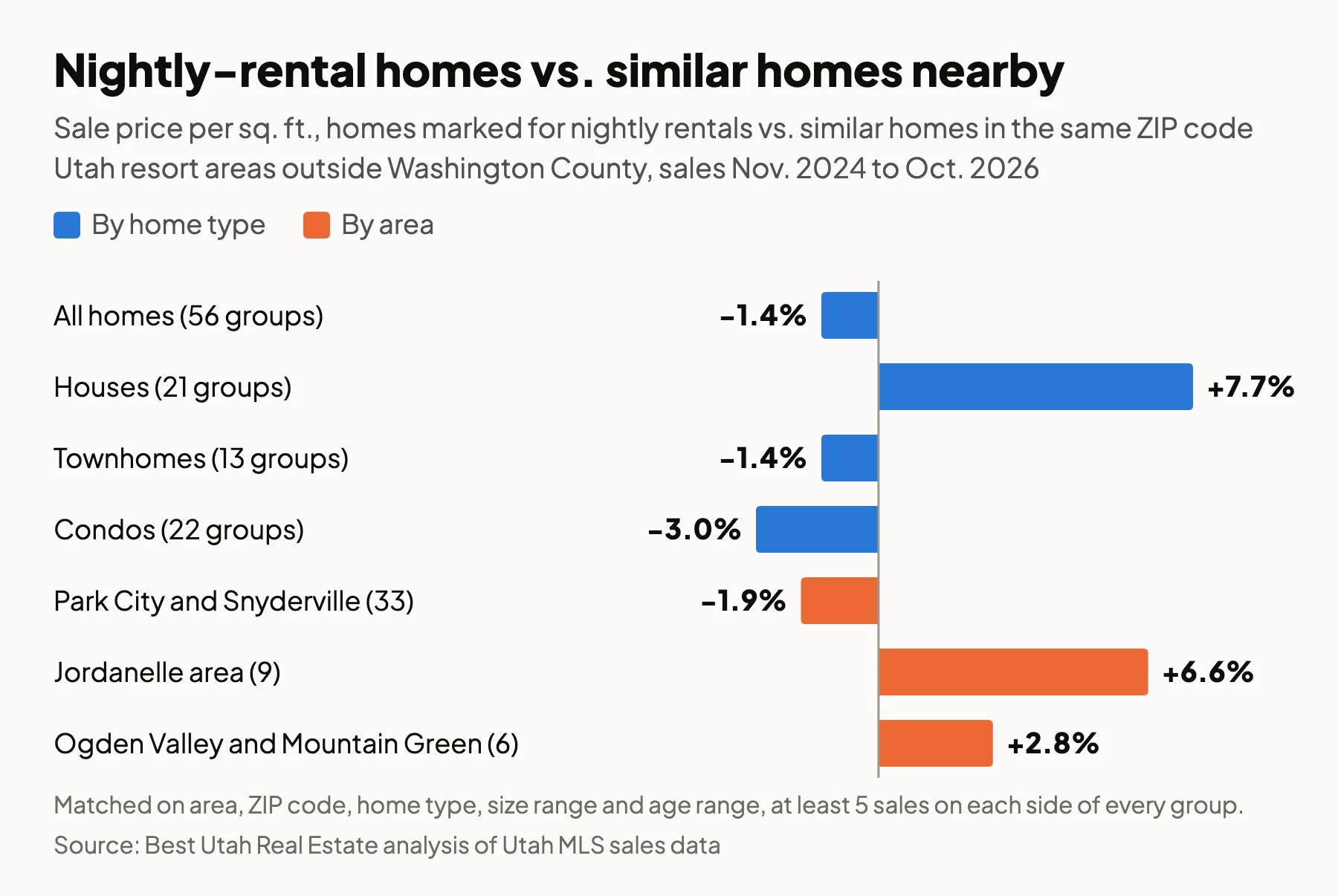
| Matched comparison (sales Nov. 2024 to Oct. 2026) | Groups | Sales compared | Groups where the nightly-rental home sold higher | Median gap, price per sq. ft. | Days to contract |
|---|---|---|---|---|---|
| All homes | 56 | 716 vs. 1,227 | 25 of 56 | −1.4% | 74 vs. 63 |
| Houses | 21 | 230 vs. 738 | 12 of 21 | +7.7% (about $87,000) | 64 vs. 79 |
| Townhomes | 13 | 172 vs. 208 | 5 of 13 | −1.4% | 77 vs. 66 |
| Condos | 22 | 314 vs. 281 | 8 of 22 | −3.0% | 80 vs. 50 |
| Park City and Snyderville | 33 | 441 vs. 744 | 15 of 33 | −1.4% | 72 vs. 58 |
| Jordanelle area | 9 | 132 vs. 204 | 5 of 9 | +6.6% | 92 vs. 60 |
| Ogden Valley and Mountain Green | 6 | 62 vs. 73 | 3 of 6 | +2.8% | 53 vs. 88 |
Each group holds homes in the same area and ZIP code, of the same type, size range and age range, with at least five sales on each side. Days to contract run from the first listing date to the accepted offer, averaged across groups by the number of nightly-rental sales. The Heber Valley (2 groups), Bear Lake (3), Brian Head and Duck Creek (2), Moab (1) and Kanab (0) had too few matched groups to report on their own.
- The overall answer is close to even. The middle half of all groups ran from −10.8% to +12.3%, so a nightly-rental listing can come in above or below similar homes nearby.
- Houses are where the gap shows up. Nightly-rental houses sold for more in 12 of 21 groups. Condos marked for nightly rentals sold for less in 14 of 22.
- Park City is about even. Inside the same ZIP code, nightly-rental homes in Park City and Snyderville sold for a median 1.4% less per square foot, ahead in 15 of 33 groups.
- They took longer to sell. Across all matched groups, nightly-rental homes went under contract in about 74 days, against 63 for similar homes.
Counting only homes the agent marked "yes" in the MLS field, the overall gap was +0.7% and houses about +9%, so the overall result stays close to even either way.
The last 12 months alone (November 2025 to October 2026) gave a similar picture with fewer groups: +4.0% overall (18 groups, 10 higher), +11.5% for houses (7 groups, 6 higher) and −5.4% for condos (8 groups, 2 higher).
HOA Dues Are the Clearer Difference
Two-thirds of nightly-rental homes in these areas (66%) reported an HOA fee, against 30% of other homes. Among homes that reported one, the median was $500 a month for nightly-rental homes and $212 for the rest. In Park City and Snyderville it was $881 against $400. Dues that high change the math on rental income, so read the HOA budget, the CC&Rs and the rental rules before you write an offer.
Whether a home can be rented nightly depends on the city or county and the HOA, and rules change. Our guide to Utah short-term rental rules by city covers what to check, and the city, county and HOA have the final word.
What the Data Can't See
- Rental income and permits. The MLS doesn't record bookings, nightly rates or whether a home holds a current license.
- Furniture. Many nightly-rental homes sell furnished, and the MLS sale price doesn't separate the furniture from the house.
- Exact location. A ZIP code still covers a lot of ground. Ski-in access, lake frontage or walking distance to Main Street can matter more than the rental label.
- What buyers did with it. A home marked for nightly rentals may have been bought as a primary or second home.
In our experience, buyers in resort towns pay for the location and the home first; the right to rent nightly helps most when it comes with a strong rental history and dues that leave room for income. Treat the numbers above as what went together, not proof of what the rental label is worth.
The Bottom Line
Outside St. George, homes marked for nightly rentals in Utah's resort areas sold for about the same per square foot as similar homes in the same ZIP code. Nightly-rental houses came out about 8% higher, condos about 3% lower, and HOA dues ran more than twice as high. In the St. George area, the same comparison still showed a clear premium. For St. George, Hurricane and Washington, see our St. George vacation rental homes page and the study linked above. Our Utah real estate guide has more of our MLS data studies.
About the data: Utah MLS sales of houses, townhomes and condos from both regional feeds, closed November 1, 2024 through October 31, 2026, one row per parcel and close date, fractional-ownership, timeshare-style and manufactured homes excluded, sales under 20% of list price dropped. Areas are defined by MLS city and county, with the Jordanelle area set by location (Wasatch County addresses north of Heber City, including Hideout). Nightly-rental homes are those with the MLS short-term rental field set to yes, or with a listing description saying nightly or short-term rentals are allowed (descriptions that say they are not allowed, or only that they could be, excluded; a "no" in the field always counts as no). The MLS short-term rental field was blank on many sales from mid-2025 to early 2026, which is why descriptions were used too. Matched groups use area, ZIP code, home type, size range and year-built range, with at least five sales on each side; gaps are medians across groups. HOA figures are monthly, from sales reporting a fee. Figures are aggregates; no single sale is shown. This is market data, not tax, legal or investment advice.
Frequently asked questions
Do nightly-rental homes sell for more in Utah resort towns?
Mostly not, once location is matched. Across 56 matched groups in Utah's mountain and resort areas outside Washington County, homes marked for nightly rentals sold for a median 1.4% less per square foot than similar homes in the same ZIP code, and came out ahead in 25 of 56. Nightly-rental houses were the exception, at about 8% more.
Do nightly-rental condos in Park City sell for more?
Not in our data. In Park City and Snyderville, condos marked for nightly rentals sold for a median 2.6% less per square foot than similar condos in the same ZIP code, ahead in 7 of 17 groups. Nightly-rental houses there ran about 10% higher, but in only 9 groups.
Why do nightly-rental homes look more expensive per square foot?
Mostly because of where they are and what they are. In these areas they sold for a median $618 a square foot against $448, but they cluster in resort cores, are smaller (a median 1,880 square feet against 2,949) and are more often condos (42% against 13%). Matched by ZIP code, type, size and age, the gap was about even.
Are HOA dues higher on nightly-rental homes in Utah?
Yes, clearly. In these areas 66% of nightly-rental homes reported an HOA fee, against 30% of other homes, and the median was $500 a month against $212. In Park City and Snyderville it was $881 against $400.
Do nightly-rental homes take longer to sell?
Yes, in our data. Across matched groups, homes marked for nightly rentals went under contract in about 74 days, against 63 for similar homes nearby.
How does this compare with St. George?
Differently. Our Washington County study found nightly-rental homes sold for about 14% more than similar homes in the same city, higher in 10 of 13 groups. Matched by ZIP code the way this study is, Washington County still came out about 19% higher, so the gap is a real market difference, not a change in method. See the St. George vacation rental study for those numbers.
Kristopher Larson
Realtor® · Air Force veteran · Licensed in Utah & Nevada · Real Broker, LLC
Kris is an Air Force veteran who started in real estate in 2011, has been part of more than 350 transactions and once ran 20 luxury vacation rentals in Copper Rock and Paradise Village. He writes this site's guides from MLS data and public records, and says where every number comes from.
Keep reading
More from the blog
How Much Cheaper Are Homes Farther From Salt Lake City?
Do Golf Course and Open Space Lots Sell for More in Utah?
Moving From Texas to Utah: What Changes for a Homeowner's Budget