Moving From Texas to Utah: What Changes for a Homeowner's Budget and House
Utah adds a state income tax and higher home prices, but property tax, insurance and power bills run lower than in Texas. Here is the full side-by-side for homeowners, how the houses differ, and how to plan the purchase.

A Texas homeowner usually pays less in Utah for property tax, insurance and electricity, and more for the house and income tax. The Tax Foundation puts Utah's effective property tax rate on owner-occupied homes at 0.48% against 1.40% in Texas (Census data for 2024), but Utah's statewide median home price runs about $190,000 higher, and its flat 4.45% income tax tends to outweigh the tax and insurance savings above roughly $136,000 of taxable income.
Most Texans weighing a move to Utah start with two facts: Utah taxes income and Texas does not, and Utah homes cost more. Both are true. They are also only two lines of a household budget that changes in about a dozen places, and several of those lines move in Utah's favor.
The traffic between the two states is steady in both directions. Census Bureau estimates from the American Community Survey show about 6,500 people moved from Texas to Utah in 2024, after roughly 7,300 in 2023 and 7,100 in 2022. More went the other way each year: about 8,700 Utahns moved to Texas in 2024. These are survey estimates with wide margins of error, but the pattern is consistent. People who make the move well tend to be the ones who ran the whole budget first.
How Do Texas and Utah Homeowner Costs Compare?
| Cost | Texas | Utah | Source |
|---|---|---|---|
| State income tax | None | Flat 4.45% | Utah Legislature, 2026 session |
| Effective property tax rate on owner-occupied homes | 1.40% (7th highest) | 0.48% (48th) | Tax Foundation, Census data for 2024 |
| Average homeowners insurance premium | $2,397 (3rd highest) | $937 (50th) | NAIC data for 2022, via Insurance Information Institute |
| Average residential electric bill | $163.72 a month | $94.57 a month | U.S. EIA, 2024 |
| Residential natural gas price, per thousand cubic feet | $19.42 | $10.19 | U.S. EIA, 2025 average |
| Sales tax on groceries | Not taxed | 3% statewide | Texas Comptroller; Utah State Tax Commission |
| Statewide median home price | $330,000 (August 2026) | $520,000 (first quarter 2026, all home types) | Texas Real Estate Research Center; Kem C. Gardner Policy Institute |
The insurance averages are the oldest figures in the table, and premiums have risen in both states since 2022. Treat that row as a ranking, not a quote.
What Gets Cheaper
Property tax
This is the largest swing. Utah exempts 45% of a primary residence's market value, so an owner-occupied home is taxed on 55% of what it is worth. Texas appraises at market value and then subtracts a $140,000 homestead exemption for school district taxes, according to the Texas Comptroller, with a 10% yearly limit on appraisal increases for homesteads.
The results show up in what owners actually pay. Tax Foundation county figures, built on Census five-year estimates through 2024, put the median property tax bill at $7,521 in Collin County, $7,727 in Travis County and $4,489 in Harris County. In Utah the median was $2,836 in Salt Lake County, $2,370 in Utah County and $2,158 in Washington County.
Two cautions for new arrivals. The Utah exemption requires living in the home at least 183 consecutive days a year, and counties can require an application after a change of ownership, so confirm it is on the first tax notice. A Texan who buys in Utah as a second home pays tax on the full value.
Insurance, with an asterisk
Utah ranked 50th for average homeowners premiums in the NAIC's 2022 data while Texas ranked third. The asterisk is availability. In 2025 Utah had the country's highest share of homeowners policies that insurers declined to renew. Buyers should get a quote on the specific address early in the contract; the details are in what to do about Utah's home insurance nonrenewal rate.
Power and gas
The average Utah household used 774 kilowatt-hours of electricity a month in 2024 against 1,096 in Texas, and paid a lower rate for each one, according to the EIA. That works out to roughly $830 less per year. Utah homes lean harder on the furnace, but the state's residential natural gas price was about half of Texas's in 2025.
What Costs More in Utah Than in Texas?
The house
The Gardner Institute's 2026 housing report ranks Utah among the 10 most expensive states for home prices. The gap with Texas's statewide median is about $190,000. With mortgage rates above 7% in fall 2026, each extra $100,000 borrowed adds about $665 a month in principal and interest on a 30-year loan. For most households that one line outweighs everything Utah saves on tax and insurance. A market-by-market view is in how the Utah and Texas real estate markets compare.
Income tax
Utah's rate is a flat 4.45% for 2026, after the Legislature cut it for the sixth year in a row. A household with $150,000 of taxable income owes up to about $6,675 before credits. Utah's taxpayer tax credit trims that for lower and middle incomes and phases out as income rises.
A rough way to size it up: at the statewide effective rates, a $500,000 home carries about $7,000 a year in property tax in Texas and about $2,400 in Utah. Add the gap in average insurance premiums and the Utah owner is ahead by about $6,000 a year. A 4.45% tax consumes that at roughly $136,000 of taxable income. Below that level Utah tends to come out ahead on taxes and insurance; well above it, Texas does. This is arithmetic on averages, not tax advice, and it assumes the same house price in both states, which is rarely the case.
Groceries
Texas does not tax food products bought at a grocery store. Utah charges a 3% statewide rate on grocery food. On $1,000 a month of groceries that is $360 a year.
What Just Feels Different
Climate
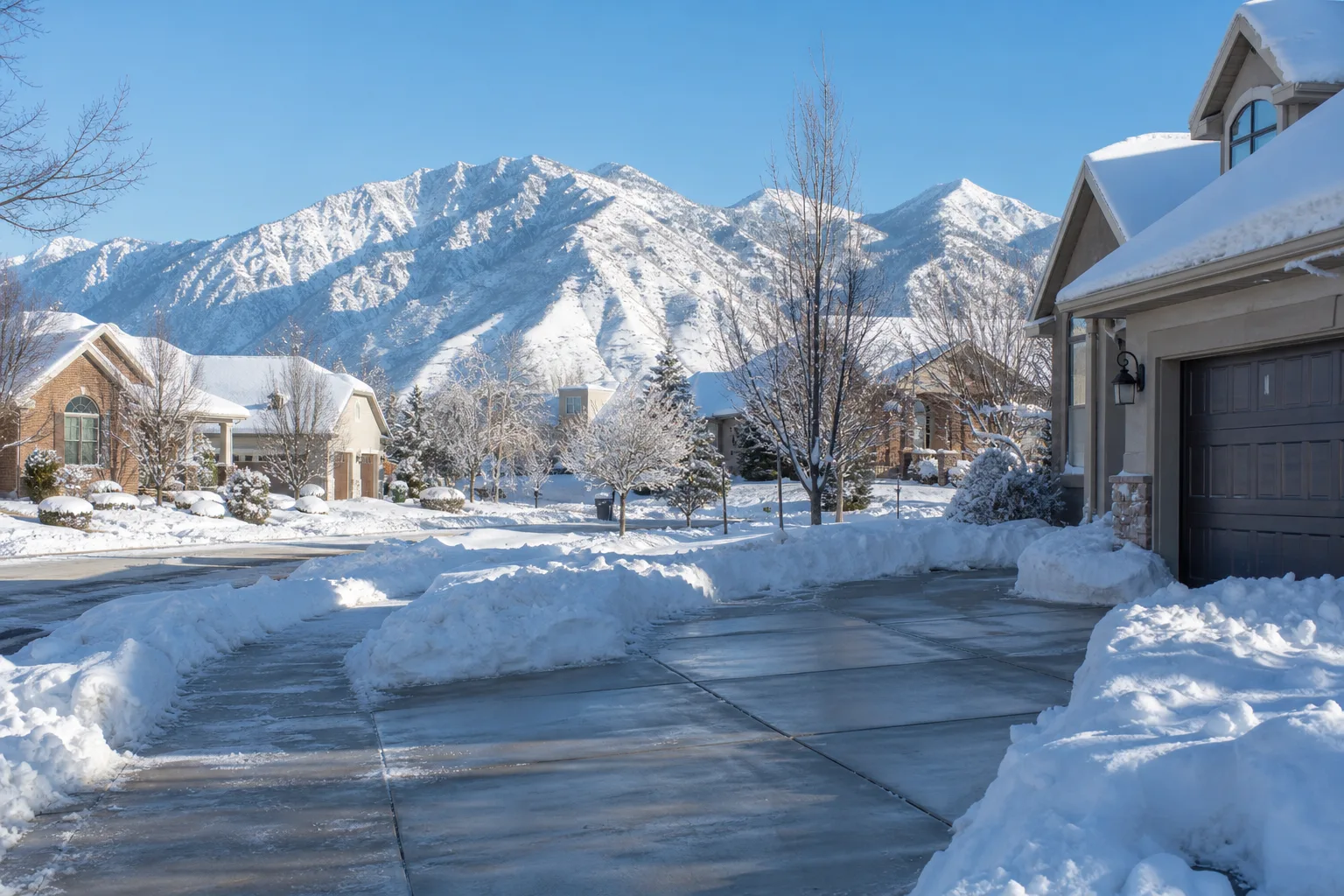
NOAA's 1991 to 2020 climate normals describe the trade plainly:
- Salt Lake City: about 52 inches of snow a year, 15.5 inches of total precipitation, 62 days at 90 degrees or hotter, and 112 nights at or below freezing. The average July low is 68 degrees. The airport sits at about 4,225 feet.
- Dallas-Fort Worth: 1.6 inches of snow, 37 inches of precipitation, 106 days at 90 or hotter, and an average July low near 76.
- Houston: almost no snow, nearly 52 inches of precipitation and 111 days at 90 or hotter.
- St. George: 128 days at 90 or hotter, an average July high of 102, about an inch of snow and 9.3 inches of precipitation.
Winter also brings inversions, when cold air and pollution are trapped on the valley floors. The Utah Department of Environmental Quality counts five to six multi-day episodes in a typical winter and an average of 18 days when fine-particle pollution exceeds the federal standard. Households with asthma or other breathing concerns should read how winter inversions affect home buying before choosing a location.
How the house is built
- Deeper foundations. Salt Lake City's building design criteria set frost depth at 30 inches, and footings go below it. With that much digging already required, a basement level is a familiar part of Utah homes, so compare above-ground square footage with above-ground square footage when measuring a listing against a Texas slab home.
- Radon. The state's radon program says one in three Utah homes tests above the level where mitigation is advised, 4 picocuries per liter. Test during due diligence; costs are covered in budgeting for radon mitigation.
- Earthquakes instead of hurricanes. State earthquake officials put the chance of at least one magnitude 6.0 or greater quake in the Wasatch Front region at 57% over 50 years. Salt Lake City places homes in seismic design category D2. The Utah Insurance Department notes that earthquake damage is not covered by a typical homeowners policy; it takes a separate policy or endorsement.
- Snow on the roof. Salt Lake City requires a ground snow load of at least 28 pounds per square foot in design, and more at higher elevations. Roof age and condition matter in a different way than they do after a Texas hailstorm.
- Two water systems. Many Wasatch Front neighborhoods water lawns from a separate secondary irrigation system that has historically been unmetered. State law requires meters on those connections by January 1, 2030. Ask whether a home has secondary water, who supplies it and whether it is metered yet.
- Less lawn. The state's water-efficiency standards, which cities adopt so residents qualify for landscaping rebates, bar lawn in park strips at new development and limit it to 35% of front and side yard landscaping in Salt Lake, Utah, Davis and Weber counties. In Washington County the limit is 15% of the lot.
Paperwork and everyday rules
- Vehicles: Utah law requires registration within 60 days of establishing residency.
- Driver license: a transfer from another state involves a 25-question open-book test, an eye test and a $52 fee, and the Texas license is surrendered, according to the Driver License Division.
- Alcohol: liquor, wine and beer above 5% alcohol by volume are sold at state liquor stores and package agencies. Grocery and convenience stores sell beer up to 5%. New residents may bring in up to nine liters of liquor bought elsewhere for personal use, per the Department of Alcoholic Beverage Services.
Where Do Texans Tend to Buy in Utah?
The choice usually follows lifestyle and job location more than price alone.
| City | Fits buyers who want | Median sale price | Median days on market | Homes for sale |
|---|---|---|---|---|
| Lehi | Newer homes near Utah County's tech employers | $607,000 | 45 days | 400 |
| South Jordan | A Salt Lake County suburb with master-planned neighborhoods | $596,570 | 38 days | 502 |
| Eagle Mountain | More house and yard for the budget, with a longer drive | $508,000 | 39 days | 576 |
| St. George | Heat, sun and almost no snow | $505,000 | 41 days | 1,003 |
The figures are the latest full month of MLS data and update automatically. Buyers who would miss Texas summers least in the north and most in the south can read why Southern Utah appeals to Texans. Mountain towns such as Park City and Heber City are a third path: higher prices, colder nights and more snow than the Salt Lake Valley.
A Relocation Timeline That Works
- Visit twice, in January and in July. January shows snow, driveways and inversion days. July shows St. George heat and how cool Wasatch Front evenings get. Drive the commute at rush hour both times.
- Price the Texas sale honestly. The Texas Real Estate Research Center reported 5.3 months of inventory in August 2026, with sold homes averaging 65 days on the market. A Utah purchase that depends on Texas sale proceeds needs that time built in.
- Decide whether to sell first or buy first. Selling first means a stronger Utah offer with no home-sale contingency, at the cost of temporary housing. Buying first avoids a double move but can mean two payments or bridge financing. A sale contingency sits in between and is weaker when a seller has other offers.
- Match the rate lock to the calendar. Ask the lender how long the lock lasts, what an extension costs, and whether it covers a new-construction closing date that could slip.
- Use the due diligence period for Utah-specific checks. Radon test, insurance quote on the address, secondary water status, furnace age, and the property tax exemption.
- Handle the 60-day items after closing. Vehicle registration, the license transfer and the primary residence exemption.
Households arriving from other states face a similar list with different numbers; the California version is in leaving California for Utah. Migration figures for every state pair are published in the Census Bureau's state-to-state migration tables, and current listings in every Utah city are on Best Utah Real Estate.
Posted by Kristopher Larson
Frequently asked questions
Is it cheaper to own a home in Utah or Texas?
Cheaper on property tax, insurance and power, but for most households the higher home price outweighs those savings. Utah's effective property tax rate was 0.48% against 1.40% in Texas in Tax Foundation figures for 2024, and average insurance and electric bills are lower. Utah homes cost more, though, and Utah charges a flat 4.45% income tax that Texas does not.
How much lower are property taxes in Utah than in Texas?
Utah taxes a primary residence on 55% of its market value, and its effective rate on owner-occupied homes was 0.48% in 2024, compared with 1.40% in Texas, according to the Tax Foundation. The median bill was $2,836 in Salt Lake County and $7,521 in Collin County, Texas, in the same data set.
What is Utah's state income tax rate?
Utah has a flat individual income tax of 4.45% for 2026, after the Legislature lowered it for the sixth straight year. Texas has no state income tax. A taxpayer tax credit reduces the Utah bill for lower and middle incomes and phases out as income rises.
Does Utah charge sales tax on groceries?
Yes. The Utah State Tax Commission lists a 3% statewide sales tax rate on grocery food. Texas does not tax food products sold at grocery stores.
How long does a new Utah resident have to register a vehicle?
Utah law requires vehicles to be registered within 60 days of the owner establishing residency. Transferring a driver license from another state involves a 25-question open-book test, an eye test and a $52 fee, and the previous state's license is surrendered.
Where do people moving from Texas usually buy in Utah?
Buyers who want newer suburbs near jobs often look at Lehi, where the median sale price is $607,000, and South Jordan. Eagle Mountain offers more house for the budget with a longer drive. Buyers who prefer heat and very little snow tend to choose St. George, where the median is $505,000.
Kristopher Larson
Realtor® · Air Force veteran · Licensed in Utah & Nevada · Real Broker, LLC
Kris is an Air Force veteran who started in real estate in 2011, has been part of more than 350 transactions and once ran 20 luxury vacation rentals in Copper Rock and Paradise Village. He writes this site's guides from MLS data and public records, and says where every number comes from.
Keep reading
More from the blog
Where to Live in Davis County, Utah: 12 Cities Compared for Homebuyers
Buying a Second Home in Utah: Taxes, Loans and Insurance That Change

Title Insurance in Utah: How to Read the Title Commitment Before Your Due Diligence Deadline