Title Insurance in Utah: How to Read the Title Commitment Before Your Due Diligence Deadline
The title commitment shows who owns a Utah home, what is recorded against it and what the policy will leave out. Here is who pays for title insurance, how to read Schedule A and Schedule B, and what to ask before the due diligence deadline.

The title commitment shows who owns the home, what is recorded against it and, in Schedule B, what the policy will not cover. Under the Utah REPC, a buyer who objects must cancel or resolve it in writing by the Due Diligence Deadline, or the condition is waived. The seller usually pays for the buyer's owner's policy, and the buyer pays for the lender's.
Somewhere in the stack of documents a Utah buyer receives in the first days under contract is a file called the Commitment for Title Insurance. After the due diligence deadline, the chance to object is mostly gone.
This article is general information, not legal advice. A title officer or a Utah real estate attorney can answer questions about a specific property.
What the Utah Contract Says About Title
Most home sales in the state use the Utah Real Estate Purchase Contract (REPC). Three sections control title:
- Section 10.1: the seller promises to convey marketable title by general warranty deed. The buyer accepts title subject to the commitment, as reviewed and approved during due diligence.
- Section 10.2: at settlement the seller pays for the buyer's policy, specifically the most current ALTA Homeowner's Policy of Title Insurance. If that form is unavailable, the seller pays for a standard ALTA Owner's Policy.
- Sections 11(c) and 12.1: the commitment is one of the seller disclosures due by the Seller Disclosure Deadline, and the buyer's review of it is part of due diligence.
Under Section 12.1 a buyer who finds something unacceptable can cancel in writing by the Due Diligence Deadline and get the earnest money back, or resolve the objection in writing with the seller. A buyer who does neither is treated as having waived the condition. The commitment arrives with the other seller disclosures and should be read the week it lands. Repeat buyers should also skim the latest REPC revision.
Who Pays for Title Insurance in Utah?
Usually the seller pays for the owner's policy and the buyer for the lender's. The Utah Insurance Department describes the owner's policy this way: it is issued in the amount of the purchase price, is paid for once, and lasts as long as the insured or the insured's heirs have an interest in the property. The lender's policy protects the mortgage lender and ends when the loan is repaid. The department says that split is local custom.
The Consumer Financial Protection Bureau (CFPB) explains that most lenders require a lender's policy, which protects the loan amount and not the buyer's equity. The owner's policy is optional in general, though the Utah contract already has the seller buying it. The other settlement charges are covered in closing costs in Utah.
According to the Insurance Department, every title insurer files its rates with the state and must charge the rate on file, so premiums differ by company but are not discounted. Escrow fees vary by agency and can be compared, and a buyer may choose any licensed agency. The department licenses title agents and escrow officers, and a five-member Title and Escrow Commission appointed by the governor makes rules for the industry.
Homeowner's Policy vs. standard Owner's Policy
The American Land Title Association (ALTA) publishes both forms. Its Homeowner's Policy is written only for an existing one-to-four family residence bought by a person or an estate planning entity, and its covered risks include several that the standard Owner's Policy does not list:
- forgery, impersonation or a new ownership claim that happens after the policy date;
- being ordered to remove or fix part of an existing structure built without a building permit, or one that violates zoning;
- being forced to remove an existing structure that encroaches on a neighbor's land or on an easement;
- a neighbor building a structure onto the land after the policy date;
- no actual vehicle and pedestrian access, where the standard form insures only a right of access.
Some of those risks carry a deductible and a maximum dollar limit shown in Schedule A of the policy.
What a Title Search Turns Up
Before issuing a commitment, the title agency searches the public land records. Under Utah Code 57-3-102, a document recorded with the county recorder gives notice of its contents to everyone, which is why the records carry so much weight. Typical findings include:
- a seller's trust deed, or an older one that was paid off but never released;
- judgment liens, tax liens and unpaid HOA charges;
- construction liens from unpaid contractors or suppliers;
- easements and recorded restrictions such as CC&Rs;
- gaps in the chain of ownership, for example an owner who died with no probate on record.
The search cannot find everything. The Insurance Department names forged deeds, undisclosed heirs, documents signed under an expired or fabricated power of attorney, and mistakes in the public records as hazards that surface later. The policy insures against those. For the basics, see title vs. deed in Utah real estate.
How to Read the Commitment
ALTA's commitment form calls itself an offer to issue a policy, not a report on the condition of title.
Schedule A shows the commitment date, the policy to be issued, the proposed insured, the proposed amount of insurance, who holds title now, and the legal description. Check the spelling of the buyer names, that the amount matches the purchase price, that the policy named is the Homeowner's Policy, that the owner shown is the person who signed as seller, and that the legal description covers everything that was toured.
Schedule B, Requirements lists what must happen before the insurer will issue the policy: payment of the price and premium, and properly signed and recorded documents. Agencies add specific items here, such as paying off the seller's loan.
Schedule B, Exceptions lists what the policy will not cover. The Insurance Department notes that an agent may be able to remove an exception if the problem is cleared up or added coverage is bought.
| Exception on Schedule B | Normal, or ask questions? | What to do |
|---|---|---|
| Property taxes for the current year, not yet due | Normal | Confirm they are prorated at settlement (REPC Section 8.1). |
| Utility easements shown on the subdivision plat | Normal | Find where they run before planning a pool or addition. |
| CC&Rs and other recorded covenants | Normal in an HOA or planned subdivision | Read them. Disclosed restrictions are not insured against. |
| Irrigation ditch, canal or pipeline easement | Ask questions | Ask who maintains it and how wide it is. |
| Access or shared driveway easement | Ask questions | Get the recorded document and any maintenance agreement. |
| Conservation easement | Ask questions | It runs with the land. Read the full text. |
| Trust deed, judgment, tax lien or construction lien | Ask questions | It should be paid and released at closing, not left as an exception. |
| Leases or rights of people occupying the property | Ask questions | REPC 10.1: the buyer takes title subject to leases that run past closing. |
| Boundary, encroachment or survey matters | Ask questions | Consider a survey before the deadline. |
Ask the title officer for a copy of every recorded document the exceptions cite.
Easements Utah Buyers Run Into
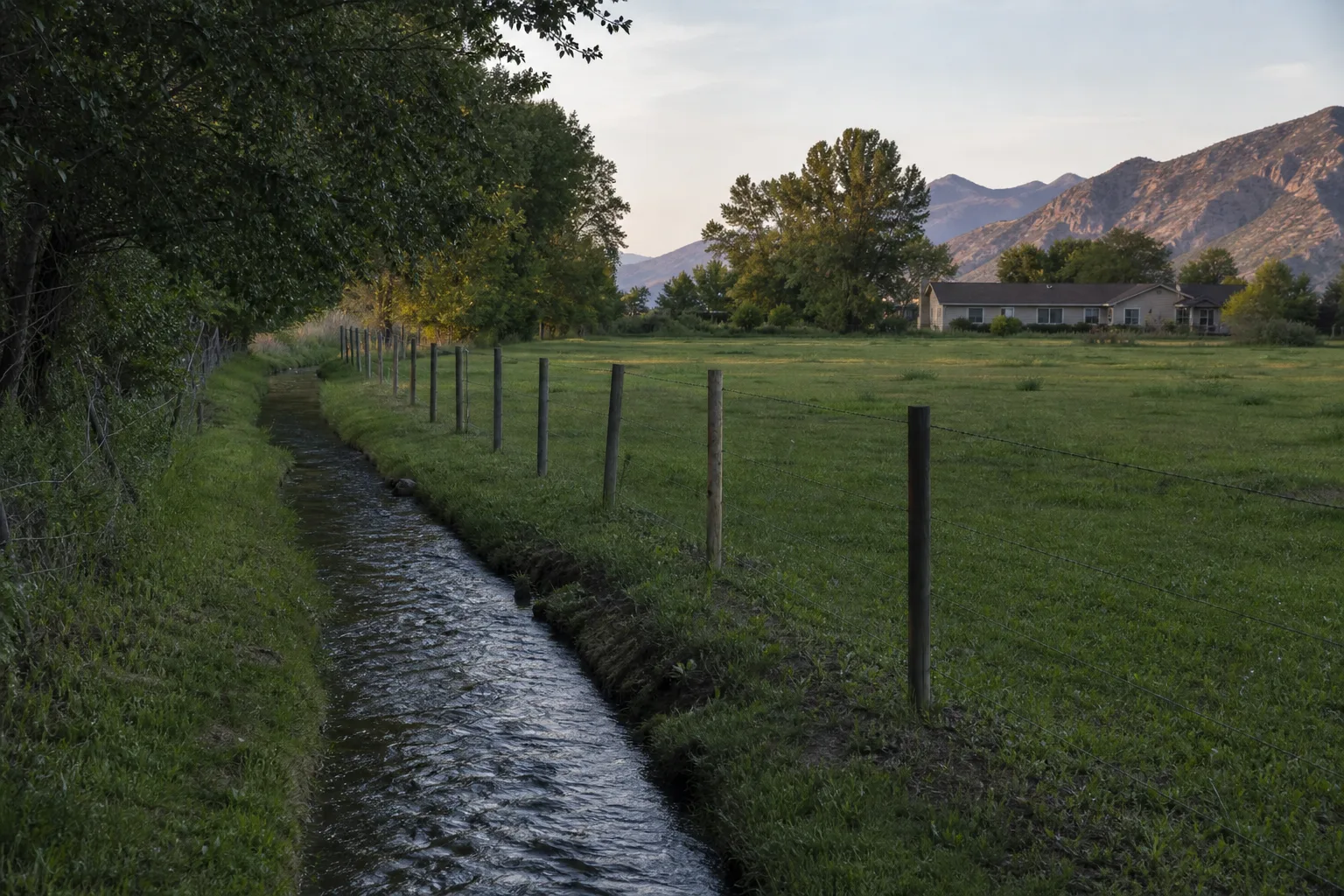
A subdivision lot in St George and a few acres outside Heber City can produce very different exception lists. Four kinds of easement are worth knowing.
- Utility easements. Strips along lot lines for power, gas, water, sewer and communications.
- Irrigation ditches and canals. These do not always appear in the records. Utah Code 57-13a-102 allows a prescriptive easement for a water conveyance that has been maintained for 20 years in a continuous, open and adverse way. Walk the property and look for them.
- Access easements. A parcel that does not touch a public road depends on a recorded right to cross someone else's land. The Insurance Department lists "no right of access to and from the land" as a title defect.
- Conservation easements. Under Utah Code 57-18-2 a conservation easement is an interest in land that keeps it in a natural, scenic, open, agricultural or similar condition, and it runs with the land to later owners.
In a planned community the recorded covenants matter as much. See what bylaws and CC&Rs are.
New Construction and Construction Liens
On a new or recently remodeled home, someone who worked on it may not have been paid, and Utah law gives that person a lien on the property. Utah also runs the State Construction Registry (SCR), an online database overseen by the Division of Professional Licensing. A contractor, subcontractor or supplier who wants lien rights must file a preliminary notice in the registry within 20 days of starting work, and one who never files may not claim a construction lien.
The registry's homeowner page says filings are free to view and searchable by address or tax parcel number, so a buyer can see who has filed on a home and ask how each will be paid. State law also bars liens against an owner-occupied residence in certain cases, including when the owner had a written contract with a licensed contractor or a real estate developer and paid it in full. The ALTA Homeowner's Policy lists as a covered risk a statutory lien for labor or material furnished before the policy date, even if the lien attaches afterward. Ask whether Schedule B takes that coverage away.
What a Survey Adds
A title search reads documents. It does not measure the ground. A survey locates the boundary lines and shows where fences, driveways and neighboring structures sit in relation to them. The REPC lists "the location of property lines" among the items a buyer may verify during due diligence, at the buyer's expense. It is worth considering on acreage and whenever Schedule B mentions a boundary or encroachment.
What Does Title Insurance Not Cover?
Title insurance is not homeowners insurance. The Insurance Department says it does not cover fire, flood, theft or other damage, and a policy generally leaves out:
- defects created after the policy is issued;
- defects the owner created or knew about;
- building, zoning and other land use violations, apart from the limited cases the Homeowner's Policy adds back;
- restrictive covenants that were disclosed to the buyer;
- everything listed as an exception in Schedule B.
The condition of the house belongs to the inspection, and zoning questions to the city or county. Where each check fits is laid out in the Utah first-time home buyers guide.
Wire Fraud: The Risk Before Closing
The FBI's Internet Crime Complaint Center counted 24,768 business email compromise complaints in its 2025 annual report, with reported losses of about $3.05 billion. The same report describes homebuyers who wired more than $449,000 after an email impersonating their attorneys. In that case the money was frozen in time.
The CFPB and ALTA give the same advice:
- Get wiring instructions in person or by calling a phone number already known to be the title agency's. Never use a number or link from an email.
- Treat any email that changes wiring instructions as suspect. ALTA says it is uncommon for title companies to change them by email.
- Ask the bank to confirm the name on the receiving account before sending.
- Call the agency right after sending to confirm the money arrived. If it did not, ask the bank for a recall immediately and file a complaint with IC3.
Utah law requires escrow money to sit in a trust account at a federally insured institution, where it is not subject to the agency's debts. The agency must also tell buyers, when the commitment is first delivered, that a closing protection letter is available. Under Utah Code 31A-4-117 that letter can cover theft or misappropriation of settlement funds by the agency, within its terms.
At the Closing Table
At settlement the buyer signs the loan documents, including the promissory note and the deed of trust, and the seller signs the warranty deed.
Signing is not the end. Under REPC Section 9.2, closing is complete only when settlement is done, the loan proceeds have been delivered, and the documents have been recorded with the county recorder, all within four calendar days of settlement. The policy itself is issued after closing. The full sequence, including when keys change hands, is in settlement, closing and possession in Utah.
Before the Due Diligence Deadline, put any title objection in writing, as the REPC requires. Current listings across the state are on Best Utah Real Estate.
Posted by Kristopher Larson
Frequently asked questions
Who pays for title insurance in Utah?
Under Section 10.2 of the Utah Real Estate Purchase Contract, the seller pays for the buyer's owner's policy, specifically the ALTA Homeowner's Policy of Title Insurance. The Utah Insurance Department says the buyer usually pays for the separate lender's policy, which most lenders require. The parties can agree to a different split in writing.
What is a title commitment?
A title commitment is the title insurer's offer to issue a policy once certain requirements are met. Schedule A names the buyer, the amount of insurance, the current owner and the legal description. Schedule B lists the requirements that must be satisfied before closing and the exceptions the policy will not cover.
When does a Utah buyer receive the title commitment?
The purchase contract lists the commitment among the seller disclosures, which are due by the Seller Disclosure Deadline. The buyer reviews it as part of due diligence. Objections must be resolved in writing with the seller, or the contract cancelled, by the Due Diligence Deadline, or the buyer is treated as having waived the condition.
Is owner's title insurance required in Utah?
Lenders generally require a lender's policy, which protects only the loan amount. The owner's policy protects the buyer and is a choice in general, according to the Consumer Financial Protection Bureau. In Utah the standard contract already has the seller paying for the buyer's owner's policy, so most financed and cash buyers end up with one.
What does title insurance not cover?
The Utah Insurance Department says title insurance does not cover fire, flood, theft or other property damage. It also generally excludes defects created after the policy is issued, defects the owner created or knew about, building and zoning violations, disclosed restrictive covenants, and anything listed as an exception in Schedule B.
What is the Utah State Construction Registry?
The State Construction Registry is an online database overseen by the Utah Division of Professional Licensing where contractors, subcontractors and suppliers file notices on construction projects. Anyone who wants construction lien rights must file a preliminary notice there within 20 days of starting work. Viewing filings is free, so a buyer of a new home can search the property by address or tax parcel number before closing.
Kristopher Larson
Realtor® · Air Force veteran · Licensed in Utah & Nevada · Real Broker, LLC
Kris is an Air Force veteran who started in real estate in 2011, has been part of more than 350 transactions and once ran 20 luxury vacation rentals in Copper Rock and Paradise Village. He writes this site's guides from MLS data and public records, and says where every number comes from.
Keep reading
More from the blog
Do Remodeled Homes Sell for More in Utah? MLS Data
Do Relisted Homes Sell for Less? Utah MLS Data
Do More Listing Photos Sell a Home Faster? Utah MLS Data