Do More Listing Photos Sell a Home Faster? Utah MLS Data
We compared Utah home sales by listing photo count and virtual tour link to see whether more photos go with a faster sale, how much, and what the data can't see.

More listing photos went with a slightly faster sale in Utah, but the gap is small and it isn't the photos alone. In our MLS data for resale homes sold from November 2024 through October 2026, homes with 50 or more photos went under contract a median of about 9 days sooner than similar homes with 25 to 34 photos, and homes with 15 to 24 photos took about 5 days longer. Virtual tour links showed no consistent difference over the two years.
Most Utah listings already land in the middle: the typical resale listing had 33 photos. The homes that stood out were the ones at the edges, with fewer than 25 photos or more than 50.
What We Compared
We looked at 83,809 Utah home sales that closed between November 1, 2024 and October 31, 2026 in both MLS feeds we carry (the Wasatch Front MLS and the Washington County MLS), one record per home and close date. We dropped 5,329 homes entered into the MLS within a day of going under contract, since those never really sat on the market, plus 679 records with no photo count, no contract date or more than 730 days to contract. That left 77,801 sales: 61,629 resale homes and 16,172 new homes, which we report separately.
The photo count is the number of photos on the listing in the MLS record. It is filled in on more than 99% of these sales. Throughout this post, Southern Utah means Washington, Iron and Kane counties, and Northern Utah means the rest of the state.
Pricier and bigger homes tend to get more photos, and they also sell on a different clock, so raw averages mix the two. For the main results we compared homes inside matched groups: same city, same size range, same price range and the same season of listing (calendar quarter), with at least 5 sales on each side of every group. The comparison side is homes with 25 to 34 photos, the most common range.
Listing Photos and Days to Contract: The Results
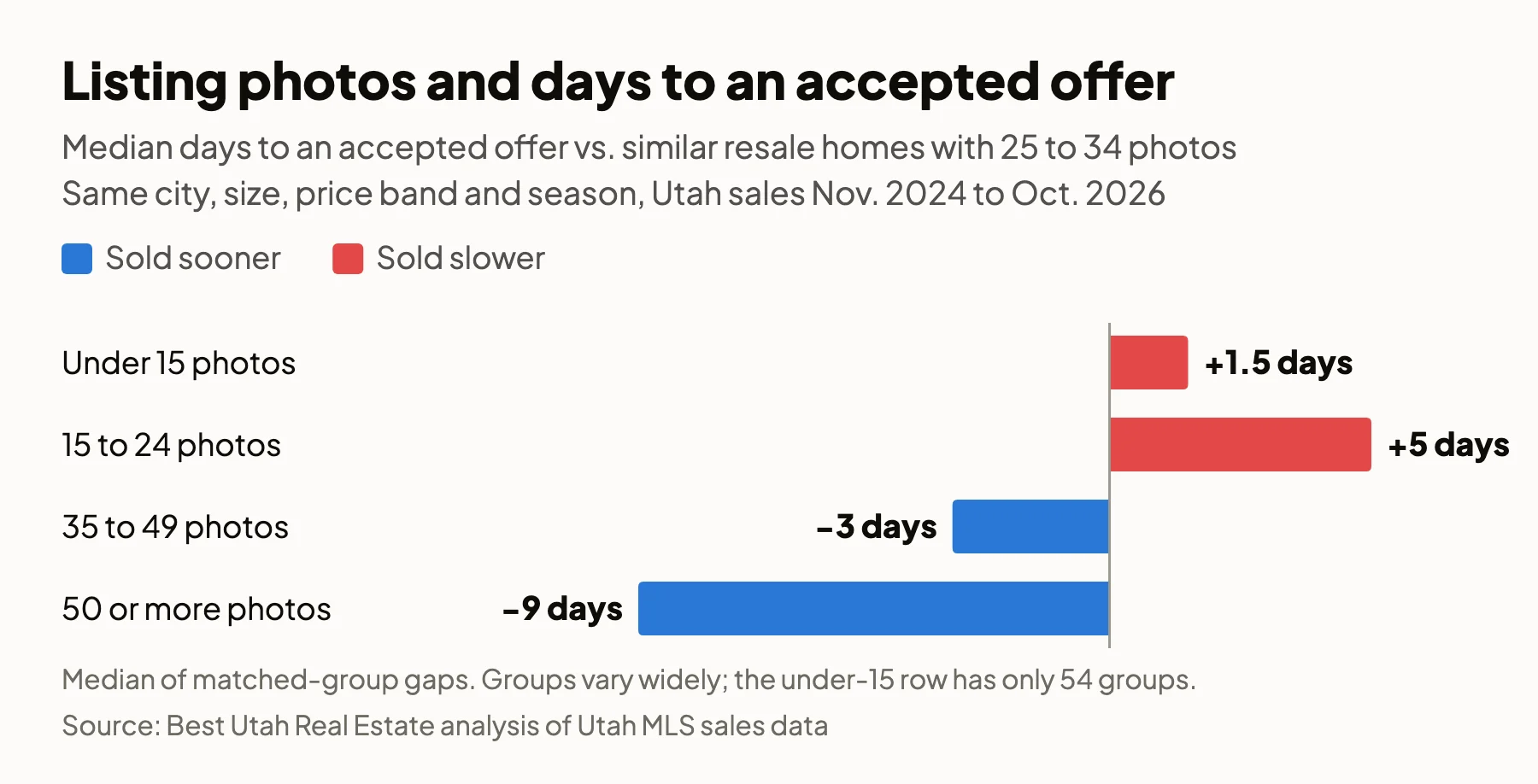
| Photos on the listing (resale, matched vs. 25 to 34 photos) | Matched groups | Sales compared | Median days to contract vs. 25 to 34 photos | Groups where it sold sooner | Sale vs. original list price |
|---|---|---|---|---|---|
| Under 15 | 54 | 489 vs. 1,192 | 1.5 days longer | 24 of 54 | 1.0 point lower |
| 15 to 24 | 498 | 6,256 vs. 7,299 | 5 days longer | 195 of 498 | 0.5 point lower |
| 35 to 49 | 643 | 7,397 vs. 8,653 | 3 days sooner | 364 of 643 | 0.3 point higher |
| 50 or more | 194 | 2,378 vs. 2,751 | About 9 days sooner | 124 of 194 | 0.7 point higher |
Groups are matched on city, size range, price range and season of listing. Days to contract run from the first MLS entry to the accepted offer. Each figure is the median across groups; the ranges are wide, so read them as a tilt, not a promise.
A few things stand out:
- Thin listings went with slower sales. Homes with fewer than 25 photos took a median of about 3 days longer than similar homes with 25 or more (618 groups), sold for about 0.75 percentage points less of their original price and were 2 points less likely to sell above it.
- The fast end is 50 or more photos. Those listings were 7 points more likely to go under contract within a week than similar homes with 25 to 34 photos, and they sold about 0.7 points closer to the original price, roughly $3,500 on a $530,000 home.
- The under-15 row is small. Only 54 groups qualified, so its 1.5-day figure is less reliable than the 15 to 24 row, which tells the same story with 498 groups.
- Raw averages point the other way. Unmatched, homes with 50 or more photos took longer (39 days) because they are mostly expensive homes, which sell slower anyway (median price $805,000). Inside matched groups they sold sooner.
Raw Numbers by Photo Count
| Photos (resale homes, unmatched) | Share of sales | Median price | Median days to contract | Under contract within 7 days | Sale vs. original list |
|---|---|---|---|---|---|
| Under 15 | 3.7% | $365,000 | 35 | 18.6% | 96.3% |
| 15 to 24 | 19.4% | $405,000 | 34 | 18.9% | 97.3% |
| 25 to 34 | 31.1% | $479,000 | 32 | 19.7% | 97.6% |
| 35 to 49 | 28.4% | $578,000 | 33 | 20.2% | 97.2% |
| 50 or more | 17.4% | $805,000 | 39 | 18.3% | 96.0% |
This table shows why matching matters: photo count climbs with price, so a raw comparison mostly measures the price of the home.
Southern Utah vs. Northern Utah
Southern Utah listings carry more photos (a median of 38, against 32 in Northern Utah), and homes there take longer to sell overall. The pattern ran the same way in both regions:
- Northern Utah: homes with 50 or more photos went under contract about 10 days sooner than similar homes with 25 to 34 (95 of 142 groups), and homes with 15 to 24 photos took about 4 days longer (446 groups).
- Southern Utah: homes with 15 to 24 photos took about 16 days longer than similar homes with 25 to 34 (37 of 52 groups slower), and homes with 50 or more went under contract about 6 days sooner, though that row is close to even (29 of 52 groups sooner).
Do Virtual Tours Help a Home Sell?
Not clearly, in our data. About 15% of resale listings had a virtual tour or video link (13% in Southern Utah, 15% in Northern Utah). Across the full two years, homes with a tour link went under contract a median of 1.5 days sooner than similar homes without one, faster in 232 of 444 groups and slower in 210, which is close to a coin flip. Sale price against the original list was the same.
Split by year, tour homes leaned faster in both: about 4 days sooner in the first year (84 of 152 groups) and about 10 days sooner in the most recent 12 months (118 of 195 groups). But matching by month of listing instead of season flipped the two-year result: tour homes took about 6 days longer (slower in 130 of 220 groups), so we would treat tours as unsettled rather than a proven edge. The MLS tour field also mixes 3D walk-throughs, videos and links to listing pages, so it can't tell a full 3D tour from a short video.
Related listings: Utah homes with virtual tours, or narrow it to Salt Lake City, Lehi or St. George.
New Construction
Builders list with fewer photos: new homes had a median of 20, and 29% had fewer than 15, often a rendering, a floor plan and a few finished rooms from a model. New homes also sell on their own timeline, depending on when the house will be finished, so we kept them out of the main results. Inside matched groups of new homes, photo count showed no clear direction: homes with fewer than 15 photos took about 7 days longer than those with 25 to 34 (51 groups), but homes with 15 to 24 photos went under contract about 3 days sooner (72 groups) and homes with 35 to 49 photos about 3 days later (41 groups).
What the Data Can't See
The MLS counts photos; it doesn't judge them. A listing with 60 dark phone photos and one with 30 professional ones look the same here, and staging, twilight shots, drone photos and floor plans aren't recorded. Agents who shoot more photos may also price more carefully or market harder, and the data can't separate those habits from the photo count. The count is also the final one on the record, so photos added while a home sat aren't distinguished from photos posted on day one. Treat these results as what went together, not proof that adding photos speeds up a sale.
What This Means If You're Selling
In our experience, the listings that sell best show every room a buyer will ask about, plus the yard, the garage and the view, which usually lands somewhere between 30 and 50 photos for a typical Utah home. Fewer than 25 photos often leaves buyers wondering what was left out. Past that, quality matters more than count: good light, a clean house and the first five photos doing the work.
Photos are only part of the launch. Our studies on the best day to list a house in Utah, homes that sell in the first week and which price cuts sell Utah homes cover timing and pricing, and our Utah sellers guide walks through the whole process. If you'd like a price before you list, request a free home value estimate, and see the Utah real estate guide for more of our MLS data studies.
About the data: Utah MLS residential sales from both regional feeds, closed November 1, 2024 through October 31, 2026. One row per parcel and close date across the two feeds (the Washington County MLS copy kept in Washington, Iron and Kane counties); fractional-ownership and manufactured or mobile home listings excluded; listings with a sale under 20% of list price dropped. Homes entered within a day of an accepted offer, with no contract date, more than 730 days to contract or no photo count were left out. Photo count is the MLS photo count (filled on 99.2% of Wasatch Front MLS sales and all Washington County MLS sales; it matched the stored photo list on 91% of a 2,000-sale sample). Virtual tour means a branded or unbranded tour link on the listing. New construction means built in the year of sale or the year before. Matched groups are city, size range, price range (by original list price) and season of listing, with at least 5 sales on each side; gaps are medians across groups. Matching by month of listing instead of season gave the same direction for photo counts (homes with 50 or more photos about 7.5 days sooner, 15 to 24 photos about 5 days longer) with fewer groups. The last 12 months alone (November 2025 to October 2026) showed homes with 50 or more photos about 13 days sooner across 55 groups. Figures are aggregates; no single sale is shown.
Frequently asked questions
How many photos should a listing have in Utah?
The typical Utah resale listing had 33 photos in our MLS data from November 2024 to October 2026. Homes with fewer than 25 photos went under contract a median of about 3 days later than similar homes with more, and homes with 50 or more photos about 9 days sooner than similar homes with 25 to 34. In our experience, 30 to 50 photos that show every room, the yard and the garage covers most homes.
Do more listing photos help a house sell faster?
They went with a slightly faster sale in our data, though the gap is small and it isn't proof that photos alone did it. In matched groups of similar homes, listings with 50 or more photos went under contract about 9 days sooner than those with 25 to 34 (124 of 194 groups), and listings with 15 to 24 photos took about 5 days longer (498 groups).
Do homes with more photos sell for more?
Only slightly. Matched homes with 50 or more photos sold about 0.7 percentage points closer to their original list price than homes with 25 to 34, roughly $3,500 on a $530,000 home. Homes with fewer than 25 photos sold about 0.75 points further below their original price.
Do virtual tours help sell a house?
Not clearly. About 15% of Utah resale listings had a virtual tour or video link. Over the two years, homes with one went under contract about 1.5 days sooner than similar homes without, close to a coin flip (232 of 444 groups). Split by year they leaned faster, but the result changed with how we matched homes, so we treat tours as unsettled.
Why do expensive homes have more listing photos?
Bigger, pricier homes have more rooms and features to show. Homes with 50 or more photos had a median sale price of $805,000, against $405,000 for listings with 15 to 24 photos. That is why we compared homes in the same city, size and price range rather than using raw averages.
Do new construction listings have fewer photos?
Yes. New homes had a median of 20 photos, and 29% had fewer than 15, often renderings and a few finished rooms. Inside matched groups of new homes, photo count showed no clear link to how fast they sold.
Kristopher Larson
Realtor® · Air Force veteran · Licensed in Utah & Nevada · Real Broker, LLC
Kris is an Air Force veteran who started in real estate in 2011, has been part of more than 350 transactions and once ran 20 luxury vacation rentals in Copper Rock and Paradise Village. He writes this site's guides from MLS data and public records, and says where every number comes from.
Keep reading
More from the blog
Do Remodeled Homes Sell for More in Utah? MLS Data
Do Relisted Homes Sell for Less? Utah MLS Data
Does RV Parking or a Shop Add Value? Utah MLS Data