Do Golf Course and Open Space Lots Sell for More in Utah?
We matched Utah home sales by county, size, age and lot to see how homes backing onto a golf course, open space or a trail sold, and whether "no rear neighbors" made a difference.

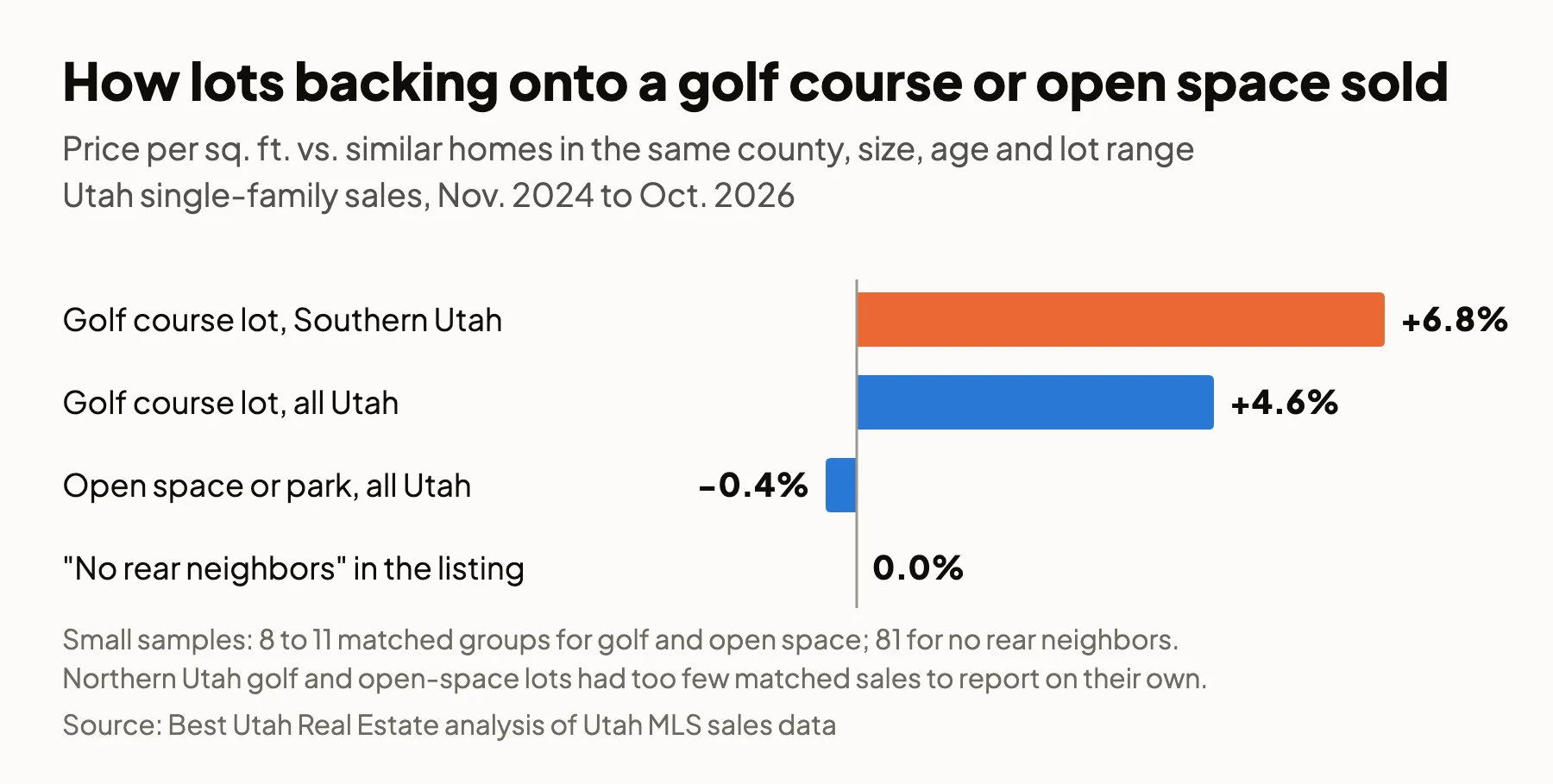
In Southern Utah, homes on a golf course sold for more than similar homes in our MLS data, about 7% more per square foot. Elsewhere the picture is much less clear. Lots backing onto open space or a park showed no clear per-square-foot difference, there were too few trail-side sales to measure, and homes whose listings promised "no rear neighbors" sold for about the same as everything else.
These are small samples, so treat the numbers as a direction, not a price tag. Golf course and open-space lots make up less than 1% of Utah single-family sales, and about half of the golf course lots we found are in Washington County, most of them in St. George. In this post, Southern Utah means Washington, Iron and Kane counties, and Northern Utah means the rest of the state.
What We Compared
We looked at 60,493 single-family home sales in Utah that closed between November 1, 2024 and October 31, 2026, from both MLS feeds we carry. Each home counts once, even when it appeared in both feeds.
A home counted as backing onto a golf course, open space or a trail when the MLS lot field said so ("On Golf Course") or when the listing described the lot that way: backs to, borders, sits on or is adjacent to the course, a fairway, open space, a park, BLM or forest land, or a trail. Listings that only said the home was near, close to or minutes from a course or trail were left out, and so were mentions of a park or trail that was planned or coming soon. We checked a random sample of 20 listings in each group by hand. "No rear neighbors" was tracked as its own group.
The comparison homes had none of those descriptions. To compare like with like, we grouped sales by county, size range, age range and lot size, and compared homes only inside groups with at least five sales on each side. We report both the gap in price and the gap in price per square foot. The per-square-foot figure is the cleaner one here, because golf course homes tended to be noticeably larger than their neighbors even within the same size range.
Golf Course, Open Space and No Rear Neighbors: The Results
| Comparison (sales Nov. 2024 to Oct. 2026) | Matched groups | Sales compared | Groups where the lot sold higher | Price gap | Price per sq. ft. gap | Days to contract |
|---|---|---|---|---|---|---|
| Golf course lot, all Utah | 11 | 93 vs. 2,195 | 8 of 11 | +17.6% | +4.6% | 42 vs. 46 |
| Golf course lot, Southern Utah | 8 | 77 vs. 1,273 | 7 of 8 | +18.8% | +6.8% | 44 vs. 48 |
| Golf course lot, Northern Utah | Too few matched groups (3) to report | |||||
| Open space or park, all Utah | 8 | 46 vs. 4,694 | 6 of 8 | +14.3% | −0.4% | 37 vs. 34 |
| Backs onto a trail | Too few sales (16) to report | |||||
| "No rear neighbors" in the listing | 81 | 887 vs. 30,059 | 40 of 81 | 0.0% | 0.0% | 35 vs. 33 |
Groups are matched on county, square footage range, year-built range and lot size. Days to contract run from the first listing date to the accepted offer, weighted by the number of sales on the lot side of each group.
- Golf course lots in Southern Utah sold for more. In 7 of 8 matched groups the golf course home sold higher, a median 6.8% more per square foot and 18.8% more in price. Most of these are in St. George, where 114 golf course sales turned up, against 21 in Park City and a handful in other towns. A closer match by city instead of county gave a similar answer: 9.1% more per square foot across 8 groups, all in Southern Utah.
- Northern Utah golf course lots are too few to call. Only 3 matched groups, which went the other way. The MLS lot field marks golf course lots far more often in the Washington County feed than on the Wasatch Front, so Northern Utah golf homes are harder to find in the data.
- Open space showed a price gap but not a per-square-foot gap. Homes backing onto open space or a park sold for 14.3% more, but about the same per square foot (−0.4%). A looser match that ignores lot size put the per-square-foot gap near 5%, so any premium for the open space itself looks small, and bigger homes explain most of the price gap.
- "No rear neighbors" made no difference. Across 81 groups and nearly 900 sales, homes whose listings said they had no rear neighbors sold for the same as similar homes, and the home with that line sold higher in 40 of 81 groups, about half.
The last 12 months alone had too few golf course and open-space groups to report separately. For "no rear neighbors" the result held: 1.7% across 38 groups, close to even.
How Common These Lots Are
About 0.45% of Utah single-family sales were golf course lots, 1.7% in Southern Utah against 0.25% in Northern Utah. About 0.4% backed onto open space or a park, and only 0.02% described backing onto a trail. "No rear neighbors" showed up in about 2.2% of listings, at the same rate in both regions. If you want to browse, our Utah golf course homes page lists the current ones, with town pages for St. George, Washington, Hurricane and Park City.
What the MLS Can't See
- Which side of the course. A lot on a quiet fairway and a lot beside a tee box or in range of slices are both "on the golf course" in the data.
- Golf balls, carts and foot traffic. Trails and parks bring people past the back fence. Some buyers want that and some pay to avoid it.
- Views and privacy. Much of what buyers pay for on these lots is the view and the open feeling. Our views study found valley and lake views went with about an 8% higher price, and about 4 in 5 golf course listings in our data also mentioned a view, against 3 in 10 comparison homes. "No rear neighbors" often overlaps with a view lot too.
- Whether the open space stays open. Protected open space and a vacant field zoned for homes look the same in a listing.
- HOA dues. Many golf course homes sit in communities with higher dues. Our HOA study covers how HOA and no-HOA homes compare.
So these gaps show what went together in the sales, not what a golf course or open space is worth on its own.
What It Means for Buyers and Sellers
For buyers, a golf course lot in Southern Utah usually costs more than a similar home a street over. Walk the back of the lot at different times of day before you pay for it. For open space, ask the city or county whether the land is protected or could be built on, and check who maintains it.
For sellers, "no rear neighbors" on its own didn't move the price in our data, so it is better described with what it actually gives the buyer: a view, privacy or a bigger usable yard. In our experience, a clear photo from the back patio does more than the phrase. If lot size is the real draw, our lot size study shows how much bigger lots sold for.
The Bottom Line
Golf course homes in Southern Utah sold for about 7% more per square foot than similar homes, in a small but consistent set of matched groups. Lots backing onto open space showed no clear per-square-foot difference, trail-side lots were too rare to measure, and "no rear neighbors" made no difference at all. Our Utah real estate guide has more of our MLS data studies.
About the data: Utah MLS single-family sales from both regional feeds, closed November 1, 2024 through October 31, 2026. One row per parcel and close date across the two feeds; fractional-ownership and manufactured or mobile home listings excluded; sales under 20% of list dropped. Golf course, open space, park and trail lots identified from the MLS lot field and from listing remarks describing the lot as backing onto, bordering, sitting on or adjacent to the feature; listings that only described a feature as near or nearby, or as planned, were left out. Comparison homes had none of those descriptions and no "no rear neighbors" line. Matched groups: same county, square footage range, year-built range and lot-size range, with at least 5 sales on each side; gaps are medians across groups. A closer match by city gave fewer groups and a similar golf course result. Figures are aggregates; no single sale is shown.
Frequently asked questions
Do homes on a golf course sell for more in Utah?
In Southern Utah, yes in our data. Golf course homes sold for a median 6.8% more per square foot than similar homes across 8 matched groups, and came out higher in 7 of them. Northern Utah had too few matched golf course sales to call.
Does backing onto open space add value to a home?
Not clearly in our data. Homes backing onto open space or a park sold for 14.3% more in price but about the same per square foot (−0.4%) as similar homes, which points to bigger homes on those lots rather than a premium for the open space itself. The sample was small, 8 matched groups.
Do homes with no rear neighbors sell for more?
No. Across 81 matched groups and nearly 900 sales, homes whose listings said they had no rear neighbors sold for the same as similar homes (0.0%), and came out higher in 40 of the 81 groups, about half.
Do homes that back onto a trail sell for more?
We couldn't measure it. Only 16 sales in two years described a lot backing onto a trail, too few to compare against similar homes.
How many Utah homes are on a golf course?
About 0.45% of Utah single-family sales in our data were golf course lots: about 1.7% in Southern Utah and 0.25% in Northern Utah. Most were in St. George.
What should I check before buying a home on a golf course or open space?
Walk the back of the lot at different times of day for golf balls, carts and foot traffic, and check the HOA dues. For open space, ask the city or county whether the land is protected or could be built on, and who maintains it.
Kristopher Larson
Realtor® · Air Force veteran · Licensed in Utah & Nevada · Real Broker, LLC
Kris is an Air Force veteran who started in real estate in 2011, has been part of more than 350 transactions and once ran 20 luxury vacation rentals in Copper Rock and Paradise Village. He writes this site's guides from MLS data and public records, and says where every number comes from.
Keep reading
More from the blog
Do Nightly Rentals Sell for More in Utah Resort Towns?
How Much Cheaper Are Homes Farther From Salt Lake City?
Moving From Texas to Utah: What Changes for a Homeowner's Budget