What Does an Extra Acre Add to a Utah Home's Value? Our MLS Data (November 2026)
We compared 29,640 Utah home sales by lot size within the same ZIP code to see what an extra half acre or acre adds by region, plus 3,198 land sales that show how price per acre falls as parcels get bigger.

A Utah house on 1 to 2 acres sold for about 33% more than a house of similar size and age in the same ZIP code on under a quarter acre (roughly $173,000 more on a typical $530,000 home), in our MLS data for sales that closed from November 2025 through October 2026. A half acre to one acre added about 23% (around $120,000), 2 to 5 acres about 44%, and 5 acres or more about 74%. Each added acre was worth less than the one before (again on that $530,000 home): from 1 to about 2.5 acres an extra acre added roughly $40,000, and past that, closer to $28,000 an acre. Vacant land shows the same pattern in price per acre: lots of a quarter to half acre sold for a median of about $628,000 per acre, while parcels of 20 acres or more sold for about $5,400 per acre.
So more land does raise a home's price, but buyers pay most for the first fraction of an acre. Here is how we measured it, how it varies by region and what to check before buying acreage.
How We Measured It
We looked at 29,640 single-family home sales in Utah that closed between November 1, 2025 and October 31, 2026, from both MLS feeds we carry (the Wasatch Front MLS and the Washington County MLS). Each home counts once, even when it appeared in both feeds.
Bigger lots tend to come with bigger houses (a median of about 3,500 square feet on a half to one acre, against 2,300 on under a quarter acre), so raw medians would overstate the land. To separate the land from the house, we used a statistical model (a regression) rather than a simple median. It compares each sale only with sales in the same ZIP code and adjusts for square footage, build-year range and the month it sold. The percentages below are the price difference left after those adjustments, against homes on under a quarter acre in the same ZIP code: estimates for a typical home, not a promise for any one property. As a check, we compared homes in matched groups (same city, size range and age range, at least 5 sales on each side). Only smaller lots had enough sales for that test, and it lined up: homes on a quarter to half acre sold for a median of about 8% more than matched homes on smaller lots, higher in 215 of 262 groups.
What Lot Size Added to Utah Home Prices
| Lot size | Home sales | Typical lot | Price premium vs. under 1/4 acre | About this much on a $530,000 home | Median days to contract | Median sale-to-list |
|---|---|---|---|---|---|---|
| Under 1/4 acre | 18,311 | 0.17 acre | Base | Base | 34 | 100.0% |
| 1/4 to 1/2 acre | 7,746 | 0.30 acre | +8.7% | +$46,000 | 38 | 99.2% |
| 1/2 to 1 acre | 1,994 | 0.60 acre | +22.6% | +$120,000 | 48 | 98.0% |
| 1 to 2 acres | 938 | 1.12 acres | +32.7% | +$173,000 | 58 | 97.2% |
| 2 to 5 acres | 347 | 2.59 acres | +43.9% | +$233,000 | 72 | 96.0% |
| 5 acres or more | 304 | 8.45 acres | +74.4% | +$394,000 | 72 | 95.8% |
The dollar column is an illustration: each percentage applied to $530,000, the median sale price of homes on under a quarter acre. Your own home's dollar figure depends on its price. Days to contract counts from the listing date to the accepted offer.
Step through the table and the value per added acre drops fast:
- From about 0.17 to 0.30 acre: about $46,000 for an eighth of an acre more.
- From about 0.30 to 0.60 acre: about $74,000 more, close to $250,000 per added acre.
- From about 0.6 to 1.1 acres: about $54,000 more, or roughly $100,000 per added acre.
- From about 1.1 to 2.6 acres: about $59,000 more, or around $40,000 per added acre.
- From about 2.6 to 8.5 acres: about $162,000 more, or about $28,000 per added acre.
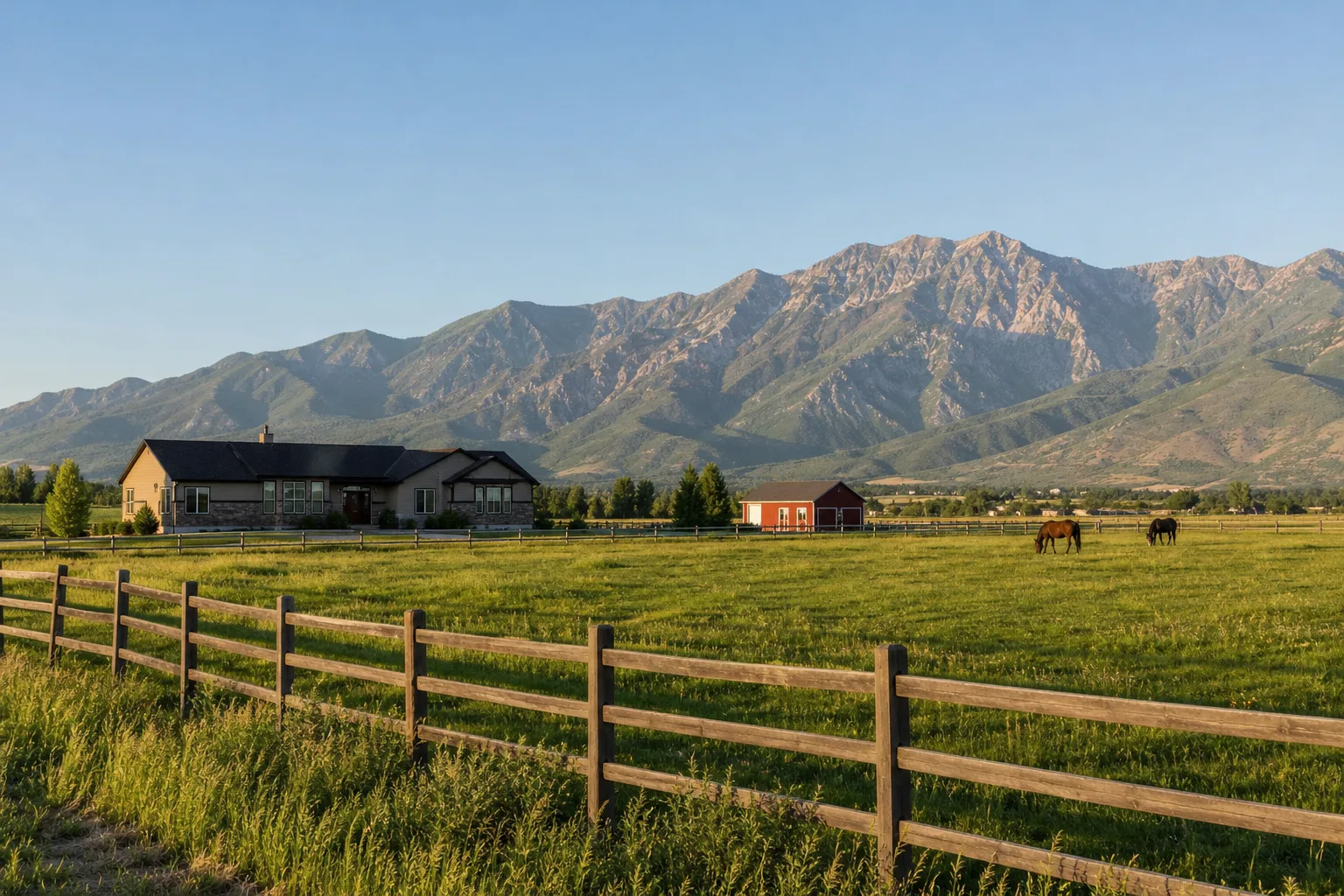
Some of the premium is what comes with the land. Big lots more often have a horse setup: 54% of the 5-plus-acre listings mention horses, livestock, a barn, corral or pasture, against 1% of homes on lots under a quarter acre. Adjusting for those mentions, water-right mentions and bathroom count barely moved the premiums (1 to 2 acres went from 33% to 31%, 5-plus acres from 74% to 71%), and leaving out new construction didn't change them either. What the data can't see, such as views, privacy, the quality of a barn or which street a home sits on, may still explain part of the premium.
Lot Premiums by Region
| Region | Home sales | Median price, under 1/4 acre | 1/4 to 1/2 acre | 1/2 to 1 acre | 1 to 2 acres | 2 to 5 acres | 5+ acres |
|---|---|---|---|---|---|---|---|
| Wasatch Front (Salt Lake, Utah, Davis, Weber) | 19,868 | $549,900 | +7.9% | +23.2% | +36.8% | +58.5% | +96.0% (38 sales) |
| Southern Utah (Washington, Iron) | 3,985 | $505,000 | +14.4% | +34.3% | +37.3% | +41.7% (40 sales) | +61.7% (42 sales) |
| Cache County | 1,081 | $440,000 | +8.2% | +16.2% | +32.5% | +45.2% (20 sales) | +47.3% (20 sales) |
| Summit and Wasatch counties | 1,190 | $1,138,634 | +17.6% | +27.5% | +28.4% | +39.6% | +66.3% |
| Rural counties (all others) | 3,516 | $428,000 | +4.9% | +11.9% | +24.6% | +37.0% | +71.5% |
Premiums are against homes on under a quarter acre in the same ZIP code, adjusted for size, age and sale month. Cells marked with a sales count have fewer than 50 sales, so treat them as rough.
Wasatch Front: acreage kept adding the most value per acre here. An acre to two acres added about $202,000 on a $549,900 base, and from 1.1 to 2.4 acres the gain still worked out to about $90,000 per added acre, so expect every added acre to cost real money, not just the first half acre.
Southern Utah: the jump to a half to one acre lot is the biggest of any region (about 34%), and then the gains flatten. Past one acre, each added acre was worth roughly $15,000 to $30,000. Only about 200 homes on an acre or more sold here, so those bands are less certain.
Summit and Wasatch counties: moving from a small lot to a quarter to half acre carries a big premium (about 18%, or roughly $200,000 on a $1.1 million base), then the curve goes nearly flat between a half acre and two acres. Our guess is that location within the ZIP code (views, ski access, golf frontage) matters more than the lot line here, which this data can't measure.
Rural counties: a small premium for the first step up in lot size, then a steady climb. Past about 2.7 acres, each added acre was worth roughly $21,000.
Vacant Land: Price per Acre Falls as Parcels Get Bigger
We also looked at 3,198 vacant land sales in the same 12 months: residential lots, recreational land, farm land and unimproved acreage. We left out commercial and industrial land, water-right-only sales, multi-lot packages and land sold with a house. Statewide, the median price per acre was about $1.1 million on lots under a quarter acre, $628,000 on a quarter to half acre, $449,000 on a half to one acre, $246,000 on 1 to 2 acres, $45,000 on 2 to 5 acres, $23,500 on 5 to 20 acres and $5,400 on parcels of 20 acres or more. Land sold for a median of 95.9% of its final list price and took a median of 82 days to go under contract.
| County | Land sales | Median lot | Median price | Per acre, 1/4 to 1/2 acre | Per acre, 1 to 2 acres | Per acre, 5 to 20 acres |
|---|---|---|---|---|---|---|
| Salt Lake | 149 | 0.50 acre | $517,500 | $1,258,696 | $764,228 | $58,382 |
| Utah | 344 | 0.50 acre | $395,000 | $915,556 | $434,783 | $90,909 |
| Davis | 72 | 0.46 acre | $450,000 | $1,045,983 | $555,577 | Too few sales |
| Weber | 191 | 0.67 acre | $265,000 | $567,091 | $289,963 | $142,476 |
| Wasatch | 289 | 1.00 acre | $850,000 | $1,416,667 | $767,327 | $148,221 |
| Summit | 198 | 1.27 acres | $960,000 | $808,824 | $734,364 | $127,060 |
| Cache | 179 | 0.68 acre | $196,000 | $512,471 | $200,000 | $53,677 |
| Washington | 366 | 0.41 acre | $258,750 | $714,901 | $277,521 | $76,283 |
| Iron | 331 | 1.25 acres | $95,000 | $322,727 | $36,873 | $16,965 |
| Sanpete | 160 | 2.83 acres | $100,000 | $268,486 | $55,947 | $26,200 |
| Duchesne | 176 | 6.52 acres | $54,000 | $69,767 | $70,238 | $8,798 |
| Uintah | 85 | 1.68 acres | $86,000 | $175,676 | $81,481 | $13,379 |
Every cell has at least 5 sales. The 2-to-5-acre band shows why price per acre alone can mislead: statewide, those parcels sold for a lower median price ($140,000) than 1-to-2-acre lots ($312,500), because many of them are remote desert or range lots, such as the Beryl area of Iron County, where land sold for a median of about $12,500 a parcel. Town matters too: Cedar City land sold for a median of about $201,000 per acre, Heber City land about $864,000.
Statewide estimates such as the $15,000 an acre figure for Utah development land (from USDA, Federal Reserve and listing data) measure something different: one average across land of every size and type. Ours are medians of closed MLS sales split by parcel size, and our rural-county median for 5 to 20 acres, about $14,700 an acre, is close to it.
Bigger Lots Take Longer to Sell
Homes on lots under a quarter acre went under contract in a median of 34 days. On 1 to 2 acres it was 58 days, and on 2 acres or more, 72 days. Sale-to-list price slipped from 100% to about 96%. The share of listings that cut their price, about 40% to 44%, was nearly the same at every lot size, so big-lot sellers weren't cutting more often; they were waiting longer and giving a little more off the list price at the end. In our experience, acreage buyers are a smaller pool who walk the fence lines, call the water company and check the zoning before they write an offer.
What to Check Before You Pay for Acreage
- Water rights or shares. In Utah the water often doesn't transfer just because the land does, and a private well needs a water right. Our guide to Utah water rights and water shares covers what to ask for and how to look a right up with the Utah Division of Water Rights.
- Zoning and minimum lot size. The zone sets whether a parcel can be split, how many animals you can keep and whether you can add a second home. Lehi, for example, sets a one-acre minimum in its A-1 zone. See Utah zoning explained.
- Easements and access. Rural parcels often reach the road over a neighbor's land, and canals or power lines can cross a lot. Read Utah easements explained and our guide to property lines and boundary disputes.
- Septic and well. Rural homes on wells usually have septic too. Have both inspected and pull the well log from the Division of Water Rights well database.
- The listed acreage. The listing agent enters lot size. Check it against the county parcel record and a survey.
The buyers we see happiest with acreage bought it for a use they had already planned: animals, a shop, a garden. As an investment alone, the acres past the first return less per acre than most people expect.
The Bottom Line
An extra acre adds the most on the Wasatch Front and much less in rural Utah, and everywhere the first half acre carries the most value per acre. If you're shopping, start with Utah homes with acreage or Utah land for sale. For more of our own MLS studies, see what a finished basement adds, single-story vs. two-story homes, the cheapest places to live in Utah and the rest of our Utah real estate guide.
About the data: MLS single-family sales and vacant land sales in Utah (Wasatch Front MLS and Washington County MLS) that closed November 1, 2025 through October 31, 2026. One row per parcel and close date, cross-feed duplicates removed; fractional-ownership, manufactured and mobile homes excluded. Home premiums come from a within-ZIP regression adjusting for square footage, build-year range and sale month; dollar figures apply each percentage to the median under-a-quarter-acre price. Lot size is the listing's acreage field. The data can't see views, condition or neighbors, so part of the premium may reflect those. Aggregates only; no single sale is shown.
Frequently asked questions
How much value does an extra acre add to a house in Utah?
In our MLS data for sales from November 2025 to October 2026, a Utah home on 1 to 2 acres sold for about 33% more than a similar-size, similar-age home in the same ZIP code on under a quarter acre. On a $530,000 home that works out to roughly $173,000. Homes on 5 acres or more sold for about 74% more. The value of each added acre shrinks as lots get bigger: between about 1 and 2.5 acres, one more acre added roughly $40,000, and past that about $28,000.
Why is land cheaper per acre on bigger parcels in Utah?
Partly because buyers pay most for the first part of a lot, the part that holds a house, a yard and a driveway, and bigger parcels are more often far from town. Among vacant land sales in our data, the statewide median was about $628,000 per acre for a quarter to half acre, $246,000 per acre for 1 to 2 acres, $23,500 per acre for 5 to 20 acres and about $5,400 per acre for 20 acres or more. A 5-to-20-acre parcel still sold for a median of about $180,000 statewide, ranging from about $650,000 on the Wasatch Front to about $115,000 in the rural counties.
Is a bigger lot worth more on the Wasatch Front or in rural Utah?
It is worth more on the Wasatch Front. In Salt Lake, Utah, Davis and Weber counties, a home on 1 to 2 acres sold for about 37% more than a comparable home on under a quarter acre in the same ZIP code, and between about 1 and 2.5 acres each added acre was worth around $90,000. In Utah's rural counties the 1-to-2-acre premium was about 25%, and past about 2.7 acres an added acre was worth roughly $21,000.
Do homes on acreage take longer to sell in Utah?
Yes. Homes on lots under a quarter acre went under contract in a median of 34 days in our data, homes on 1 to 2 acres in 58 days and homes on 2 acres or more in 72 days. They also sold a bit further below list price: a median of about 96% of list on 2+ acres, against 100% on small lots.
Do water rights come with land in Utah?
Not automatically. Water rights and canal company shares in Utah can be held and sold separately from the land, and a private well needs a water right. Ask the seller which rights or shares are included, get them named in the purchase contract and check them in the Utah Division of Water Rights records. Our water rights guide explains how.
What is the minimum lot size for a house in Utah?
There is no statewide minimum; each city or county sets it in its zoning code. Many Utah zone names carry the number: in Lehi, for example, R-1-8 means an 8,000-square-foot minimum, R-1-22 means 22,000 square feet and the A-1 agricultural zone requires one acre. Check the zone and its lot table with the city before you buy land you plan to split or build on. See Utah zoning explained.
Kristopher Larson
Realtor® since 2011 · Licensed in Utah & Nevada · Real Broker, LLC
Kris has sold Utah real estate since 2011 and been part of more than 350 transactions. He writes this site's guides from MLS data and public records, and says where every number comes from.
Keep reading
More from the blog
Does Listing at $499,900 Instead of $500,000 Help a Home Sell? Utah MLS Data (2026)
Best Time to Buy a House in Utah: Which Months Are Cheapest
What Does a Finished Basement Add to a Utah Home's Value? Our MLS Data (November 2026)