Single-Story vs. Two-Story Homes in Utah: Which Costs More? 2026 MLS Data
Is it cheaper to build up? In 2,496 new Utah home sales, single-story homes sold for about 27% more per above-grade square foot than same-size two-story homes in the same city. The bigger lot and the basement explain much of the gap.

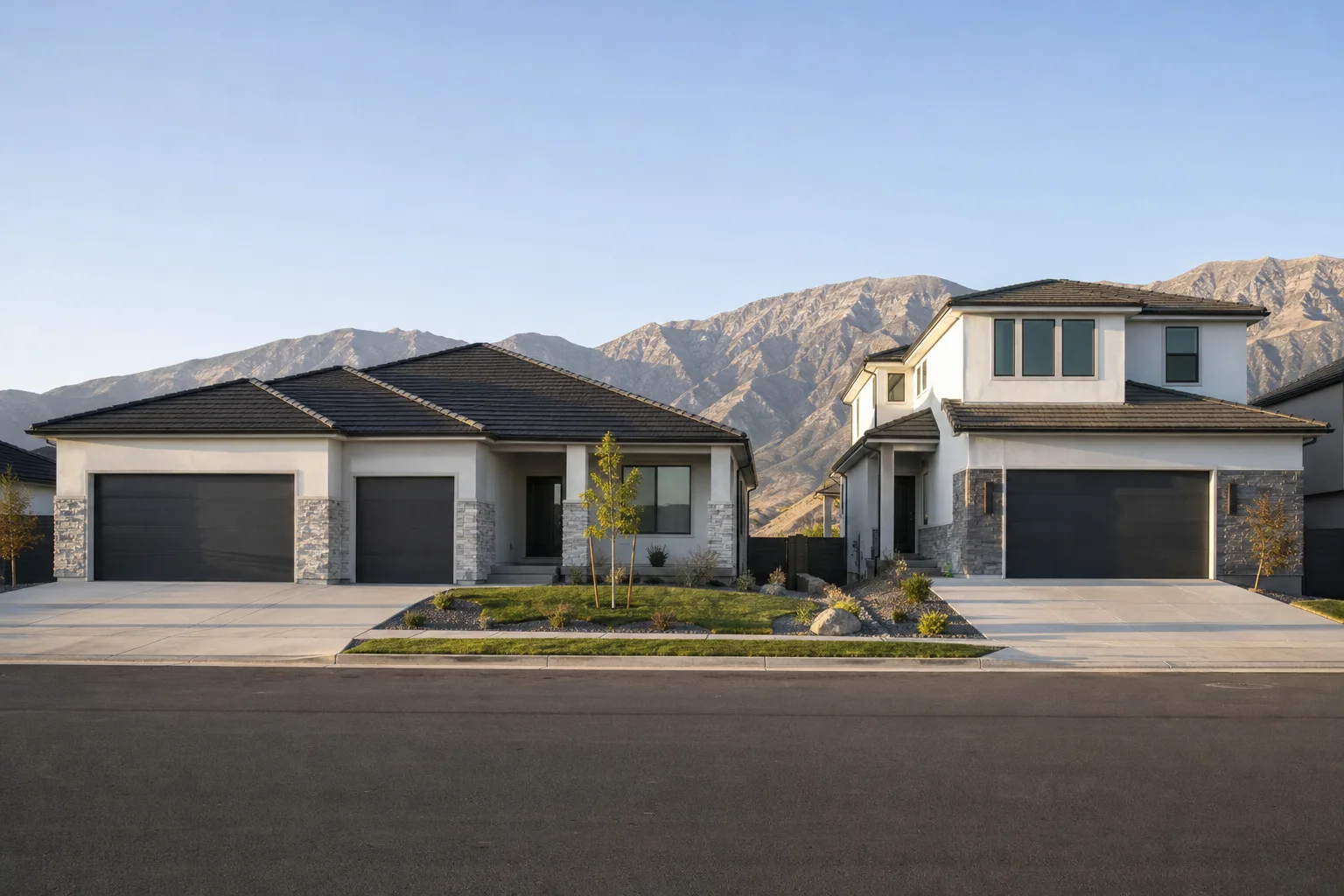
Yes. A single-story house usually costs more per square foot than a two-story house of the same size, both to build and to buy. In Utah, new single-story homes sold for a median 27% more per above-grade square foot than new two-story homes of the same size in the same city from May through October 2026. About half of that gap goes with the bigger lot a one-level home needs, and the gap is smallest on small homes.
Building up is cheaper per square foot because a two-story house puts the same living space on about half the foundation and half the roof. Our MLS can't show what a builder spent, so this post pairs what buyers actually paid for new homes in Utah with what national construction surveys say about where the money goes.
What the Utah MLS data shows
We looked at 11,013 single-family homes sold in Utah from May 1 to October 31, 2026, that the MLS records as either a one-level rambler or a two-story home. That includes 2,496 new homes (built in the year of sale or the year before). We compared price per above-grade square foot, meaning the floors at or above ground, and treated basements separately, because most Wasatch Front ramblers sit on one.
To keep the comparison fair, we grouped homes by city, above-grade size range and whether they had a basement, then compared single-story and two-story sales inside each group (at least three sales on each side). Every one of the 42 groups of new homes came out with the single-story home higher per square foot.
| Above-grade size | New homes, Wasatch Front and north | New homes, Southern Utah | Resale, Wasatch Front and north | Resale, Southern Utah |
|---|---|---|---|---|
| Under 1,400 sq ft | too few | too few | +12% (10 groups) | too few |
| 1,400 to 1,599 | too few | too few | +16% (14) | too few |
| 1,600 to 1,999 | +26% (10) | +32% (4) | +22% (33) | +18% (4) |
| 2,000 to 2,499 | +29% (11) | +41% (3) | +34% (42) | +5% (3) |
| 2,500 to 2,999 | +32% (7) | +23% (3) | +40% (13) | +15% (3) |
| 3,000 to 3,499 | too few | +25% (2) | too few | +46% (2) |
| 3,500 and up | too few | too few | too few | +64% (1) |
| All sizes | +27% (28 groups) | +27% (14) | +23% (114) | +17% (14) |
How much more single-story homes sold for per above-grade square foot than two-story homes, median of matched groups (same city, same size range, same basement yes/no). "Too few" = no matched group, or a single group with fewer than five sales on one side; the All sizes row counts every group. Single-family homes sold in Utah, May through October 2026. Southern Utah = Washington, Iron and Kane counties. Source: Best Utah Real Estate analysis of MLS data.
Three patterns stand out:
- The gap grows with size. On the Wasatch Front, resale ramblers under 1,400 square feet sold for about 12% more per square foot than same-size two-story homes. By 2,500 square feet the gap was about 40%. Small homes come closest: under 1,400 square feet, with lot size matched too, the gap was about 5%.
- Part of the gap is the lot. New ramblers on the Wasatch Front sat on a median 0.25 acre, new two-story homes on 0.15 acre. When we also matched on lot size, the premium for new homes fell to about 15% (16 groups) and for resales to about 17% (74 groups).
- Count the basement and the Wasatch Front gap closes. A new rambler there typically had a 1,850-square-foot basement under it, against about 1,100 under a new two-story. Per total square foot, basement included, new ramblers and new two-story homes both sold for a median of about $200.
What a typical new home looked like
| New homes sold, May to Oct 2026 | Rambler, north | Two-story, north | Single-story, Southern Utah | Two-story, Southern Utah |
|---|---|---|---|---|
| Sales | 583 | 1,396 | 296 | 221 |
| Above-grade sq ft | 1,810 | 2,387 | 1,972 | 2,354 |
| Has a basement | 88% | 81% | 1% | 0% |
| Total sq ft incl. basement | 3,560 | 3,379 | 1,980 | 2,354 |
| Lot size | 0.25 acre | 0.15 acre | 0.22 acre | 0.13 acre |
| Price per above-grade sq ft | $371 | $279 | $301 | $239 |
| Price per total sq ft | $199 | $200 | $299 | $239 |
| Median sale price | $667,266 | $633,990 | $580,145 | $549,900 |
Medians, not matched by city or size. North = every Utah county outside Washington, Iron and Kane. Basement square footage from the MLS level data includes unfinished space. Source: Best Utah Real Estate analysis of MLS data.
Southern Utah is the cleaner test of "building up," because almost no homes there have basements. A new single-story home sold for a median $301 per square foot and a new two-story for $239. Single-level plans are the most common new build there (57% of new sales in our data), and builders tend to put them on larger lots and price them higher. Some of the lowest-priced two-story homes in the data are small-lot homes in resort communities, on lots of a few hundredths of an acre, which pulls the two-story median down.
Single-story homes are also less common here than you might guess. They were 35% of the new homes in our data: 29% on the Wasatch Front and the rest of northern Utah, and 57% in Southern Utah. On the Wasatch Front they were 85% of new homes under 1,400 above-grade square feet but only 19% at 2,000 to 2,499. Nationally, 48.6% of single-family homes started in 2025 were one story, and in the Mountain division, which includes Utah, the share was 41.9%, according to the National Association of Home Builders.
Why a single-story house costs more to build per square foot
It comes down to footprint. An 1,800-square-foot single-story home needs roughly 1,800 square feet of foundation and 1,800 square feet of roof (plus overhangs). An 1,800-square-foot two-story home stacks two floors of about 900 square feet each, so it needs about half as much foundation and roof.
Those are big parts of the bill. In NAHB's 2024 Cost of Constructing a Home survey, published January 2025, foundations were 10.5% of construction cost, roof trusses 3.0% and roofing 3.9%. Average construction cost in that survey was about $162 per finished square foot. A single-story plan roughly doubles the foundation and roof area for the same living space, and it usually needs a wider lot.
Building up isn't free, though. A two-story home adds a staircase, a framed second floor and more wall height, and it may need a second HVAC zone or unit. Neither NAHB nor the Census Bureau publishes a cost per square foot by number of stories, and we didn't find a public, dated source that puts a reliable percentage on the difference, so we won't quote one. The direction is clear; the size of the gap depends on the plan, the lot and the builder.
The basement changes the math on the Wasatch Front
Most Wasatch Front ramblers sit on a basement: 88% of the new ones in our data had one. Footings there already have to reach below the frost line, which Salt Lake City's building design criteria set at 30 inches, and a basement under a wide rambler footprint adds a lot of space that buyers value at well under the main-floor price. That's why the price per total square foot came out even in our data. In Southern Utah, homes are mostly built on slabs, so there's no basement space to even out the comparison.
Which should you build or buy?
- If the budget per square foot matters most, a two-story home gets you more living space for the money, on a smaller lot.
- If you want every room on one level, expect to pay more per square foot and for more land. Ask whether the price includes a larger lot, because that's where much of the premium goes.
- If you're on the Wasatch Front, compare ramblers by total finished space, not just the main floor. Counting the basement, new ramblers sold for about the same per square foot as new two-story homes.
- If you're building on your own lot, get bids on both plans. Lot width, slope and setbacks can rule out a wide single-story footprint before cost comes into it.
For budget numbers in Southern Utah, see how much it costs to build a house in St. George, and for how new homes compare with resales on price and incentives, see our new construction vs. resale data. You can browse single-story homes for sale in Utah and new construction across Utah, or narrow it down to single-story homes in St. George, new homes in Washington, Eagle Mountain and Saratoga Springs. If you're still sorting out styles, here's what makes a ranch-style home (in Utah, usually called a rambler). More data studies are in our Utah real estate guide.
How we ran the numbers
Single-family detached homes sold in Utah, May 1 to October 31, 2026, from the two MLS feeds we receive, with duplicate listings of the same home removed. We used these six months because the MLS floor-level fields are complete only from May 2026. Single-story = listed as a rambler with no second level (Wasatch Front feed) or as one story (Southern Utah feed); two-story = two levels above ground. Split-entry, tri-level, cabin, manufactured and fractional-ownership listings were left out. Above-grade square feet come from the MLS level data; basements are counted separately. New = built in the year of sale or the year before. Matched groups need at least three sales of each type. Sale prices include the lot and the builder's margin, so they show what the market pays, not what a home costs to build.
Frequently asked questions
Is it cheaper to build a one-story or a two-story house?
A two-story house is usually cheaper per square foot to build, because the same living space sits on about half the foundation and half the roof. Foundations were 10.5% of construction cost and roof trusses plus roofing 6.9% in NAHB's 2024 Cost of Constructing a Home survey. A two-story plan adds stairs and a framed second floor, so the savings depend on the plan and the lot, and no public survey puts a reliable percentage on it.
How much more does a single-story home cost per square foot in Utah?
From May through October 2026, new single-story homes in Utah sold for a median 27% more per above-grade square foot than new two-story homes of the same size range in the same city, in our MLS data. When lot size was matched too, the gap was about 15%. For resale homes it was about 23% on the Wasatch Front and 17% in Southern Utah.
Why are single-story homes more expensive?
Three reasons. A one-level home needs about twice the foundation and roof area of a two-story home with the same living space, it needs a wider lot (new ramblers on the Wasatch Front sat on a median 0.25 acre against 0.15 acre for new two-story homes), and many buyers want no stairs, so builders price single-level plans higher.
Is a rambler with a basement cheaper than a two-story house?
Per total square foot, about the same. New Wasatch Front ramblers sold for a median $199 per square foot counting the basement, and new two-story homes for $200. Per main-floor square foot the rambler costs far more ($371 against $279), so compare listings on total finished space, not just the main floor.
Is a single-story or two-story home better for resale?
Single-story homes held a price premium on resale too: resale ramblers on the Wasatch Front and in northern Utah sold for about 23% more per above-grade square foot than same-size two-story homes in the same city, and Southern Utah single-story homes for about 17% more. The premium was small on homes under 1,400 square feet and grew with size. Time to contract was similar for both.
Why compare price per above-grade square foot instead of total square feet?
Above-grade square feet are the floors at or above ground, so they compare the space a buyer pays the most for. Total square feet on the Wasatch Front include the basement, finished or not, and a rambler usually has a much bigger basement than a two-story home. Counting the basement, new ramblers and new two-story homes there sold for about the same $200 per square foot. For build budgets with lots and impact fees, see how much it costs to build a house in St. George.
Kristopher Larson
Realtor® since 2011 · Licensed in Utah & Nevada · Real Broker, LLC
Kris has sold Utah real estate since 2011 and been part of more than 350 transactions. He writes this site's guides from MLS data and public records, and says where every number comes from.
Keep reading
More from the blog
Does Listing at $499,900 Instead of $500,000 Help a Home Sell? Utah MLS Data (2026)
Best Time to Buy a House in Utah: Which Months Are Cheapest
What Does a Finished Basement Add to a Utah Home's Value? Our MLS Data (November 2026)