
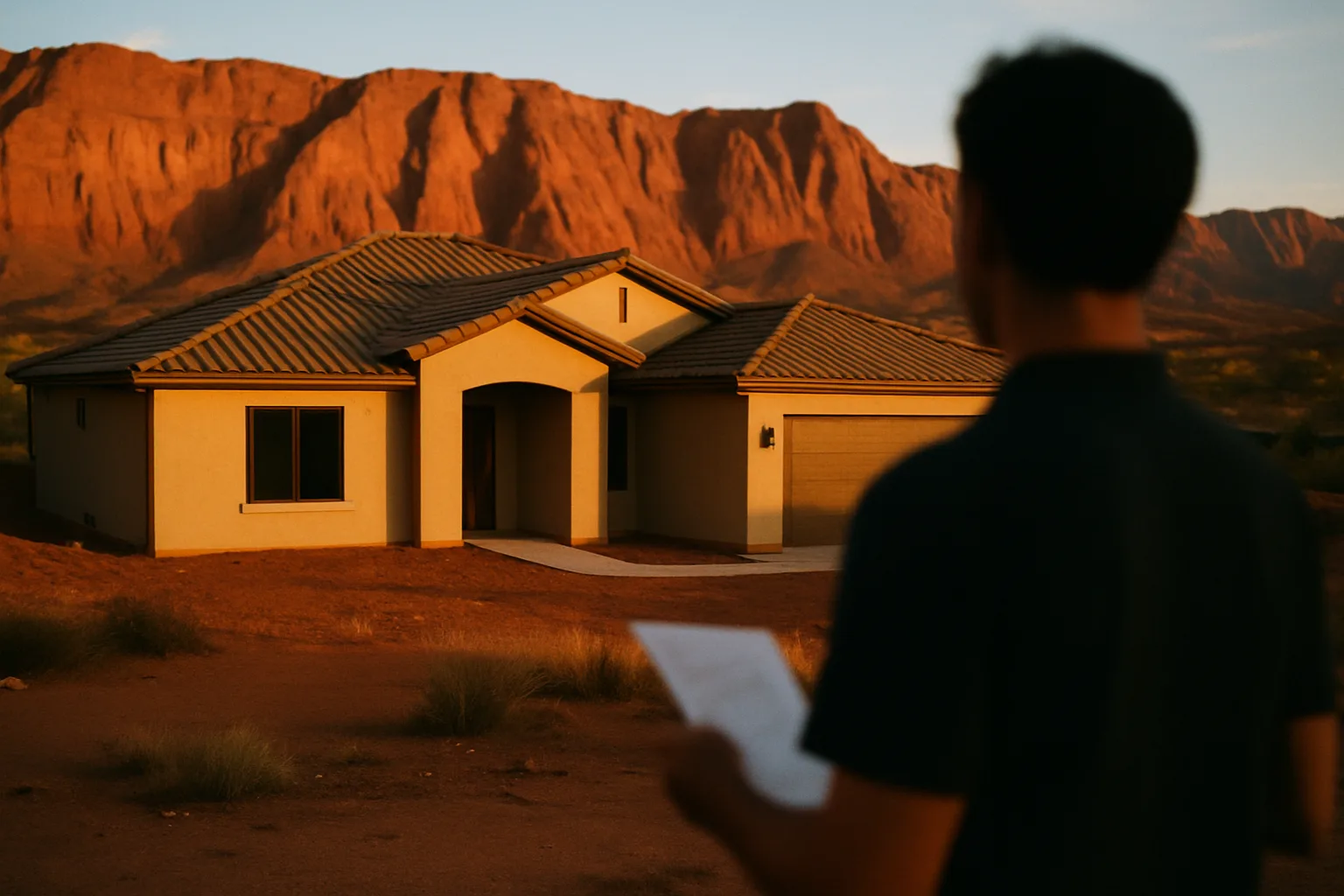
How much does it cost to build a house in St. George Utah
What it really costs to build a house in St. George, Utah: price per square foot, lot prices, $33K+ in impact fees, water rules and a sample budget.
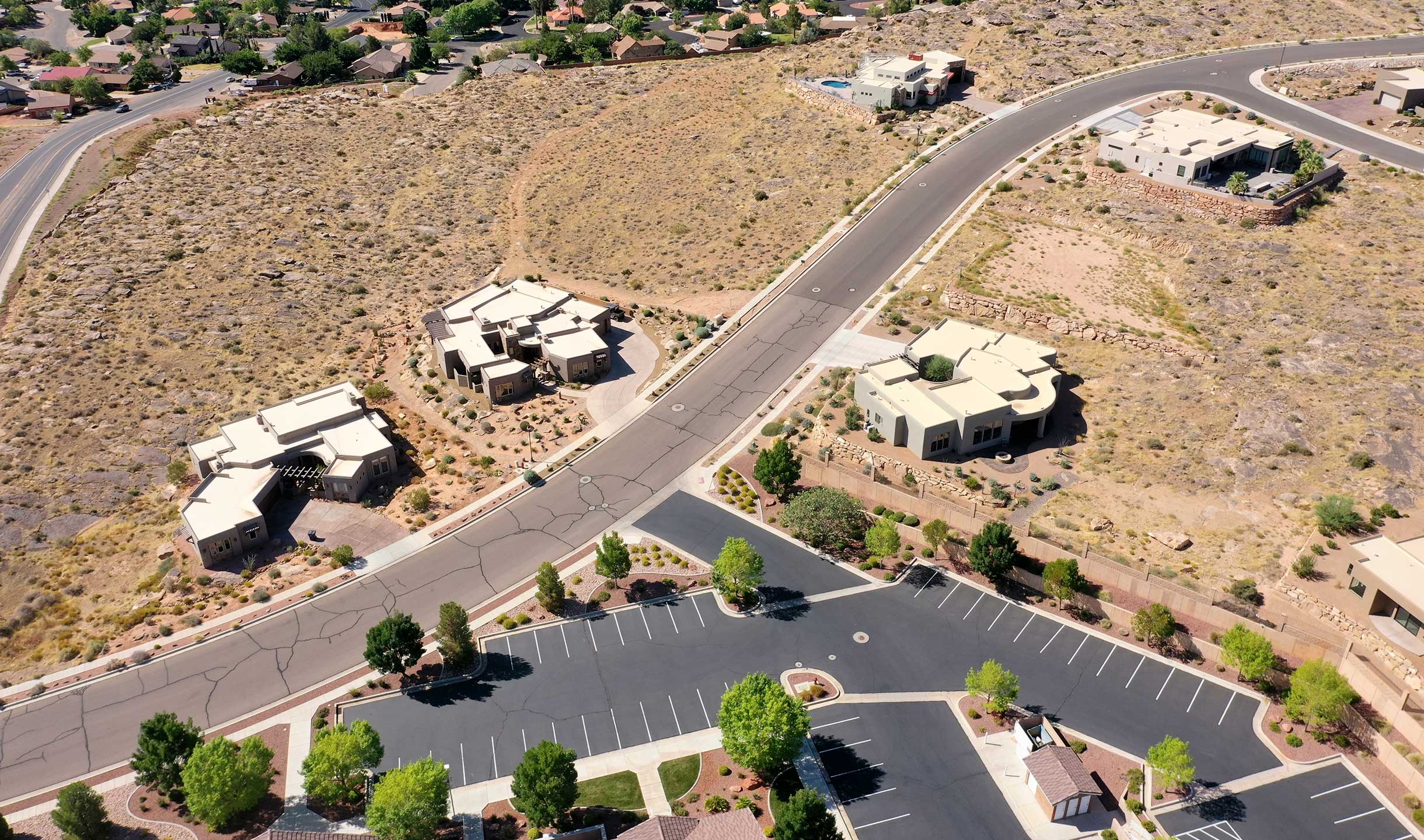
The honest answer to what it costs to build a house in St. George is that the price per square foot is only half the number. A builder's quote covers the house. The lot, the dirt work, roughly $33,000 in water and city impact fees, the yard the city requires, and a reserve for surprises all sit on top of it. This guide walks through each piece so you can build a real budget for St. George, Washington, Ivins, Santa Clara or Hurricane, and then compare it against what homes are selling for right now.
Key takeaways
- New homes listed for sale in St. George are asking a median of $303 per square foot right now, and that price includes the lot.
- The construction-only figure is lower. Census data for 2025 put the median contract price for contractor-built homes in the West at about $177 per square foot, before land. Custom finishes, hillside lots and hard ground push St. George bids above that.
- Fees are a real line item. The Washington County Water Conservancy District charges $17,266 for a standard single-family connection, and St. George's own impact fees add about $16,230.
- Water rules limit lawn to a small share of the lot and require a hot-water recirculation system in most new homes. Design the yard and plumbing around them from day one.
- Building rarely beats buying on price here. It wins when the home you want doesn't exist for sale.
What does it cost per square foot to build in St. George?
There isn't one number, because "cost per square foot" means different things depending on who is talking. A production builder quotes a finished home on a lot it already owns. A custom builder quotes the structure on your lot, from your plans. Those two numbers can't be compared directly. Here is how we break it down when buyers ask.
| Build type | What the number covers | Where St. George sits |
|---|---|---|
| Production (builder's plan and lot) | Home plus lot, builder margin and standard options | New homes for sale ask a median of $303 per sq ft right now |
| Contractor-built on your lot | Construction only; no land | The 2025 median contract price in the West was about $177 per sq ft. Treat it as the low end for a simple plan |
| Semi-custom | A builder plan with layout changes and upgraded finishes | Above the basic figure. Upgrades and roof complexity move it most |
| Custom and luxury custom | Your design, premium materials, hillside or view lots | Well above the basic figure, and the ceiling is set by your selections |
For context across the county, new homes for sale in Washington ask about $272 per square foot, Hurricane $296, Ivins $391 and Santa Clara $334. Those figures update with our listings and include the lot.
The national picture helps explain where the money goes. In the National Association of Home Builders' 2024 cost survey, construction made up 64.4% of a new home's sale price, the highest share since the survey began in 1998, and the finished lot made up 13.7%. In other words, labor and materials are the bulk of the price, and they're the part that has climbed.
Ask how the square footage is counted
Two builders can quote what sounds like the same rate and land tens of thousands of dollars apart. One divides by finished living space. Another counts the garage, or covered patios at a partial rate, or an unfinished basement. Take a hypothetical $660,000 contract. On 2,200 square feet of living space it's $300 per square foot. Add a 600-square-foot garage to the count and the same contract reads as about $236. Get every builder to state in writing what's included in the square footage and what's excluded from the price.
What does the per-square-foot price leave out?
Most budget surprises in Southern Utah come from the lines that never appear in a builder's per-foot rate:
- The lot. A separate purchase, covered below.
- Site work. Grading, excavation, utility trenching, retaining walls and driveway. A flat finished lot with utilities stubbed to the property line is predictable. A sloped lot on rock is not.
- Plans and engineering. A builder's stock plan costs far less than a custom design. Structural and soils engineering are extra either way.
- Impact, connection and permit fees. These run well into five figures in St. George.
- Landscaping. St. George requires front-yard landscaping within a year of occupancy, so it can't be put off indefinitely.
- Pool, casita, RV pad or shop. These are common Southern Utah add-ons, and they're rarely in the base price.
- Contingency. A reserve of about 10% of construction cost is a sensible minimum, and more on a custom or hillside build.
Impact fees and permits in St. George
Fees are paid before the building permit is issued, so they belong in the budget before you close on a lot.
- Regional water impact fee: $17,266 for a standard single-family connection, or $11,413 for a home in the district's "ultra water efficient" program, according to the Washington County Water Conservancy District. The current fee took effect March 2, 2026. It's tied to the lot and can't be transferred.
- City of St. George impact fees: on the city's most recent posted impact fee schedule, a single-family home with a 200-amp power service pays about $16,230. That covers water, wastewater, parks, transportation, police, fire, drainage and power. The city began a new fee study in 2024, so confirm current amounts before you sign.
- Connections and meters: water and power meter charges come on top, and they're higher when the line isn't already at the lot.
- Building permit: priced from the project's valuation, so a larger or more expensive home pays more.
Together that is roughly $33,500 in water and city impact fees for a typical St. George home, before connections and the permit itself. Washington, Ivins, Santa Clara and Hurricane each set their own city fees, so ask the building department of the city where your lot sits for its current schedule.
Water rules shape the yard, the plumbing and the pool
Washington County's growth depends on the Virgin River, and new homes are built under some of the tightest water-efficiency rules in Utah. These affect your design and your budget, not only your water bill. The district's water efficiency standards and St. George's landscape code include:
- Limited lawn. St. George caps lawn at 8% of the lot, up to 1,500 square feet on lots up to 20,000 square feet. No lawn is allowed in park strips, in areas narrower than 8 feet, or on steep slopes.
- Front yard landscaping within a year. At least 30% of the front yard has to be landscaped within a year of occupancy, at least half of it with live plants, plus two water-conserving trees. The landscape plan is recorded against the property.
- Hot-water recirculation. Required in homes over 1,400 square feet unless hot water reaches the fixtures quickly. Our guide to plumbing decisions in St. George new construction covers what that means for layout.
- Smart irrigation. A WaterSense-labeled controller is required, with drip irrigation on everything that isn't lawn.
- The ultra-efficient trade-off. Homes in the district's ultra program pay the lower $11,413 water fee. They give up private lawns and private swimming pools, though community pools and small covered spas are allowed. Those limits are recorded permanently, so find out whether a subdivision is in the program before you buy a lot there.
For the bigger picture on supply and what it means for buyers, see our Washington County water guide for home buyers.
What's under the lot matters
Southern Utah ground is not ordinary soil. The Utah Geological Survey's hazard mapping for the St. George area names flooding as the most damaging hazard and expansive (shrink-swell) clay as the most troublesome building condition. It also maps collapsible soils, gypsum that can dissolve, shallow bedrock, caliche and blowing sand. Each one can change the foundation design or the excavation bid.
- Get a soils report before you close. St. George's building department uses a pre-building geotechnical data sheet, and a soils engineer verifies the foundation work before the home can be occupied. Pay for the report during your lot due diligence, not after you own the problem.
- Rock costs money. Shallow sandstone and lava rock make basements and deep cuts expensive, which is why most homes here are built on slabs or with walkout basements on sloped lots. A flat lot usually builds cheaper as a single-story or two-story home above grade.
- Check the flood picture. Homes near the Santa Clara and Virgin rivers and their washes carry real flood risk, and the January 2005 flood destroyed or seriously damaged 28 homes. Look at flood zones and drainage before the lot, not after.
Our article on site preparation and foundations goes deeper on the dirt-work side.
How much does a lot cost?
Land is often the swing factor in the whole project. Right now about 161 lots and parcels are listed in St. George at a median asking price of $412,500. Washington lists 82 at a median of $377,450, Hurricane 176 at $255,000, and Ivins 29 at $389,000. Those are asking prices that mix small infill lots with view homesites, so size, views, utilities and HOA rules still set the price of any one lot.
A finished lot with water, sewer and power at the street costs more up front but less to build on. A cheaper raw parcel can need utility extensions, long driveways, engineering and grading that erase the savings. Before you buy:
- Confirm utilities, the water connection and the impact fee for that exact lot.
- Read the HOA's architectural guidelines. In some communities, The Ledges among them, the architectural committee must approve plans before you can apply for a city permit, which adds time and sets materials, colors and height.
- Make sure your house plan, garage, setbacks and any pool or casita actually fit.
Many buyers never buy a lot on its own. Production builders in master-planned communities such as Desert Color and Little Valley sell the lot and home together, and custom homesites come up in places like Stone Cliff, Entrada and Kayenta. Our comparison of St. George home builders and new construction communities and our guide to home builders in Desert Color show who builds where.
A sample budget for a 2,200-square-foot home
To show how the pieces add up, here is a planning framework for a 2,200-square-foot single-story home on a finished lot. We use a hypothetical construction budget of $550,000, which is $250 per square foot. That is an illustration of the method, not a quote. The split between trades follows the national averages in the NAHB survey. Your bids will differ, and that's the point of getting them.
| Line item | Share of construction | On a $550,000 build |
|---|---|---|
| Site work (grading, utility trenching, inspections) | 7.6% | $41,800 |
| Foundation | 10.5% | $57,750 |
| Framing (including roof framing and trusses) | 16.6% | $91,300 |
| Exterior finishes (stucco or stone, roofing, windows, doors) | 13.4% | $73,700 |
| Plumbing, electrical and HVAC rough-ins | 19.2% | $105,600 |
| Interior finishes (drywall, cabinets, counters, flooring, paint, appliances) | 24.1% | $132,550 |
| Final steps (driveway, landscaping, clean-up) | 6.5% | $35,750 |
| Other | 2.1% | $11,550 |
| Construction subtotal | 100% | $550,000 |
Then add what sits outside construction:
- Water and city impact fees, connections and the permit: about $35,000 to $40,000 in St. George, depending on the permit valuation and whether lines are already at the lot.
- Plans and engineering, from a modest fee for a stock plan to much more for a custom design.
- A contingency of about $55,000 (10%).
- The lot, at whatever you pay for it.
On this example, the house, fees and reserve come to roughly $640,000 to $645,000 before the lot and the plans. Interior finishes are the biggest line and the one you control most. Tile throughout, a custom cabinet package or a pro-style range can move that line far more than any structural choice.
How long does it take to build a house in St. George?
Plan on roughly a year of construction for a custom home, and longer for a large or complicated one. Design, HOA approval and permitting come before that. A builder's spec plan on a finished lot moves faster. The usual sequence:
- Lot due diligence and design. Soils report, utilities, HOA rules and plans.
- HOA architectural review, where the community requires it.
- Permit and plan review. Utah law sets a deadline for cities to review complete plans for one- and two-family homes, 14 business days under the current code. An incomplete submission resets the clock, so a clean package saves weeks.
- Site work and foundation, with soils and foundation inspections.
- Framing through finishes, then landscaping.
- Final inspection, occupancy and the switch to permanent financing.
Summer heat slows concrete and exterior work, and good subcontractors book out during busy seasons. Build a schedule cushion, and if you're relocating, line up housing that won't fall apart if the move-in date slips. A new construction home inspection at pre-drywall and before closing is cheap insurance on a build this size.
Building it yourself: Utah's owner-builder rules
Utah lets an owner act as their own builder, with limits. Under the state's contractor licensing exemption, a sole owner can build one home a year, and no more than three in five years, on their own property for their own use. Unpaid helpers working under the owner's direction are also exempt. Anyone you pay has to hold the right license. St. George's owner-builder declaration warns that hiring an unlicensed worker is a Class A misdemeanor.
Being your own general contractor can cut the builder's markup. In exchange you take on scheduling, buying materials, managing subcontractors, inspections and the lender's draw process. Two Utah rules matter here:
- Liens. Subcontractors and suppliers file preliminary notices on the State Construction Registry and can lien the home if they go unpaid, even after you've paid the builder. Collect lien waivers with every draw.
- The lien recovery fund is empty. Utah's Residence Lien Recovery Fund was depleted as of June 2026. Homeowners who sign a written contract with a licensed contractor and pay in full still have protections, but paying cash to an unlicensed crew leaves you exposed.
Paying for a build: construction-to-permanent loans
A standard mortgage needs a finished house as collateral, so most builds use a construction loan. The lender releases money in draws as inspected work is completed, and you usually pay interest only on what has been drawn. A construction-to-permanent loan converts to a regular mortgage when the home is finished, so you close once. Lenders want the plans, a line-item budget, the builder's license and track record, and a down payment. Many also want the contingency shown in the budget. If you already own the lot, its equity can often count toward the down payment. Ask early whether the lender allows owner-builders.
Is it cheaper to build or buy in St. George?
For most buyers, buying is cheaper and faster. The latest median sale price in St. George is $500,000, the median list price is $550,000, and there are 1,035 homes for sale with a median of 35 days on the market. Compare that against your all-in build number: lot, fees, construction, landscaping and contingency. The resale home usually wins on price, and it's ready in weeks instead of a year or more. Our St. George housing market report updates these numbers monthly.
Production new construction sits in between. Builders often offer rate buydowns or closing-cost credits on finished or nearly finished homes, so compare the payment, not only the price. Browse new construction homes in St. George, Washington and Hurricane, and read our head-to-head on new construction vs. pre-owned homes in St. George.
Building makes sense when what you want isn't for sale:
- You already own a good lot, or want a specific view or acreage. Browse St. George homes with acreage to see what's out there.
- You want an exact layout: a single level with wide halls, a big shop, an RV garage, or a home oriented away from the afternoon sun.
- You want a casita or guest house. St. George has loosened its rules on accessory dwelling units, and many new homes now include one. See homes with casitas for finished options first.
How to get accurate bids and compare builders
A useful bid describes a specific house. Give every builder the same plans, specs and scope, then compare line by line instead of by the bottom number.
- Square footage basis: living area only, or garage and patios too?
- Inclusions: are site work, utility connections, impact fees, engineering, landscaping and the driveway in the price or excluded?
- Allowances: an allowance is a placeholder budget for items you haven't chosen, such as tile, lighting or appliances. If your pick costs more, you pay the difference. Price the items you care about before signing.
- Change orders: how are changes priced and approved after signing?
- Schedule: what assumptions support the completion date, and what happens if it slips?
- References and license: verify the license with Utah's Division of Professional Licensing, visit recent homes, and ask subcontractors whether the builder pays on time.
Common mistakes that wreck a St. George build budget
- Treating a per-foot rate as the project price and leaving out the lot, fees, site work and landscaping.
- Buying the lot before the soils report and finding rock, expansive clay or a drainage problem afterward.
- Designing a big lawn or pool that the water rules, or a subdivision's ultra-efficient restrictions, won't allow.
- Comparing bids with different square-footage definitions or different allowances.
- Spending the contingency on upgrades instead of keeping it for surprises.
- Skipping lien waivers now that the state recovery fund is empty.
Thinking about building elsewhere in the state? Our guide to building in Utah: risks, rewards and smarter options covers the broader picture. If you're also looking just across the state line, see the cost to build a home in Mesquite, Nevada.
Next steps
The strongest next step is a written budget tied to one lot, one set of plans and two or three comparable bids. We can line that up against current new construction and resale homes for sale in St. George, so you can see where building makes sense and where buying wins. Reach out to Best Utah Real Estate and we'll help you run both numbers.
Posted by Kristopher Larson
Frequently asked questions
How much does it cost to build a house in St. George, Utah?
Start with the lot, then add construction, fees, landscaping and a contingency. New homes for sale in St. George ask a median of $303 per square foot right now, lot included. Construction alone on a simple plan starts lower, and custom homes run well above it. On top of construction, budget about $33,500 in regional water and city impact fees, plus connections, the permit and a reserve of at least 10%.
How much are impact fees for a new house in St. George?
The Washington County Water Conservancy District's regional water impact fee is $17,266 for a standard single-family connection, or $11,413 for homes in its ultra water efficient program (effective March 2, 2026). St. George's own impact fees for water, sewer, parks, transportation, police, fire, drainage and power total about $16,230 on the city's posted schedule. Connection, meter and permit fees are extra. Confirm current amounts with the city before signing a contract.
How long does it take to build a house in St. George?
Plan on roughly a year of construction for a custom home, with design, HOA approval and permitting before that. Utah law gives cities 14 business days to review a complete plan set for a one- or two-family home, but an incomplete submission restarts the clock. A builder's spec plan on a finished lot is usually faster.
Is it cheaper to build or buy a house in St. George?
Buying is usually cheaper and much faster. The latest median sale price in St. George is $500,000. Compare that against your full build budget, including the lot, fees, landscaping and contingency. Building makes sense when you want something that isn't for sale, such as a specific lot, acreage, a shop or RV garage, or a custom layout.
Can I have a lawn or a pool if I build in St. George?
Yes, within limits. St. George caps lawn at 8% of the lot, up to 1,500 square feet on most lots, with no lawn in park strips, narrow strips or steep slopes. Pools are allowed on standard lots. Subdivisions in the water district's ultra water efficient program are different: they pay a lower water fee but permanently give up private lawns and private pools. Check which rules apply before buying a lot.
Can I build my own house in Utah without a contractor?
Yes. Utah's owner-builder exemption lets a sole owner build one home a year, and up to three in five years, on their own property for their own use, with unpaid helpers. Anyone you pay must be properly licensed. You also take on scheduling, inspections, lender draws and lien waivers. That matters more now that the state's Residence Lien Recovery Fund was depleted as of June 2026.
St George, Utah housing market
A quick read on what homes are doing in St George right now — pulled live from the MLS.
Keep reading
More from the blog
How to Choose Large Sliding Glass Doors for Utah Homes
How Home Renderings Help Buyers, Builders and Sellers
Home Inspections Skip Smart Locks and Entry Systems
