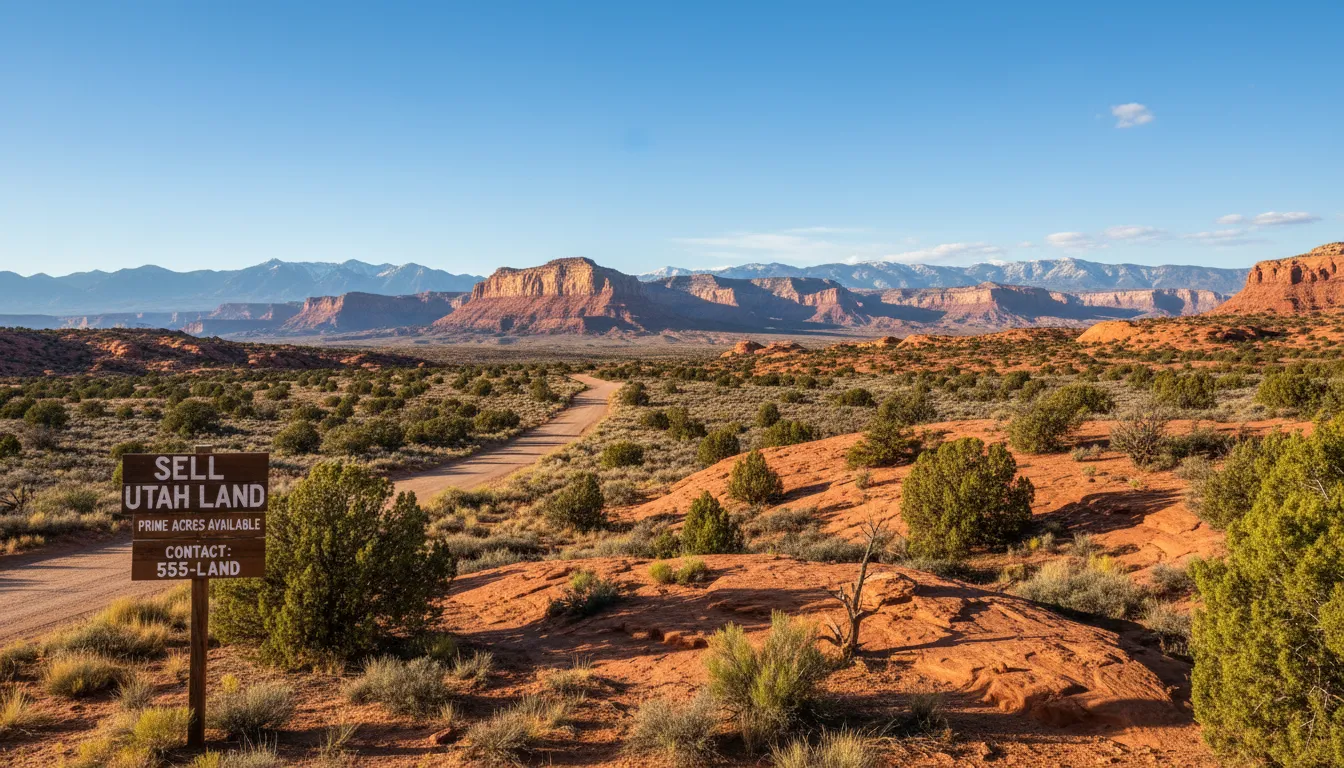
Utah Vacant Land Averages $15,000 Per Acre in 2026, Sitting Above Nevada and Idaho but Well Below California
A data-driven news article examining Utah's 2026 vacant land market, comparing the state's $15,000 per acre average against neighboring states and breaking down the internal pricing factors that drive Utah's wide land value range.
New estimates place Utah's development land at three times Nevada's average and $30,000 per acre below California, with wide internal price variation driven by water rights, infrastructure, and distance from the Wasatch Front.
By SellTheLandNow.com
Vacant land in Utah is averaging $15,000 per acre for development-stage parcels in 2026, according to estimates drawn from USDA land value data, Federal Reserve agricultural credit surveys, and active listing prices across major land marketplaces. The figure positions Utah above both Nevada ($3,500 per acre) and Idaho ($12,000 per acre) among Mountain West states, while remaining well below California's $45,000 per acre average — a spread that reflects meaningful structural differences across the region's land markets.
The $15,000 figure represents the middle tier of Utah's three-part pricing structure. Raw and agricultural land in the state averages $3,150 per acre, while retail-ready or fully entitled parcels in established markets command an average of $95,000 per acre — a range of nearly 30 to one between the lowest and highest land categories. For landowners considering selling land in Utah, understanding where a parcel falls within that range is the starting point for any realistic pricing conversation.
Utah in Regional Context
Placed alongside neighboring states, Utah's land pricing reflects a market with stronger demand fundamentals than its immediate neighbors to the west and north, but without the supply constraints and regulatory complexity that push California values to a different tier entirely.
|
State |
Dev. Land Avg. |
Raw Land Avg. |
Retail Land Avg. |
|
Utah |
$15,000 |
$3,150 |
$95,000 |
|
Idaho |
$12,000 |
$4,400 |
$55,000 |
|
Nevada |
$3,500 |
$1,150 |
$28,000 |
|
California |
$45,000 |
$14,200 |
$185,000 |
Nevada's low average is primarily a function of geography. The vast majority of Nevada's land area is arid and remote, far from the infrastructure corridors around Las Vegas and Reno that support higher-value development. When stripped to its development-ready parcels, Nevada's market is active — but the statewide average is pulled down sharply by the volume of low-utility desert acreage.
Idaho's $12,000 figure sits closest to Utah's, reflecting a comparable dynamic of strong urban-fringe demand — particularly in the Treasure Valley around Boise — offset by rural areas with modest pricing and recovering inventory levels. A key difference is trajectory: Idaho's market is experiencing modest upward pressure in its growth corridors, while Utah's is in a stabilization phase following a steeper appreciation run from 2020 through 2022.
California's $45,000 development average reflects a structurally constrained market shaped by slow entitlement processes, CEQA environmental review requirements, and coastal and metro-adjacent scarcity. Utah does not face the same regulatory environment, but the comparison illustrates the premium that supply-side constraints can add to land values over time.
Internal Price Variation Within Utah
Within Utah, the spread between the cheapest and most expensive land is as significant as the differences between states. The $3,150-to-$95,000 range from raw land to retail-ready parcels is driven by several measurable variables:
|
Factor |
Market Impact |
|
Water rights |
Documented water certificates can separate comparable parcels by tens of thousands of dollars per acre. |
|
Wasatch Front proximity |
Land near the Salt Lake City–Provo corridor consistently outperforms rural and remote parcels. |
|
Utility access |
Year-round road access and utility connections are increasingly treated as baseline requirements by buyers. |
|
Zoning and entitlement |
Parcels with clear rezoning potential or approved development status move faster and attract stronger offers. |
Market Conditions in 2026
Utah's land market is broadly characterized as stable heading into 2026 — a description that reflects normalization rather than contraction. The rapid appreciation that defined 2020 through 2022, driven in part by pandemic-era migration and speculative land buying, has largely run its course. Prices have not reversed significantly, but the rate of gain has slowed to a level more consistent with underlying population and development demand.
One condition supporting current price levels is a lock-in effect among existing landowners. Sellers who acquired parcels during the appreciation period have shown limited willingness to accept prices below their acquisition cost, keeping active inventory constrained and providing a floor for the market even as buyer enthusiasm has moderated.
Demand remains concentrated in specific segments. Build-ready parcels with water certificates, utility hookups, and Wasatch Front access are drawing consistent buyer interest. More speculative raw acreage — particularly in rural counties without near-term development prospects — is moving more slowly and at prices that reflect the reduced appetite for long-horizon land investments.
The Wasatch Front itself continues to post population and employment growth that ranks among the strongest in the Mountain West, providing a durable demand base for residential lot absorption that differentiates Utah from slower-growth neighboring markets.
Data sources: USDA Land Values Summary (2025), Federal Reserve Agricultural Credit Surveys (2026), active listing data from major land marketplaces, and regional development and migration trend analysis. Outlier filtering applied; figures represent median-based estimates.
Keep reading
More from the blog
Gas Line Installation: What Homeowners Need to Know First
Roof Timeline Guide for Buying an Older Utah Home
How to Choose Windows for a Utah Home With a Mountain View