Utah Property Lines and Encroachments: A Guide for Owners and Buyers
How Utah property lines are set and proven: encroachments, surveys, title insurance survey exceptions, boundary by acquiescence, adverse possession, recorded boundary agreements and what buyers should check.

Your Utah property line is the boundary in your deed and the recorded plat or survey, not the fence, hedge or driveway edge you see today. An encroachment is anything that crosses that line, such as a neighbor's fence, shed or driveway on your lot, or yours on theirs. If a fence and the record line disagree, Utah law settles it in a few ways: a recorded boundary establishment between neighbors, a court ruling (quiet title, boundary by acquiescence) or adverse possession, which takes seven years of continuous occupation plus payment of all property taxes on the land.
Boundary problems usually surface during a sale, a fence replacement or an addition. Below: how to find your line, which survey you need, what title insurance covers, and the Utah rules that decide who owns a disputed strip.
This is general information, not legal advice. I'm a real estate agent, not an attorney or surveyor. For a dispute, talk with a Utah real estate attorney and hire a licensed surveyor.
What Is an Encroachment in Real Estate?
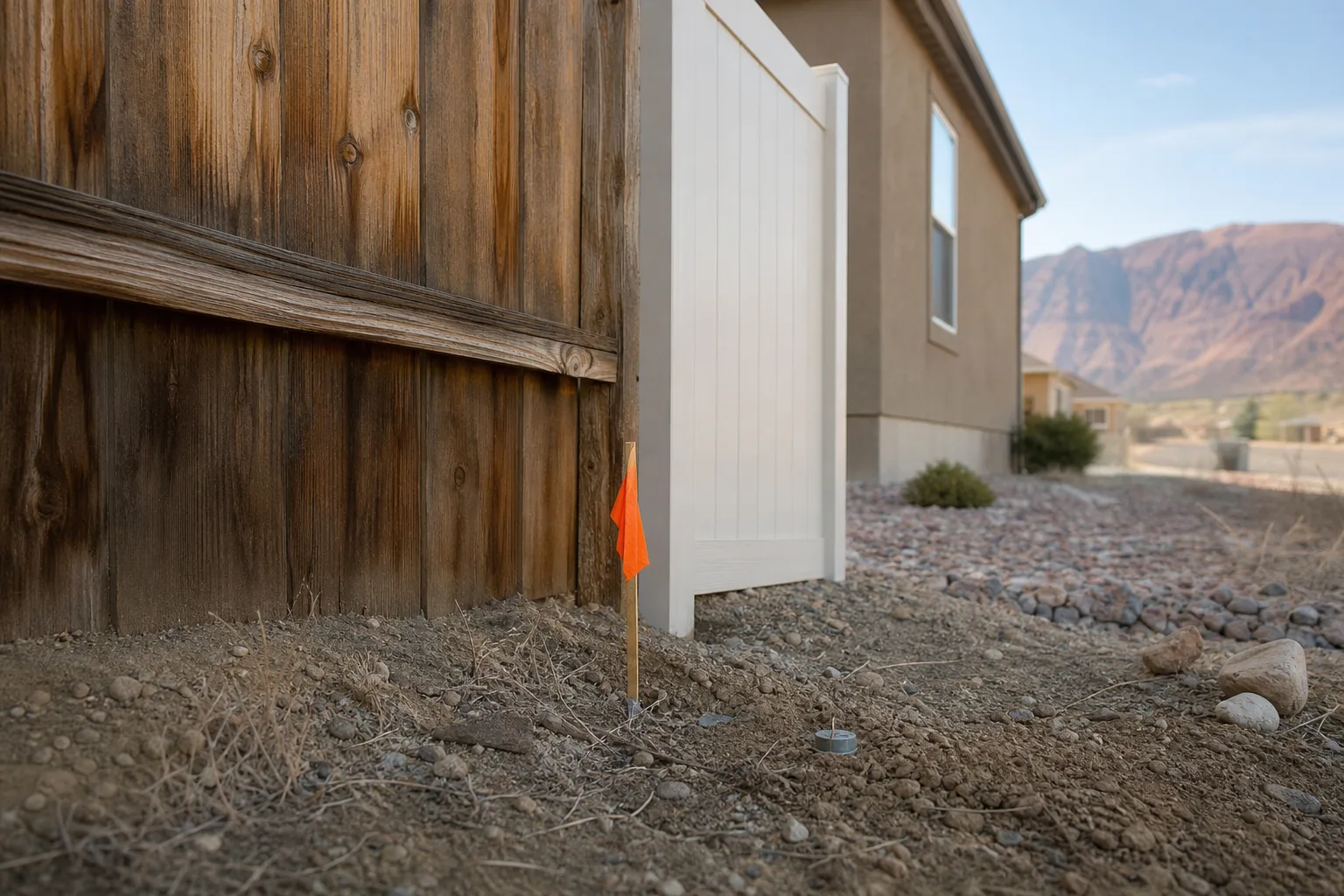
An encroachment is a structure or improvement that sits partly on land the owner doesn't own, or on an easement the owner has to keep clear. Common examples:
- a fence built a few feet off the true line, often decades ago;
- a shed, carport or RV pad that crosses into the side yard next door;
- a driveway or parking strip poured over the line;
- a retaining wall on a sloped lot, which can be expensive to move;
- a deck, patio or landscaping built over a recorded utility easement along the back of the lot.
An encroachment doesn't change ownership by itself, but buyers, lenders and title companies will ask about it. See the definitions of encroachment, easement and quiet title in our Utah real estate glossary.
How Do I Find My Property Line in Utah?
- Start with your deed and plat. Your deed's legal description names your lot and subdivision, or describes the parcel by measurements. The county recorder keeps the deed and the subdivision plat. Our guide to deed vs. title in Utah explains what each document shows.
- Look for a record of survey. Every Utah professional land surveyor who establishes or re-establishes a boundary must file a map of the survey with the county surveyor within 90 days, and that map is a public record (Utah Code 17-73-504). A neighbor's survey from years ago may already show your shared line.
- Find the corner markers. Monuments a licensed surveyor sets must be marked with the firm name or "L.S." and the surveyor's registration number (17-73-504). A pin in the ground tells you a surveyor was there. It doesn't tell you the pin is still where it was set.
- Hire a licensed surveyor when the answer matters. Utah requires a license to practice professional land surveying (Utah Code 58-22-301), and you can check one on the state's license lookup.
County GIS parcel maps are useful for a rough look, but they are drawn for tax purposes and aren't a survey. Blue Stakes 811 marks buried utility lines, not property lines. You still need a free Blue Stakes request before setting fence posts; see our Blue Stakes rules for fences, trees and sprinklers.
Which Survey Do You Need?
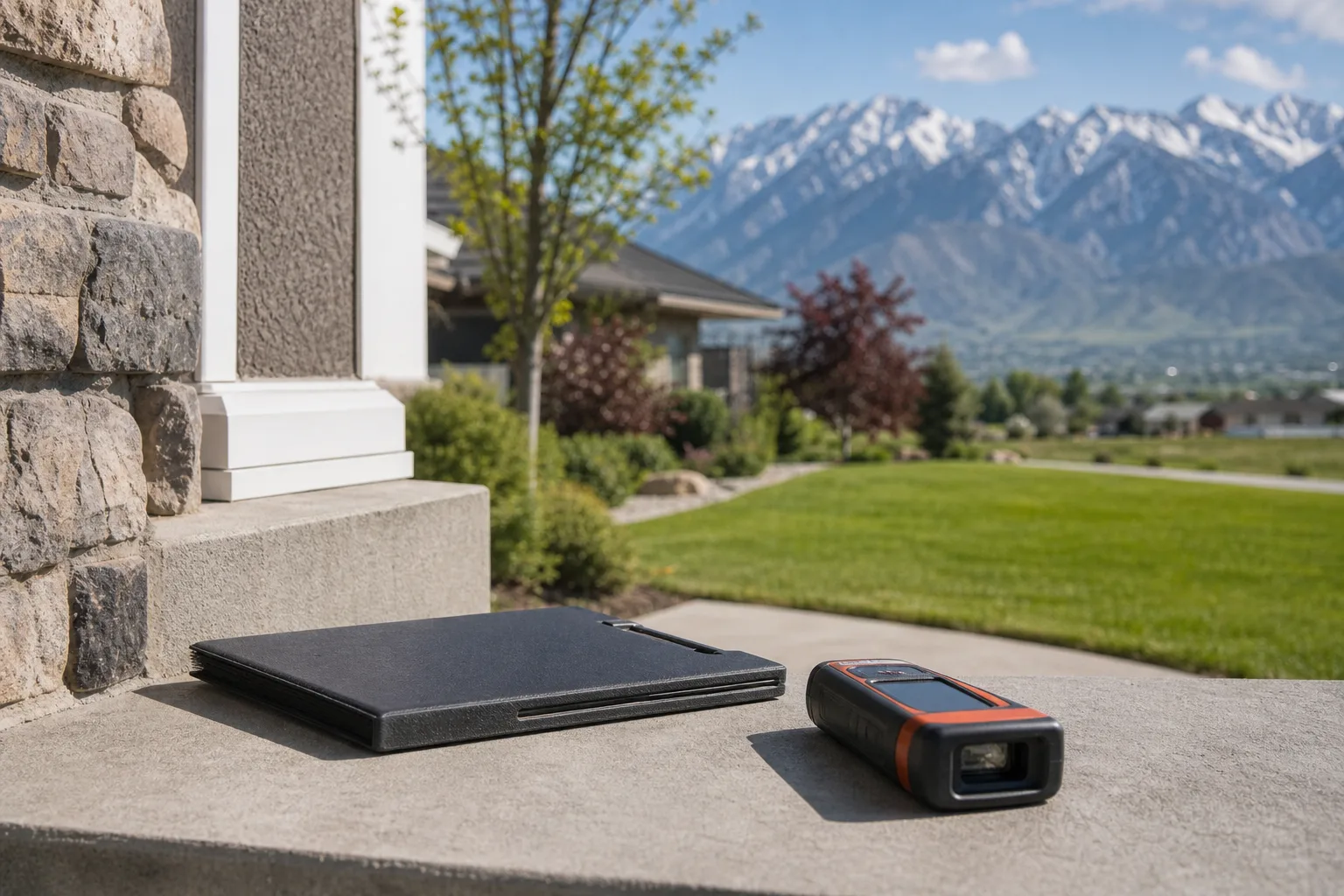
- Boundary survey. The surveyor researches the record, finds or sets the corners, and shows where fences and buildings sit in relation to the line. This is the survey for a fence, an addition, a dispute or a home purchase where the lines look off.
- ALTA/NSPS Land Title Survey. A more detailed survey built to standards adopted jointly by the American Land Title Association and the National Society of Professional Surveyors (current version effective February 23, 2026). Title companies rely on it to remove survey exceptions, so it's common on commercial deals and larger land purchases.
Does Title Insurance Cover Encroachments?
Sometimes. A title search reads recorded documents. It doesn't measure the ground, so an off-line fence won't show up in it. Under the title insurance section of the standard Utah REPC, the seller pays for the buyer's ALTA Homeowner's Policy of Title Insurance. It covers more boundary problems than the standard Owner's Policy, including being forced to remove part of an existing structure that encroaches on a neighbor's land or onto an easement, and a neighbor building a structure onto your land after the policy date (boundary walls and fences excepted). Some of these, including forced removal of an encroaching fence or wall, carry a deductible and a dollar cap.
Read Schedule B of the title commitment closely. Title commitments often list a general exception for matters "that would be disclosed by an accurate and complete land survey." If that exception stays in, the policy won't cover a survey problem. A survey ordered during due diligence is how buyers and title companies deal with it.
What Is Boundary by Acquiescence in Utah?
Boundary by acquiescence is a court-made rule that can turn a long-accepted fence line into the legal boundary. The Utah Supreme Court set out the elements in Staker v. Ainsworth, 785 P.2d 417 (Utah 1990), and the Utah Property Rights Ombudsman summarizes them this way:
- a visible line marked by monuments, fences, buildings or natural features, treated as the boundary;
- occupation up to that line, enough that a reasonable owner would notice;
- mutual acquiescence in the line by the adjoining owners;
- all of this for at least 20 years (Jacobs v. Hafen, 917 P.2d 1078 (Utah 1996)).
Each element must be proven by clear and convincing evidence (Essential Botanical Farms v. Kay, 2011 UT 71). The neighbors don't need a formal agreement. Title to the disputed strip passes once the elements are established (Q-2, LLC v. Hughes, 2016 UT 8). That's why an old fence on a lot you're buying deserves a look: the deed may describe land the seller no longer owns, or land the seller owns past the fence.
How Does Adverse Possession Work in Utah?
Adverse possession lets someone gain title by occupying land against the owner, but Utah sets a hard bar. Utah Code 78B-2-214 says it "may not be established unless it is shown that the land has been occupied and claimed continuously for seven years," and that the claimant and those the claimant took over from "have paid all taxes which have been levied and assessed upon the land." Other rules narrow it further:
- The law presumes the record owner is in possession (78B-2-208).
- Without a deed or judgment to the land, the claim covers only "the land actually occupied" (78B-2-212), and only if it was enclosed by a substantial enclosure, usually cultivated or improved, or irrigated with at least $5 an acre spent on ditches, dams or similar works (78B-2-213).
- No one can gain land that a town, city, county or special district holds for public use, such as a street, alley, park or water conveyance right-of-way, by adverse possession, prescriptive use or acquiescence (78B-2-216). The narrow exception is land the government entity sold.
Occupying the land isn't enough on its own: both the seven years and the tax payments have to be proven.
A related rule applies to use rather than ownership. A prescriptive easement, such as a right to keep using a path or ditch, requires open, notorious and adverse use, continuous for at least 20 years, according to the Property Rights Ombudsman.
What Is a Boundary Line Agreement in Utah?
Neighbors who agree on where an unclear or disputed line belongs can settle it by recording a boundary establishment document with the county recorder (Utah Code 57-1-45). The document must describe the ambiguity or dispute being resolved, include current and new legal descriptions, reference a recorded survey map if one was done (or a drawing if not), carry each owner's signature with an acknowledgment, and, for lots in a recorded subdivision, confirm that the owners were told a plat amendment may be required. Once recorded it fixes the common boundary and conveys ownership to that line, and it doesn't affect any easement recorded earlier. It can't create a new lot. It also isn't a land use approval, so a city or county can still enforce its ordinances if the new line breaks them. Moving a known boundary, rather than clarifying an uncertain one, is a boundary adjustment and needs approval from the city or county.
What to Do About a Neighbor's Encroachment
- Get a boundary survey so the conversation starts from facts.
- Talk with the neighbor and share the survey.
- Put any deal in writing and record it: a boundary establishment, a sale of the strip by deed, or a recorded easement or license for the structure.
- Check your title policy and call the title company if it may cover the problem.
- See a real estate attorney before removing anything or when talks stall. A court can decide ownership in a quiet title action (Utah Code 78B-6-1301). The state Property Rights Ombudsman doesn't resolve boundary disputes between private owners.
Our post on when you need a real estate attorney in Utah covers what to expect.
Buying a Utah Home: What to Check Before Due Diligence Ends
The REPC's Due Diligence Condition lists "the location of property lines" among the items a buyer may verify, and the buyer pays for due diligence unless the contract says otherwise. On the newest REPC form the condition applies only if its box is checked, so confirm it's in your contract. Before your deadline:
- compare fences, sheds and driveways with the plat;
- read every easement and exception in Schedule B of the title commitment;
- ask the seller about past disputes, recorded surveys and boundary agreements;
- order a boundary survey on acreage, older lots, rural parcels without plats, or any lot where the fence looks off;
- check the HOA's CC&Rs and the city code for fence and setback rules; see what CC&Rs are and how they work.
Our Utah REPC guide walks through each deadline. For rural property, browse Utah homes with acreage and land for sale in Utah, where a survey matters most. More buying and property-law guides are in our Utah real estate guide.
Posted by Kristopher Larson
Frequently asked questions
How do I find my property line in Utah?
Start with your deed and the subdivision plat at the county recorder, then ask the county surveyor's office for any recorded map of survey; Utah surveyors must file one within 90 days of establishing a boundary (Utah Code 17-73-504). Corner monuments a surveyor sets are tagged with the firm name or "L.S." and a registration number. To know exactly where the line runs on the ground, hire a licensed professional land surveyor. County GIS maps and fences aren't proof of the line.
How long does adverse possession take in Utah?
Seven years. Utah Code 78B-2-214 requires that the land be "occupied and claimed continuously for seven years" and that the claimant and the claimant's predecessors paid all property taxes levied on it. Without a deed or court judgment, the claim reaches only land that was enclosed, cultivated, improved or irrigated (78B-2-212 and -213), and land a city, county or special district holds for public use, like streets and parks, can't be taken this way (78B-2-216).
Can a neighbor's fence become the property line in Utah?
It can, under boundary by acquiescence. Following Staker v. Ainsworth (Utah 1990), the claimant has to show a visible line such as a fence, occupation up to it, mutual acquiescence by the neighbors in that line as the boundary, and a long period, which the Utah Supreme Court has held means at least 20 years. Each element must be proven by clear and convincing evidence. A fence put up a few years ago on the wrong line doesn't move the boundary.
Does title insurance cover encroachments?
Partly. The ALTA Homeowner's Policy, which the Utah REPC has the seller pay for, covers some encroachment risks, such as being forced to remove part of an existing structure that sits on a neighbor's land or an easement, some with a deductible and a cap. Many title commitments also carry a general exception for matters an accurate land survey would show, and that exception removes survey problems from coverage. Read Schedule B and ask the title officer before your due diligence deadline.
What is a boundary line agreement in Utah?
Utah law calls it a boundary establishment. Neighbors sign and record an establishment document with the county recorder that describes the uncertainty or dispute, gives the current and new legal descriptions, and references a survey map or a drawing (Utah Code 57-1-45). Once recorded, it fixes the shared boundary and conveys ownership to that line. It can't create a new lot and isn't a city or county land use approval.
Who pays for a property survey when buying a home in Utah?
Usually the buyer. The Utah REPC lists "the location of property lines" among the things a buyer may check under the Due Diligence Condition, and due diligence is paid by the buyer unless the contract says otherwise. Buyer and seller can agree to a different split in writing. Order the survey early enough to finish before your Due Diligence Deadline.
Kristopher Larson
Realtor® since 2011 · Licensed in Utah & Nevada · Real Broker, LLC
Kris has sold Utah real estate since 2011 and been part of more than 350 transactions. He writes this site's guides from MLS data and public records, and says where every number comes from.
Keep reading
More from the blog
Utah Zoning Explained: Zones, Variances, ADUs and Grandfathered Uses
Utah Eminent Domain Law: A Homeowner's Guide to Just Compensation
Utah Landlord-Tenant Law: Leases, Deposits, Repairs and Evictions