
What to Know Before Hiring a General Contractor for a Commercial Renovation
Choosing a general contractor for a commercial renovation involves far more than a price comparison. Here's what architects, designers, and commercial decision-makers need to know before signing.
Commercial renovation projects fail in predictable ways.
Timelines slip because no one owned the permitting sequence. Budgets blow out because the contractor priced for the design on the drawing, not for the building conditions behind the wall.
Design intent gets compromised because the general contractors and the architect never established a shared language.
And openings get delayed because the punchlist was treated as an afterthought rather than a managed process.
Every one of those failures is preventable, and most of them trace back to a single decision made before construction begins: contractor selection.
The general contractor you hire for a commercial renovation does not just execute work. They shape the pace, cost, compliance profile, and ultimate finish quality of the project from day one.
Getting that decision right requires knowing what to look for, what questions to ask, and what the answers should sound like.
This guide is written for architects and interior designers working with execution partners, commercial decision-makers commissioning renovation work, and business owners approaching their first major build.
The standards and observations below are drawn from the operational realities of high-complexity commercial construction in dense urban environments, where the margin for procedural error is essentially zero.
-
Verify the scope of services before comparing quotes
The biggest mistake in contractor selection is comparing quotes that are not pricing the same thing.
One contractor may include permits, temporary protection, project management, and coordination. Another may only price the visible construction work. A third may exclude key responsibilities such as MEP coordination or owner-furnished material integration. On paper, the cheaper number looks better. In practice, it often just means the missing costs will appear later as change orders.
Before reviewing proposals, make sure the scope is clearly defined in writing.
What to confirm before comparing bids
- Permit and filing responsibilities
- Temporary protection and site logistics
- Inspection coordination
- Punchlist management
- Owner-furnished material coordination
- Project management and supervision
- MEP coordination responsibilities
A contractor who can explain these responsibilities clearly before pricing is showing the kind of operational discipline the project will require.
The regulatory landscape for commercial renovation adds a further layer of complexity that pricing must account for. Commercial real estate law differs significantly between markets like Utah and New York, and a contractor with deep familiarity with local building departments, permit sequences, and inspection protocols carries a genuine competitive advantage over one who does not.
That advantage should be visible in their pre-construction process, not just their portfolio.
2. Assess design fluency, not just technical capability

Technical competence matters, but on commercial renovations, especially high-end ones, it is not enough.
The more important question is whether the contractor understands design intent. Construction drawings never answer everything. There are always moments where the GC has to interpret details, coordinate tolerances, and protect the visual outcome of the design.
That is where design fluency matters.
Experienced full-service NYC luxury general contractors understand that precision is not an upgrade on a premium project. It is the baseline. Millwork reveals, material transitions, lighting alignments, and finish tolerances all depend on a contractor who understands what the design is trying to achieve, not just what is written on paper.
A simple way to test design fluency
Ask the contractor to review your drawings and identify:
- key coordination issues before mobilization
- areas where tolerances may be difficult to achieve
- likely material substitution risks
- installation sequences that are critical to design intent
A technically capable contractor may only point out structural or MEP conflicts. A design-fluent one will identify those issues and the finish-level decisions that affect the final result.
3. Understand their permitting and regulatory process
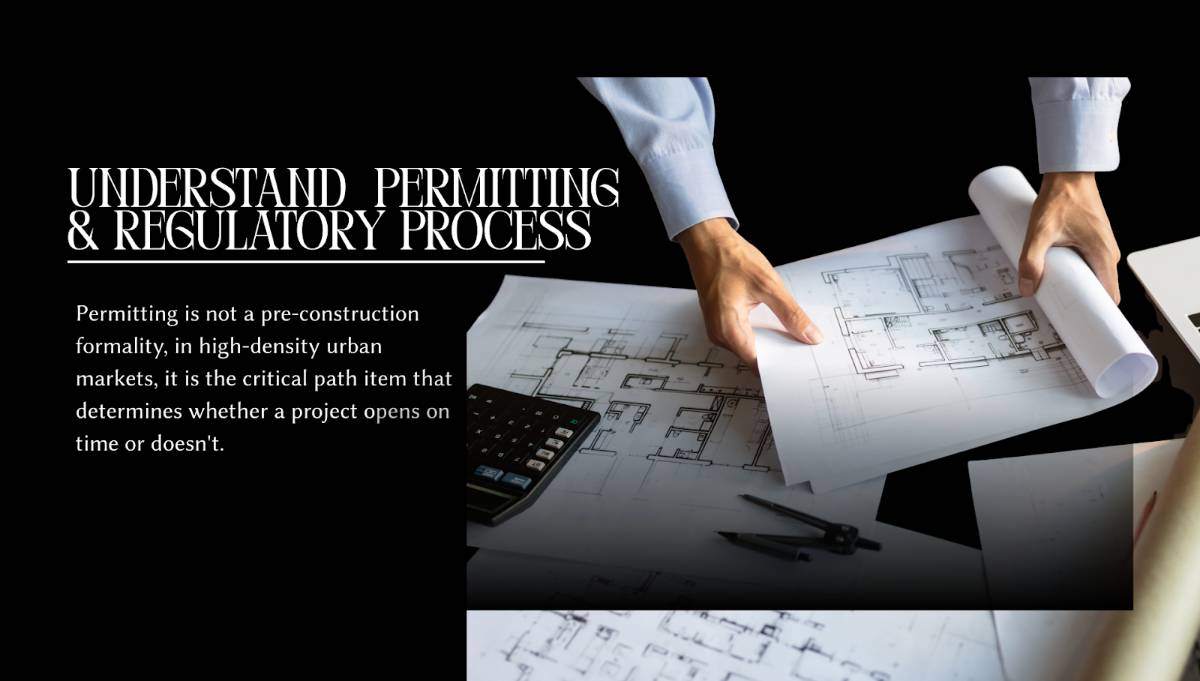
Permitting is not just paperwork. On many commercial renovations, it is the critical path.
A contractor who treats permitting as something that starts after pricing is already creating schedule risk. In dense or highly regulated markets, delays often come not from construction itself, but from approvals, objections, and inspection sequencing.
In New York City, for example, commercial work can involve multiple filing streams and agency coordination requirements. That means the contractor’s permitting process is not a side detail. Obtaining the necessary permits is a part of the project schedule from day one.
Questions to ask about permitting
- Who prepares and files permit-related documents?
- How is coordination handled with the architect or filing professional?
- How are objections tracked and resolved?
- What is the typical timeline from filing to permit issuance?
- How are inspections scheduled and managed?
The answers will tell you whether the contractor has real operational infrastructure or is relying on improvisation.
4. Evaluate subcontractor relationships, not just the General contractor

A general contractor does not personally perform every part of a commercial renovation. They manage the specialists who do.
That means the quality of the finished project depends heavily on the subcontractor network behind the GC. If the millwork installer, MEP trades, finish carpenters, and tile specialists are weak, the project will feel weak, no matter how polished the GC presentation is.
What to ask about subcontractors
- Who are their regular millwork, MEP, and finish-trade partners?
- How long have they worked together?
- Have those subcontractors completed similar projects before?
- Have they worked with the same design team or building type?
A contractor with a proven trade network has a real coordination advantage. The trades already understand each other’s standards, sequence, and communication style. That reduces mistakes and shortens decision-making during construction.
Be cautious of contractors who take on high-end commercial work only occasionally. They may not have the specialty subcontractors needed for detail-driven execution.
5. Clarify project management and communication structure
The person who sells the work is often not the person who runs the job.
That is why you should meet the project manager before signing. In most commercial renovations, the day-to-day performance of the project depends far more on the assigned PM than on the company principal.
This person manages communication flow, trade coordination, RFIs, schedule pressure, inspections, and issue escalation.
Clarify these communication points early
- How often will progress updates be shared?
- What reporting format will be used?
- How are RFIs logged and answered?
- How are potential change orders flagged?
- Who can approve field decisions?
- Who is the day-to-day contact?
These are not minor administrative details. They are the framework that holds budget, design intent, and schedule together.
Projects that finish well do not do so by luck. They are managed with the same level of care as the build itself, much like other interior painting projects that boost property value or renovations where execution discipline affects the final return.
Red flags to watch for before hiring
Even a polished proposal can hide execution risk. Watch for these warning signs:
- vague or incomplete scope language
- unclear permitting responsibilities
- no assigned project manager before contract signing
- weak answers about subcontractor partners
- no clear process for RFIs or change orders
- heavy reliance on verbal assurances instead of documented process
- portfolio examples without explanation of delivery method or complexity
If the contractor cannot explain how they work, they are unlikely to manage complexity well once the project begins.
Questions to ask before signing
Use these questions as a quick vetting tool:
- What exactly is included in your scope?
- What has been excluded from your price?
- Who manages permitting and inspections?
- Who will run the project day to day?
- Which subcontractors do you regularly use?
- How do you handle change orders?
- How do you protect design intent during execution?
- What problems would you flag in these drawings before mobilization?
The quality of the answers matters as much as the answers themselves.
The contractor decision shapes the entire project
Timeline, budget, finish quality, and design fidelity all flow from this choice.
A strong contractor will identify issues early, coordinate clearly, and solve problems before they become expensive. A weak one will turn manageable challenges into delays, compromises, and overruns.
That is why hiring a general contractor for a commercial renovation should never be reduced to a price comparison.
The right contractor brings scope clarity, permitting discipline, design fluency, trade coordination, and project management structure before the first day on site.
That is the standard worth hiring for.
Keep reading
More from the blog
Gas Line Installation: What Homeowners Need to Know First

Roof Timeline Guide for Buying an Older Utah Home

How to Choose Windows for a Utah Home With a Mountain View