Utah County Housing Market 2026: Prices Hold While Sellers and Buyers Both Step Back
Provo-Orem inventory and asking prices ended October 2026 almost exactly where they were a year earlier, while new listings fell 22.8% and pending sales fell 17.3%. Here is what the data shows and what it means for buyers and sellers in seven Utah County cities.
Utah County did not get the 2026 that Salt Lake County got. In October the Provo-Orem metro had 2,876 homes for sale, 17 fewer than a year earlier, and a median asking price of $565,000, down $450. Over the same twelve months Salt Lake's supply of listings grew 17.7% and its median asking price fell 3.5%.
Flat does not mean healthy, though. The supply is level because sellers and buyers both pulled back at the same time: new listings in October were down 22.8% from a year earlier and homes under contract were down 17.3%. The figures below come from Realtor.com data published through FRED, the Federal Reserve Bank of St. Louis database, for the Provo-Orem metro area, along with state and federal sources named in each section.
The Provo-Orem Numbers, October 2026 vs. October 2025
| Measure (Provo-Orem metro) | October 2025 | October 2026 | Change |
|---|---|---|---|
| Median list price | $565,450 | $565,000 | -0.1% |
| Median list price per square foot | $215 | $218 | +1.4% |
| Active listings | 2,893 | 2,876 | -0.6% |
| New listings during the month | 928 | 716 | -22.8% |
| Listings under contract (pending) | 1,109 | 917 | -17.3% |
| Listings with a price cut | 1,298 | 1,228 | -5.4% |
| Median days on market | 62 | 68 | +6 days |
Three longer comparisons put those rows in context.
- Against 2019: the median list price is 41.8% above October 2019 ($398,500) and active listings are 25.8% higher (2,286 then). Pending listings are 48.5% lower: 1,782 in October 2019 against 917 now. There is more to choose from than before the pandemic and about half as many deals in progress.
- Against the peak: the asking-price high was $619,000 in April 2022. October's figure is 8.7% below it. Active listings set their high for the whole series, which starts in July 2016, this August at 2,989.
- Against other Octobers: 917 pending listings is the lowest October count in the series, and 68 days is the slowest October. Price per square foot has barely moved in four years: $212, $215, $216, $215 and $218 in the last five Octobers.
How 2026 Unfolded Month by Month
The year started with more supply than 2025. Active listings were up 10.1% year over year in January and 5.7% in February. Then buyers showed up. Pending listings ran 10% above the prior year in February and 13.7% above in March, when Freddie Mac's weekly average for a 30-year fixed loan sat near 6%, touching 5.98% in the last week of February. By March the inventory gain was gone, and from March through October the year-over-year change in active listings stayed between -3.5% and +4.2%.
The second half went the other way. Pending listings have trailed 2025 in every month since April, and the gap widened as rates rose: Freddie Mac's survey averaged 6.86% in September and 7.33% in October, compared with about 6.25% in October 2025. On a $565,000 home with 10% down, that difference is roughly $366 a month in principal and interest ($3,497 against $3,131). Sellers responded by staying put. New listings were down 11.4% in July, 12.4% in September and 22.8% in October.
Asking prices spent the whole year inside a narrow band, from about $559,800 in February to $572,450 in June.
Why Utah County Is Not Following Salt Lake
The Salt Lake City metro ended October with 4,030 active listings, the most in its series, and a median list price of $559,000. The Salt Lake October report covers that side. One detail stands out: the typical Provo-Orem listing is now priced above the typical Salt Lake listing, yet costs far less per square foot, $218 against $260. That gap implies larger homes on the Utah County side. Several things set the county apart.
Builders are a second market
The Kem C. Gardner Policy Institute's September 2026 housing report counts 6,733 residential units permitted in Utah County in 2025, of which 3,254 were single-family homes. The same report shows 5,311 single-family sales in the county that year. Salt Lake County had 1,141 single-family permits against 7,530 sales. Put simply, a Utah County buyer is far more likely to be choosing between a resale and a builder's home.
Builders have also slowed down. Census Bureau permit files show 3,262 single-unit permits across Utah County from January through September 2026, down 17% from 3,929 in the same months of 2025. Saratoga Springs issued 816 (1,141 a year earlier), Eagle Mountain 551 (864) and Lehi 300 (516). Spanish Fork went the other way, 248 against 119. The 2026 figures are preliminary.
Nationally, the National Association of Home Builders reported that 43% of builders cut prices in October 2026, with an average cut of 6%, and 65% used sales incentives. Those are national survey figures, not Utah County ones, but they describe what a resale seller near a model home is up against.
Jobs are growing, tech is not
Utah Department of Workforce Services figures for the Provo-Orem-Lehi metro show 327,200 nonfarm jobs in September 2026, up 1.8% from a year earlier. The information sector, at 13,100 jobs, was down 1.5%, and professional and business services were flat at 47,700. Health care and education added the most. Utah County's unemployment rate was 3.5%, down from 3.8% a year earlier. Steady paychecks help explain why few owners are forced to sell.
Younger households and two universities
The Gardner report projects Utah County will add about 89,000 households between 2025 and 2035, more than any other county in the state. It also estimates that 94.3% of the county's renter households could not afford the median-priced home in the second quarter of 2026. Demand is there. The monthly payment is the obstacle.
Provo and Orem add something the newer cities lack. Brigham Young University reports 37,874 daytime students for fall 2026 and Utah Valley University more than 48,000 as of fall 2025. That is a large renter population in two cities where very little new single-family housing is being built: Provo issued 102 single-unit permits through September and Orem 53.
What It Means City by City
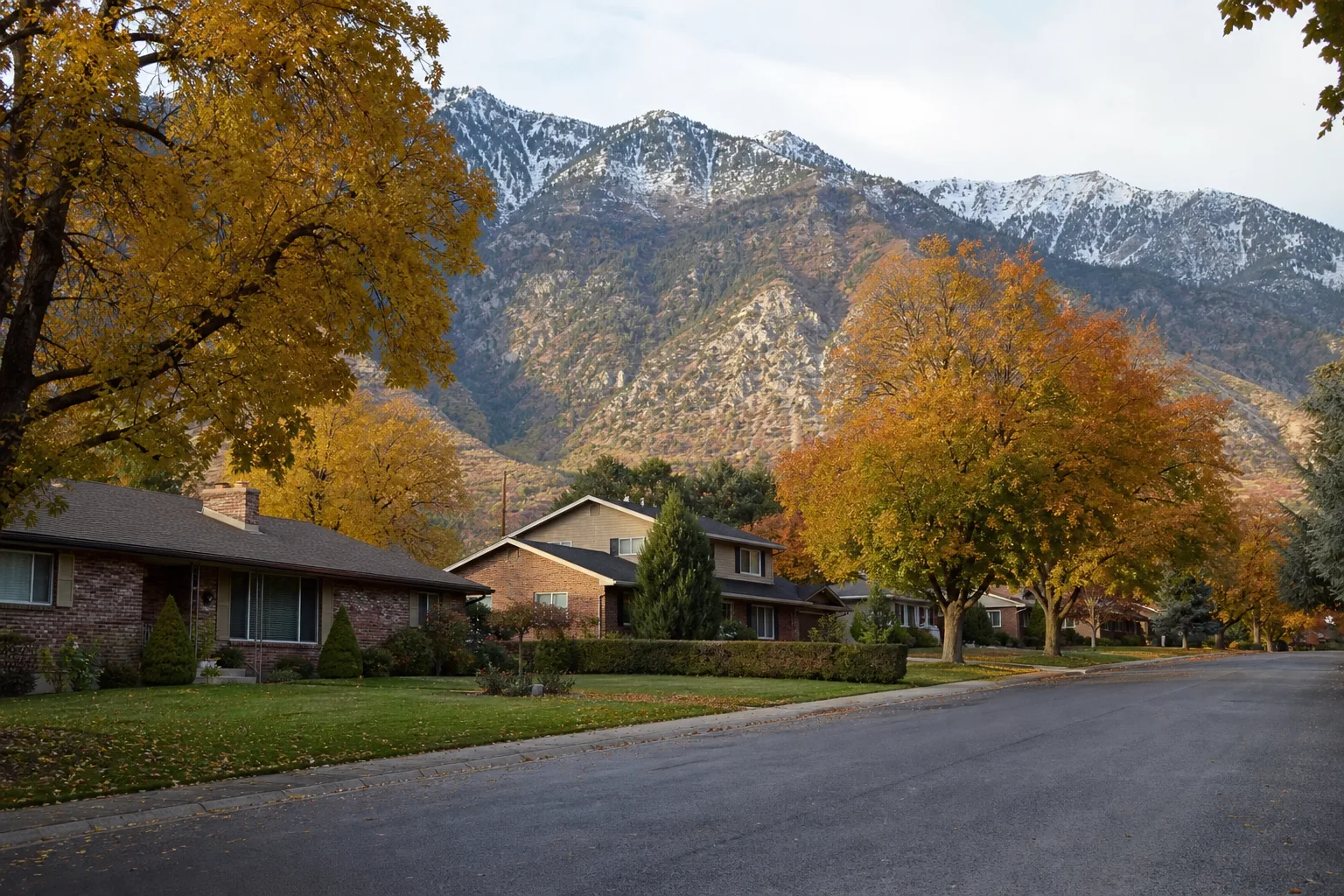
The table shows current MLS figures for each city. They update monthly and are counted differently from the Realtor.com series above, so compare cities with each other, not with the metro table.
| City | Median sale price | Days on market | Sale-to-list | Active listings |
|---|---|---|---|---|
| Lehi | $589,000 | 43 days | 98.0% | 388 |
| American Fork | $472,450 | 40 days | 98.2% | 166 |
| Orem | $486,200 | 39 days | 98.8% | 241 |
| Provo | $542,500 | 34 days | 98.6% | 265 |
| Spanish Fork | $529,900 | 21 days | 98.7% | 274 |
| Saratoga Springs | $490,000 | 37 days | 99.0% | 546 |
| Eagle Mountain | $500,000 | 37 days | 99.0% | 550 |
- Saratoga Springs and Eagle Mountain: the two cities with the most new homes, and the places where resale sellers compete most directly with builders. Permits are down 28% and 36% this year, which points to fewer new homes arriving in 2027. Road relief is on a slower clock: UDOT expects the 2100 North freeway to be under construction through late 2028, and its May 2026 update to legislators lists the Mountain View Corridor extension to State Route 73 for construction from early 2029 to fall 2031, subject to change.
- Lehi: single-unit permits fell 42% through September, the sharpest drop of the group. With fewer new homes started, resales should carry more of the market here in the year ahead. The metro's information sector shed jobs over the year, so sellers should not count on tech hiring to bring in buyers.
- American Fork: modest building (131 single-unit permits through September, 147 a year earlier), so sellers face less builder competition than in the cities to the west, and buyers are mostly choosing among resales.
- Orem and Provo: the least new construction of the group and a large student renter base. Buyers here are mostly choosing among older resales, and landlords are part of the buyer pool.
- Spanish Fork: the one city in the group where building accelerated in 2026. More new homes means more choice for buyers and more competition for sellers of homes built in the last ten years.
For a broader comparison of the cities themselves, see the Utah Valley suburbs comparison.
For Buyers: Where the Negotiating Room Is
- Finished builder homes. A completed house costs a builder interest, taxes and upkeep every month it sits. That is where price cuts, closing-cost credits and rate buydowns tend to show up. Ask for every incentive in writing and compare the net price with nearby resales, not the sticker.
- Listings past 60 days. With a metro median of 68 days, half of the active listings have been waiting longer than that. Of 2,876 listings in October, 1,228 had taken a price cut. A seller who has already reduced once is usually open to a conversation about repairs, closing costs or possession dates.
- The rate itself. A seller-paid or builder-paid buydown can be worth more per month than the same dollars off the price. Have a lender run both versions.
- State help on new homes. Utah Housing Corporation's First-Time Homebuyer Assistance Program offers up to $20,000 toward a down payment, closing costs or a permanent rate buydown. It applies only to newly built homes, with a $450,000 maximum price that can vary by location and home type. Confirm with a participating lender that funds are still available.
Leverage has limits. Asking prices have not fallen, and well-priced homes in good condition still sell.
For Sellers: Competing With a Model Home
- Price against the builder's net, not the brochure. If a builder down the street is covering closing costs and buying down the rate, a buyer will do that math. Price per square foot in the metro has been flat for four years, so an asking price built on 2022 expectations will sit.
- Sell what a new home lacks. A finished yard, fencing, window coverings, a finished basement, mature trees and no construction traffic are real money to a buyer pricing out a new build. List them.
- Offer the same tools. A credit toward a rate buydown or closing costs often costs less than a price cut and speaks directly to the payment problem.
- Get the first two weeks right. Fewer homes are coming on the market, which helps a new listing stand out. Fewer buyers are signing contracts, which punishes one that starts too high. The reasons listings stall are laid out in this analysis of why Utah homes are not selling.
What to Watch Next
- Mortgage rates. Freddie Mac's weekly average eased to 7.18% on Nov. 5 after reaching 7.40% in mid-October. The spring showed how quickly Utah County buyers respond when rates approach 6%.
- Pending listings in the winter data. If contracts stay 15% or more below last year while new listings recover in spring, inventory would start to climb the way it has in Salt Lake. If sellers keep holding back, the standoff continues.
- Full-year permits. A second year of lower permits in Saratoga Springs, Eagle Mountain and Lehi would mean less builder competition for resales in 2027 and 2028.
- Information-sector jobs. The monthly Workforce Services report shows whether the tech payroll decline is leveling off.
None of these settles the direction on its own, and nobody knows where rates will be in March. What the data does show is a county where prices have held, activity has thinned, and the advantage goes to whichever side is better prepared. Current listings for every Utah County city are on Best Utah Real Estate.
Sources: Realtor.com housing data published through FRED (Federal Reserve Bank of St. Louis), October 2026; Freddie Mac Primary Mortgage Market Survey; U.S. Census Bureau Building Permits Survey, year-to-date place files for September 2026 and 2025; Kem C. Gardner Policy Institute, State of the State's Housing Market: 2025-2026; Utah Department of Workforce Services; National Association of Home Builders; Utah Housing Corporation; UDOT; Brigham Young University; Utah Valley University.
Posted by Kristopher Larson
Frequently asked questions
Are home prices falling in Utah County in 2026?
Asking prices are flat. Realtor.com data published through FRED shows a median list price of $565,000 in the Provo-Orem metro in October 2026, down 0.1% from a year earlier and 8.7% below the April 2022 high of $619,000. Price per square foot was $218, up 1.4% over the year.
How many homes are for sale in the Provo-Orem area?
The Provo-Orem metro had 2,876 active listings in October 2026, almost exactly the 2,893 of October 2025 and about 26% more than in October 2019. The count peaked at 2,989 in August 2026, the highest in a series that begins in 2016.
How is the Utah County market different from Salt Lake County's?
Salt Lake's supply grew and its asking prices slipped: active listings were up 17.7% year over year in October 2026 and the median list price was down 3.5%. In the Provo-Orem metro both figures were essentially unchanged, because new listings fell 22.8% while pending sales fell 17.3%. Utah County also has far more new construction relative to resales.
How long do homes take to sell in Utah County?
The median listing in the Provo-Orem metro had been on the market 68 days in October 2026, six days longer than a year earlier and the slowest October since the Realtor.com series began in 2016. City figures from the MLS differ: Lehi's current median is 43 days and Provo's is 34 days.
Is it a good time to buy a home in Utah County?
Buyers have more room to negotiate than in recent years, mainly on completed builder homes and on listings that have been for sale more than 60 days. Prices have not dropped, though, and Freddie Mac's average 30-year rate was 7.33% in October 2026, about a point higher than a year earlier. The decision depends on the monthly payment a household can carry, not on timing the market.
Are builders slowing down in Saratoga Springs, Eagle Mountain and Lehi?
Yes. Preliminary Census Bureau permit data for January through September 2026 shows 816 single-unit permits in Saratoga Springs, down from 1,141 in the same months of 2025, 551 in Eagle Mountain, down from 864, and 300 in Lehi, down from 516. Spanish Fork moved the other way, from 119 to 248.
Keep reading
More from the blog

Utah Property Taxes Are Due Nov. 30, 2026: How to Pay, What Late Costs and What 2026 Buyers Should Check
Utah's 35,000 Starter Home Goal Is a Quarter Done: What First-Time Buyers Can Use in 2026
Half of Young Utahns Own a Home in 2026, and 91% of Renters Can't Afford One: How First-Time Buyers Still Get In