Small Closet Organization on a Budget: Measure, Double the Rods, Slim the Hangers
Measure first, add a doubler rod, switch to slim velvet hangers and use shelf dividers and the door. Rental-friendly small closet fixes that cost little.
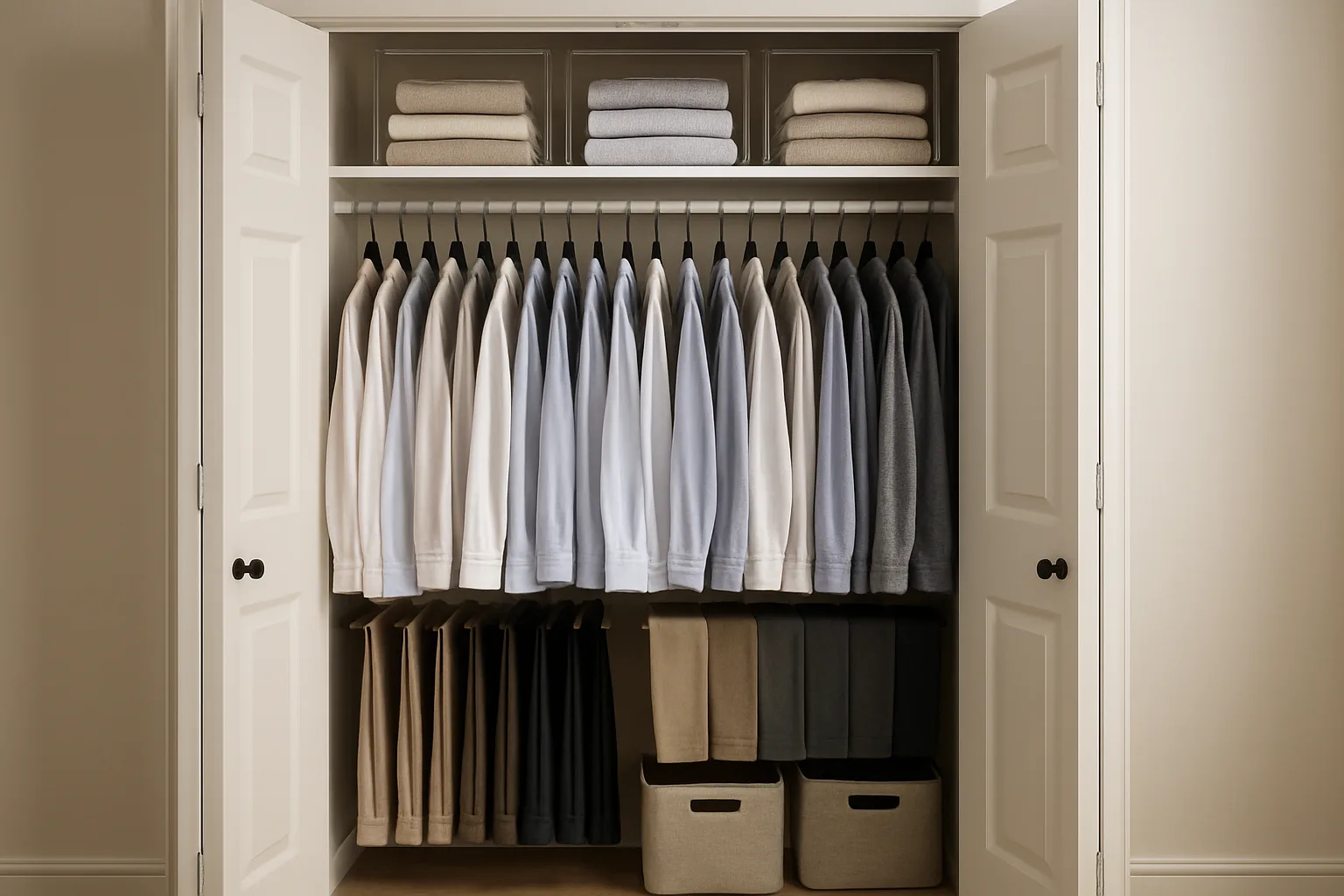
A small closet usually fails for the same reason: one rod, one shelf and a lot of empty air. The clothes get crammed into the top half while the floor collects shoes and bags and the space above the shelf goes unused. Fixing that does not require a custom system. A tape measure, a second hanging rod, matching slim hangers and a few dividers recover a surprising amount of room, and nearly all of it works in a rental because it goes up without drilling.
This guide covers how to measure, how to split a closet into zones, and which inexpensive tools solve which problem.
As an Amazon Associate, Best Utah Real Estate earns from qualifying purchases.
Quick verdict: the best budget upgrades, in order
- Matching slim hangers. The cheapest way to gain rod space. The Amazon Basics slim velvet hangers (50-pack) are a widely sold option with a very large review base.
- A hanging doubler rod under the existing rod, for shirts, folded pants and skirts.
- Shelf dividers so folded stacks stop toppling into each other.
- Back-of-door storage for shoes, accessories or cleaning supplies.
- Bins on the floor and above the shelf for out-of-season items.
Step 1: Empty it and measure
Take everything out first. It is the only way to see the real space and to notice items that no longer belong there. Then measure and write down:
- Interior width wall to wall, and the width of the door opening (often narrower).
- Depth from the back wall to the door frame.
- Rod height to the center of the rod, and the height of the shelf above it.
- Clearance above the shelf to the ceiling.
- Door thickness and swing if adding an over-the-door organizer.
Measuring before buying is the step people skip. A cube organizer that is two inches too tall blocks the hanging space, and a doubler rod that is too wide will not fit between the side walls.
Typical closet dimensions
| Measurement | Common guideline | Why it matters |
|---|---|---|
| Closet depth | About 24 inches | Most adult hangers are about 17 inches wide, so shallower closets force hangers to sit at an angle |
| Rod position | About 12 inches from the back wall to the rod center | Centers clothes so they clear the back wall and door |
| Single rod height | About 66 inches | Clears dresses and long coats |
| Double hang, upper rod | About 80 to 84 inches | Shirts and jackets |
| Double hang, lower rod | About 40 to 42 inches | Shirts, folded pants and skirts |
| Shelf spacing | 12 to 16 inches | Fits folded sweaters without wasted air |
Guidelines vary by a few inches between builders and closet companies, so treat these as starting points and adjust for the tallest person using the closet.
Step 2: Divide the closet into zones
Every closet has prime real estate (between shoulder and hip height) and harder-to-reach space (top shelf, floor corners). Assign zones by how often things are used:
- Prime zone: clothes worn every week.
- Upper zone: off-season clothes, extra bedding, overflow paper goods, all in labeled bins.
- Floor zone: shoes in daily rotation, a laundry hamper, or bins for bags.
- Door zone: shoes, accessories, scarves, or cleaning tools in a hall closet.
In a hall or linen closet, the same idea applies with different contents: a cleaning zone, an overflow zone and a grab-and-go zone near the front.
Step 3: Add a second hanging rod
Most reach-in closets have a single rod around 66 inches high, which leaves a lot of air under short garments. A doubler rod hooks over the existing rod and hangs a second bar below it, which roughly doubles the hanging length for shirts, blouses and folded pants without any drilling. The Simple Houseware adjustable closet hanging rod extends from about 18 to 30 inches wide and adjusts in height in 1-inch steps. Its listing gives a maximum weight recommendation of 25 pounds, so keep heavy coats and denim on the main rod.
Two practical notes:
- Set the lower bar high enough that the shirts on the upper rod clear it. Hang the longest shirt first, then adjust.
- Keep one section of the original rod free of the doubler for long items like dresses and coats.
 Simple Houseware Adjustable Closet Hanging RodCheck today’s price on AmazonBuy on Amazon →
Step 4: Switch to slim, matching hangers
Bulky plastic and wooden hangers take up far more rod width than slim velvet ones, and mixed hangers sit at different heights, which makes the rod look messier than it is. Velvet also grips fabric, so wide-neck tops and slippery blouses stay put. The Amazon Basics velvet hangers have notched shoulders and a metal core, and the listing rates each one to hold up to 10 pounds. Replace hangers in one batch rather than a few at a time, so the whole rod is uniform.
A simple trick while switching: hang everything with the hooks facing backward. After a season, anything still facing backward has not been worn and is a candidate for donation.
Step 5: Tame the shelves
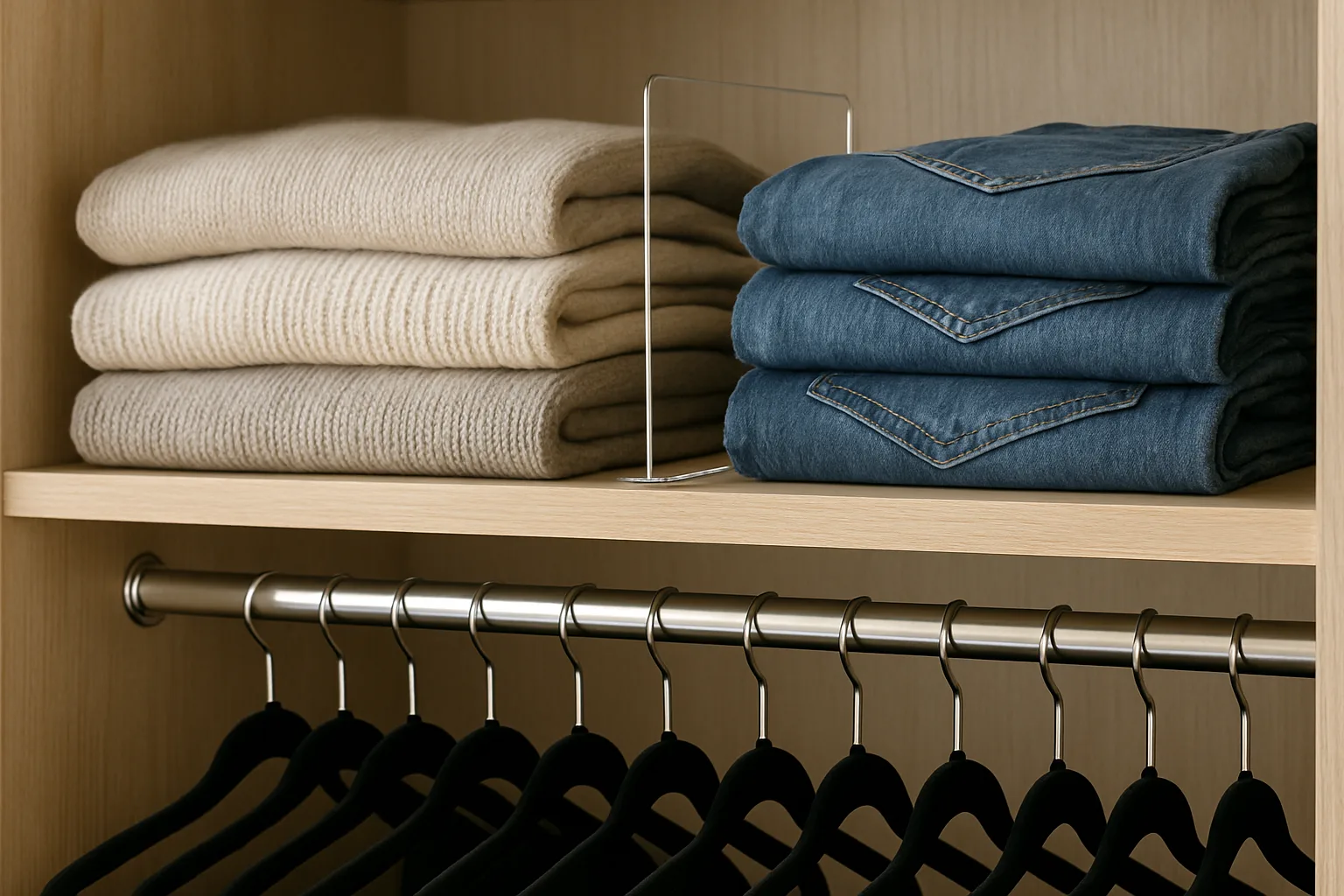
Folded stacks on an open shelf slump into each other within a week. Clear dividers keep each stack upright and make it easy to see what is where. The ROUFA clear acrylic shelf dividers (8-pack) are 11.8 inches deep and 11 inches tall and slide onto solid shelves of different thicknesses. They are not meant for wire shelving, so closets with wire shelves need a divider designed to clip onto wire.
Above the top shelf there is often a foot or more of empty space. Two options:
- Bins: collapsible fabric cubes such as the Amazon Basics collapsible fabric storage cubes (6-pack), 10.5 by 10.5 by 11 inches, hold off-season clothes and fold flat when empty. Label the front of each one.
- Tension rods: in a closet with solid side walls, a tension rod set a few inches above the shelf creates a second level for light items like paper towels or rolled towels. Check the rated load on the package and keep heavy items off it.
Step 6: Use the back of the door
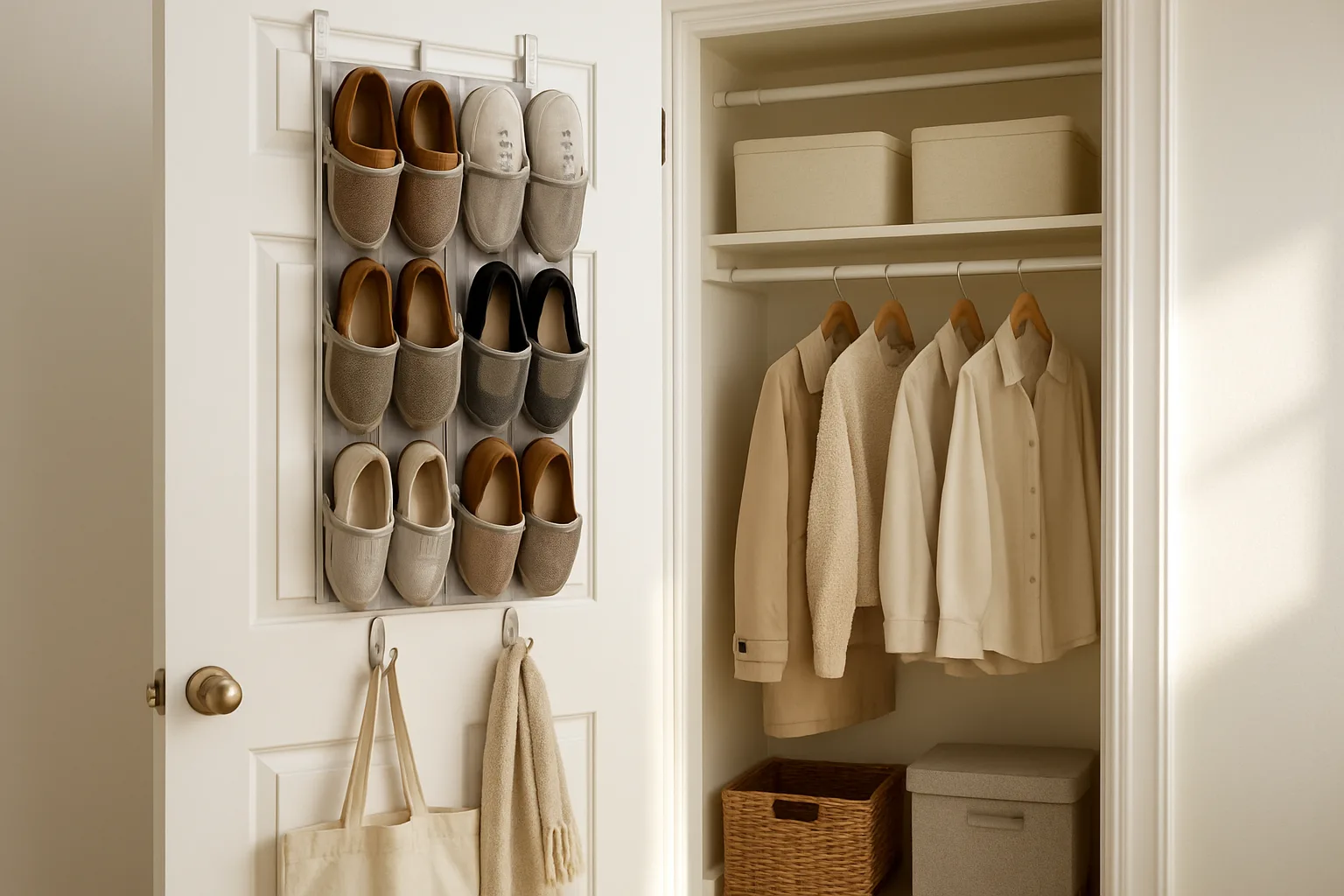
The back of a closet door is the most overlooked storage surface in a small home. An over-the-door pocket organizer holds shoes, but it works just as well for gloves, hats, chargers or cleaning sprays. The Simple Houseware 24-pocket over-the-door organizer measures 56 by 22.5 inches with 5-by-9-inch clear pockets and hangs on four metal hooks. Before buying any over-door product, confirm there is a gap at the top of the door for the hooks and that the door still closes with the organizer full.
For hooks without screws, adhesive utility hooks work well on smooth, painted doors. Clean the surface first (adhesive hook makers typically recommend rubbing alcohol), press firmly, and wait the recommended time before hanging anything. Poor surface prep is the most common reason they fall. More ideas for footwear specifically are in this guide to setting up a dedicated shoe storage area.
Step 7: Anchor anything tall
Freestanding shelving units and drawer towers added inside a closet can tip if a drawer is pulled out while the unit is loaded. The U.S. Consumer Product Safety Commission's Anchor It! campaign recommends anchoring all furniture with drawers, doors or shelves to the wall, which matters most in homes with young children. Most units ship with a wall strap; use it.
Budget tools compared
| Tool | Problem it solves | Cost tier | Rental-friendly |
|---|---|---|---|
| Slim velvet hangers | Crowded rod, slipping clothes | Budget | Yes |
| Doubler rod | Wasted space under short garments | Budget | Yes |
| Shelf dividers | Toppling folded stacks | Budget | Yes |
| Fabric cubes | Loose items, off-season storage | Budget | Yes |
| Over-the-door organizer | Shoes and small items on the floor | Budget | Yes |
| Tension rod above shelf | Unused space near the ceiling | Budget | Yes |
| Added shelf or rod with brackets | Permanent second level | Mid-range | Ask the landlord first |
Keeping it organized
A reorganized closet stays that way only if it holds less than it can. A few habits help:
- One in, one out for clothes and shoes.
- Seasonal swap: twice a year, move off-season clothes to the upper bins and bring the current season down.
- Leave a gap on the rod. If hangers cannot slide, the closet is full.
For more ways to gain space beyond the closet, see these space-saving bedroom upgrades.
The bottom line
A small closet gains the most from changes that use height: a second rod below the first, dividers and bins on the shelf, and storage on the back of the door. Measure before buying anything, switch to one style of slim hanger, and anchor any freestanding unit. The whole project can be done in an afternoon, and apart from anchoring a freestanding unit, none of it needs a drill.
Posted by Kristopher Larson
Frequently asked questions
How deep does a closet need to be for hanging clothes?
About 24 inches is the common guideline. Most adult hangers are roughly 17 inches wide, and the extra depth keeps sleeves from rubbing the back wall and the door. In shallower closets, hangers have to sit at an angle or face forward on a front-to-back rod.
What height should double closet rods be?
A common layout puts the upper rod around 80 to 84 inches from the floor and the lower rod around 40 to 42 inches, measured to the center of the rod. Guidelines vary by a few inches, so hang the longest shirt on the upper rod and set the lower rod just below its hem.
Do velvet hangers really save space?
Yes. Slim velvet hangers are much thinner than tubular plastic or wooden hangers, so more garments fit on the same rod. Matching hangers also sit at one height, which makes the closet look neater, and the velvet surface keeps slippery tops from falling off.
How much weight can a closet doubler rod hold?
It depends on the model, so check the listing. Many hang-from-the-rod doublers are rated around 25 pounds, which suits shirts and blouses. Keep heavy coats, denim and long garments on the main rod.
How can a small closet be organized without drilling?
Use a doubler rod that hooks over the existing rod, slim matching hangers, slide-on shelf dividers, fabric bins, a tension rod above the shelf and an over-the-door organizer. Adhesive hooks work on smooth painted doors if the surface is cleaned first. Tall freestanding units are the exception and should be anchored to the wall.
What should go on the top shelf of a closet?
Items used least often: off-season clothes, spare bedding, luggage and overflow supplies. Store them in labeled bins so they can be pulled down and put back as a unit instead of in loose piles.
Keep reading
More from the blog
Whole-House Surge Protectors: Type 1 vs. Type 2, What They Can't Stop, and Square D vs. Siemens vs. Eaton
Propane vs. Electric Patio Heaters: Mushroom vs. Infrared vs. Tabletop, and How Much Heat a Patio Needs
Chain vs. Belt vs. Wall-Mount Garage Door Openers: Chamberlain vs. Genie, Plus Smart Retrofits