How to Choose a Robot Lawn Mower: Mammotion vs Ecovacs vs Navimow
How robot mowers navigate and where each type fails: RTK, LiDAR and vision, yard-size ratings, slopes, edges and upkeep, with Mammotion and Ecovacs picks.
Every robot mower on the market can cut grass. What separates them over a full season is how often they stop: lost signal under a tree, a wet camera, a gap in the fence, a wheel spinning in a soft corner.
So the right pick starts with how a mower finds its way, then the yard it has to cover. Below: navigation types and where each fails, size and slope ratings, edges, upkeep, payback and the picks.
Quick verdict
- Slopes, bumps and rock beds on an open yard: the Mammotion LUBA 2 AWD 5000HX. All-wheel drive gets it over ruts and rock beds that stop two-wheel mowers. It needs open sky.
- Heavy tree cover or tall buildings next door: the ECOVACS GOAT A3000 LiDAR. It steers by laser, not satellites, so tree canopy doesn't matter, and it mows at night.
- A small, flat, simple lawn: the Navimow i-series. The i110 has a long record of not getting lost; the Segway Navimow i105N is the same RTK-plus-vision design in a smaller size.
The mowers side by side
| Mower | Shop | Navigation | Drive | Best fit | Main weak spot |
|---|---|---|---|---|---|
| Mammotion LUBA 2 AWD 5000HX |  View on Amazon | RTK base antenna plus vision, 4G | All-wheel drive | Open yards up to about 1.25 acres, rough or sloped | Skid-steers; can scuff wet turf and lose signal near buildings |
| ECOVACS GOAT A3000 LiDAR |  View on Amazon | Dual LiDAR plus vision, no antenna | Two rear wheels, casters | Shaded or built-up yards, smooth ground | Edge gap until an update; delicate LiDAR dome |
| Navimow i-series (i110) | RTK base antenna plus vision | Two rear wheels, caster | Small, flat lawns | Narrow cut; struggles on slopes and divots | |
| Navimow X450 | Network RTK, vision | All-wheel drive, steered front wheels | Larger lawns | Three perimeter laps every job | |
| Eufy E18 | Cameras only, self-mapping | Two rear wheels, caster | Tiny, simple yards under trees | Very slow; stops at sunset | |
| Yarbo | RTK base antenna, five cameras | Tracks | Multi-acre lots that also need snow clearing | Heavy; hours of assembly |
Best for slopes and rough yards
Mammotion LUBA 2 AWD 5000HX
A motor in each wheel, suspension and omnidirectional front wheels get it over ruts, divots and rock beds, and its dual discs leave some of the best stripes of any robot.
- AWD
- RTK plus vision
- 4G option
Good for
- Hills, ruts and rock beds
- Open yards up to about 1.25 acres
Skip it if
- Heavy tree cover (it needs open sky)
- Wet turf (skid-steering can scuff it)
Navigation: the choice that decides everything
RTK with a base antenna
Most mowers pair satellite positioning with a small RTK base station that corrects it to within centimeters. It works well on open lawns. It struggles under big pines, against the side of a house and in narrow channels: a 20-foot gap between a fence and a house is enough for the Yarbo and the Luba Mini to lose signal in the same spot every day, leaving that strip unmowed. Losing signal mid-map can also wipe a half-finished map; on a Luba Mini that meant a 45-minute redo.
Network RTK
Network RTK, used by the Navimow X450 and Kress mowers, borrows corrections from a regional network of antennas, so there is nothing to mount in the yard. The X450 ran four months with a single fault: a network drop sent it past the boundary into a garden bed before it stopped with an error. An antenna comes in the box as a backup.
Vision only
Camera mowers like the Eufy E18 and Terramow S1200 map the yard by themselves and spot pine straw, dirt patches and sidewalk edges. They are the easiest to set up and never lose a satellite. The costs: they need daylight (the E18 parks at sunset), they are slow, and memory limits how big a map they can hold. Results vary: the Worx Landroid Vision XL never mowed a complex yard on its own.
LiDAR
LiDAR mowers scan their surroundings with lasers, so they work under heavy trees, beside tall buildings and in the dark. On the GOAT A3000 the trade-offs are a dome that has to be protected and a map size capped by memory, like vision mowers.
When two systems disagree
Blending RTK and cameras isn't always redundancy. One larger Navimow refused to keep cutting when raindrops wet its cameras, even with a good GPS fix. The X450's cameras flagged a lay-flat drain hose as an obstacle and steered into a lily bed; marking that path as a no-vision zone fixed it.
Yard-size ratings vs reality
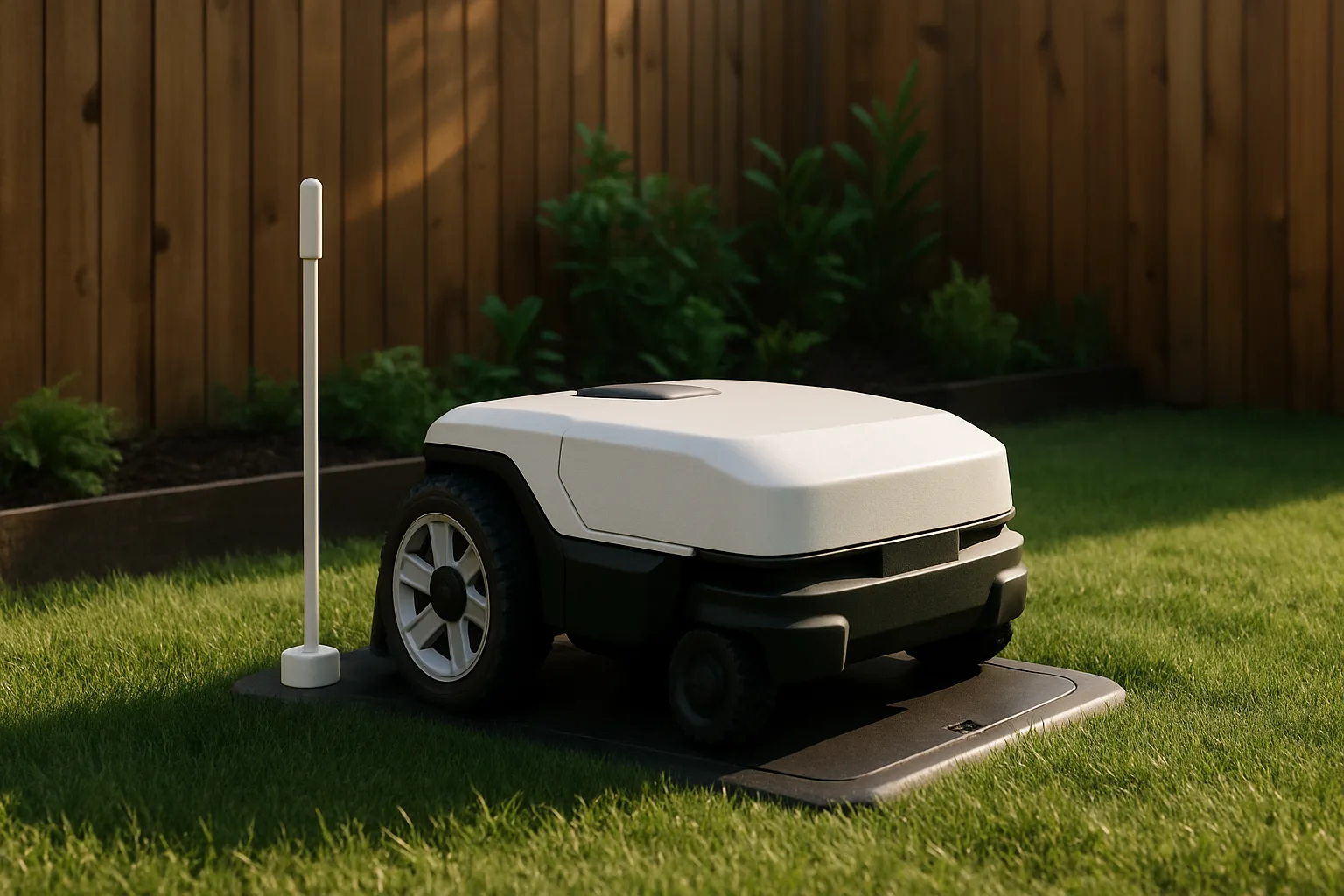
Robot mowers trim about a quarter inch at a time and are meant to run every day or two. Size the mower so it covers the whole lawn in one or two days at most. Real coverage falls short of the rating on complex layouts and short days. The E18 couldn't finish 0.3 acre in a day. A big-yard Navimow X350 ran back to its dock so often that it never kept up. On a 3.6-acre lot, only the Yarbo and a Kress model covered everything.
The LUBA 2 AWD 5000HX listing gives a reception area of 1.25 acres and a maximum of 1.48. The 10000X shares the same body and cut with a bigger battery, rated for just under 3 acres.
Best under trees
ECOVACS GOAT A3000 LiDAR
Steers by laser instead of satellites, so tree canopy and tall buildings don't matter, mows at night and leaves wide, straight lines.
- Dual LiDAR
- Night mowing
- AI obstacle avoidance
Good for
- Medium yards beside buildings or woods
- No antenna to place
Skip it if
- Rough ground or separated yard areas
- Complex multi-acre properties
Slopes, bumps and AWD
Two-wheel mowers with a front caster handle flat, even turf. A drain hole or small ditch can trap the caster, and steep grades are beyond them. All-wheel drive and tracks barely ever get stuck: the Luba 2 crossed rock beds and a rutted one-acre yard. The Luba skid-steers on sideways rollers and can tear soft, wet grass. The X450's independently steered front wheels left no torn grass, even on new seed, and the Sunseeker Elite X7 Plus uses a motorized, steered caster that is also easy on turf.
Edges and trimming
Expect a strip of uncut grass along raised edging, walls and playset borders. The Husqvarna 440 iQ's small center disc leaves about 7 inches. The GOAT A3000 first left over a foot and the Sunseeker 6 to 8 inches; software updates brought both closer. The fix that works is a mow strip: flat concrete curbing set level with the grass lets a wheel ride on it while the deck cuts the last inch.

Best for small, simple lawns
Segway Navimow i105N
The Navimow i-series RTK-plus-vision design that rarely loses signal, sized for about an eighth of an acre: map the yard once and it keeps going.
- About 1/8 acre
- RTK plus vision
- Height dial
Good for
- Small, flat, open lawns
- Carrying between areas
Skip it if
- Slopes (two-wheel drive)
Getting it unstuck from anywhere
On many mowers, the Luba 2 and Navimow among them, manual driving works only within Bluetooth range, so a stuck mower means a walk outside. The Yarbo can be driven over the internet from anywhere, cameras on, and the smaller Luba Mini AWD has a remote camera mode. A stuck or lost Kress needs buttons pressed on the machine itself before it restarts.
Setup effort
Camera mowers set up in minutes. RTK mowers mean placing the antenna with a clear view of the sky, then driving the perimeter with the phone like an RC car and drawing no-go zones around beds and trees. The Yarbo takes hours: many boxes, bags of hardware and an RTK base that needs an Ethernet cable to the router. Kress dealers map the yard with a wheeled trolley over most of a day, and later edits need that trolley.

Newer flagship for kept lawns
Mammotion LUBA 3 AWD 3000
No antenna needed, light enough for one person to lift, longer runtime per charge and the more refined app, with custom stripe patterns.
- AWD
- LiDAR plus network RTK
- Cuts 1 to 2.7 in
Good for
- Kept lawns up to about 3/4 acre
- Custom stripes
Skip it if
- Tight spots under trees and beside the house
Maintenance, winter and payback
- Blades: nearly all use small razor blades on a spinning disc that fold back when they hit something. They swap in minutes, roughly every 45 days or about a season with the included spares.
- Cleaning: clean the underside regularly; most apps send reminders.
- Winter: no fuel to drain, but store the mower or cover it for snow season. A Luba 2 left out all winter survived, though that isn't recommended. In snow country, bring it in once mowing ends.
- Leaves: razor-blade discs have no lift, so they won't mulch leaves or tackle long grass.
- Payback: against a weekly mowing service on a large lot, a mower can pay for itself in one to two seasons. They also run quietly and kick up no dust or pollen.
Will the company be around?
Many brands are young, and a mower depends on its app and update servers. Updates fix problems and sometimes add bugs. Navimow belongs to Segway, one of the longer-established names. The Sunseeker Elite X7 Plus sells only through dealers.
Best for slopes and rough yards
Mammotion LUBA 2 AWD 5000HX
A motor in each wheel, suspension and omnidirectional front wheels get it over ruts, divots and rock beds, and its dual discs leave some of the best stripes of any robot.
- AWD
- RTK plus vision
- 4G option
Good for
- Hills, ruts and rock beds
- Open yards up to about 1.25 acres
Skip it if
- Heavy tree cover (it needs open sky)
- Wet turf (skid-steering can scuff it)
The picks in detail
Mammotion LUBA 2 AWD 5000HX
The Luba 2 AWD is built for terrain: a motor in each wheel, suspension, and omnidirectional front wheels. It handles ruts, divots and rock beds, and its dual discs leave some of the best stripes of any robot. The app offers many settings and frequent updates, and the treads wear well. It navigates with RTK and vision; Wi-Fi is only needed for updates and live progress, with 4G available.
The drawbacks: it skid-steers, so it can scuff wet turf and still wedge itself. Flaky home internet bothers it. Once in a long run it simply stopped mowing for about a week until someone checked. The 5000HX and 10000X cut the same; choose by yard size.
Best for slopes and rough yards
Mammotion LUBA 2 AWD 5000HX
A motor in each wheel, suspension and omnidirectional front wheels get it over ruts, divots and rock beds, and its dual discs leave some of the best stripes of any robot.
- AWD
- RTK plus vision
- 4G option
Good for
- Hills, ruts and rock beds
- Open yards up to about 1.25 acres
Skip it if
- Heavy tree cover (it needs open sky)
- Wet turf (skid-steering can scuff it)
ECOVACS GOAT A3000 LiDAR
Cut quality is the GOAT A3000's strength: wide, straight lines from dual discs with three blades each. It has gone a full season, mowing every other day, without a blade change. LiDAR means no antenna to place, no worry about trees or clouds, and night mowing, with AI obstacle avoidance on top.
It has two weak spots. With rear-wheel drive and casters it struggles between separated yard areas and on rough ground. It also left a wide edge strip until an update, and on a complex multi-acre property its route logic wandered instead of holding a steady pattern. Don't flip it on its back; the LiDAR dome is the fragile part.
Best under trees
ECOVACS GOAT A3000 LiDAR
Steers by laser instead of satellites, so tree canopy and tall buildings don't matter, mows at night and leaves wide, straight lines.
- Dual LiDAR
- Night mowing
- AI obstacle avoidance
Good for
- Medium yards beside buildings or woods
- No antenna to place
Skip it if
- Rough ground or separated yard areas
- Complex multi-acre properties
Navimow i-series
The i110 is simple and durable enough to run for years, and it rarely loses signal: map the yard once and it keeps going. It has a height dial (2 to 3.6 inches), uses online weather instead of a rain sensor, and is light enough to carry between areas, though it has no real handle. Its single disc cuts a narrow stripe, and two-wheel drive limits it on slopes. The Segway Navimow i105N is the same design sized for about an eighth of an acre.
Best for small, simple lawns
Segway Navimow i105N
The Navimow i-series RTK-plus-vision design that rarely loses signal, sized for about an eighth of an acre: map the yard once and it keeps going.
- About 1/8 acre
- RTK plus vision
- Height dial
Good for
- Small, flat, open lawns
- Carrying between areas
Skip it if
- Slopes (two-wheel drive)
The newer flagships: Navimow X4 vs. LUBA 3 AWD
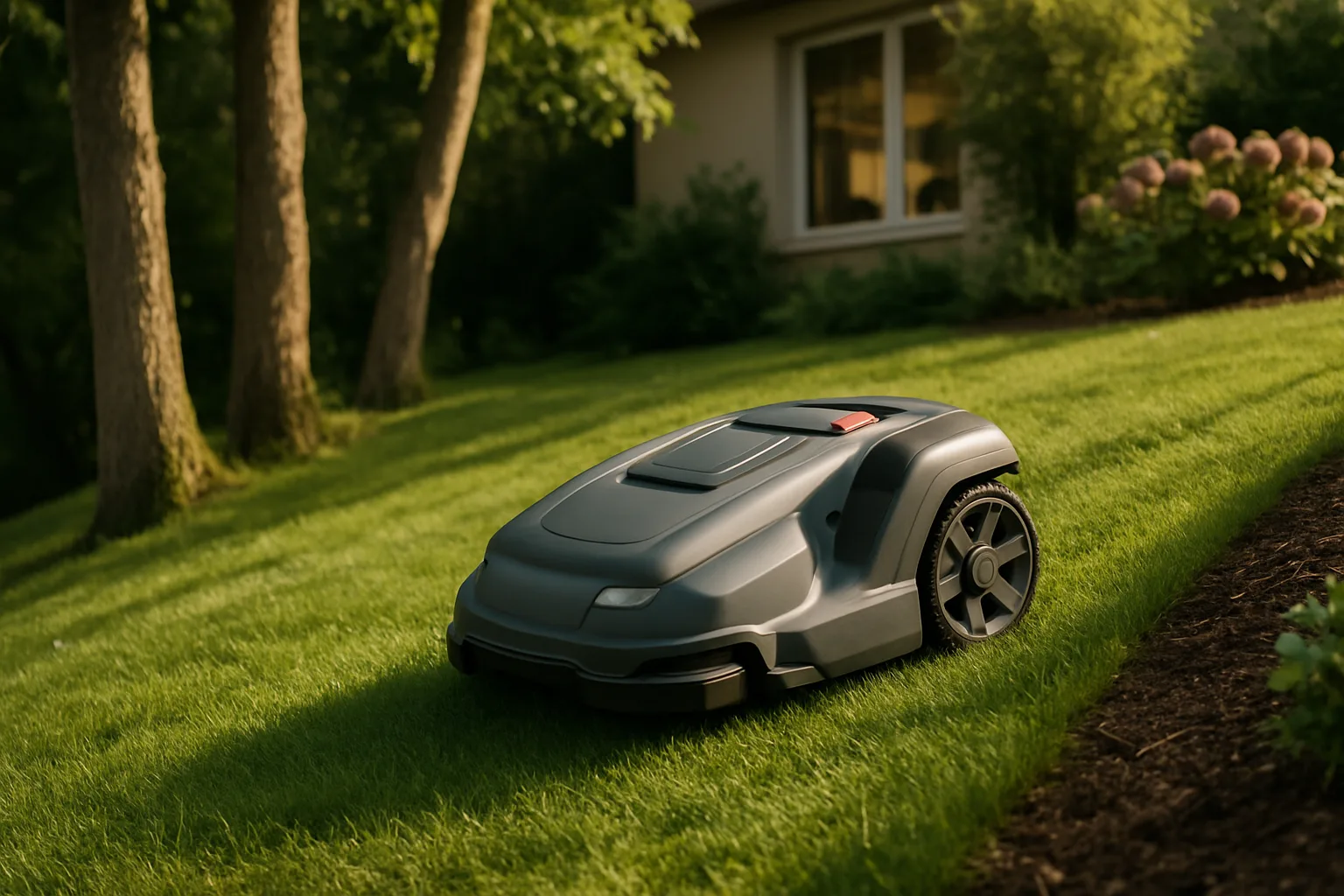
Side by side on a rough fescue lawn, Segway's Navimow X430 and Mammotion's LUBA 3 AWD split the honors. They suit different yards.
- Navimow X430: the one for rough ground. Big cleated wheels on all four corners turn in place without tearing turf, and it never got stuck, even on a rutted, weedy hillside. It cuts as low as 0.75 inch. The trade-offs: it weighs about 29 kg, it charges faster but runs down faster, and its app is simpler, cycling through three preset mowing directions with no custom patterns. It isn't sold on Amazon.
- Mammotion LUBA 3 AWD 3000: the one for a kept lawn. It needs no antenna (the listing pairs 360-degree LiDAR with network RTK and cameras), weighs about 19 kg so one person can lift it, lasts longer per charge and has the more refined app, with custom stripe directions and patterns. It got stuck and dug in a couple of times, could be finicky about its position under trees and beside the house, and pushed against a fence until the edge offset was set to about 9 cm. The LUBA 3 size behind these results isn't known; the linked 3000 is listed for about three-quarters of an acre and cuts 1 to 2.7 inches.
- Both: about three passes before the lawn looked right, and neither is meant for grass that has grown a foot or more. Cut it down first.
- Navimow Terranox: built for steep, rural lots, rated for 42-degree slopes, and set up with its own RTK base rather than relying on cell coverage. Its acreage rating assumes flat ground; hills drain the battery much faster. It isn't on Amazon either.
Newer flagship for kept lawns
Mammotion LUBA 3 AWD 3000
No antenna needed, light enough for one person to lift, longer runtime per charge and the more refined app, with custom stripe patterns.
- AWD
- LiDAR plus network RTK
- Cuts 1 to 2.7 in
Good for
- Kept lawns up to about 3/4 acre
- Custom stripes
Skip it if
- Tight spots under trees and beside the house
Worth knowing about
- Yarbo: the strongest all-rounder for multi-acre lots: fastest, remote driving, and modules for snow, leaves and a trimmer. At about 230 pounds on tracks it can wear lines on repeated paths. See the Yarbo review.
- Eufy E18: the easiest setup and best under trees, for tiny, simple lawns. See the Eufy E18 guide.
- Navimow X450: the most trouble-free bigger mower, though it can't pause and dock without canceling the job.
- Other approaches: the Ecovacs GOAT O1000 RTK takes the satellite route, and the LawnMaster OcuMow review covers another option.
Which kind fits your yard
- Small, flat, open lawn: a Navimow i-series or a camera mower.
- Small lawn under big trees: a camera mower like the E18, or LiDAR.
- Medium yard beside buildings or woods: the GOAT A3000.
- Hills, ruts or rock beds: the LUBA 2 AWD, sized to the lawn.
- Several acres plus a snowy driveway: a Yarbo, or two smaller mowers.
Where summers are dry and watering is restricted, check local rules before planning around a lush lawn; Utah's Division of Water Resources and the EPA WaterSense watering tips are good starting points. Prefer to push a mower yourself? The battery lawn mower guide covers that route.
Posted by Kristopher Larson
Frequently asked questions
Do robot mowers work under trees?
It depends on how they navigate. RTK mowers need a clear view of the sky and can lose position under large trees or in tight gaps between buildings. LiDAR mowers such as the ECOVACS GOAT A3000 and camera-only mowers don't rely on satellites, so they handle shade and nearby buildings better.
What is the difference between network RTK and an RTK base station?
Both correct satellite positioning to within centimeters. A base station is a small antenna you mount in the yard with a clear view of the sky. Network RTK pulls the same corrections from a regional network of antennas, so nothing gets mounted, though a dropped connection can briefly throw the mower off.
How big a robot mower do I need?
Pick one that can mow the whole lawn in one or two days, since robot mowers take off only about a quarter inch per pass and are meant to run daily or every other day. Treat the maximum area on the box as a ceiling; complex layouts, short days and recharge trips cut real coverage.
Can a robot mower handle hills?
Two-wheel mowers with a caster are best on flat, even lawns and can get stuck in holes or on steep grades. All-wheel-drive and tracked mowers, such as the Mammotion LUBA 2 AWD line and the Yarbo, handle slopes, ruts and rock beds far better. Check the slope rating on the listing for your model.
Do robot mowers trim edges?
Not fully. Most leave a strip of uncut grass along raised edging, walls and borders, from a few inches to more on some models. A flat mow strip of concrete set level with the lawn lets the mower run a wheel on it and cut right to the edge; otherwise plan on a string trimmer.
What maintenance does a robot mower need?
Swap the small razor blades every month or two (they are cheap and take minutes), clean the underside regularly and keep the software updated. There is no gas or oil. Store or cover the mower for the snow season rather than leaving it out all winter.
Keep reading
More from the blog
Best Smart Floor Lamp: Govee Floor Lamp 3 vs Pro vs Lamp 2 vs Hue Play
Which Govee LED Strip to Buy: H6125 vs H617A vs H618A

Best Socks to Wear Around the House: Warm Wool, Alpaca and Art Socks