Best Wireless Meat Thermometer: Typhur Sync Gold vs. MEATER Pro vs. CHEF iQ Sense
Typhur Sync Gold, MEATER Pro and CHEF iQ Sense compared on signal through lids and walls, ambient accuracy, searing, apps and which cook each one suits.
A wireless meat thermometer is a leave-in probe with no cable: it stays in the brisket, roast or chicken for the whole cook and sends the temperature to a base and a phone app. That removes the wire pinched under the lid, and it works on a rotisserie, in an air fryer or in a deep fryer where a cabled probe can't go.
Most of these probes look alike, and most read the inside of the meat accurately. Where they differ is in whether the signal gets out of a closed grill and through a wall, how far the built-in air-temperature sensor can be trusted, and how much can be done without picking up a phone.
Quick verdict
- Signal through heavy lids and a base that works without a phone: the Typhur Sync Gold Gen2. A sub-1 GHz radio that kept reporting from inside a covered cast-iron pot, built-in Wi-Fi and a screen on the base that runs a whole cook by itself.
- Thin single probe for searing, frying and the oven: the MEATER Pro. Accurate inside the meat, comfortable over high heat and paired with a clean, easy app, but its Bluetooth link is the easiest of the three to break.
- Thin probes, Wi-Fi and spoken alerts, all through the app: the CHEF iQ Sense. The hub has a speaker but no screen, so every reading and setting lives on the phone.
The three thermometers side by side
| Thermometer | Shop | Sensors per probe | Ambient heat limit | How it connects | Screen on the base | Probe thickness |
|---|---|---|---|---|---|---|
| Typhur Sync Gold Gen2 |  View on Amazon | 5 internal, 1 ambient | 932°F on the linked listing; 1,000°F on Typhur's newer probe | Sub-1 GHz from probe to base, then Wi-Fi (2.4 GHz) or Bluetooth | Yes, color display with full controls | 5.5 mm, or 4.2 mm on Typhur's newer probe |
| MEATER Pro |  See options | 5 internal, 1 ambient | 1,000°F | Bluetooth through the charger; Wi-Fi only by leaving a second phone or tablet nearby | No | 5 mm (about 0.2 in) |
| CHEF iQ Sense |  View on Amazon | 4 internal, 1 ambient | 1,000°F | Bluetooth and Wi-Fi through the hub | No, a speaker instead | 0.19 in |
A note on the Typhur: the Sync Gold has shipped with two probes. Typhur's newer specification keeps the radio, base and range rating and changes the probe to 4.2 mm with a 1,000°F ambient limit, against 5.5 mm and 932°F before. The linked listing carries the Gen2 name and states a 932°F limit, so read the probe details on the listing before ordering. The signal, frying, air-temperature and app findings below were established with the 5.5 mm probe.
Sub-1 GHz radio and a base with a screen
Typhur Sync Gold Gen2
18% offBlack Friday Dealoff recent price · as of 9:20 am MT · details
Six-sensor probes on a sub-1 GHz link that gets out of cast iron and thick-walled cookers, with built-in Wi-Fi and a base that runs a cook from its own screen.
- 5 internal sensors and 1 ambient per probe
- Sub-1 GHz, Wi-Fi and Bluetooth
- Base with a screen and controls
Good for
- Kamados, thick steel smokers and ovens that block Bluetooth
- Cooks who would rather glance at a display than open an app
Skip it if
- The only Wi-Fi at home is 5 GHz
- One probe a few steps from the kitchen covers the cooking
Where they actually differ
Getting a signal out of the cooker
A closed steel lid is the first obstacle, and with the receiver on the grill's side shelf all three get through it. Distance and extra metal sort them out. With the probe sealed inside a cast-iron Dutch oven under a closed grill lid and the receiver 6 feet away, the Sync Gold kept reporting and the MEATER Pro did not. With the pot full of water and the probe in a foil-wrapped potato, the MEATER Pro lost its signal as soon as the pot lid went on, the CHEF iQ Sense held until the grill lid closed, and the Sync Gold could be carried a long way from the grill before it dropped.
Sub-1 GHz has limits too. With the base carried to the far side of a house, several walls and windows from the grill, the Sync Gold lost the probe, as did the MEATER Pro. In day-to-day use that rarely matters: the Typhur base sat indoors behind a stucco wall through months of cooks without a dropped reading, and held a probe inside a thick-walled kamado from about 300 feet away.
Leaving home is a separate question. The Sync Gold and the CHEF iQ Sense have Wi-Fi built in, so the app keeps updating from anywhere; the Sync Gold was still reporting from about a mile away. The MEATER Pro is Bluetooth only. MEATER's answer is to leave a second phone or tablet near the charger as a relay, and without one the readings stop when the phone leaves range.
The air-temperature reading is the weak spot
Every probe here has a sensor in its ceramic end that reports the temperature of the cooker. It sits next to a large, cold, wet piece of meat and is insulated to survive a sear, so it tends to read low and react slowly. Over an 11-hour pork shoulder cook, no built-in ambient sensor, the MEATER Pro's included, came within 10°F of the grate temperature during the first three hours; the gap closed around hour four.
On an offset smoker, where the fire swings up and down, the MEATER Pro averaged about 11°F off the true air temperature, one of the better results for this kind of probe, and could be 40°F or more off for a minute or two after wood went on the fire. On a steadier gas grill, the Sync Gold's ambient reading tracked a wired probe clipped at the grate closely. The practical rule: trust the internal reading, treat the ambient number as a trend, and keep a grate-level probe if the pit temperature is what you manage by. Pellet cookers hold steadier than stick burners; see the pellet grill buying guide.
Searing, frying and washing
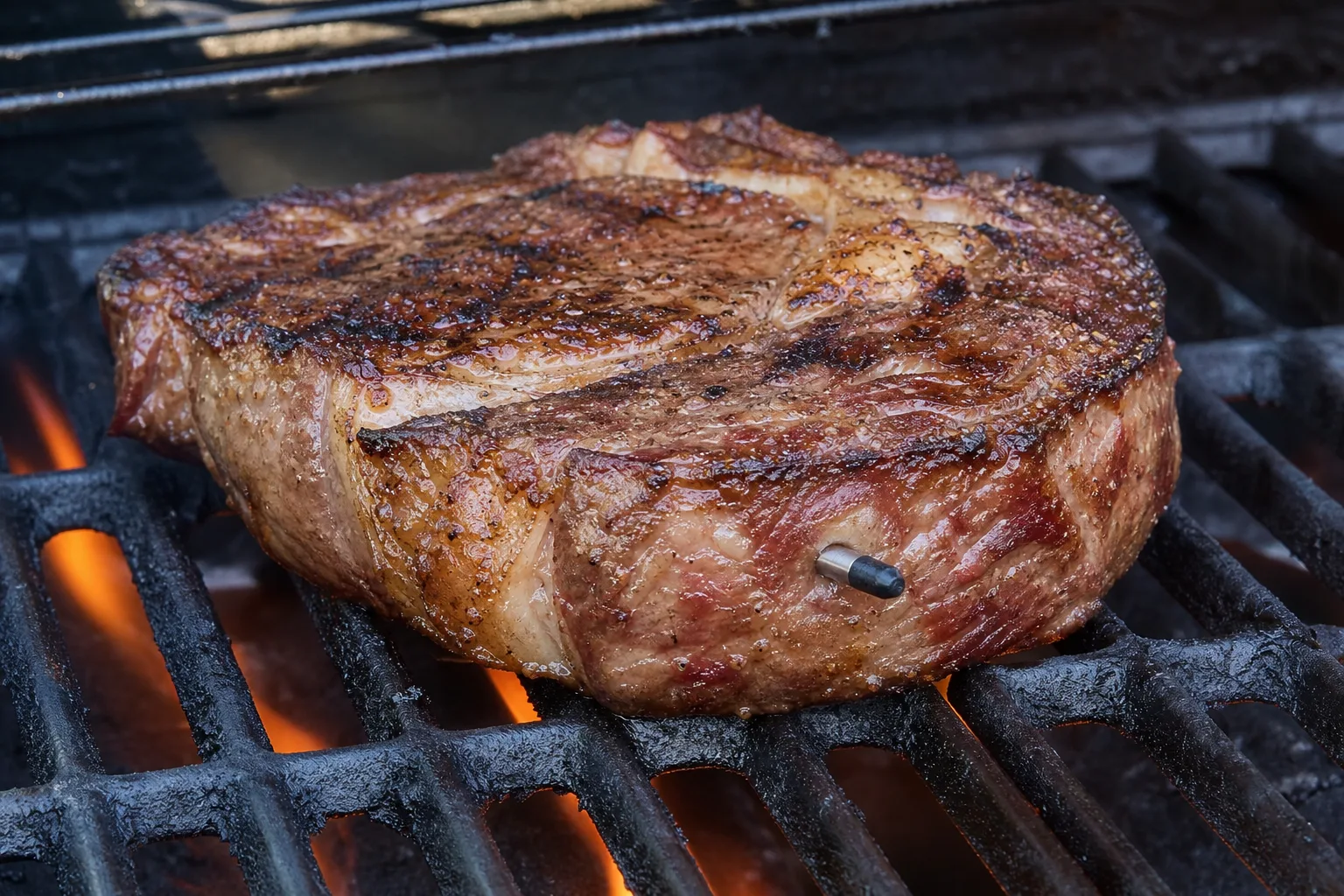
The MEATER Pro went through a sear on a gas grill running 650°F to 700°F at the hood without a heat warning, and held bare over a gas burner for a full minute before the app complained. It and the Sync Gold both kept reading through four minutes in 350°F frying oil. All three makers rate their probes for deep frying and sous vide and call them dishwasher safe; smoke residue still needs a scrub pad. For water-bath cooking, see the sous vide cooker comparison.
Apps, time estimates and the base
The MEATER app is clean and easy to set up, and it warns ahead of the target so carryover heat finishes the job. Its time-remaining estimates are less dependable, in one case showing two hours with about 30 minutes left. Typhur's app shows every sensor along the probe and gives steadier estimates, though it tends to call the pull a little late on poultry, so allow for carryover yourself. On the Sync Gold the base shows a reading a moment before the app does, and a cook can be started, changed and stopped from its buttons.
The picks in detail
Typhur Sync Gold Gen2
The Typhur Sync Gold Gen2 pairs six-sensor probes, five internal and one ambient, with a base that has its own screen and three radios. Typhur sells the Sync Gold in a two-probe Dual kit and a four-probe Quad kit, so check the probe count on the listing. Typhur states internal accuracy of ±0.5°F and includes a calibration certificate. The probes are rated IPX8, Typhur rates them at 50-plus hours on a full charge, and it says two minutes of charging covers about two hours.
The earlier 5.5 mm probes were the thickest of this group, and their minimum insertion line sat far up the shaft, which made thin fillets and small chops awkward. Typhur's newer probe is its answer: at 4.2 mm it is the slimmest of the three on paper, and the line moves from about 74 mm to 60 mm. The base goes to sleep five minutes after the probes are pulled, and its Wi-Fi is 2.4 GHz only.
Sub-1 GHz radio and a base with a screen
Typhur Sync Gold Gen2
18% offBlack Friday Dealoff recent price · as of 9:20 am MT · details
Six-sensor probes on a sub-1 GHz link that gets out of cast iron and thick-walled cookers, with built-in Wi-Fi and a base that runs a cook from its own screen.
- 5 internal sensors and 1 ambient per probe
- Sub-1 GHz, Wi-Fi and Bluetooth
- Base with a screen and controls
Good for
- Kamados, thick steel smokers and ovens that block Bluetooth
- Cooks who would rather glance at a display than open an app
Skip it if
- The only Wi-Fi at home is 5 GHz
- One probe a few steps from the kitchen covers the cooking
MEATER Pro
The MEATER Pro is the probe MEATER first sold as the MEATER 2 Plus; MEATER says only the name changed. It is a single 5 mm probe in a small charger that runs on one AAA battery and doubles as the Bluetooth repeater. Internal readings were within a degree in ice water, boiling water and a steak, and with five internal sensors the app reports the coldest point even when the probe is pushed in too far.
Its weakness is the link between probe and charger. An oven door or heavy smoker lid is enough to interrupt it unless the charger sits very close, and in open air the phone connection reached about 375 feet, then fell off quickly behind an exterior wall. Two more cautions: the probe quit in the last hour of an 11-hour overnight cook, and MEATER probes have occasionally come out of the charger flat, so check the charge the night before a long smoke. MEATER says five minutes in the charger covers a two-hour cook.
Thin single probe for high heat
MEATER Pro
A slim, accurate one-probe thermometer that shrugs off searing and frying and has a clean, easy app, held back by a Bluetooth link that walls and heavy lids interrupt.
- 5 internal sensors and 1 ambient
- Ambient limit 1,000°F
- Bluetooth, no built-in Wi-Fi
Good for
- Steaks, roasts and rotisserie cooks watched from nearby
- Searing and deep frying with the probe left in
- Anyone who wants a simple, guided app
Skip it if
- The smoker sits a few walls away from the couch
- Readings are needed away from home without leaving a spare phone behind
CHEF iQ Sense
The current CHEF iQ Sense has four internal sensors and one ambient sensor in a 0.19-inch probe rated to 1,000°F. Earlier versions of the Sense had three internal sensors, so check the sensor count on a listing before buying. The hub charges over USB-C, connects to Wi-Fi and speaks its alerts aloud, including a warning when a probe loses its connection. The linked kit has two probes; CHEF iQ sells it with one to four.
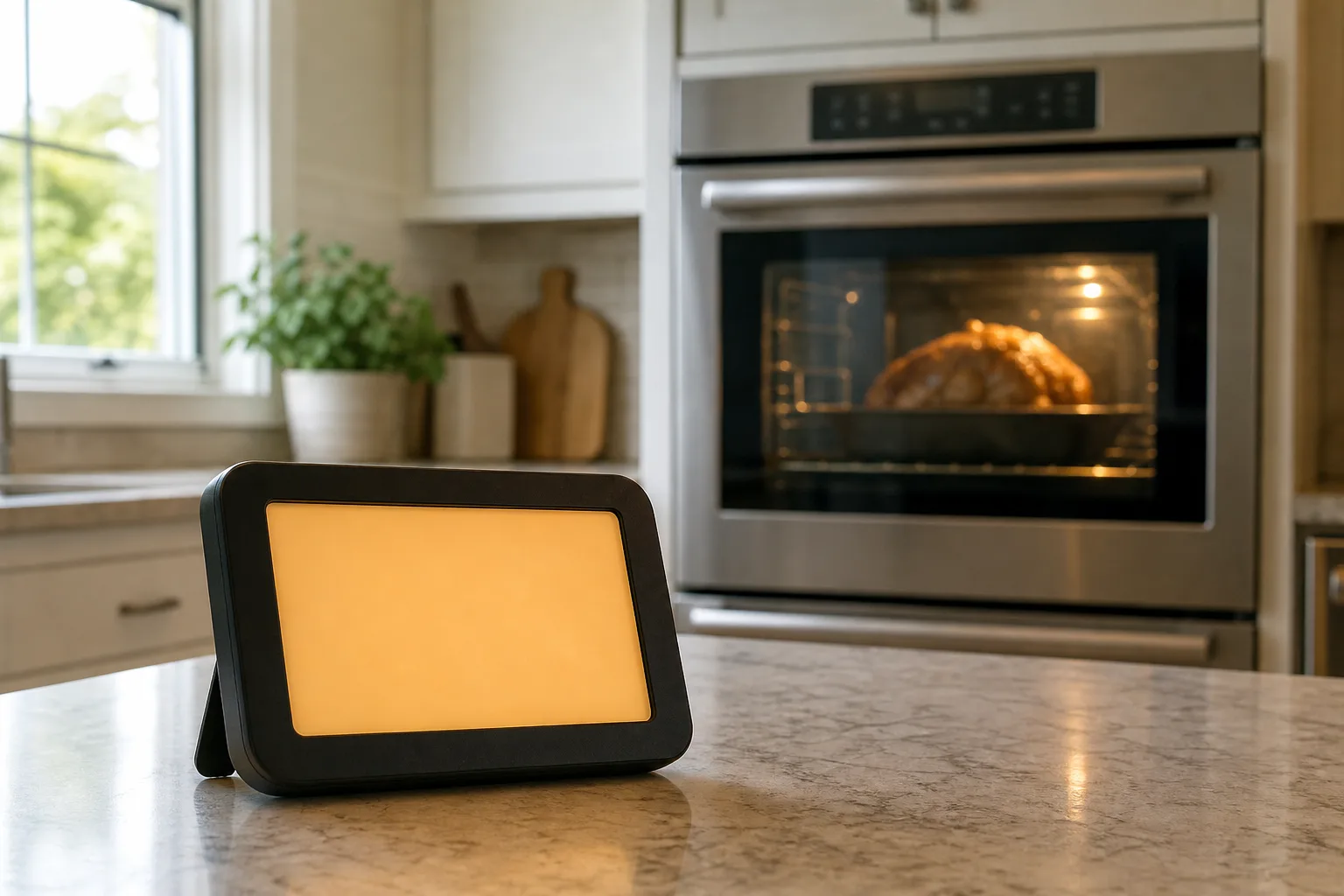
There is no display and no way to run a cook from the hub, so a phone is always part of the process. The app walks through a cook step by step, and its time estimates land behind Typhur's. Signal strength also sits in the middle: better than the MEATER Pro inside cast iron, short of the Sync Gold.
App-run hub with spoken alerts
CHEF iQ Sense
22% off list price · as of 9:20 am MT · details
Two thin five-sensor probes and a Wi-Fi hub that speaks its alerts, for cooks happy to do everything from the app, with a signal that held under a cast-iron lid but not with a grill lid closed over it.
- 4 internal sensors and 1 ambient
- Ambient limit 1,000°F
- Wi-Fi and Bluetooth, speaker hub
Good for
- Guided, step-by-step cooks from the app
- Checking a cook over Wi-Fi from another room or away from home
- Thin cuts such as chicken breasts and fish
Skip it if
- A screen at the grill matters more than a phone alert
- The probe will sit inside cast iron or a very thick-walled cooker
What about the ThermoWorks RFX?
The ThermoWorks RFX belongs in this comparison, though ThermoWorks sells it direct. It also uses a sub-1 GHz radio, and it still reached its gateway from the far side of a house, where the Sync Gold and MEATER Pro dropped; inside the water-filled pot it managed about 17 feet. ThermoWorks left the ambient sensor off the probe and plugs a wired air probe into the gateway instead, and the wire pays off: it gave the most accurate cooker temperature in 7 of the 11 hours of the pork shoulder cook. The RFX has no display and no time-remaining estimate, and its app is plain: alarms and graphs, little guidance.
App-run hub with spoken alerts
CHEF iQ Sense
22% off list price · as of 9:20 am MT · details
Two thin five-sensor probes and a Wi-Fi hub that speaks its alerts, for cooks happy to do everything from the app, with a signal that held under a cast-iron lid but not with a grill lid closed over it.
- 4 internal sensors and 1 ambient
- Ambient limit 1,000°F
- Wi-Fi and Bluetooth, speaker hub
Good for
- Guided, step-by-step cooks from the app
- Checking a cook over Wi-Fi from another room or away from home
- Thin cuts such as chicken breasts and fish
Skip it if
- A screen at the grill matters more than a phone alert
- The probe will sit inside cast iron or a very thick-walled cooker
How to choose and use one
- Match the radio to the cooker. Thin-lidded gas and pellet grills let Bluetooth through. Kamados, cast iron and thick steel smokers call for the Sync Gold.
- Keep the base near the cooker. The short hop from probe to base is the fragile one. Park the base or charger within a few feet and let Wi-Fi cover the rest.
- Insert past the minimum line. The internal section of these probes is rated only to 212°F or 221°F, so it has to be buried in the meat. Go in through the side of a steak or chop and leave only the ceramic end exposed.
- Cook to the safe temperature, not the estimate. The USDA safe minimum internal temperature chart lists 165°F for all poultry, including ground poultry, 160°F for ground meats and 145°F with a rest of at least three minutes for steaks, chops and roasts of beef, pork, veal and lamb.
- Keep an instant-read for spot checks. A leave-in probe watches one spot for hours; a handheld confirms the rest of the bird in seconds. See the instant-read thermometer comparison.
Who should buy which
- Long smokes in a kamado, offset or thick steel cooker: the Typhur Sync Gold Gen2. Its signal gets out and its base shows the cook without a phone.
- Steaks, roasts and rotisserie chicken a few steps from the kitchen: the MEATER Pro. One thin probe, a clean app and no trouble with a hard sear.
- Thin cuts and app-guided cooking with remote checks: the CHEF iQ Sense, as long as a hub without a screen is acceptable.
- Pit temperature matters more than a wire-free setup: the ThermoWorks RFX with its wired air probe, bought from ThermoWorks.
Posted by Kristopher Larson
Deal badges come from Amazon. Product prices and availability are accurate as of the date/time indicated and are subject to change.
Frequently asked questions
Are wireless meat thermometers accurate?
For the inside of the meat, yes. Typhur and MEATER both state ±0.5°F for their internal sensors, CHEF iQ states accuracy within 1°F, and the MEATER Pro read within a degree in ice water and boiling water. The built-in air-temperature sensor is a different story: it sits next to cold meat and commonly reads 10°F or more off the real grate temperature, especially early in a cook.
Do wireless meat thermometers work through a closed grill lid or oven door?
Usually, when the base or charger sits within a few feet of the cooker. Trouble starts with more metal and more distance. Bluetooth probes such as the MEATER Pro drop out inside cast iron and can struggle behind a heavy smoker lid, while the sub-1 GHz link in the Typhur Sync Gold kept working from inside a covered Dutch oven and a thick-walled kamado.
Is the MEATER Pro the same as the MEATER 2 Plus?
Yes. MEATER renamed the MEATER 2 Plus to MEATER Pro so the name would be easier to tell apart from the MEATER Plus, and says the name is the only difference. What applied to the 2 Plus applies to the Pro.
Can a wireless meat thermometer be used without Wi-Fi?
Yes. All three connect to a phone over Bluetooth with no home network, and the Typhur Sync Gold can run an entire cook from the screen and buttons on its base with no phone at all. Wi-Fi only matters for checking the cook from farther away than Bluetooth reaches. The MEATER Pro has no Wi-Fi of its own and needs a second phone or tablet left nearby to relay readings.
Can a wireless meat probe stay in during a sear or in a deep fryer?
The probes in this comparison can. The MEATER Pro and CHEF iQ Sense are rated to 1,000°F at the ambient end, Typhur lists 932°F for the Sync Gold's 5.5 mm probe and 1,000°F for its newer 4.2 mm one, and all three makers approve deep frying. The part inside the meat is only rated to 212°F or 221°F, so the probe has to be inserted past its minimum line before it goes over high heat.
How many probes are needed?
One covers a single roast, brisket or bird. Two helps when cooking different meats, or two pieces that should finish at different temperatures, at the same time. The MEATER Pro is a single probe, Typhur sells the Sync Gold in two-probe Dual and four-probe Quad kits, and the CHEF iQ Sense is sold with one to four.
Keep reading
More from the blog
Solar Generator Bundles Compared: Jackery 1000 v2 vs. Anker SOLIX C300 vs. Bluetti Elite 30 V2
Home Theater Room Setup: Best Projectors, Surround Sound, Screens and Lighting
Best Whole-Home Battery Backup: EcoFlow DELTA Pro Ultra vs. Jackery 5000 Plus vs. Anker SOLIX F3800 Plus