
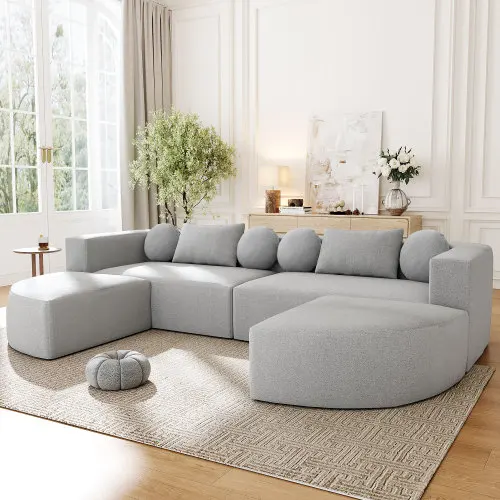
What Is a Boneless Couch? Why It's Catching On in Utah
A boneless couch ships compressed in a box with no frame, tools, or delivery crew required. Here's why the category is catching on with Utah's new construction buyers, out-of-state transplants, and short-term rental investors.
If you have shopped for a sofa online recently, you may have run into a term that sounds more like a butcher shop order than a piece of furniture: the boneless couch. The name is odd, but the idea behind it is simple, and it is catching on fast with a specific kind of buyer that Utah has plenty of. New construction owners moving into empty houses, out-of-state transplants, and short-term rental investors are all discovering the same thing, which is that the hardest part of furnishing a home is not choosing the furniture. It is getting a large, rigid object delivered, carried inside, and set up without turning move-in week into a logistics project.
Here is what a boneless couch actually is, why the category exists, and an honest look at who it suits and who it does not.
The couch with no skeleton
A traditional sofa is built around a frame. Wood or metal forms the skeleton, springs stretch across it, foam and fabric wrap around the outside. That frame is what makes a normal couch heavy, rigid, and awkward to move. It is also the reason sofa delivery is its own industry, complete with two-person crews, doorway measurements, and the occasional removed door.
A boneless couch removes the skeleton entirely. There is no wood, no metal, and no springs. The entire structure is dense, layered foam, cut and shaped so the body of the sofa holds its form on its own. The seat, the backrest, and the arms are all foam through and through, wrapped in a removable cover.
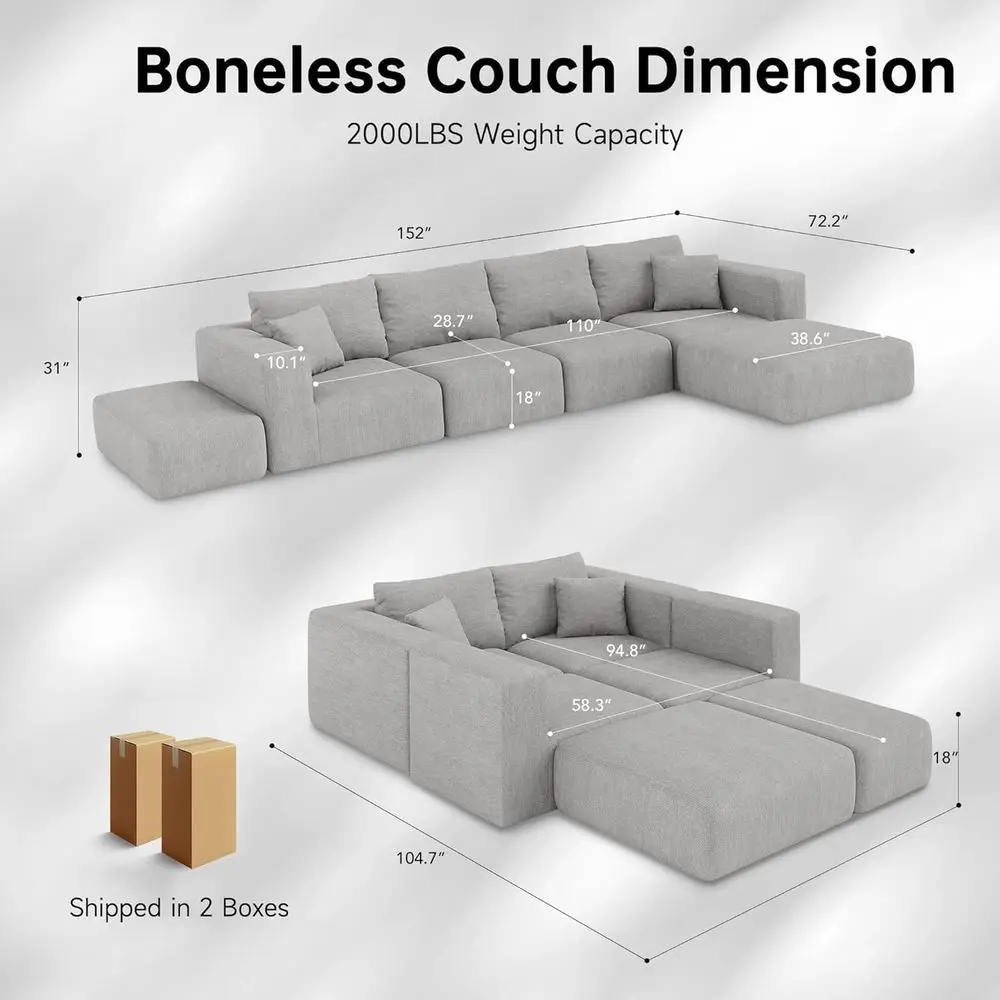
Because there is no frame to protect, the whole sofa can be vacuum-compressed at the factory, squeezed down to a fraction of its size, and packed into a box. It ships like a large parcel rather than freight. When it arrives, you carry the box inside, open it, unroll the sofa, and let it expand back to full size. Most reach their final shape within a day or two. There is nothing to assemble, no legs to screw in, no brackets, no tools.
If you have ever unboxed a bed-in-a-box mattress, the experience is nearly identical. The boneless couch is essentially that same compression technology applied to a sofa.
Why the category took off
The boneless couch did not appear because anyone was unhappy with how sofas feel. It appeared because of how sofas move. A few pressures pushed the category into existence.
Shipping costs shaped it. A compressed sofa in a box can move through standard parcel networks. A full-size framed sofa needs freight carriers, delivery appointments, and a much bigger fuel and handling bill. Compression cut the delivery problem down to something one person can manage.
Renters and frequent movers shaped it. A foam sofa that arrived in a box can be moved again far more easily than a framed sectional. For people who relocate every few years, furniture that survives multiple moves without a professional crew has real value.
And apartment living shaped it. Narrow stairwells, small elevators, and tight doorways stop a surprising number of sofa deliveries every year. A box solves what a fully assembled frame cannot.
Why it fits Utah specifically
Utah is one of the fastest-growing states in the country, and a large share of that growth comes from people moving in from somewhere else, a trend covered in depth in our guide to relocating to Utah and setting up a new household. That migration pattern creates exactly the situations where a boneless couch makes the most sense.
Consider the new construction buyer. Utah builds a lot of new homes, from Lehi's tech corridor out to the growth around St. George and Hurricane. A new build means an empty house on day one, and furnishing an entire home usually means juggling multiple freight deliveries with multi-week lead times. A sofa that ships in days through a parcel carrier and needs no delivery crew removes one of the biggest items from that puzzle.
Consider the out-of-state transplant. Many people relocating to Utah sell or donate their old furniture rather than pay to move it across the country, since long-distance moving costs are usually charged by weight and volume. Arriving in Salt Lake City or Provo with no sofa, and needing one before the family flies in, is a common situation. A boxed sofa that arrives quickly and gets carried in by one or two people fits that timeline in a way traditional furniture retail does not. For buyers weighing whether Utah is the right move at all, our comparison of East Coast vs. West Coast living against Utah's lower-cost alternative is a useful starting point.
And consider the investor. Utah's short-term rental market, from Moab to Park City to the red rock country around Springdale, runs on fast turnarounds. When an investor closes on a property, every week the unit sits unfurnished is lost booking revenue. Furniture that can be ordered, delivered, and guest-ready inside a week, without coordinating freight windows, is an operational advantage. The removable, washable covers common on foam sofas also matter more when strangers are sitting on the couch every weekend. Investors weighing a rental conversion may also want our step-by-step guide to turning a Utah home into a rental.
There is one more Utah-specific point worth making. Plenty of homes here sit up canyon roads, on steep lots, or in rural stretches where freight delivery is slow, expensive, or occasionally refused. A parcel-sized box gets to addresses that furniture trucks find difficult.
What it is like to live with one
Honesty matters here, because a boneless couch is not simply a regular sofa in a more convenient package. It sits differently.
Foam construction gives a firmer, denser feel than a sprung frame. Some people prefer it, describing it as supportive, closer to a firm mattress than a bouncy traditional couch. Others miss the give of springs. The sit is also lower and more casual, which suits a family room or a den more than a formal living room.
Durability runs on a different clock too. A quality hardwood frame can last decades and be reupholstered. Foam compresses gradually with use, and while good high-density foam holds up for years, it will not outlive a well-built frame. The tradeoff is that a boneless couch typically costs meaningfully less than a comparable framed sofa, partly because the shipping economics are so much better.
The practical upsides are real. No assembly at all, covers that zip off and go in the wash, light enough for one or two people to reposition, and no frame to crack or joints to loosen if it gets moved repeatedly. For households with kids, pets, or a rotation of short-term guests, washable covers alone win a lot of arguments.
Several brands now make frame-free compressed sofas, and the buying process is similar across them: order online, receive a large box, unbox, and wait a day for full expansion. Among the dedicated options, Boneless Couch USA ships its foam sofas compressed to US addresses with free shipping, which gives a sense of how the category typically works. As with any online furniture purchase, read the return terms before ordering, since compressed items generally cannot be re-compressed once opened, and most sellers in the category only take returns on unopened boxes or genuinely defective items. If you're deciding between this and a more traditional piece, our comparison of handcrafted vs. mass-produced furniture for Utah homes covers the tradeoffs in more depth.
Who should and should not buy one
A boneless couch is a strong fit if you are furnishing a new or empty home on a deadline, moving into a walk-up or a tight-access property, furnishing a short-term rental where speed and washability matter, or working with a budget that a framed sofa of similar size would strain.
It is a weaker fit if you want a formal, high-sitting sofa, if you strongly prefer the softness of a sprung seat, or if you are furnishing a forever home and want a piece to last twenty years and be reupholstered once. In those cases, a traditional framed sofa remains the better long-term buy.
For a lot of the people arriving in Utah right now, though, the math is straightforward. The house is new, the timeline is short, the stairs are real, and the moving truck already cost enough. A couch that shows up at the door in a box, gets carried in by one person, and is ready to sit on by dinner solves the problem they actually have.
Frequently asked questions
How long does it take a boneless couch to fully expand after unboxing?
Is a boneless couch a good fit for a Utah short-term rental?
How much does a boneless couch cost compared to a traditional sofa?
Can a boneless couch be delivered to rural or canyon-area Utah homes?
Does a boneless couch feel different to sit on than a regular sofa?
How long does a boneless couch typically last compared to a framed sofa?
Keep reading
More from the blog

Gas Line Installation: What Homeowners Need to Know First
Roof Timeline Guide for Buying an Older Utah Home
How to Choose Windows for a Utah Home With a Mountain View