Best Garage Parking Aid: Laser vs. Sensor vs. Stop Indicator vs. Wheel Stop
Garage parking laser vs. ultrasonic sensor vs. stop indicator vs. rubber wheel stop: how each signals stop, setup, power, mounting and two-car garages.
A garage parking aid solves one small, daily problem: pulling in far enough for the door to close behind the car, without pulling in so far that the bumper ends up against the workbench, the shelving or the door to the house. Most people eyeball it, and most people miss by a little in one direction or the other. A good parking aid makes the stopping point the same every time.
This guide compares four ways to do it: an ultrasonic sensor with stoplight colors, a ceiling-mounted laser that puts a dot on the dashboard, a mechanical sight-line indicator on the wall and a rubber stop on the floor. It covers how each one tells you to stop, how to set it up, what it needs for power and where each one falls short.
Quick verdict
- Most precise stop: the MAXSA Dual Laser Park Assist. A motion-activated laser puts a red dot on a spot you choose on the dashboard, and the dual version covers two bays from one unit. It needs an outlet near the ceiling.
- Best for several drivers in one bay: the STKR Concepts Parking Sensor. Green, yellow and red lights count down to a stopping point you set with one button, for any car that pulls in. Plug it in if you can; batteries can run out fast.
- Best no-power wall option: the Park Ranger Parking Indicator. A small C-shaped piece with red lines you line up from the driver's seat. Nothing to charge, nothing hanging in the walkway.
- A stop you feel at the tires: the YesBes Rubber Parking Stop. Heavy rubber with reflective striping; it can sit loose on the floor or bolt down.
Garage parking aids side by side
| Parking aid | Shop | How it signals stop | Power | Mounting | Main drawback |
|---|---|---|---|---|---|
| MAXSA Dual Laser Park Assist |  View on Amazon | Red laser dot lands on a chosen spot on the dashboard | Plug-in on a 9 ft cord, with backup batteries | Ceiling, three screws, hand-adjustable laser heads | Dot brightness depends on the angle; some reflection |
| STKR Concepts Parking Sensor |  View on Amazon | Green, then yellow, then red light as the bumper closes in | 4 AA batteries or micro USB wall power | Velcro or adhesive on the wall, sensor at bumper height | Battery life can be short with heavy use |
| Park Ranger Parking Indicator |  View on Amazon | Red lines on a C-shaped piece line up when you're in place | None | Adhesive pad, or two hidden holes on push pins | Tuned to one driver, seat position and car |
| YesBes Rubber Parking Stop |  View on Amazon | Front tire rolls up against it | None | Sits loose, or bolts to concrete or asphalt | Included anchors are weak; reflective strips can lift |
Most precise stop
MAXSA Dual Laser Park Assist
A motion-activated ceiling unit with two adjustable lasers that put a dot on a spot you choose on the dashboard, covering two bays from one plug.
- 2 laser heads
- Motion sensor
- Plug-in
Good for
- Two-car garages
- The same stop every time
Skip it if
- No outlet within 9 feet of the ceiling mount
How each type tells you to stop
Laser park assist
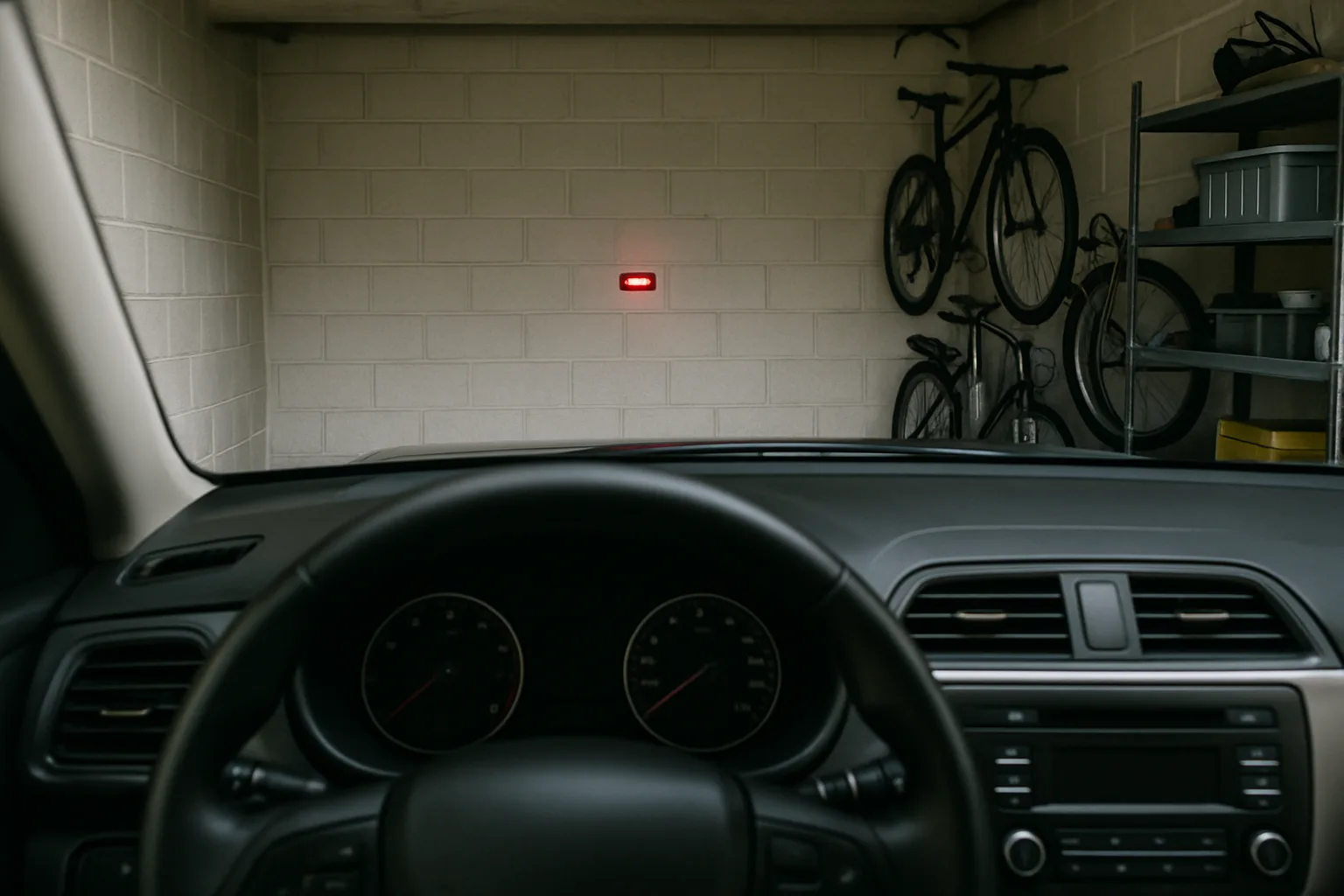
A laser parking guide mounts on the ceiling and points a red dot down at the car. You park once in the perfect spot, then aim the laser at something easy to see and remember on the dashboard, such as a button or the edge of a storage tray. After that, you pull in until the dot lands on that spot. Because the target is a small point on the car itself, a laser guide can get you within about an inch of the same place every day, both front to back and side to side.
A motion sensor turns the laser on as the car enters, so it isn't shining all the time.
Ultrasonic sensors with lights
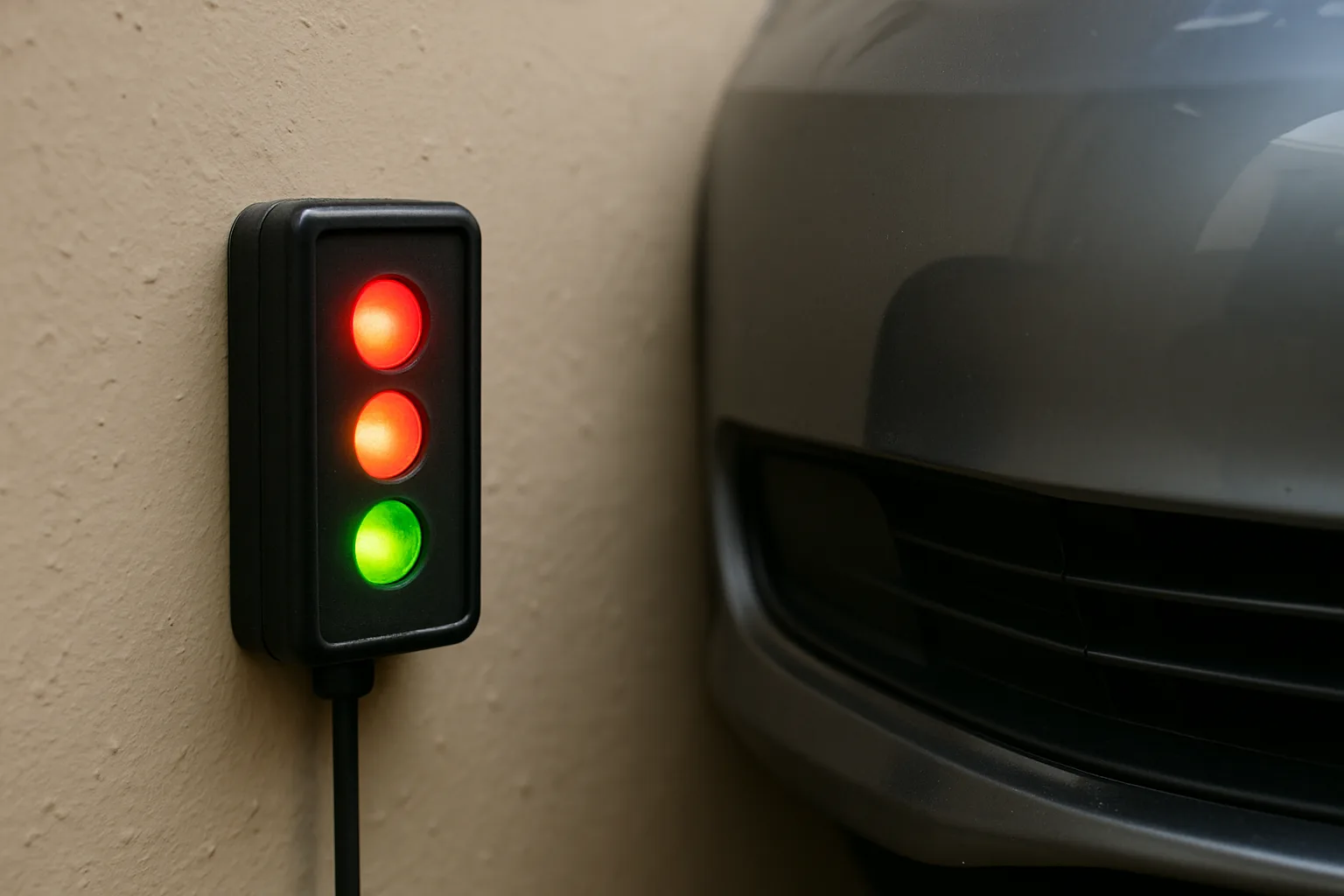
An ultrasonic parking sensor reads the distance to whatever is in front of it. When the bumper comes into range, a light changes from green to yellow to red, like a traffic signal. The stopping point is whatever distance you programmed, so you can leave room for a cabinet door to swing open or a walkway along the front wall.
Mechanical sight-line indicators
A sight-line indicator has no electronics. With the Park Ranger, a red line on the inside of the C shape lines up with red lines on the outside when the car is in position. It works on perspective, which is both its strength and its limit.
Floor stops
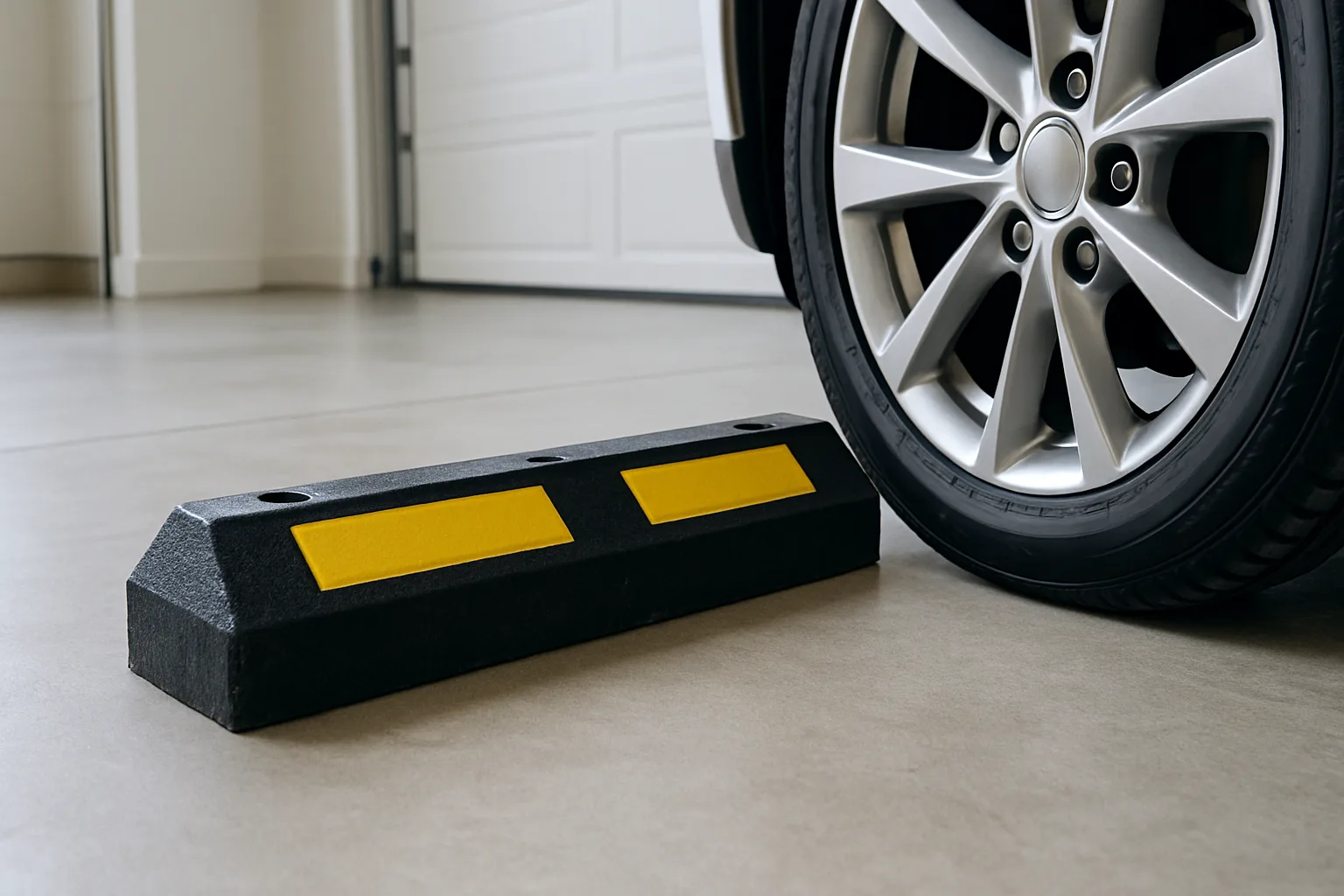
A rubber parking stop gives the front tire something to bump. The trade-off is that it stays on the floor when the car is out, where it can trip someone walking through a dim garage.
The old tennis ball on a string works the same way from above: it touches the windshield when the car is in place. It's simple and repeatable, but it dangles in the walkway whenever the car is out.
Setup and accuracy
Every type starts the same way: park the car exactly where you want it, then set the aid to match.
- Laser: mount the unit on the ceiling, park, then climb a step ladder and move each laser head by hand until the dot sits on your dashboard target. Angle it so the beam meets the windshield as close to straight on (about 90 degrees) as you can. That gives the brightest dot and the least reflection.
- Sensor: mount the sensor about where the bumper sits, with the car in its final spot, then press the set button. The STKR wants the bumper more than 6 inches from the sensor when you set it. After that, green shows at roughly 3 feet out, then yellow, then red at your set point.
- Sight-line indicator: sit in the car in your normal driving position and have someone move the indicator on the wall until the red lines line up at your eye level. Mark it there.
- Floor stop: set it in front of a tire with the car parked.
Best for several drivers
STKR Concepts Parking Sensor
Green, yellow and red lights count down to a stopping point you set with one button, because it measures the car rather than the driver's view.
- Ultrasonic sensor
- 3-color light
- One set button
Good for
- Several drivers sharing a bay
- Spotting things on a dark floor
Skip it if
- Running on batteries (they can run out fast)
Lasers: brightness, reflection and timing
Complaints that a laser dot is too dim usually come down to the angle. A beam that hits the windshield at a shallow slant spreads out and bounces away; a beam that meets it close to straight on makes a sharp, bright red dot on the dashboard.
Even at a good angle, some of the beam reflects off the glass. Expect a small red dot to show up on the ceiling or a wall as well. It's a laser, so aim to keep that stray reflection away from where people stand and walk, and never look into the beam. The FDA has basic guidance on laser product safety.
The MAXSA's motion sensor keeps the laser on for 15 seconds after it detects movement. That's plenty for the last 12 feet or so of a slow pull-in.
Two cars and tight garages
Two cars are where the types split. A sensor measures whatever pulls in, so one sensor in front of each bay works for any car. The MAXSA comes in a single-laser version for a one-car garage and a dual version with two heads, one aimed at each car. A sight-line indicator is tuned to one driver, seat position and vehicle; a taller driver or a different car sees the lines from another angle. Plan on one indicator per car.
With the stop fixed, the space above the hood is usable too; overhead garage storage racks keep the floor clear.
Best no-power option
Park Ranger Parking Indicator
A small C-shaped wall piece with red lines you line up from the driver's seat. Nothing to charge, nothing hanging in the walkway.
- Wall mount
- No power
Good for
- One driver, one car
- No outlet nearby
Skip it if
- Reading it from far back (it's small)
Power and batteries
The laser and the sensor need power; the indicator and the floor stop don't. The MAXSA plugs into a ceiling outlet, often the same one the garage door opener uses, and its 9 ft cord reaches across most garage ceilings. Backup batteries are optional, for power outages.
The STKR runs on 4 AA batteries or plugs into a wall outlet through a micro USB port. Battery life swings widely with use, from about half a year down to about 3 weeks; the more times a day a car pulls in, the faster they go. When they die, the unit shows a single flashing light instead of the color countdown. If there's an outlet near the front wall, plug it in. The micro USB plug fit can be fussy, so seat the cable fully.
Mounting
The MAXSA screws to the ceiling with three screws, and each laser sits in a ball-style joint you can move by hand. The STKR sticks on with the included Velcro or adhesive pads, including on a cabinet or closet door.
The Park Ranger includes an adhesive pad, plus two holes on the inside of the C shape. A single nail lets the indicator rotate or get knocked off. Two push pins, one in each hole, keep it straight.
The YesBes stop comes with anchor bolts and a tool to drive them into concrete or asphalt, and it also sits on gravel or uneven surfaces. The bolts are often unnecessary: it stays put when a car rolls up at normal garage speed, and a loose stop can be moved aside when the garage is cleared for a party. If you do bolt it down, the included anchors are the weak link; they strip or fail to hold. Use proper concrete masonry screws, such as Tapcons, instead.
A stop you feel
YesBes Rubber Parking Stop
A solid block of vulcanized rubber with reflective striping that lasts for years and can sit loose or bolt down.
- Vulcanized rubber
- Reflective striping
Good for
- Drivers who want to feel the stop
- Well-lit garages
Skip it if
- Trusting the included anchors
The picks in detail
MAXSA Dual Laser Park Assist
The MAXSA is a ceiling unit with two adjustable laser heads and a motion sensor. It's the most precise of these four, and the dual version handles a two-car garage from one unit and one plug; a single-laser version suits a one-car garage. Setup takes a ladder and a few minutes of aiming, and an outlet within 9 feet of the mount.
Most precise stop
MAXSA Dual Laser Park Assist
A motion-activated ceiling unit with two adjustable lasers that put a dot on a spot you choose on the dashboard, covering two bays from one plug.
- 2 laser heads
- Motion sensor
- Plug-in
Good for
- Two-car garages
- The same stop every time
Skip it if
- No outlet within 9 feet of the ceiling mount
STKR Concepts Parking Sensor
The STKR is a two-piece unit: a three-color light on top and an ultrasonic sensor pod below, with one set button. The sensor also has a small light on the bottom that shines down on the floor when the garage is dark. It isn't bright, but it's enough to spot a shoe or a tool in front of the wall. The weak spot is battery life; plugged in, it's set and forget.
Best for several drivers
STKR Concepts Parking Sensor
Green, yellow and red lights count down to a stopping point you set with one button, because it measures the car rather than the driver's view.
- Ultrasonic sensor
- 3-color light
- One set button
Good for
- Several drivers sharing a bay
- Spotting things on a dark floor
Skip it if
- Running on batteries (they can run out fast)
Park Ranger Parking Indicator
The Park Ranger is a small C-shaped piece with a red line on the inside and red lines on the outside. It mounts on the wall, out of the way, and needs no power.
Its size is the trade-off. The red lines stay visible from a spot farther back, but a larger version would be easier to read at that distance.
Best no-power option
Park Ranger Parking Indicator
A small C-shaped wall piece with red lines you line up from the driver's seat. Nothing to charge, nothing hanging in the walkway.
- Wall mount
- No power
Good for
- One driver, one car
- No outlet nearby
Skip it if
- Reading it from far back (it's small)
YesBes Rubber Parking Stop
The YesBes stop is a solid block of vulcanized rubber, the same type of material used for loading-dock bumpers, and it lasts for years. Reflective yellow striping makes it easier to see in a dark garage.
Two weak spots: the included anchor hardware, and the adhesive on the reflective strips, which can start to peel. A little rubber cement under a lifting strip presses it back down. Good LED garage lights help too, so the stop is visible when the car is out.
A stop you feel
YesBes Rubber Parking Stop
A solid block of vulcanized rubber with reflective striping that lasts for years and can sit loose or bolt down.
- Vulcanized rubber
- Reflective striping
Good for
- Drivers who want to feel the stop
- Well-lit garages
Skip it if
- Trusting the included anchors
Setup tips that prevent problems
- Check the back too. The stopping point should leave room behind the car for the garage door to close. If the door's safety sensors keep reversing it, the car may be parked in the beam. A new garage door opener won't fix that.
- Pick a laser target you can't miss. A button, vent or tray edge in the middle of the dashboard is easier to read than a blank stretch of plastic.
- Try a floor stop loose first. If it stays put for a week of normal parking, it may never need bolts.
Most precise stop
MAXSA Dual Laser Park Assist
A motion-activated ceiling unit with two adjustable lasers that put a dot on a spot you choose on the dashboard, covering two bays from one plug.
- 2 laser heads
- Motion sensor
- Plug-in
Good for
- Two-car garages
- The same stop every time
Skip it if
- No outlet within 9 feet of the ceiling mount
Who should buy which
- Two cars and an outlet on the ceiling: the MAXSA Dual Laser Park Assist, for the most precise stop in both bays from one unit.
- Several drivers sharing one car or bay: the STKR Concepts Parking Sensor, because it measures the car rather than relying on the driver's viewpoint.
- One driver, one car and no outlet nearby: the Park Ranger Parking Indicator. No batteries, nothing in the walkway.
- A driver who wants to feel the stop: the YesBes Rubber Parking Stop, kept in a well-lit spot.
Posted by Kristopher Larson
Frequently asked questions
What is the most accurate garage parking aid?
A ceiling-mounted laser is usually the most precise. You aim the red dot at a specific spot on the dashboard, such as a button or tray edge, and stop when the dot lands on it. That lines the car up front to back and side to side, often to within about an inch of the same spot every day.
How does a laser garage parking assist work?
The unit mounts on the ceiling above the parked car. A motion sensor switches the laser on as the car comes in, and on the MAXSA it stays on for 15 seconds, enough for a slow pull-in. Aim the beam so it meets the windshield close to straight on; a shallow angle gives a dimmer dot and more reflection.
How far from the wall should I set a garage parking sensor?
Set it to the space you actually need in front of the car, such as room for a cabinet door to swing open or a walkway to the house door. Park the car in that spot first, then press the set button. The STKR sensor needs the bumper to be more than 6 inches away when you set it.
How long do the batteries last in a garage parking sensor?
It depends on how often the car pulls in. On 4 AA batteries, the STKR sensor can last anywhere from about 3 weeks to about half a year, and a dead unit shows a single flashing light. Plugging it into a wall outlet through its micro USB port removes the guesswork.
Do rubber parking stops need to be bolted to the garage floor?
Often not. A heavy rubber stop like the YesBes stays in place when a car rolls up at normal garage speed, and leaving it loose means it can be moved aside to clear the floor. If you do anchor it, use proper concrete masonry screws; the anchors included with the stop tend to strip or fail to hold.
Can one parking aid work for two cars?
A distance sensor reads whatever car pulls in, so one per bay works for any vehicle. A dual laser unit has two heads, one aimed at each car's dashboard, so one ceiling unit covers a two-car garage. A sight-line indicator like the Park Ranger depends on the driver's viewing angle, so plan on one per car.
Keep reading
More from the blog
Ring Drone Cam and Rover Cam: Release Dates, Prices and What Homeowners Should Know

Best Cold Brew Coffee Maker: OXO vs. Takeya vs. County Line Kitchen

Best Portable Bluetooth Speaker: JBL Flip 7 vs. Bose SoundLink Flex vs. Soundcore