
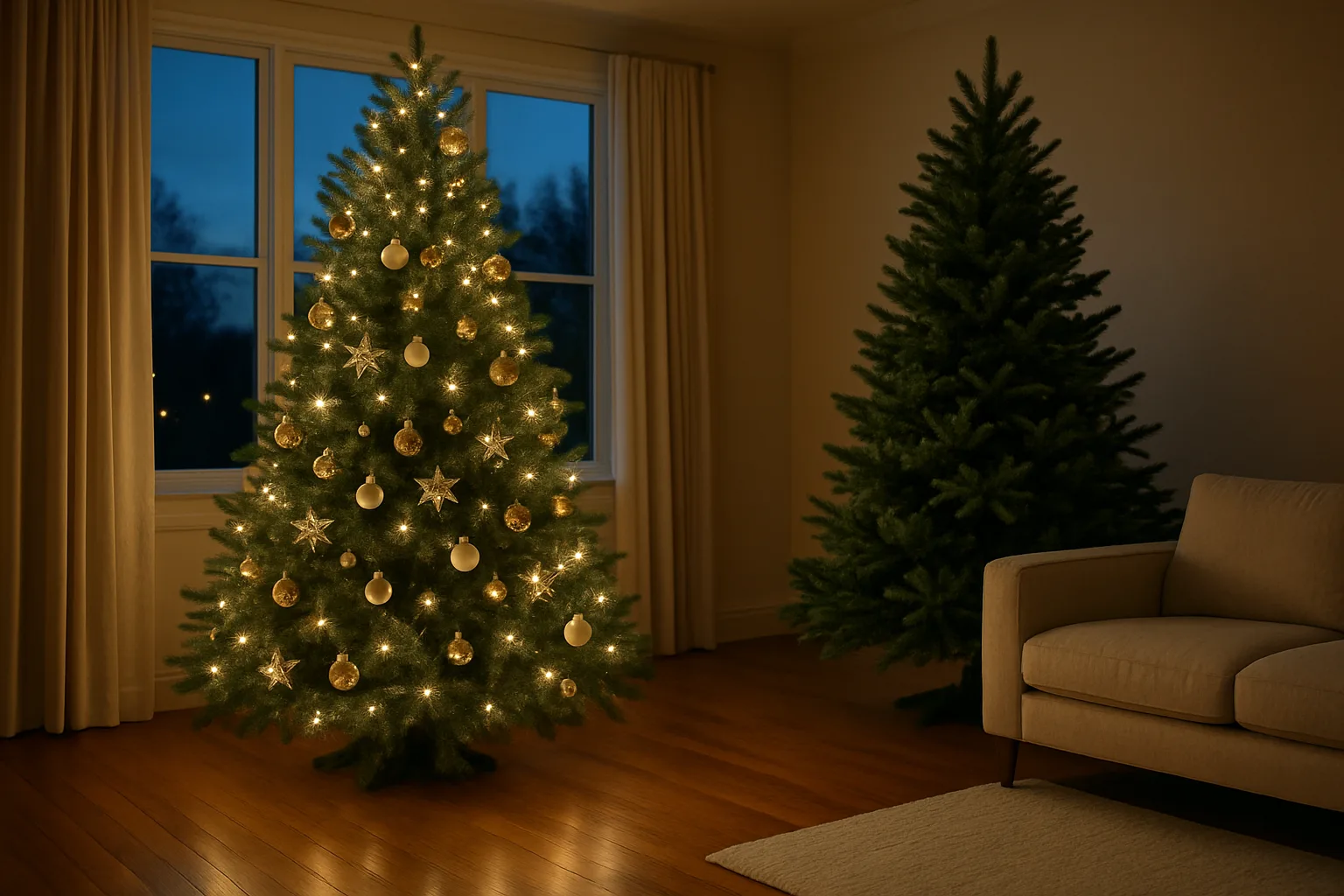
Balsam Hill vs. National Tree Company: Blue Spruce vs. Douglas Fir Artificial Trees
Balsam Hill Classic Blue Spruce vs. National Tree Company Downswept Douglas Fir: fullness, branch strength, setup time, color and why unlit can be smarter.
Balsam Hill and National Tree Company sit at two different price points, and their best-known 7.5-foot trees show where the extra money goes. Balsam Hill's Classic Blue Spruce is the premium pick: dense, blue-toned and built with stiff, wired branches. National Tree Company's Feel Real Downswept Douglas Fir costs noticeably less, mixes two kinds of branch tips and still reads as a convincing real fir from across the room.
Set up side by side, the two trees are closer than the price gap suggests. They differ in fullness, in how firmly the branches hold a shape, in setup time and in color. This guide covers those differences, the specs that matter, and one buying tip that applies to both brands.
As an Amazon Associate, Best Utah Real Estate earns from qualifying purchases.
Quick verdict
- Best for a dense tree whose branches stay put: Balsam Hill 7.5 ft Classic Blue Spruce (unlit). More tips, thicker branch wire and branches that hold whatever shape they're bent into. Expect to spend about an hour shaping it.
- Best value for a real-fir look: National Tree Company 7.5 ft Feel Real Downswept Douglas Fir (unlit). Molded tips that grip heavy ornaments, a natural yellow-green color and a 30–45 minute setup.
- Want lights already on? Both trees come pre-lit. Balsam Hill's version uses 1,000 clear LEDs, and National Tree Company's adds white-or-multicolor LEDs with 10 light functions.
For most buyers, the deciding question is simple. Pay for Balsam Hill if fullness and rigid branches matter most, or if a blue spruce is the look you want. Choose the Douglas fir if the goal is to stop buying a cut tree every year without paying premium prices.
Spec comparison
| Tree | Shop | Height | Listed tips | Base width | Foliage | Color | Lights |
|---|---|---|---|---|---|---|---|
| Balsam Hill Classic Blue Spruce (unlit) |  Buy on Amazon Buy on Amazon
| 7.5 ft | 2,960+ | About 60 in | Classic needle (PVC), one tip style | Blue-green | None |
| Balsam Hill Classic Blue Spruce (pre-lit) | 7.5 ft | 2,960+ | About 60 in | Classic needle (PVC), one tip style | Blue-green | 1,000 clear LED, Easy Plug | |
| National Tree Company Downswept Douglas Fir (unlit) |  Buy on Amazon Buy on Amazon
| 7.5 ft | 1,867 | About 59 in | Molded PE tips plus PVC | Yellow-green | None |
| National Tree Company Downswept Douglas Fir (pre-lit) | Buy on Amazon
| 7.5 ft | 1,867 | About 59 in | Molded PE tips plus PVC | Yellow-green | 750 dual-color LED, PowerConnect, 10 functions |
Specs come from the manufacturers' Amazon listings. Tip counts and light counts sometimes differ between listings for the same model, so confirm the model number before ordering.
How the two trees actually differ
Fullness and needle count
The Balsam Hill tree is visibly fuller. Its listing counts more than 2,960 branch tips against 1,867 on the Douglas fir, and the difference is easy to see: the blue spruce looks thicker and more filled in. Both trees use hinged main branches that drop down off the center pole, and the basic construction is very similar. The extra tips are what separate them.
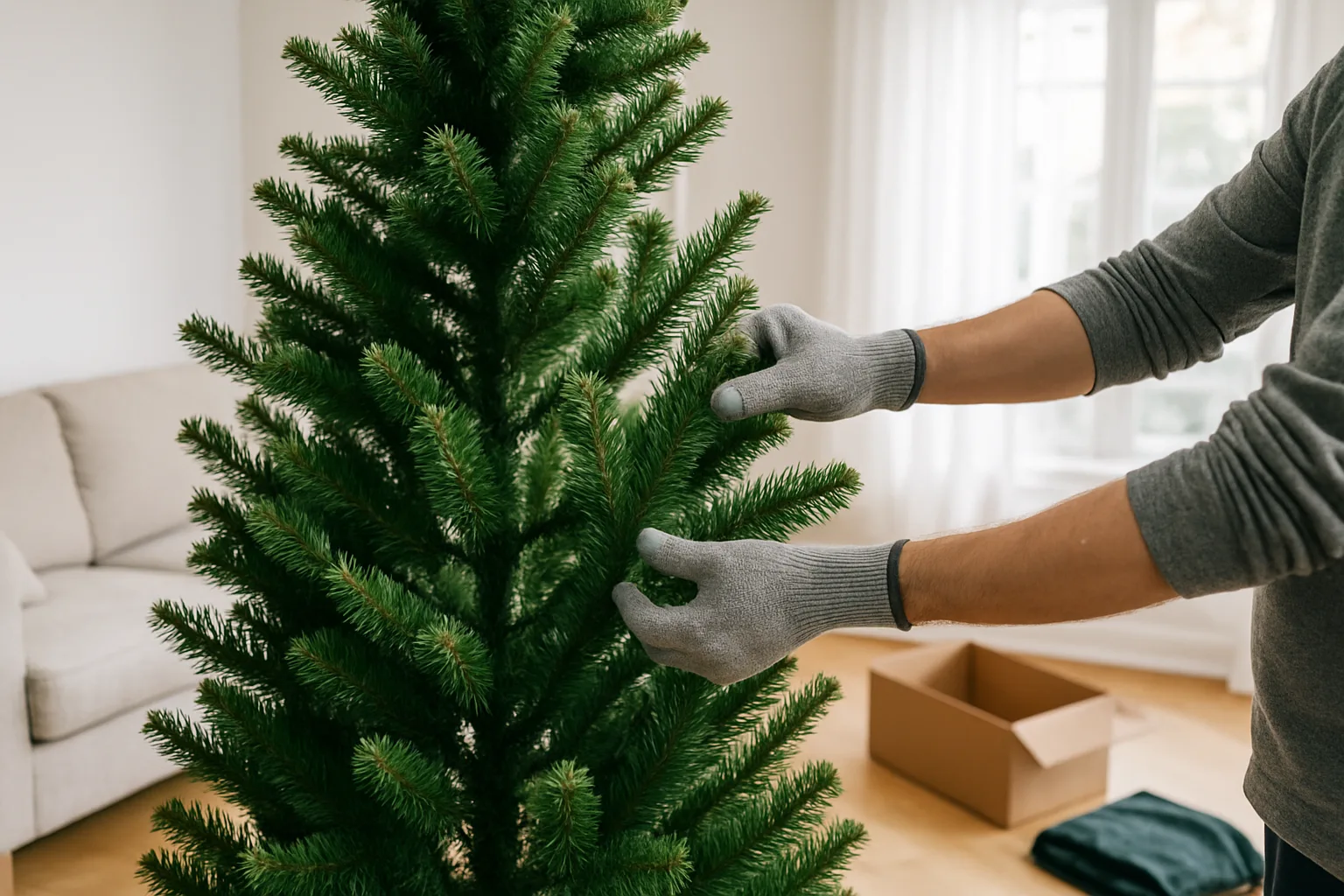
Those extra tips have a cost in time. Side-by-side setups put the Douglas fir at roughly 30 to 45 minutes to assemble and shape, and the Balsam Hill closer to an hour, since there are more tips to separate.
Branch strength and how well a shape holds
This is where the premium shows most. Each wired tip on the Balsam Hill tree is a little thicker, and the branches hold whatever position they're bent into. Once the tree is shaped, nothing drifts or sags as lights and ornaments go on.
The National Tree Company fir behaves differently. Its main branches don't lock into place as firmly, so they can shift while the tree is being shaped. Lights and ornaments end up holding them in position. The fir also uses two kinds of tips:
- Flat PVC tips that look similar to the Balsam Hill needles but are thinner and carry less weight.
- Molded PE tips (National Tree Company's "Feel Real" branches), which are thick, slightly rubbery and easy to bend. These are the ones to hang heavy ornaments on.
Every tip on the Balsam Hill tree is the same style, so there's no need to think about where heavy ornaments go. On the fir, it pays to put glass balls and other heavy pieces on the molded tips.
Color
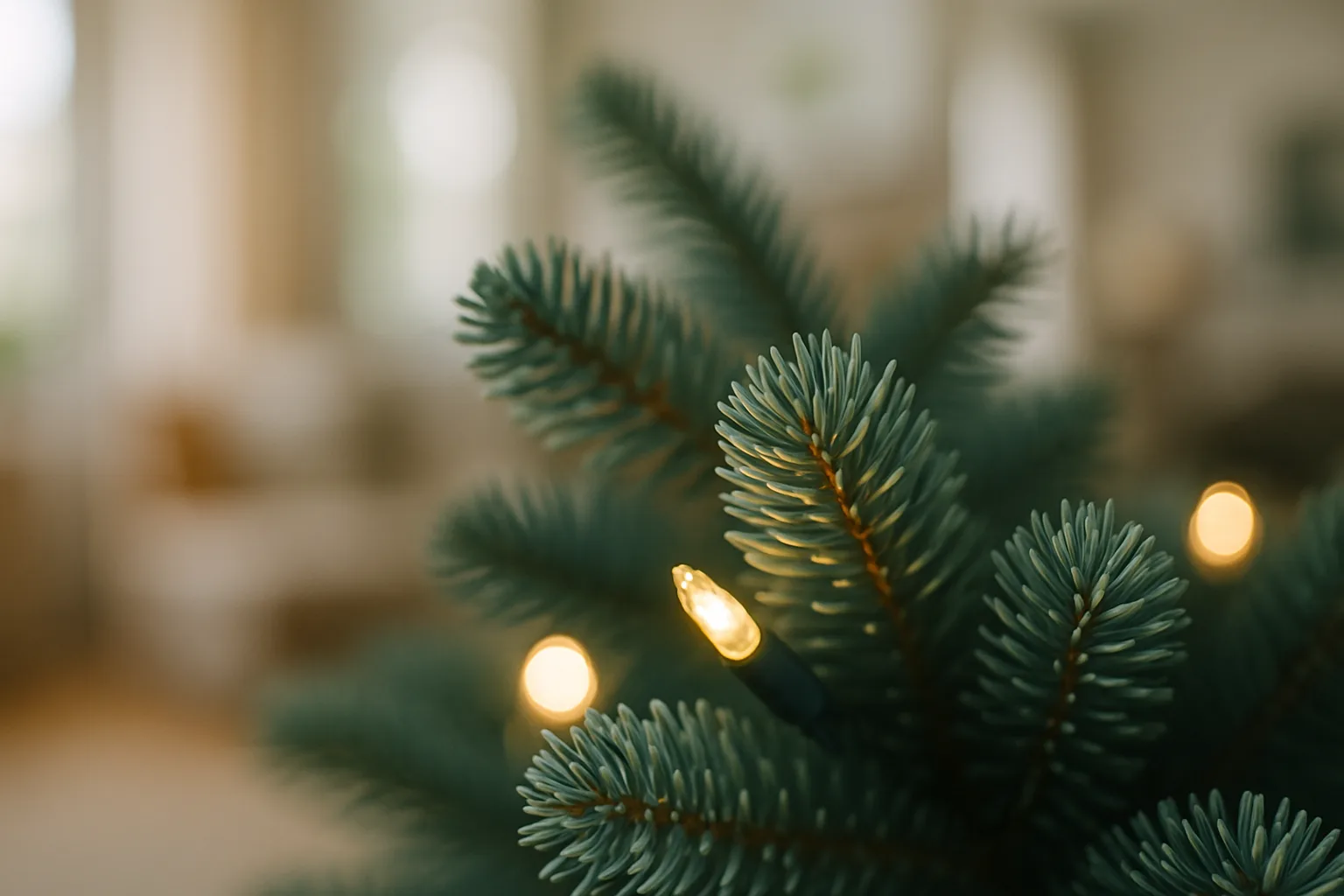
The two trees aim at different real species, and the color follows. The blue spruce has a distinct blue undertone in the needles that comes forward under warm or gold-toned lights. It suits a wintry palette of white, gold and champagne. The Douglas fir is a yellow-green with only a faint blue cast, which is accurate to a real Douglas fir and suits traditional red-and-green decorating. Both read as close to the real thing from normal viewing distance.
Footprint
Neither tree is small at the base. Both listings put the 7.5-foot full shape at roughly five feet across, about 59 to 60 inches tip to tip. That is a lot of floor in an average living room, and it's easy to underestimate when looking at product photos. Measure the spot before buying, and leave a buffer between the branch tips and the wall so there's room to reach outlets and keep cords from being crushed. If five feet won't fit, a slim or narrow profile is the better shape, and both brands sell them.
Unlit or pre-lit?
A pre-lit tree skips the job of stringing lights. The catch is that the lights are permanently attached. If a section fails after the warranty, or if tastes change from warm white to multicolor, the whole tree is stuck with them.
Buying unlit sidesteps that. LED light sets keep improving, and an unlit tree can take warm white one year and colored bulbs the next. (For picking a warm-white color temperature, see how to make a room feel cozy.) That flexibility is the main reason to choose the unlit versions of both trees here, especially the Balsam Hill, which is meant to last many seasons. The NFPA's Christmas tree safety tip sheet recommends lights listed by a qualified testing laboratory and an artificial tree labeled as fire-retardant, so check for both when adding lights to an unlit tree.
For buyers who still want lights included, the pre-lit versions are well designed. Balsam Hill's Easy Plug system and National Tree Company's PowerConnect both run power through the center pole, so the sections light up as they're stacked and only one cord goes to the wall.
The picks in detail
Balsam Hill 7.5 ft Classic Blue Spruce
The unlit Classic Blue Spruce is the one to get if the tree itself is the centerpiece. It ships compressed with a stand that has rubber feet, a storage bag and fluffing gloves. Plan on about an hour of shaping the first time. The payoff is a dense tree whose branches hold their shape all season. Its blue-green color makes it a strong base for a white-and-gold scheme.
Balsam Hill Classic Blue SpruceCheck today’s price on AmazonBuy on Amazon →
Prefer lights already on? The pre-lit version with 1,000 clear LEDs uses the same foliage, with Easy Plug wiring and a foot pedal.
 Balsam Hill Pre-Lit Classic Blue SpruceCheck today’s price on AmazonBuy on Amazon →
National Tree Company 7.5 ft Feel Real Downswept Douglas Fir
The unlit Downswept Douglas Fir is the practical pick for a household that wants a full-size, lifelike tree that holds plenty of ornaments without paying premium prices. Setup is quicker, the molded tips handle heavy ornaments well, and the color is a convincing match for a real Douglas fir. The trade-off is fewer tips and main branches that rely on decorations to stay perfectly in place.
National Tree Company Downswept Douglas FirCheck today’s price on AmazonBuy on Amazon →
The pre-lit Downswept Douglas Fir adds 750 LEDs that switch between white and multicolor, 10 light functions, a foot pedal and PowerConnect wiring. It suits buyers who want both color options without buying two sets of lights.
Who should buy which
- Buy the Balsam Hill for the fullest tree, branches that never need re-shaping mid-season, or a blue spruce for a wintry white, silver or gold scheme.
- Buy the National Tree Company fir for a full-size, realistic tree at a lower cost, a classic green look, quicker setup and lots of heavy ornaments.
- Short on floor space? Skip both full shapes. At about five feet across, they need a large room. Look at each brand's slim versions instead.
- Not sure about lights? Buy unlit and choose the lights separately. Changing the look later is then as simple as swapping a string.
Prefer a tree with built-in twinkle effects? See the comparison of twinkling trees like the Grand Duchess and My Texas House. Considering a snowy look instead? The guide to flocked vs. green artificial trees covers shedding and setup.
Lighting the outside of the house too? See the comparison of permanent outdoor lights from Govee, Lumary and Eufy, or the guide to the best time to hang Christmas lights.
Posted by Kristopher Larson
Frequently asked questions
Is a Balsam Hill tree worth the extra cost over National Tree Company?
It depends on what matters most. The Balsam Hill Classic Blue Spruce has far more branch tips (2,960+ vs. 1,867 on the 7.5-foot Downswept Douglas Fir), thicker branch wire and branches that hold their shape without help from decorations. Buyers who want the fullest, most rigid tree get that from Balsam Hill. Buyers who mainly want a realistic full-size tree at a lower cost are well served by National Tree Company.
How wide is a 7.5-foot artificial Christmas tree?
A full-shape 7.5-foot tree is usually about five feet across at the base. The Balsam Hill Classic Blue Spruce lists about 60 inches and the National Tree Company Downswept Douglas Fir about 59 inches. Slim and pencil shapes run much narrower, so measure the floor space and leave a gap to the wall before choosing a profile.
How long does it take to set up an artificial Christmas tree?
Stacking the sections takes only a few minutes. Shaping the branches takes most of the time. Expect about 30 to 45 minutes for a tree like the National Tree Company Douglas fir and closer to an hour for a denser tree like the Balsam Hill Blue Spruce, which has more tips to separate.
Should I buy a pre-lit or unlit artificial tree?
Unlit is the more flexible long-term choice. The lights on a pre-lit tree are permanently attached, so a failed section or a change of taste means living with them. An unlit tree can take warm white lights one season and multicolor the next. Pre-lit trees save setup time and keep cords out of sight, which is their main appeal.
What is the difference between PE and PVC tips on an artificial tree?
PVC tips are flat strips of needle-like plastic twisted around wire. They are the traditional, lower-cost foliage. PE tips are molded from real branches, so they look and feel more three-dimensional. On the National Tree Company Douglas fir, the molded PE tips are also the thicker, sturdier ones, so they're the best place for heavy ornaments.
Does Balsam Hill sell on Amazon?
Yes. Balsam Hill lists many of its trees on Amazon, including the Classic Blue Spruce in unlit and pre-lit versions. Listings for the same tree can differ in light type (incandescent, LED or app-controlled), so check the light count and model in the listing title before buying.
Keep reading
More from the blog

Costway Christmas Inflatables Reviewed: Snow Globe, Nativity, Santa on a Dinosaur and More

Best Christmas Tree Stand for a Real Tree: Steel vs. Plastic vs. Ratchet (Cinco, Jack-Post, Krinner)
LED vs. Incandescent Christmas Lights: Why LEDs Look Harsh and Which Sets Look Warm
