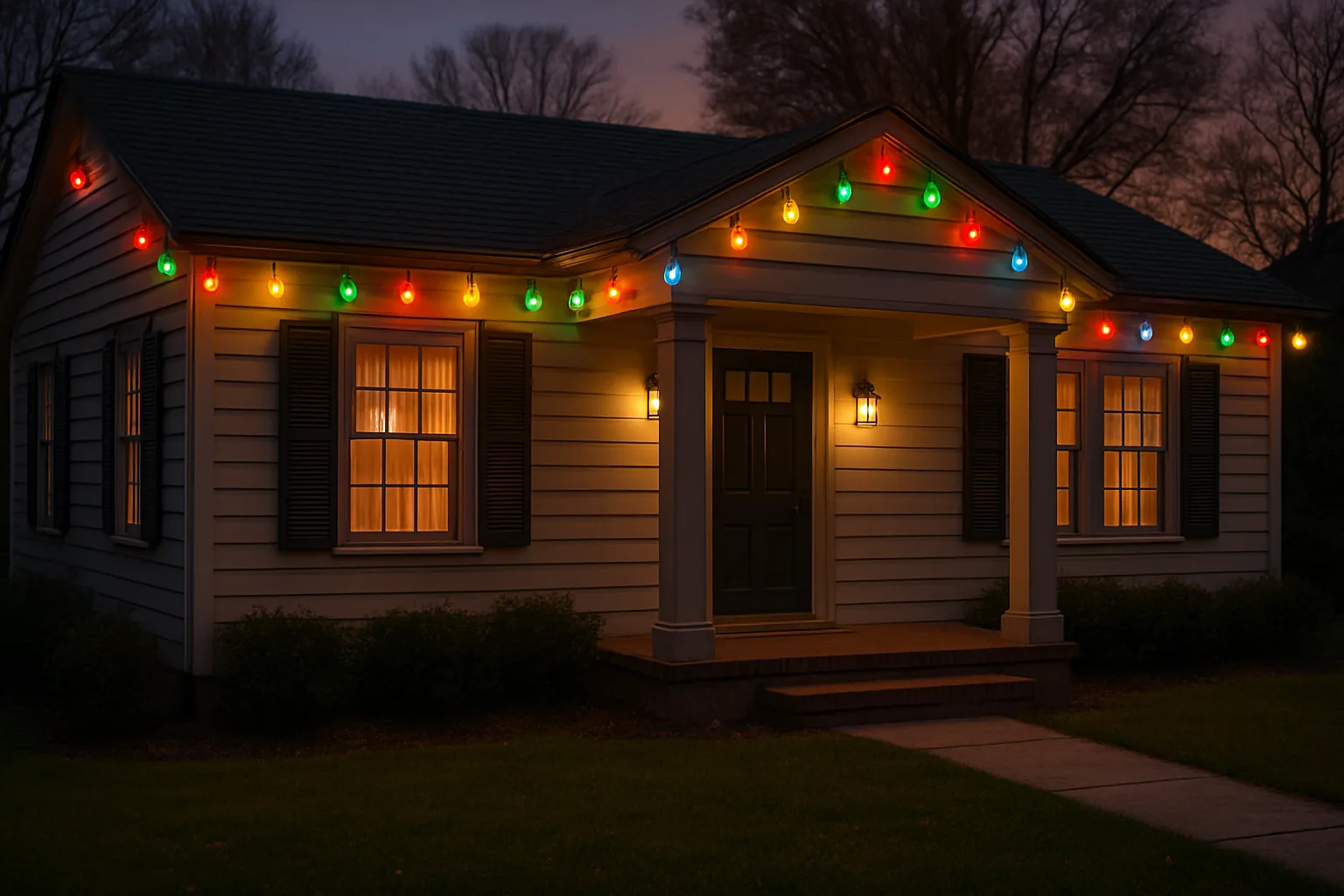
C3 vs. C6 vs. C7 vs. C9 Christmas Lights: Which Bulb Size for Rooflines, Trees and Bushes
C3, C6, C7 and C9 Christmas lights compared: what the sizes mean, which belong on a roofline, why spacing and warm white vary, and which strands to buy.
Walk down the Christmas light aisle and the boxes shout "super bright," "mega bright" and "ultra bright," while the bulb sizes, C3, C6, C7 and C9, get the small print. Size and spacing decide far more about how a display looks from the street than any brightness claim, and those claims turn out to be harder to compare than they look.
This guide covers what the C sizes mean, which ones belong on a roofline, what side-by-side comparisons of store-brand and online LED sets found about warm white, spacing and brightness, and which strands to buy for each job.
As an Amazon Associate, Best Utah Real Estate earns from qualifying purchases.
Quick verdict
- Rooflines and gutters: C9, with C7 as the slightly smaller alternative. A set like the Wintergreen Lighting 25-bulb C9 warm white on 8-inch spacing is the classic roofline look.
- A smaller roofline or porch trim: C7, such as the Wintergreen 25-bulb C7 warm white.
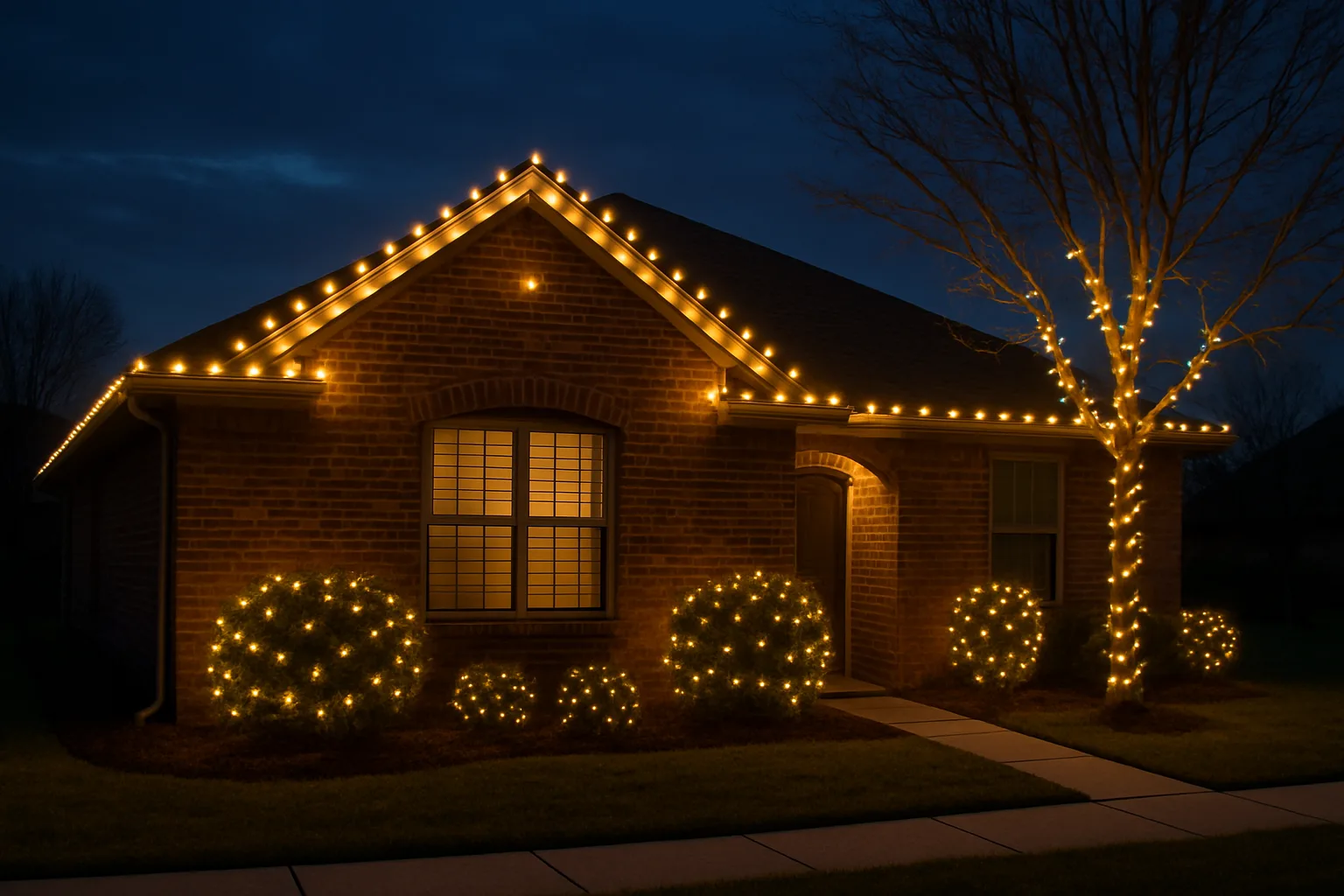
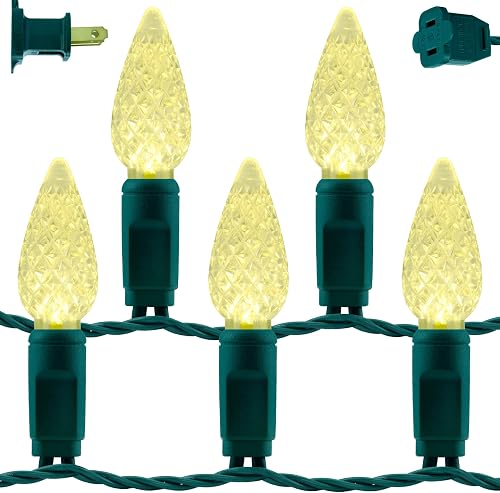
- Wrapping trees, trunks and bushes: C6 on 4-inch spacing, such as the YULETIME 100-bulb C6 warm white. C6 is borderline for a roofline.
- A modern stand-in for old mini lights: C3, such as the Yirunfa 50-bulb C3 warm white. Too small for a roofline.
What C3, C6, C7 and C9 mean
The "C" describes the shape: the tapered candle-flame or strawberry bulb most people picture as a Christmas light. The number is the size, and bigger means larger. By the common convention, the number is the bulb's widest diameter in eighths of an inch, so a C7 is about 7/8 inch across and a C9 about 1 1/8 inches. In practice the convention is loose. Side-by-side comparisons found that two bulbs both sold as C7 can differ visibly in size between brands, so treat the label as a size class, not a measurement.
On LED strands, the "bulb" is usually a plastic cover over an LED rather than a true glass bulb. Larger replaceable LED bulbs still follow the old socket standards: C7 uses the E12 candelabra base and C9 the larger E17 intermediate base, so the two don't interchange. The 1000Bulbs guide to C7 vs. C9 lists typical uses for each.
The sizes side by side
| Size | Approximate width | Typical spacing | Best use | Pick |
|---|---|---|---|---|
| C9 | About 1 1/8 in | 8 in (some 12 in) | Rooflines, gutters, large outdoor trees | Wintergreen 25-bulb C9 warm white (8 in) |
| C7 | About 7/8 in | 8 in | Smaller rooflines, porches, railings | Wintergreen 25-bulb C7 warm white (8 in) |
| C6 | Smaller strawberry bulb | 4 in | Wrapping trees, trunks and bushes; borderline on rooflines | YULETIME 100-bulb C6 warm white (4 in) |
| C3 | Mini strawberry bulb | About 4 in | Replacing classic mini lights; palms and landscaping accents | Yirunfa 50-bulb C3 warm white |
What side-by-side comparisons found
C9 is the roofline size; C6 and C3 are not
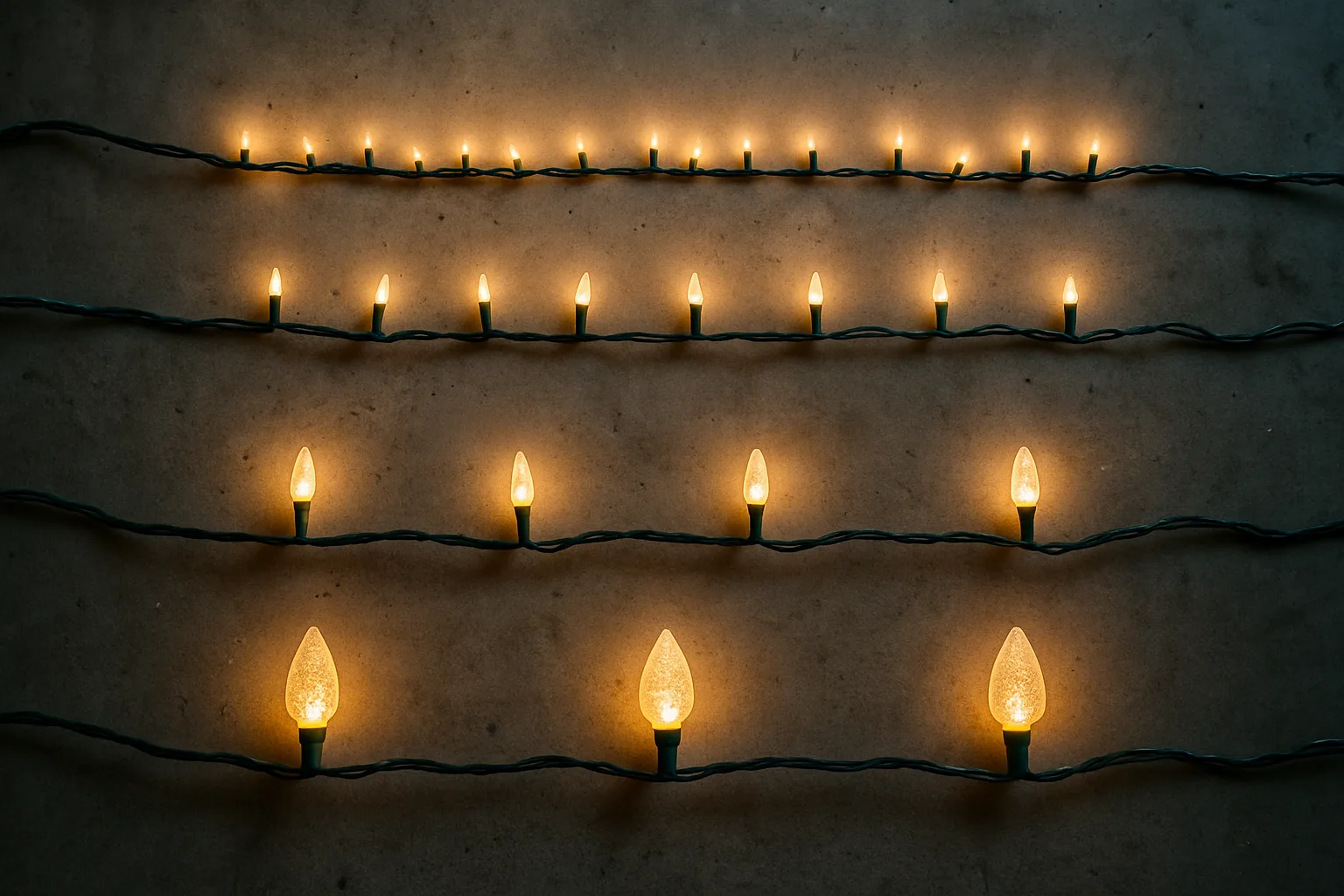
Lit side by side, C7 and C9 read clearly from the street, and C9 gives the fullest roofline outline. C7 works fine on a roofline too, just with a slightly lighter line. C6 sits on the line: on most houses it looks a little small for a roofline but works well wrapped around trees and shrubs or on a Christmas tree. C3 is too small for anything structural. Its best role is as a replacement for traditional mini lights outdoors, where its candle shape looks more finished. It also pairs well with other small LED shapes such as raspberry bulbs and square-topped dome lights, which makes it useful for wrapping palms and landscape plants.
"Warm white" is not a single color
Every set compared was labeled warm white, and they did not match. Bulb shape alone changed the tint. One faceted C6 set from a big-box house brand looked distinctly yellow in person, while other C6 sets on the same shelf looked like a normal warm white. The practical lesson is to pick one brand and line, buy enough for the whole house at once, and avoid adding a few strands a year later from a different batch or brand.
Spacing changes the look more than brightness
Most C3 and C6 strands space bulbs about 4 inches apart. Most C7 and C9 strands use about 8 inches, and some C9 sets stretch to 12. That spacing hides inside the box's numbers. Two C9 strands from the same store each held 25 bulbs, but one had a lighted length of 14 feet 6 inches and the other 24 feet. On the roofline, the 12-inch strand looked noticeably sparser, with gaps between bulbs instead of a continuous line. Tighter spacing generally suits trunks and trees, and 8 inches is the usual sweet spot for a roofline. The useful comparison is lighted length and bulb count, not just the number of bulbs per box.
Brightness claims are relative
"Two times brighter" turned out to mean brighter than the same store brand's other lights, not brighter than anything in particular. In that comparison, the "brighter" C9 used a clear, smooth cover instead of a faceted one, drew more power (4.2 watts per strand versus 2.4) and spread its 25 bulbs farther apart. It did look brighter, but the wide spacing undercut it. The store's top-tier "ultra bright" C9s were brighter still and returned to 8-inch spacing. Meanwhile the basic store-brand C9s looked slightly brighter than a popular online C9 set, so price isn't a reliable guide to output either.
Finish matters as well. Faceted covers sparkle and throw light in many directions. Smooth, clear covers look brighter and, mounted close to siding or trim, cast a visible pool of color on the surface behind them.
Cheap strands can flicker
Seen through a camera shooting at 60 frames per second, the cheapest strands kept blinking out of the frame as the camera panned, while the higher-end sets stayed lit in every frame. That suggests the cheaper strands flicker more. Most people won't see it with a steady gaze, but some notice it when glancing across a display. The guide to LED vs. incandescent Christmas lights explains why LED strands flicker and why many LED colors look harsher than incandescent.
How to choose
- Measure the run first. Add up roofline, gutter and peak lengths and divide by each strand's lighted length, not its total cord length.
- Pick size by distance. Anything viewed from the street, such as rooflines and second stories, wants C9 or C7. Anything viewed up close, such as railings, shrubs and tree trunks, can go smaller.
- Pick spacing by look. About 8 inches gives a continuous roofline. Twelve inches covers more ground per strand but looks dotted.
- Buy all of one color at once. Warm white varies by brand, batch and bulb shape.
- Decide on replaceable bulbs. Many consumer strands have bulbs molded in place, so a failed or cracked bulb can't be swapped. Commercial-style sets with removable bulbs usually cost more but can be repaired bulb by bulb. The Wintergreen OptiCore commercial C9 set is one example, with removable warm white bulbs on a 25 ft stringer.
Homeowners tired of ladders every year can skip strands altogether: the permanent outdoor lights comparison covers track systems that stay up year-round.
The picks in detail
Wintergreen Lighting 25-bulb C9 warm white
Twenty-five warm white C9 LEDs on green wire, spaced 8 inches apart over a 17 ft set, rated for indoor and outdoor use and UL certified. The listing gives 3000K and about 2.4 watts per set. The bulbs are molded in, not replaceable. This is the go-to roofline strand when the goal is a continuous classic outline.
 Wintergreen C9 Warm White, 25 BulbsCheck today’s price on AmazonBuy on Amazon →
Wintergreen Lighting 25-bulb C7 warm white
The same format in C7: 25 bulbs over a 17 ft set with 8-inch spacing. It suits single-story rooflines, porch trim and railings, where C9 can look oversized up close. Buy it alongside the C9 strand from the same line if the two sizes will sit near each other, so the warm whites match.
 Wintergreen C7 Warm White, 25 BulbsCheck today’s price on AmazonBuy on Amazon →
YULETIME 100-bulb C6 warm white
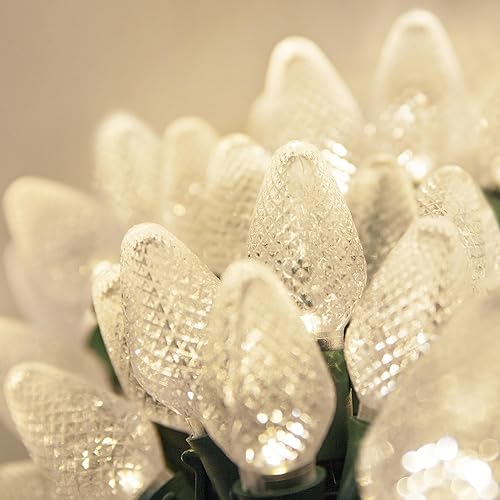
One hundred warm white C6 strawberry bulbs on a 33 ft lighted length with 4-inch spacing, in one-piece construction. The listing gives about 7.2 watts and allows up to 30 strands end to end. The tight spacing is what makes C6 good for spiraling up trunks and wrapping shrubs.
 YULETIME C6 Warm White, 100 BulbsCheck today’s price on AmazonBuy on Amazon →
Yirunfa 50-bulb C3 warm white
Fifty warm white C3 bulbs on a 17 ft green-wire set, UL listed for indoor and outdoor use, with spare fuses. Use it where mini lights would normally go: hedges, small trees, palms and garland. Don't use it on the roofline.
 Yirunfa C3 Warm White, 50 BulbsCheck today’s price on AmazonBuy on Amazon →
Who should buy which
- Outlining a two-story roofline: C9 on 8-inch spacing.
- Outlining a single-story house, porch or railing: C7, or C9 for a bolder look.
- Wrapping trunks, trees and bushes: C6 on 4-inch spacing.
- Replacing worn-out mini lights in landscaping: C3.
- Wanting strands that can be repaired: a commercial set with removable bulbs.
Once the strands are picked, the guide on the best time to hang Christmas lights covers when to get them up.
Posted by Kristopher Larson
Frequently asked questions
What is the difference between C7 and C9 Christmas lights?
Size. By the common convention the number is the bulb's diameter in eighths of an inch, so a C7 is about 7/8 inch wide and a C9 about 1 1/8 inches. Replaceable C7 bulbs use the smaller E12 candelabra base and C9 bulbs the E17 intermediate base, so they aren't interchangeable. C9 gives a bolder roofline; C7 suits smaller houses, porches and railings.
Which Christmas light size is best for a roofline?
C9 is the standard roofline size, and C7 works on smaller or single-story houses. C6 usually looks too small on a roofline, and C3 is far too small. For a continuous outline, choose strands with about 8 inches between bulbs.
What does the C mean in C9 Christmas lights?
The C refers to the bulb shape: the tapered cone or candle-flame bulb, sometimes called a strawberry shape on small LED sets. The number after it indicates size, with higher numbers meaning larger bulbs, though actual dimensions vary between brands.
What spacing should outdoor Christmas lights have?
About 8 inches is typical for C7 and C9 roofline strands and gives a continuous line from the street. Some C9 sets use 12-inch spacing, which covers more distance per strand but looks dotted. Small C3 and C6 sets usually use about 4-inch spacing, which suits wrapping tree trunks, trees and bushes.
Why do warm white Christmas lights from different sets not match?
Warm white isn't a standard color. It varies between brands, product lines and even bulb shapes, so faceted and smooth bulbs labeled the same can look different. Buy enough strands from one brand and line at the same time, and keep a spare or two for repairs.
Are brighter Christmas lights better?
Not automatically. "Two times brighter" claims usually compare a brand's lights to its own cheaper line, and a brighter strand with wider bulb spacing can still look sparse. Clear, smooth covers look brighter than faceted ones. Size and spacing usually matter more to how a display looks than raw brightness.
Keep reading
More from the blog

Costway Christmas Inflatables Reviewed: Snow Globe, Nativity, Santa on a Dinosaur and More

Best Christmas Tree Stand for a Real Tree: Steel vs. Plastic vs. Ratchet (Cinco, Jack-Post, Krinner)
Smart Christmas Tree Lights Compared: Govee String Lights 2 vs. Govee Tree Lights vs. Twinkly