Data Centers Near Utah Neighborhoods: A Buyer's Due-Diligence Checklist for 2026
Spanish Fork rewrote its zoning for a self-powered data center, then the project moved closer to Utah Lake. Here is what buyers near any proposed site should check before closing.
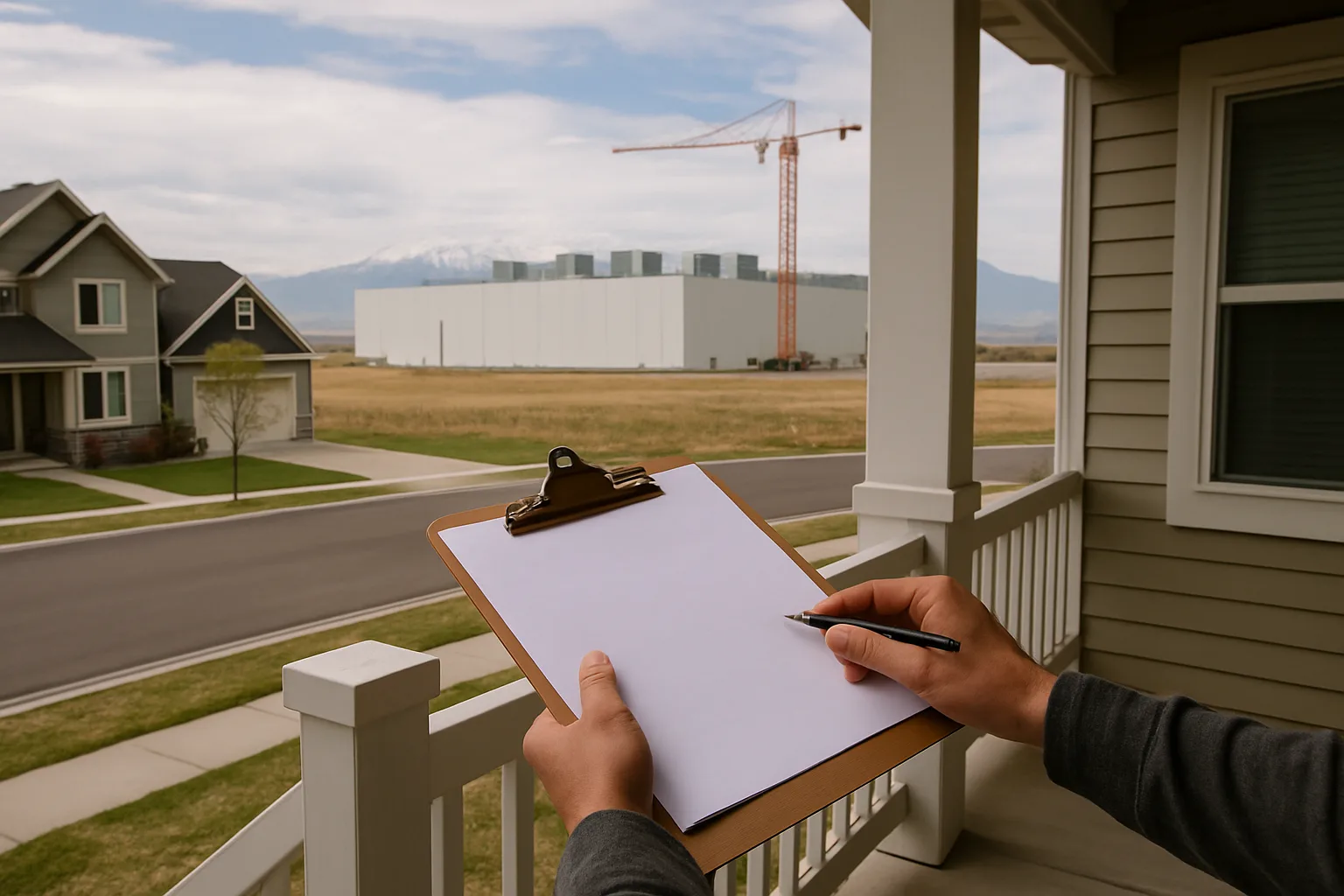
On a 3-2 vote in late September 2026, the Spanish Fork City Council rewrote its zoning code so a data center that generates its own electricity could be built inside city limits. Within days, the developer said it would not use the site residents had fought over at the mouth of Spanish Fork Canyon and would move the project to an industrial area closer to Utah Lake. For anyone shopping for a home in a growing Utah city, the episode is a useful reminder: the empty warehouse or farm field down the road can be rezoned for something very different, and the decision usually happens in a public meeting that few buyers ever see.
This guide walks through what happened in Spanish Fork, where other large data center projects stand in Utah, and the specific items a buyer should check when a home sits near a proposed site.
The Spanish Fork Case, Step by Step
Provo-based Volition proposed redeveloping the former Fingerhut warehouse at 4000 E. U.S. 6, a building of roughly 1 million square feet that now operates as a distribution center, into an AI data center with its own power plant. The company said the facility would run on natural-gas-fueled fuel cells, stay off the existing electric grid, and use a closed-loop cooling system that is filled once and topped off for humidity. Reported capacity shifted as the proposal evolved, ranging from about 225 to 400 megawatts in news coverage between August and late September.
Spanish Fork's code did not address data centers or facilities that make their own electricity, so the city drafted an amendment to Title 15, its zoning title. The council heard more than six hours of discussion on August 18, 2026, including almost two hours of public comment that was nearly unanimous in opposition, according to KSL. Concerns included air emissions, noise, wildlife, the nearby Spanish Fork River Trail, and the lack of independent data behind the company's claims. Residents of neighboring Mapleton, some living less than a mile from the site, also spoke.
The council delayed again on September 1, then adopted the amendment 3-2 at a special meeting reported by The Salt Lake Tribune on September 24. The adopted rules, as reported, include:
- Water caps: the initial fill for closed-loop cooling is limited to 600,000 gallons, and annual water for cooling and humidification is limited to half of that amount.
- Independent studies: the applicant must provide independent analysis of noise, vibration and heat, followed by ongoing monitoring.
- A limit on the number of sites: the company's CEO told the Tribune the final rules allow only one power-generating data center in the city.
On September 29 the Tribune reported that Volition would move to a newer warehouse of about 440,000 square feet in the Stockman Flats development near Utah Lake, an industrial area farther from neighborhoods. A city spokesperson said the project still has to go through the regular development process: a site plan, technical studies and a development agreement. In other words, approval of the zoning text was not approval of the building, and there are more public steps to come. Buyers watching homes in Spanish Fork can follow those steps on the council and planning commission agendas.
Spanish Fork Is One of Several Utah Proposals
Data centers are already part of the landscape in several Utah communities. A 2026 presentation to a legislative interim committee, citing the Kem C. Gardner Policy Institute, counted 48 data centers operating in Utah as of April 2026, drawing about 920 megawatts combined, with roughly 2,600 more megawatts reported under construction.
Eagle Mountain
Eagle Mountain has hosted Meta's campus off Pony Express Parkway for years. In 2018, the Utah County Commission approved about $150 million in property tax incentives for that project, according to the Associated Press. QTS broke ground on a multi-year campus just west of the Meta site in October 2024, according to the city.
Millard County and Delta
In 2025 the Millard County Commission approved rezoning roughly 1,200 acres southeast of Delta from agricultural to heavy industrial for a planned campus called the Delta Gigasite, and separately rezoned about 4,000 acres of farmland for a Joule Capital Partners campus, KSL reported. Joule has described campus buildings powered by natural gas generators, while Creekstone Energy has outlined a mix of solar, natural gas and power from the Intermountain Power Project. These are rural sites, but they show how quickly agricultural land can be reclassified for industrial use.
Why Self-Powered Proposals Are Appearing Near Towns
Two pieces of state policy explain part of the trend. First, S.B. 132 from the 2025 session created a separate process for "large load" customers expected to reach 100 megawatts or more within five years, including a framework for closed private generation systems that operate apart from the utility. That opens the door to data centers that bring their own power plant instead of waiting on Rocky Mountain Power. Second, Utah offers a sales and use tax exemption for data centers of at least 150,000 square feet, according to the legislative presentation cited above, which also noted a 2026 water-reporting law for large data center water users.
For a homeowner, the practical result is that a data center proposal may now include on-site generation equipment, fuel lines and air permits, not just a windowless building. That changes the list of questions worth asking.
What Buyers Near a Proposed Site Should Check
1. Current zoning and what is already allowed
Start with the parcel's zoning map and the list of permitted and conditional uses in that zone. In Spanish Fork, FOX 13 reported that other possible futures for the old warehouse included a distribution hub, a fulfillment center or even a cement plant. Knowing what can be built by right is as important as knowing what is proposed. A site that is already zoned heavy industrial will almost always host something busy.
2. Noise, vibration and heat
Ask whether the city requires a noise study, who performs it, where the measurement points are, and whether monitoring continues after opening. Spanish Fork's new rules require independent analysis and ongoing monitoring. Cooling equipment, backup generators and on-site power plants all produce sound, and the location of that equipment on the lot matters as much as the building itself.
3. Power lines, substations and generation
Look for planned transmission lines, new substations or utility easements on the city's capital projects list and in the project's site plan. A self-powered project replaces some grid work with on-site generation, which brings fuel delivery, exhaust stacks and an air quality permit from the Utah Division of Air Quality. Permit applications go through a public comment period, which is another point where residents can see emissions estimates.
4. Water use
Cooling method drives water demand. Closed-loop and dry or air-cooled systems use far less water than evaporative cooling. Check whether the city has written a numeric cap into code or a development agreement, as Spanish Fork did, rather than relying on a company's description.
5. Tax base and incentives
Data centers can add large values to the tax rolls, but incentives and abatement agreements can reduce what reaches local budgets in the early years. Ask the city or county whether an incentive or tax increment agreement is proposed, how long it lasts, and which taxing entities (city, school district, county) are participating. The same legislative presentation noted that large data centers tend to create many construction jobs and far fewer permanent ones; QTS has cited more than 2,000 construction jobs and more than 100 permanent positions in Eagle Mountain.
6. Traffic during construction
Multi-year build-outs mean heavy trucks, workforce traffic and road work. Ask whether a traffic study is required and which routes construction traffic will use, especially if a school or a neighborhood collector road sits between the site and the highway.
How to Read a City Agenda
Utah cities post meeting notices and agendas on the state's Utah Public Notice Website, and most also post packets on their own sites. A simple routine:
- Search the public notice site for the city name and the planning commission, city council and any redevelopment agency board. Sign up for notifications if available.
- Open the full packet, not just the agenda. The packet holds the staff report, the proposed ordinance text, maps and any studies.
- Learn the item types. A "text amendment" changes rules citywide (what happened in Spanish Fork). A "rezone" or "zone map amendment" changes one area. A "site plan" or "conditional use permit" is a specific project.
- Read the staff recommendation and conditions. Conditions such as water caps or monitoring often decide how a project will actually operate.
- Check the minutes afterward. Items are frequently tabled or continued, as Spanish Fork's was twice.
What Is Not Known Yet
There is no reliable Utah data yet showing how a nearby data center affects the sale price of surrounding homes, and the Spanish Fork project has not reached a site plan, let alone construction. A buyer's best protection is information gathered before closing: the zoning map, the agenda history, and the conditions attached to any approval. Current listings and new construction in Spanish Fork new-construction neighborhoods can be compared against those planning maps, and statewide listings are searchable at Best Utah Real Estate.
Frequently asked questions
Was a data center approved in Spanish Fork, Utah?
The Spanish Fork City Council adopted zoning rules in September 2026, on a 3-2 vote, that allow a data center with its own power generation under conditions on water use, noise, vibration and heat. That was a code change, not a building approval. The developer, Volition, then said it would move the project to the Stockman Flats industrial area near Utah Lake, where it still needs a site plan, technical studies and a development agreement.
Where was the original Spanish Fork data center site?
The first proposal targeted the former Fingerhut warehouse at 4000 E. U.S. 6, at the mouth of Spanish Fork Canyon. Residents of Spanish Fork and nearby Mapleton raised concerns about emissions, noise and the Spanish Fork River Trail before the company chose a site farther from neighborhoods.
How much water can a data center use under Spanish Fork's new rules?
As reported by The Salt Lake Tribune, the initial fill for a closed-loop cooling system is capped at 600,000 gallons, and annual water for cooling and humidification is limited to half of that amount. Buyers in other cities should check whether similar numeric limits exist in code or in a development agreement.
Do data centers lower nearby home values in Utah?
There is no reliable Utah data yet that measures the effect of a nearby data center on home prices. Buyers can reduce uncertainty by reviewing the zoning, the conditions attached to any approval, and planned power lines, substations and truck routes before closing.
Where can residents find city council and planning commission agendas in Utah?
Utah public bodies post meeting notices on the Utah Public Notice Website, and most cities also post full agenda packets on their own websites. The packet, not the one-page agenda, contains the staff report, proposed ordinance text, maps and studies.
Why are some Utah data centers building their own power plants?
A 2025 state law, S.B. 132, created a separate process for customers expected to use 100 megawatts or more, including a framework for private generation systems that run apart from the utility. Several developers, including proposals in Spanish Fork and Millard County, have planned on-site generation, often using natural gas.
Keep reading
More from the blog
How Utah Decides Where Homeless Shelters Go: Siting Rules and Public Records in 2026

Sign PDF Online: Fastest Way to Manage Digital Documents
When a Utah HOA Stops Working: Who Pays for Roads, Walls and Common Areas