15-Year vs. 30-Year Mortgage: Which Is Better in Utah?
We ran a 15-year and a 30-year mortgage on a median-priced Utah home: monthly payment, total interest, equity, paying a 30 like a 15, investing the difference and how each affects qualifying.

A 15-year mortgage is better if you can comfortably afford the higher payment and plan to keep the loan: on a typical Utah loan it saves about $358,000 in interest and clears the debt 15 years sooner. A 30-year mortgage is better if you need the lower payment, want room in your monthly budget, or would struggle to qualify at the 15-year payment. The gap in the monthly payment is about $860 on a median-priced Utah home with 20% down.
Below are the numbers both ways, what changes if you take a 30-year loan and pay it like a 15, and how the higher payment affects how much house you qualify for. This is general information, not financial advice; a lender can price both options for your own situation.
The Example Loan (as of November 2026)
- Home price: $521,000, Utah's median sale price for October 2026 (Utah Association of Realtors, Monthly Indicators, published November 10, 2026). Our Utah housing market report has the latest month.
- Loan: $416,800 with 20% down, and $468,900 with 10% down.
- Rates: 7.26% for a 30-year fixed and 6.82% for a 15-year fixed, Mortgage News Daily's daily indexes for November 25, 2026. A 15-year loan usually carries a lower rate than a 30-year loan; on that day the gap was 0.44 points.
- What's included: principal and interest only. Property taxes, homeowners insurance, HOA dues and mortgage insurance are the same or similar either way and are left out.
15-Year vs. 30-Year Mortgage: The Numbers
| $416,800 loan (20% down) | 30-year at 7.26% | 15-year at 6.82% |
|---|---|---|
| Monthly principal and interest | $2,846 | $3,705 |
| Difference per month | – | $858 more |
| Total interest over the loan | $607,810 | $250,010 |
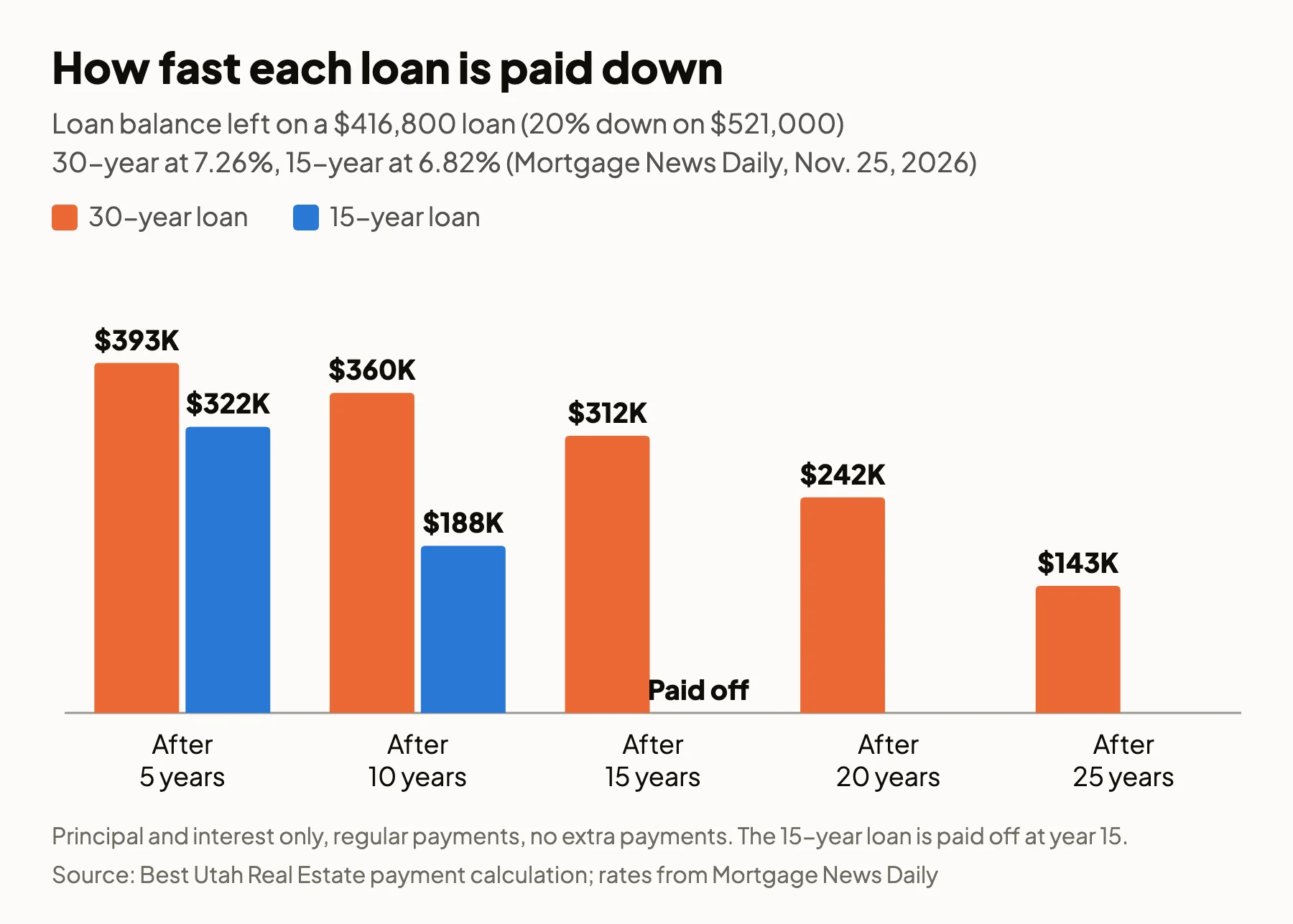
| Principal paid off after 5 years | $23,389 | $95,181 |
| Principal paid off after 10 years | $56,977 | $228,911 |
| Loan balance after 15 years | $311,589 | $0 |
The 15-year loan saves about $357,800 in interest. The early years show why: on the 30-year loan, the first five years of payments reduce the balance by about $23,000, because most of each payment is interest. On the 15-year loan, the same five years reduce it by about $95,000. "Principal paid off" leaves out your down payment and any change in the home's value; it is only what the payments themselves have paid down.
With 10% down ($468,900 loan), the payments are $3,202 on the 30-year and $4,168 on the 15-year, a difference of $966 a month. Total interest is $683,786 on the 30-year and $281,261 on the 15-year. Both would also need mortgage insurance at 10% down, which isn't counted here.
Paying a 30-Year Mortgage Like a 15-Year
Some buyers take the 30-year loan for its lower required payment and then pay extra. On the example loan:
- Paying the 15-year amount ($3,705) on the 30-year loan pays it off in 15 years and 10 months, with about $284,300 in total interest. That is about $34,000 more interest than the true 15-year loan, because the 30-year rate is higher.
- To finish the 30-year loan in exactly 15 years, the payment would need to be about $3,807 a month, roughly $100 more than the 15-year payment, for about $268,500 in total interest.
What the extra cost buys is flexibility. With the 30-year loan, the required payment stays at $2,846, so in a month with a job change, a medical bill or a new baby you can drop back to it. With a 15-year loan, $3,705 is owed every month. Whether that flexibility is worth about $34,000 depends on how steady your income is and how much cash you keep in reserve. Our study of extra mortgage payments, monthly vs. lump sum vs. biweekly runs the numbers on different ways to pay extra, and these strategies for paying off a mortgage faster cover the budgeting side.
What If You Take the 30-Year and Invest the Difference?
The common argument for the 30-year loan is to invest the $858 a month instead. To compare fairly, assume the same $3,705 a month goes out either way for 30 years:
- 30-year path: pay $2,846 on the loan and invest $858 a month for 30 years.
- 15-year path: pay $3,705 on the loan for 15 years, then invest the full $3,705 a month for the next 15 years.
| Assumed investment return (before taxes) | 30-year path after 30 years | 15-year path after 30 years | Difference |
|---|---|---|---|
| 5% a year | $714,378 | $990,172 | 15-year path ahead by about $276,000 |
| 7% a year | $1,047,174 | $1,174,187 | 15-year path ahead by about $127,000 |
Both homes are paid off after 30 years, so the difference is the investment balance. In this example the 30-year path only comes out ahead if investments earn more than about 8% a year, because the 30-year loan costs 7.26% while the 15-year loan's lower rate applies to the whole balance. These returns are illustrations, not predictions: they ignore taxes on investment gains and any mortgage interest deduction, and the risk that returns are lower or uneven. The comparison also assumes the 30-year borrower really invests the difference every month for 30 years.
Does a 15-Year Mortgage Make It Harder to Qualify?
Yes, for the same home. Lenders compare your total monthly debts to your gross monthly income. Under Fannie Mae's Selling Guide (B3-6-02), the maximum total debt-to-income ratio is 36% for manually underwritten loans, up to 45% for manually underwritten loans that meet set credit score and reserve requirements, and 50% for loans approved through Fannie Mae's Desktop Underwriter system.
| Income needed for principal and interest alone ($416,800 loan) | 30-year | 15-year |
|---|---|---|
| At 36% of income | $94,900 a year | $123,500 a year |
| At 45% of income | $75,900 a year | $98,800 a year |
| At 50% of income | $68,300 a year | $88,900 a year |
Real qualifying uses the full payment, including property taxes, insurance, HOA dues and mortgage insurance, plus car loans, student loans and card minimums, so the income needed is higher than these figures. The point is the gap: at the same ratio, the 15-year payment takes about 30% more income, or the same income qualifies for a smaller loan. Our Utah rent vs. own study shows the full monthly cost of owning by city.
When Each Tends to Fit
A 15-year loan tends to fit buyers with steady income who can make the payment and still keep a cash cushion, buyers who want the home paid off by a set date such as retirement, and people refinancing a loan they have already paid down.
A 30-year loan tends to fit first-time buyers stretching to buy, households with variable income, buyers who want the lower required payment as a safety margin, and anyone who expects to sell or refinance within a few years. If you choose a 30-year loan to keep the payment low, a lower rate also matters more; our guides to rate buydowns, assumable loans and ARMs and to a builder rate buydown vs. a price cut cover those options. Longer terms go further still; our 50-year mortgage explainer covers what stretching past 30 years costs.
In our experience, the right term is usually the one whose payment you could still make in a bad month. Lenders quote both terms side by side, so ask for each, along with the rate and fees, before you lock.
The Bottom Line
On a median-priced Utah home at November 2026 rates, a 15-year mortgage costs about $860 more a month and saves about $358,000 in interest. A 30-year loan paid like a 15 gets most of the savings while keeping a lower required payment, at a cost of about $34,000 more interest. Our Utah real estate guide has more on buying and financing a home.
About the numbers: standard fixed-rate amortization with monthly payments and monthly interest, rates held constant for the life of the loan. Rates are Mortgage News Daily's 30-year and 15-year fixed indexes for November 25, 2026; your rate will depend on credit, down payment, loan type and the day you lock. The home price is the Utah Association of Realtors' October 2026 statewide median. Investment figures assume the stated return is earned evenly every month with no taxes or fees. This is general information, not financial advice.
Frequently asked questions
Is a 15-year or 30-year mortgage better?
A 15-year mortgage is better if you can comfortably afford the higher payment and keep the loan; on a $416,800 Utah loan at November 2026 rates it saves about $358,000 in interest. A 30-year mortgage is better if you need the lower payment, want flexibility in your budget, or would have trouble qualifying at the 15-year payment.
How much more is a 15-year mortgage payment than a 30-year?
On a $416,800 loan (20% down on a $521,000 home), principal and interest are about $3,705 a month on a 15-year loan at 6.82% and $2,846 on a 30-year loan at 7.26%, a difference of about $858 a month. With 10% down the gap is about $966 a month.
How much interest does a 15-year mortgage save?
In our example, total interest is about $250,000 on the 15-year loan and $608,000 on the 30-year loan, a saving of about $358,000. The savings come from the shorter term and the lower rate that 15-year loans usually carry.
Can I pay off a 30-year mortgage in 15 years?
Yes, by paying extra. On the example loan, paying about $3,807 a month would finish the 30-year loan in 15 years. Paying the 15-year amount of $3,705 finishes it in about 15 years and 10 months, with about $34,000 more interest than a true 15-year loan, but the required payment stays at $2,846 if money gets tight.
Is it better to get a 30-year mortgage and invest the difference?
Only if the investments earn more than the mortgage costs. In our example, putting the same total monthly budget toward each plan for 30 years, the 15-year path came out ahead at an assumed 5% or 7% yearly return; the 30-year path only pulled ahead above about 8% a year, before taxes. These are illustrations, not predictions, and this isn't financial advice.
Is it harder to qualify for a 15-year mortgage?
Yes, for the same home, because the payment is higher. Fannie Mae caps total debt-to-income at 36% for manually underwritten loans, up to 45% with set credit and reserve requirements, and 50% through Desktop Underwriter. At 45%, principal and interest alone on the example loan take about $75,900 a year of income on a 30-year loan and $98,800 on a 15-year loan.
Kristopher Larson
Realtor® · Air Force veteran · Licensed in Utah & Nevada · Real Broker, LLC
Kris is an Air Force veteran who started in real estate in 2011, has been part of more than 350 transactions and once ran 20 luxury vacation rentals in Copper Rock and Paradise Village. He writes this site's guides from MLS data and public records, and says where every number comes from.
Keep reading
More from the blog
Builder Rate Buydown or Price Cut? Utah MLS Data
How Many Utah Homes Have an Assumable Loan? MLS Data
Do Newer Homes Sell for More? Utah Home Value by Year Built