GE Opal 2.0 Ultra vs. Typhur vs. Kismile vs. Frigidaire: 12 Countertop Ice Makers Measured
Side-by-side test of 12 countertop ice makers for tank size, speed, basket fill and noise: GE Opal 2.0 Ultra, Typhur, Kismile and Frigidaire.
Every countertop ice maker box makes the same promises: nine cubes in six minutes, 26 pounds a day, quiet enough to forget it is running. A side-by-side comparison of 12 machines, from the cheapest bullet makers to the GE Profile Opal 2.0 Ultra, checked those promises with a scale, a stopwatch, a watt meter and a sound meter. Every machine got the same 45°F water, and the bullet machines were set to small cubes for the main run.
The results split the field cleanly. The GE won almost every measured category, two mid-priced nugget machines from Typhur and Kismile tied for second, and the Frigidaire was the best of the bullet-ice machines. Several brands' claims about noise and basket size did not hold up.
As an Amazon Associate, Best Utah Real Estate earns from qualifying purchases.
Quick verdict
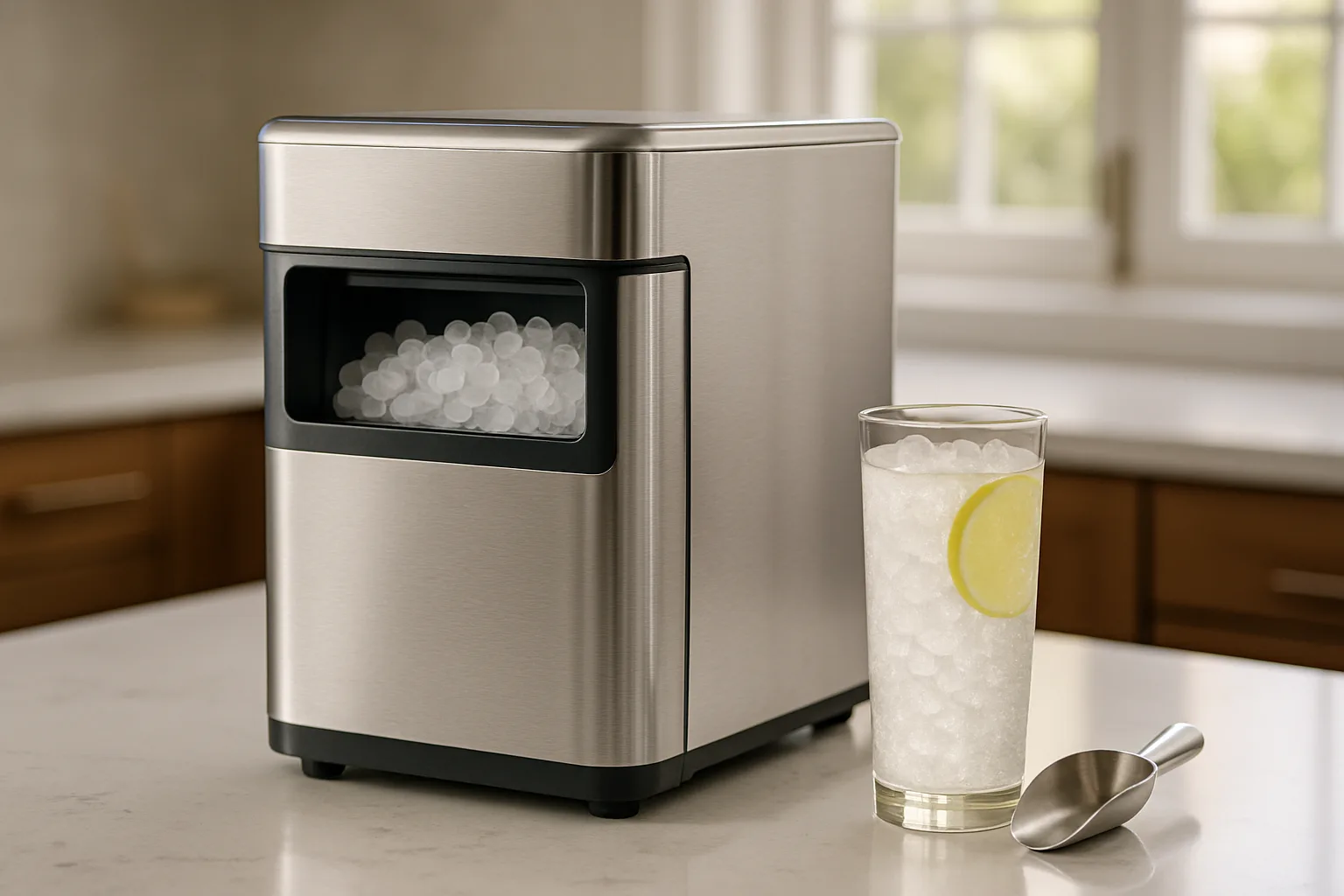
- Best overall and best nugget ice: GE Profile Opal 2.0 Ultra. The largest water tank, by far the most ice held at once, the fastest production rate and the most consistent soft pellets. It is also the biggest, heaviest and most power-hungry machine in the group, and the most expensive.
- Best mid-priced nugget machine: Typhur Nugget Ice Maker. It held the second-most ice, made soft, chewable pellets close to the GE's, and kept its ice from clumping. It was also the loudest machine tested.
- Budget nugget-style pick: Kismile Nugget Ice Maker. It tied the Typhur overall, drew about half the power of most machines and started making ice quickly, but its ice looked more crushed than pelleted.
- Best bullet ice maker: Frigidaire EFIC120 Bullet Ice Maker. The most ice in a full basket of any bullet machine, the second-largest bullet-machine tank and a quick first batch, at a budget-tier price.

How the machines compared
Water capacity was measured by weighing the water jug before and after filling each tank to its max line. First batch is the time until the first full drop of bullet cubes, or until pellet ice started flowing on the nugget machines. Basket fill is how long each machine took to fill its basket, and the ice figure is the weight in the basket with the basket's own weight subtracted.
| Machine | Shop | Ice type | Water held (measured) | First ice | Basket fill time | Ice in full basket | Noise | Power draw |
|---|---|---|---|---|---|---|---|---|
| GE Profile Opal 2.0 Ultra |  Buy on Amazon | Nugget | 93 fl oz | About 8 min | 162 min | 3.35 lb | 51.3 dB | About 154 W |
| Typhur Nugget Ice Maker |  Buy on Amazon | Nugget | 48.6 fl oz | About 12 min | About 96 min | 1.75 lb | 56.6 dB | About 100 W |
| Kismile Nugget Ice Maker |  Buy on Amazon | Nugget (crushed look) | About 41 fl oz | About 6 min | 83 min | 1.52 lb | 51.9 dB | About 54 W |
| Frigidaire EFIC120 Bullet Ice Maker |  Buy on Amazon | Bullet | About 65 fl oz | 8 min 5 s | 57 min | 1.04 lb | 54.5 dB | About 97 W |
| GoveeLife Smart Ice Maker |  Buy on Amazon | Bullet | 67.5 fl oz | About 8 min (partial batch) | About 58 min | 0.86 lb | 53.5 dB | About 110 W |
| Silonn Ice Maker |  Buy on Amazon | Bullet | About 45 fl oz | 6 min 55 s | About 49 min | About 0.75 lb | 54.1 dB | About 107 W |
| COWSAR Ice Maker | 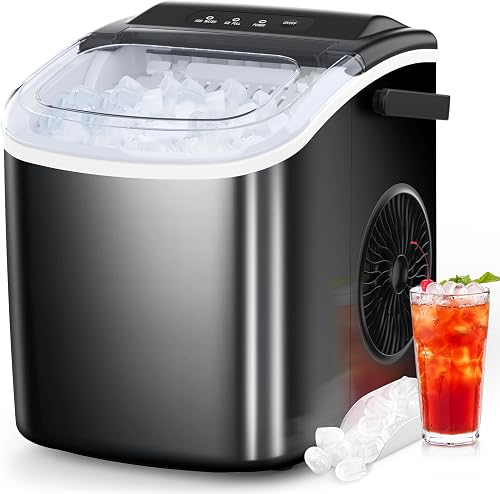 Buy on Amazon | Bullet | 42.6 fl oz | 8 min 41 s | 51 min | About 0.75 lb | 53.8 dB | About 110 W |
Small-cube setting for the bullet machines. Noise readings were taken the same way for every machine and are useful for comparing them to each other, not as absolute figures.
What the measurements showed
Water capacity: the GE is in a different class
The GE's side tank held about 93 fluid ounces, roughly 2.75 liters. The next two were the GoveeLife at 67.5 ounces and the Frigidaire at about 65, both close to their listed 2-liter and 2.1-quart tanks. Most of the other bullet machines held 41 to 45 ounces. The smallest tank belonged to an Antarctic Star bullet maker at just 28.6 ounces, about half of what the larger budget machines held.
First ice: fast starts, small batches
The quickest bullet machines to drop a first batch were the Antarctic Star at 6 minutes 42 seconds and the Silonn at 6 minutes 55 seconds, close to the six-minute claims on their boxes. Speed was not the whole story, though. The Antarctic Star's first drop was six cubes weighing about 31 grams, and the Silonn's nine cubes weighed about 43 grams. The COWSAR took 8 minutes 41 seconds but dropped nearly 60 grams, and the Frigidaire's first nine cubes weighed 57.7 grams at just over eight minutes.
The GoveeLife's first cycle at around eight minutes produced only three cubes. Its second cycle was a full nine cubes weighing about 66 grams, the heaviest single batch of any bullet machine. Among the nugget machines, the Kismile began flowing ice at about six minutes, the GE at about eight and the Typhur not until about 12, though the GE caught up fast and had made about 76 grams by the 15-minute mark.
The cheapest machine barely worked
The least expensive machine in the lineup, a dual-size bullet maker advertised at nine cubes in seven minutes, took over 13 minutes to produce one small piece of ice weighing about 2 grams. After four hours it still had not filled its basket and had made just over a quarter pound of ice. It was later dropped from the large-cube round because it was no longer working properly.
Basket capacity: claims vs. the scale
This is where the box numbers fell apart most. Most bullet machines stopped with about three-quarters of a pound of small cubes in the basket, and the Frigidaire led them at 1.04 pounds. Several brands advertise more:
- Frigidaire lists a basket that holds up to 1.5 pounds; it held 1.04 pounds of small cubes and just under 1 pound of large cubes.
- GoveeLife lists a 1.5-pound basket; it held 0.86 pound of small cubes and 0.99 pound of large ones.
- Silonn lists 1.3 pounds of storage; it held about 0.75 pound of small cubes and 0.89 pound of large ones.
- Typhur lists a basket that holds up to 2.6 pounds; it held 1.75 pounds before the machine called it full.
The GE was the exception. It held 3.35 pounds of pellet ice, nearly double the Typhur, though it took 162 minutes to get there. The bullet machines filled their baskets in 49 to 72 minutes, while the nugget machines took 83 to 162.
The fairer speed comparison is ice per minute. The GE led at about 9.4 grams a minute, the Kismile followed at 8.4, and the Typhur and the Frigidaire tied at 8.3. That puts the best bullet machine level with the Typhur, a nugget machine in a higher price tier.
Large cubes
Switched to large cubes, most of the bullet machines held a little more ice by weight before stopping. The GoveeLife led at 0.99 pound, the Frigidaire was next at 0.96 and the Silonn third at 0.89. The COWSAR was not part of this round.
Noise: almost nobody hit their number
All 12 machines measured between about 50 and 57 decibels on the same meter. Several brands promise far quieter operation. Antarctic Star claims under 40 dB and measured 52.4; Kismile claims 43 dB and measured 51.9; Typhur claims 50 dB and was the loudest in the group at 56.6. The GE, the biggest machine, was among the quietest at 51.3 dB. The spread is modest in practice, but the advertised figures are not a reliable way to choose.
Melting and ice quality
Every basket sat at about 31 to 32°F, but none of these baskets is a freezer, so ice slowly melts and can fuse into clumps. The bullet machines all melted at about the same rate. The nugget machines differed more. The Typhur and the GE kept their pellets loose and earned the top score for resisting clumping, with the Kismile a step behind. The Typhur and the GE both made soft, chewable pellet ice, with the GE's pellets a little more uniform in shape and texture. The Kismile's ice looked more like crushed ice than true pellets.
How to choose
- Decide on ice type first. Bullet machines make hard, hollow cubes and are smaller and cheaper. Nugget machines make soft, chewable pellets but cost more and need more descaling.
- Look at the tank, not the daily rating. Almost every bullet machine here was rated at 26 pounds a day, yet tanks ranged from under 30 ounces to about 67. The tank sets how often the machine needs a refill.
- Expect less ice in the basket than the box says. Plan to move ice into a freezer bag as the basket fills, especially before a party.
- Check power draw if it will run all day. Most machines drew about 95 to 110 watts while making ice, the Kismile about 54 and the GE about 154. A plug-in meter like those in the home energy monitor guide shows what a unit uses over a full day.
- Plan for water quality. Hard water scales nugget machines quickly. GE's Opal owner's manual calls for descaling every two to three weeks on tap water, and Typhur recommends filtered or distilled water to avoid sandy-textured ice. Homes with hard water may also want to read about whole-house filters and softeners.
The picks in detail
GE Profile Opal 2.0 Ultra
The Opal 2.0 Ultra finished first in every measured category except noise, and it was still one of the three quietest machines. GE rates it at up to 38 pounds a day with Wi-Fi control through the SmartHQ app, a removable 0.75-gallon side tank and a scale-inhibiting filter. With the tank attached it measures 17.5 inches deep, 13.43 inches wide and 16.5 inches tall, and it weighed nearly 40 pounds, more than twice most of the field. A light inside the ice compartment makes it easy to check the ice level. The trade-offs are size, the highest power draw in the group and a price far above every other machine here.
GE Profile Opal 2.0 UltraCheck today’s price on AmazonBuy on Amazon →
Typhur Nugget Ice Maker
The Typhur is the closest thing to Opal ice for much less. It held 1.75 pounds of pellets, the second-most in the group, matched the Frigidaire for production rate and kept its ice from clumping as well as the GE did. Typhur lists a 1.5-liter tank, a 35-pound daily rating, a seven-minute cleaning cycle and a footprint of about 12 by 9 by 12.4 inches. It was the slowest machine to start making ice, and the loudest at 56.6 dB. The dark-tinted lid also makes it hard to see the ice level.
Typhur Nugget Ice MakerCheck today’s price on AmazonBuy on Amazon →
Kismile Nugget Ice Maker
The Kismile tied the Typhur for second overall. It drew about 54 watts, roughly half of most of the field, started flowing ice at about six minutes and had the second-best production rate. Its basket held 1.52 pounds. Kismile rates it at 35 pounds a day and lists a self-clean cycle started by holding the power button. The catch is the ice itself: it came out more like irregular crushed ice than uniform soft pellets.
Kismile Nugget Ice MakerCheck today’s price on AmazonBuy on Amazon →
Frigidaire EFIC120 Bullet Ice Maker
Among the bullet machines, the Frigidaire was the most consistent. It held the most water of any bullet maker except the GoveeLife, made the heaviest basket of small cubes at 1.04 pounds, came second in the large-cube round and tied the Typhur on ice per minute. Frigidaire lists 26 pounds a day, nine cubes per cycle in two sizes, a 2.1-quart tank and a drain plug for emptying.
Frigidaire EFIC120 Bullet Ice MakerCheck today’s price on AmazonBuy on Amazon →
Other bullet machines worth a look
The GoveeLife Smart Ice Maker had the largest bullet-machine tank and won the large-cube round, and it adds app control, three cube sizes and scheduling. Its first cycle was a partial batch, and it drew about 110 watts. The Silonn Ice Maker filled its basket fastest, in just over 49 minutes, and placed third with large cubes, though its first batch was light. The COWSAR Ice Maker made heavy early batches and filled its basket in 51 minutes, but its basket held only about three-quarters of a pound.
Who should buy which
- Daily nugget-ice drinkers with the counter space and budget: GE Profile Opal 2.0 Ultra.
- Soft pellet ice for much less, where noise is not a concern: Typhur Nugget Ice Maker.
- Low power use and fast ice, texture less important: Kismile Nugget Ice Maker.
- Regular cubes on a budget: Frigidaire EFIC120 Bullet Ice Maker.
- App control, large cubes or the fewest refills among bullet machines: GoveeLife Smart Ice Maker.
For another countertop appliance comparison, see the guide to air fryers by kitchen type.
Posted by Kristopher Larson
Frequently asked questions
Which countertop ice maker makes the most ice?
In side-by-side testing of 12 machines, the GE Profile Opal 2.0 Ultra made ice fastest at about 9.4 grams per minute and held the most at once, 3.35 pounds of pellet ice. The Kismile and Typhur nugget machines and the Frigidaire bullet machine were next at about 8.3 to 8.4 grams per minute.
Are ice maker noise ratings accurate?
Mostly not. Every machine measured between about 50 and 57 decibels on the same meter, including models advertised at under 40 or 43 dB. Treat a decibel claim as a rough guide; all of these machines hum and clatter as ice drops into the basket.
How much ice does a countertop ice maker basket really hold?
Usually less than the listing says. Most bullet machines stopped with about three-quarters of a pound to one pound of ice in the basket, even when rated for 1.3 to 1.5 pounds. Nugget machines held more, from about 1.5 pounds to 3.35 pounds for the GE Opal.
Is nugget ice better than bullet ice?
It depends on what the ice is for. Nugget ice is soft, chewable and packs tightly in a glass, but nugget machines cost more and need regular descaling. Bullet ice is harder and hollow, and bullet machines are smaller and cheaper. For simply chilling drinks or a cooler, a good bullet machine such as the Frigidaire EFIC120 makes ice about as fast as a mid-priced nugget machine.
Do countertop ice makers keep ice frozen?
No. The baskets stay near freezing, around 31 to 32°F, but they are not refrigerated, so ice slowly melts and can clump together. Meltwater drains back to be refrozen. Move ice to a freezer if it needs to last, especially before a party.
How often should a nugget ice maker be descaled?
Follow the manual for the specific model. GE's Opal manual calls for descaling every two to three weeks when the machine runs on tap water. Filtered or distilled water slows mineral buildup and, on some machines, prevents gritty-textured ice.
Keep reading
More from the blog
Laser vs. Ink Tank Printer for Home: Brother HL-L2480DW vs. Epson EcoTank ET-2800 and ET-2980
Best Baby Monitor for Your Parenting Style: VTech vs. eufy E21 vs. Nanit Pro vs. Owlet vs. Harbor
PETLIBRO Luma vs. Litter-Robot 5 Pro vs. PETKIT Purobot Max Pro 2: Which Controls Odor Best?