Bike Hoist for Garage: RAD Sportz vs. Delta vs. Wallmaster Ceiling Lifts
Garage bike storage with a ceiling hoist: RAD Sportz, Delta Cycle and Wallmaster bike lifts plus a 125 lb kayak hoist. Mounting, pull force and rope locks.
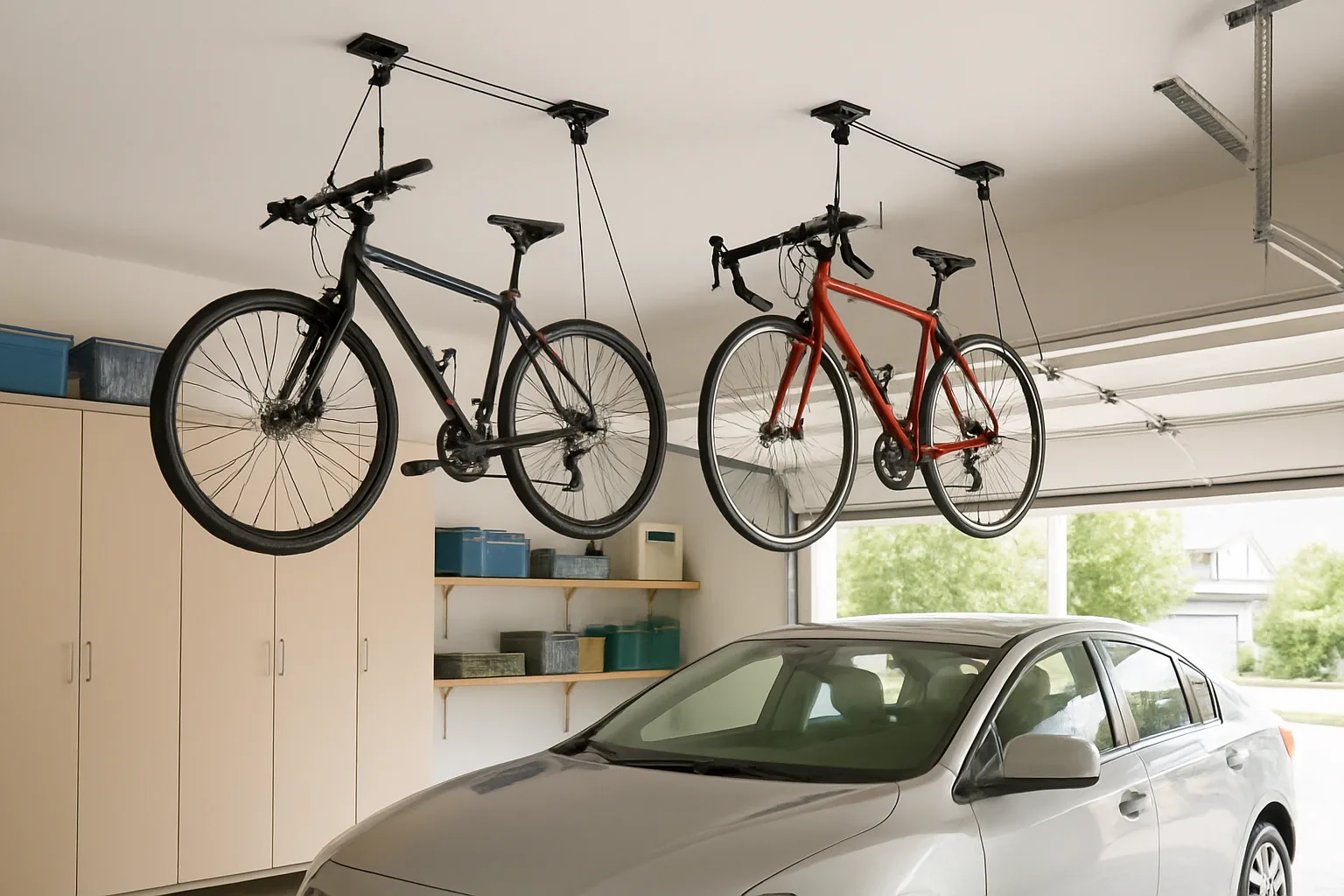
A bike leaning against the garage wall takes up floor space, gets knocked over and scratches the car door. A ceiling bike hoist fixes that with two hooks, a few pulleys and a rope: the bike rides up flat against the ceiling and comes back down with a light pull. It's the easiest form of garage bike storage for anyone who doesn't want to lift a bike overhead.
This guide compares three bike hoists and one heavier kayak hoist, and covers the parts that decide whether one works in a given garage: what to screw it into, how hard the rope is to pull, and how the lock and wall cleat keep the load up.
Quick verdict
- Several bikes in a row: the RAD Sportz Bicycle Hoist. Swivelling hooks hold a bike by the wheels or by the seat and handlebars, and several units fit side by side across one ceiling.
- A single kid's or spare bike: the Delta Cycle Hoist Bike Hanger, a simple two-hook hoist that lifts a small bike one-handed.
- Long-term, set-and-forget use: the Wallmaster Bike Ceiling Lift Hoist, with rubber-gripped hooks, a self-locking rope and a 50 lb rating.
- Kayaks and heavy loads: the RAD Sportz Kayak Hoist (2-Pack), rated to 125 lb with straps and a pulley brake.
The hoists side by side
| Hoist | Shop | Best for | Load rating | Hooks | Lock |
|---|---|---|---|---|---|
| RAD Sportz Bicycle Hoist |  View on Amazon | Rows of bikes | 100 lb (per listing) | Two swivelling hooks, wheels or seat and bars | Rope tied off at the wall |
| Delta Cycle Hoist Bike Hanger |  View on Amazon | One light bike | 100 lb (per listing) | Two hooks, frame and handlebar | Rope tied off at the wall anchor |
| Wallmaster Bike Ceiling Lift Hoist | 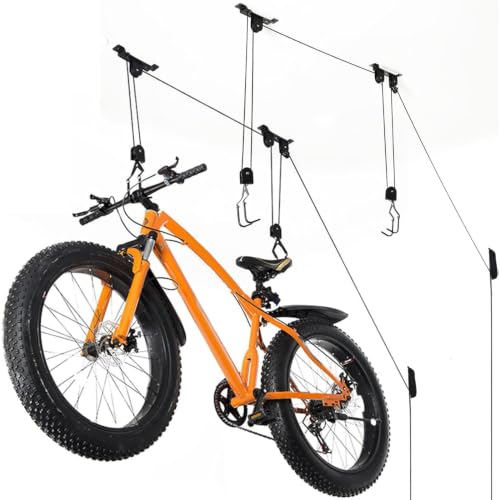 View on Amazon | Road, mountain and cross bikes | 50 lb | Two swivelling, rubber-gripped hooks | Tension lock plus optional wall cleat |
| RAD Sportz Kayak Hoist (2-Pack) |  View on Amazon | Kayaks and cargo | 125 lb | Two hooks with straps | Pulley brake plus rope wrap |
Best for several bikes
RAD Sportz Bicycle Hoist
The standard ceiling hoist design, with flexing hooks that hold a bike by the tires or by the seat and bars, and several units fit across one ceiling.
- 100 lb (per listing)
- 2 swivel hooks
- Rope tie-off
Good for
- A family with several bikes
- Positioning each bike where it fits
Skip it if
- Heavy e-bikes or kayaks
Pulley hoist vs. ceiling hooks vs. wall racks
Wall hooks hang a bike flat against a wall, and front-wheel hooks hold it upright by the front wheel. Both are simple, but a vertical bike sticks out a long way from the wall. In a garage with only a couple of feet between the parked car and the wall, that bike ends up in the walkway.
Fixed ceiling hooks keep the bike overhead, but someone has to lift the whole bike above their head and catch both wheels on the hooks. That's much heavier than it sounds.
A pulley hoist moves the bike to the same spot without the lift. The hooks come down to the bike, the rope takes the weight, and anyone in the household can raise or lower it. The trade-off is setup time and a short learning curve with the hooks.
How much force it really takes
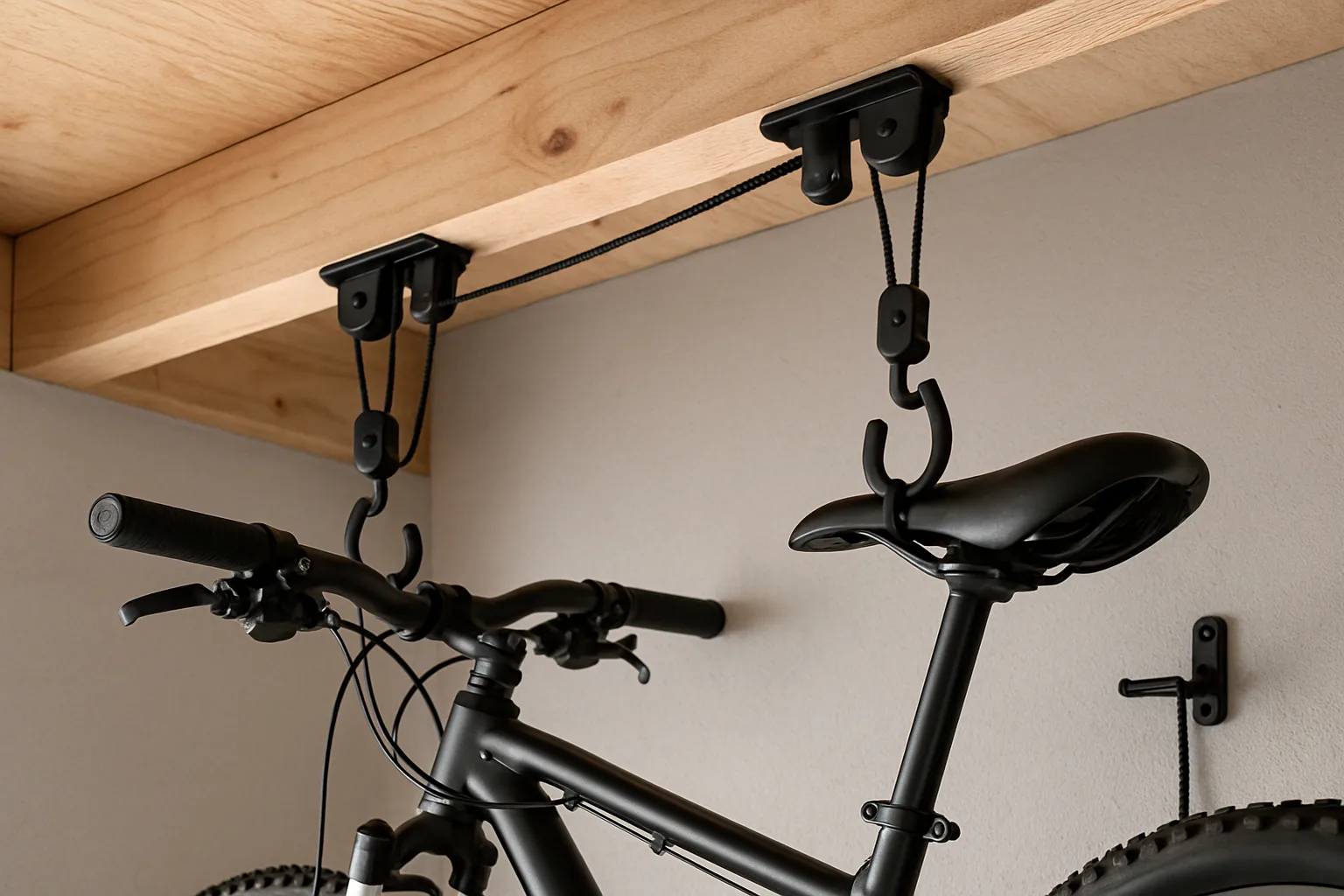
Most bike hoists share the same design: two hook pulleys hang from four lengths of rope. In theory, four ropes divide the load by four, so a 42 lb bike would need about 10 lb of pull. In practice, pulley friction adds to that. With a 42 lb bike on a 50 lb-rated hoist, raising it takes about 16 lb of pull, closer to one-third of the bike's weight than one-quarter.
Friction helps on the way down. Lowering takes very little force because the pulleys hold back part of the weight. The back hook moves first in both directions, because the rope reaches it through fewer pulleys, so the seat end rises first and drops first. A normal bike still ends up level, because it only needs to tilt a few degrees for its center of gravity to settle between the hooks. A heavy bag strapped to the rear rack can upset that balance.
A 43 lb bike on a 50 lb hoist is close to the limit. The rope is usually the weak link. For a heavy bike, buy a hoist rated for its weight or swap in a stronger rope. E-bikes are a different story: many weigh more than 50 lb, which rules out a standard bike hoist.
Best for one small bike
Delta Cycle Hoist Bike Hanger
A compact two-hook pulley hanger that fits the dead air above a crowded one-car garage and lifts a small bike one-handed.
- 2 hooks
- 100 lb (per listing)
- Wall anchor
Good for
- A kid's or spare bike
- Tight one-car garages
Skip it if
- Several bikes in a row
Ceiling height, spacing and car clearance
Pulley spacing comes from the bike. Measure from the handlebar to the back of the seat (about 30 inches on a typical adult bike) and space the two pulleys to match, straight above those points. Ropes that angle down slightly can make hooking easier but make the bike harder to pull up.
Before drilling, check the hanging bike's lowest point against the roof of the tallest vehicle, the open garage door and the opener rail. Leave space between the wheel and the wall so the tire doesn't rub paint when the bike swings.
Mounting: joists, blocking and stud finders
Every pulley bracket has to screw into framing, not drywall alone. Ceiling joists are typically one and a half inches wide and 16 inches apart, center to center. When the spot needed falls between joists, cut a 2x10 block (really about 1.5 by 9.5 inches) a little over 18 inches long, set it across two joists and drive three long screws through it into each joist's side. Joists are not always where the drywall screws suggest, so drill a small test hole first and move sideways if it misses.
A stud finder can come up empty on insulated walls and ceilings, because the insulation hides the hollow-to-solid change it reads. A strong magnet slid over a sheet of paper finds the drywall screws, and the screws mark the framing. The best stud finders handle insulation better than basic ones. Brackets with all their screw holes in one line, such as rail-style mounts, suit narrow joists, while a wide bracket may not fit all its screws into a single joist. For a concrete ceiling, use anchors made for concrete.
Best for long-term use
Wallmaster Bike Ceiling Lift Hoist
Smooth pulley wheels, a self-locking rope, swiveling rubber-gripped hooks and rust-resistant coated metal.
- 50 lb rating
- Self-locking rope
- Rubber-gripped hooks
Good for
- Adult road and mountain bikes
- Set-and-forget storage
Skip it if
- Heavy e-bikes (rated 50 lb)
Rope locks and the wall cleat
The rope lock sits by one pulley. Pull the rope straight down and it slides through to raise the bike; let it swing to an angle and it locks. To release, pull down first, then let the rope up straight. A wall cleat screwed into a stud gives the loose end something to tie around, so the bike stays up even if the lock slips. Tie it off every time.
Tie a tight, thick knot at the fixed end of the rope, since that knot carries the bike. Some manuals say not to cut the extra rope; coil and bundle it instead, and the leftover length doubles as a spare. When lowering, keep the rope moving hand over hand rather than letting it slide through a closed fist, which can burn a finger. Steady the bike so it doesn't swing into the wall.
The picks in detail
RAD Sportz Bicycle Hoist
This is the standard ceiling hoist design, and it works well in multiples: four of them can line up across one garage ceiling. The hooks flex side to side, so each bike can be positioned where it fits. Bikes can hang by the tires or by the handlebars and seat. Installation is a matter of measuring the gap between the front and back pulleys, screwing them in, threading the rope through both pulleys and running it down the wall to a tie-off point. Mount the pulleys into a joist wherever possible.
Best for several bikes
RAD Sportz Bicycle Hoist
The standard ceiling hoist design, with flexing hooks that hold a bike by the tires or by the seat and bars, and several units fit across one ceiling.
- 100 lb (per listing)
- 2 swivel hooks
- Rope tie-off
Good for
- A family with several bikes
- Positioning each bike where it fits
Skip it if
- Heavy e-bikes or kayaks
Delta Cycle Hoist Bike Hanger
The Delta Cycle Hoist is a compact pulley hanger that fits the dead air above a crowded one-car garage. The box holds the front and back pulleys, two hooks and the screws. With a small bike it can be raised with one hand and tied off at the wall anchor. Hooking the frame instead of the seat is the safer choice, because a seat clamp that works loose can let the bike drop.
Best for one small bike
Delta Cycle Hoist Bike Hanger
A compact two-hook pulley hanger that fits the dead air above a crowded one-car garage and lifts a small bike one-handed.
- 2 hooks
- 100 lb (per listing)
- Wall anchor
Good for
- A kid's or spare bike
- Tight one-car garages
Skip it if
- Several bikes in a row
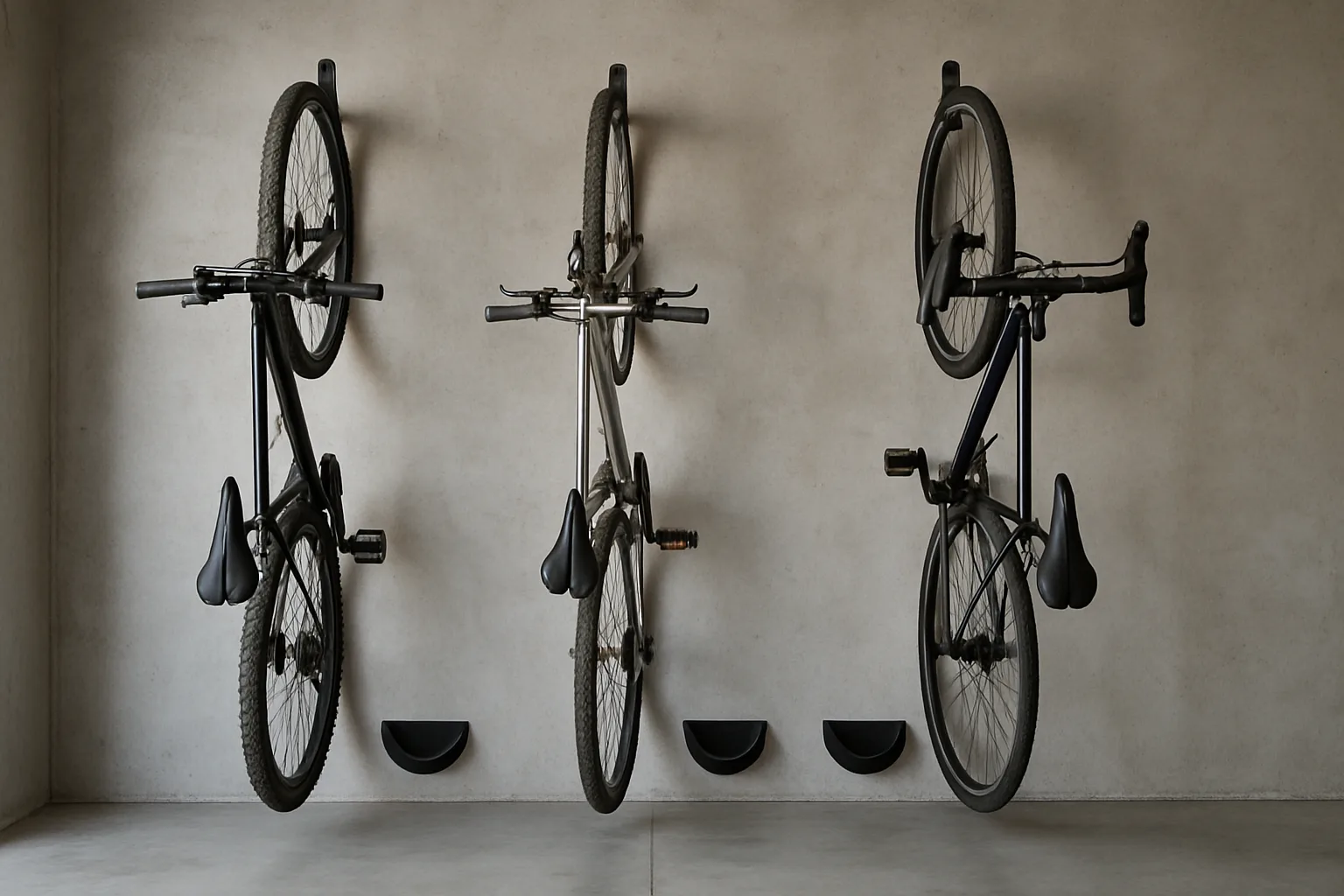
Wallmaster Bike Ceiling Lift Hoist
The Wallmaster is built for long-term use, with pulley wheels that spin smoothly. A pull on the rope releases the lock at the top so the bike can be let down slowly. The lock works by tension and engages on its own when the rope is pulled to one side. Both hooks swivel, so the bike can even hang upside down, and the hook arms swivel in and out to fit different handlebar shapes. Rubber grips protect the paint, and the coated metal resists rust. It's rated for 50 lb, which covers standard road, mountain and cross bikes but not a heavy e-bike. The lock holds firmly on its own, but tying off to the included cleat is still the safer habit.
Best for long-term use
Wallmaster Bike Ceiling Lift Hoist
Smooth pulley wheels, a self-locking rope, swiveling rubber-gripped hooks and rust-resistant coated metal.
- 50 lb rating
- Self-locking rope
- Rubber-gripped hooks
Good for
- Adult road and mountain bikes
- Set-and-forget storage
Skip it if
- Heavy e-bikes (rated 50 lb)
RAD Sportz Kayak Hoist (2-Pack)
For a kayak, a canoe or a cargo box, step up to a hoist built for the weight. The RAD Sportz kayak hoist is rated to 125 lb. Each pulley has two hooks with straps that cradle the hull, and a pulley brake holds the load at any height. That means the kayak can stop at waist level for work and then go back to the ceiling. The rope wraps onto a built-in holder when the boat is up. The pulleys can sit 6 to 10 feet apart; 6 feet is enough to carry a 12 ft 7 in fishing kayak.
The mounting deserves more care than a bike hoist. One solid way is to fasten a 2x4 board across the ceiling framing with 4-inch, 5/8 lag bolts, then mount the pulleys to the board. Using five lag bolts instead of the two the manual asks for adds a margin of safety. It's a 2:1 system, so a loaded kayak of about 100 lb takes roughly 50 to 60 lb of pull. That's noticeably harder than a bike hoist, so keep the load well under the 125 lb rating.
Best for kayaks
RAD Sportz Kayak Hoist (2-Pack)
Rated to 125 lb, with straps that cradle the hull and a pulley brake that holds the load at any height, including waist level for work.
- 125 lb rating
- Pulley brake
- 6 to 10 ft pulley spacing
Good for
- Kayaks, canoes and cargo boxes
Skip it if
- A weak pull (a 100 lb kayak takes about 50 to 60 lb of pull)
Hooking technique and safety
- Bend the hooks if they slip. Right-angle hooks can pull out of a seat. Bend them slightly tighter so they wrap the seat rails or frame.
- Hook low. Lower the hooks close to the floor, put the front hook on first, then lift the back of the bike slightly onto the rear hook. To unhook, lift the bike a little, free the back, then the front.
- Stay within the rating. Count racks, bags and accessories in the bike's weight.
- Tie off every time. The cleat is the backup if the rope lock fails.
- Keep heads clear. Never walk or work under a bike or kayak while it's moving.
Best for kayaks
RAD Sportz Kayak Hoist (2-Pack)
Rated to 125 lb, with straps that cradle the hull and a pulley brake that holds the load at any height, including waist level for work.
- 125 lb rating
- Pulley brake
- 6 to 10 ft pulley spacing
Good for
- Kayaks, canoes and cargo boxes
Skip it if
- A weak pull (a 100 lb kayak takes about 50 to 60 lb of pull)
Who should buy which
- A family with several bikes: a row of RAD Sportz Bicycle Hoists across one ceiling.
- One small bike in a tight garage: the Delta Cycle Hoist Bike Hanger.
- Adult road or mountain bikes under 50 lb: the Wallmaster Bike Ceiling Lift Hoist.
- A kayak, canoe or heavy cargo: the RAD Sportz Kayak Hoist (2-Pack).
For bins and bulk items rather than bikes, an overhead garage storage rack uses the same ceiling space with a fixed platform.
Posted by Kristopher Larson
Frequently asked questions
Is a bike hoist better than ceiling hooks for garage bike storage?
For most households, yes. Fixed ceiling hooks mean lifting the whole bike overhead and catching both wheels, which is heavy and awkward. A pulley hoist brings the hooks down to the bike and the rope does most of the lifting, so anyone in the house can store or grab a bike.
How much weight can a bike hoist hold?
Standard bike hoists are commonly rated around 50 lb, which covers most road, mountain and cross bikes. Kayak hoists are built heavier, with ratings such as 125 lb. Count bags and racks in the total, and choose a higher-rated hoist or a stronger rope for a heavy bike.
Can a bike hoist lift an e-bike?
Usually not. Many e-bikes weigh more than the roughly 50 lb limit of a standard bike hoist. Check the e-bike's weight with the battery installed and only use a hoist rated well above it.
How hard is it to pull a bike up with a hoist?
A four-rope hoist would cut the pull to one-quarter of the bike's weight without friction. In practice it's closer to one-third: about 16 lb of pull for a 42 lb bike. Lowering takes very little effort because the pulley friction holds back part of the weight.
What if there is no ceiling joist where the bike hoist needs to go?
Add blocking. With joists 16 inches apart on center, a 2x10 cut a little over 18 inches can be screwed across two joists from the sides, giving a solid spot for the pulley bracket anywhere along that gap. Never hang a hoist from drywall alone.
Do I need to use the wall cleat on a bike hoist?
It's strongly recommended. The rope lock at the ceiling holds the load by tension, but tying the loose rope end around a cleat screwed into a wall stud keeps the bike up even if the lock slips.
Keep reading
More from the blog
Ring Drone Cam and Rover Cam: Release Dates, Prices and What Homeowners Should Know

Best Cold Brew Coffee Maker: OXO vs. Takeya vs. County Line Kitchen
Best Portable Bluetooth Speaker: JBL Flip 7 vs. Bose SoundLink Flex vs. Soundcore