Best Dash Cam: Viofo vs. Vantrue vs. Thinkware
Readable plates by day and night, parking modes that catch the whole hit, screens vs. apps: how Viofo, Vantrue and Thinkware dash cams compare.
A dash cam earns its keep in a few seconds of footage: the plate of the car that clipped you and drove off, the light that was still red, the bumper that hit you while you were stopped. Most cameras record something. Far fewer record a plate you can actually read on a moving car, at night, through a windshield. And past a certain point, a step up stops buying a sharper picture and starts buying extra features.
This guide covers what separates a dash cam that gets you usable evidence from one that only looks like it does, and which camera fits which driver.
Quick verdict
- Best dash cam overall: the VIOFO A329S Dash Cam Front and Rear. The clearest daytime plates of the flagship cameras, strong night footage, a polarizing filter in the box and a parking mode that saves the 20 seconds before an impact.
- Best 4K front and rear: the VIOFO A229 Pro Dash Cam Front and Rear. Front image quality on par with the A329S, the same rear camera and the same buffered parking mode.
- Best at night and for three channels: the Vantrue N4 Pro S 3-Channel Dash Cam. The most readable plates after dark, plus a cabin camera and a waterproof rear camera, which suits rideshare drivers.
- Best for watching a parked car: the Thinkware ARC700 Dash Cam Front and Rear. Its motion-detection parking mode draws unusually little power and catches what happens before anything hits the car.
The dash cams side by side
| Dash cam | Shop | Cameras | Front sensor | Screen | Parking mode | Best for |
|---|---|---|---|---|---|---|
| VIOFO A329S Dash Cam Front and Rear |  View on Amazon | Front + rear (cabin camera optional) | 4K Sony STARVIS 2 IMX678 | Yes | Buffered impact, motion, time-lapse | The best picture day and night |
| VIOFO A229 Pro Dash Cam Front and Rear | 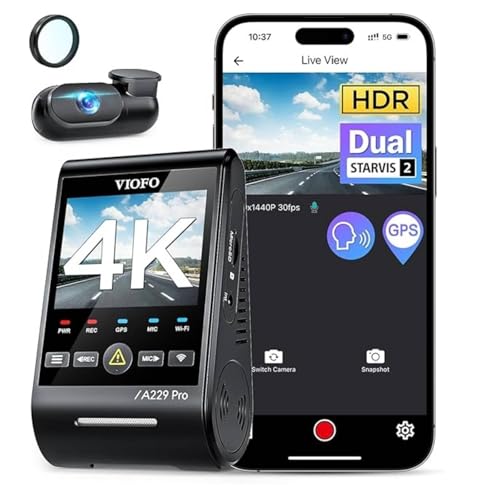 View on Amazon | Front + rear | 4K Sony STARVIS 2 IMX678 | Yes | Buffered impact, motion, time-lapse | Near-flagship footage |
| VIOFO A229 Plus Dash Cam Front and Rear |  View on Amazon | Front + rear | 2K Sony STARVIS 2 | Yes | Buffered impact, motion, time-lapse | Front and rear with a 2K front |
| VIOFO A119M Pro 4K Mini Dash Cam |  View on Amazon | Front only | 4K Sony STARVIS 2 IMX678 | Yes, small | Buffered impact | Sharp front-only footage in a tiny wedge |
| Vantrue N4 Pro S 3-Channel Dash Cam |  View on Amazon | Front + cabin + rear | 4K Sony STARVIS 2 | Yes | Impact and motion (slow to wake on impact) | Night plates, rideshare, outside rear mount |
| Thinkware ARC700 Dash Cam Front and Rear |  View on Amazon | Front + rear | 4K Sony STARVIS (first generation) | No, app only | Low-power motion and impact, time-lapse | Long parking-mode coverage |
Best overall
VIOFO A329S Dash Cam Front and Rear
The clearest daytime plates of the flagship cameras on parked and moving cars, strong night footage, a polarizing filter in the box and buffered impact parking.
- 4K front, 5 MP rear
- Polarizing filter
- Screen
Good for
- The best of everything, front and rear
- Adding an interior camera later
Skip it if
- You want a microSD card and hardwire kit included
What makes a dash cam good
Plates on moving cars, not just parked ones
Nearly every camera can read a plate on a parked car 10 feet away in daylight. That's the easy case. The hard cases are a car moving alongside you, a car passing you while you're stopped, and any of that at night. That's where cameras separated. No-name cameras that claim 4K couldn't read a parked plate past 20 to 30 feet, and several upscale a lower-resolution sensor to a 4K file, which adds pixels but no detail. The best cameras read plates on passing cars in daylight, and the Vantrue N4 Pro S was often the only one to get a full, correct plate from a fast car going by.
Night footage, glare and exposure
Night is where good cameras earn their keep. The problem isn't darkness so much as headlights and reflective plates: a camera that overexposes turns the plate into a glowing white rectangle. The Vantrue keeps its night image darker, which looks less impressive but keeps plates readable. Cameras tuned like security cameras, the Thinkware ARC700 among them, brighten shadows and show more of the scene but blow out the plate. Windshield glare is the other enemy. A circular polarizing filter (CPL) cuts reflections from the dashboard on the glass, and it's worth buying if your camera doesn't include one. The VIOFO A329S comes with one.
The sensor name tells you less than you think
Almost every camera advertises a Sony STARVIS sensor. STARVIS is a whole family of image sensors, from small, low-resolution parts to true 4K chips, so a basic camera and a flagship one can both claim it. Look for the specific part instead. The IMX678 is a true 4K STARVIS 2 sensor and shows up in most of the best front cameras here. Even then, the lens and image processing make the difference: four cameras with the same IMX678 still produced different results, and the VIOFO A119M Pro's heavy sharpening drew white halos around power lines.
Box claims like 4K at 60 frames per second
Some cameras advertise 4K and 60 frames per second, but can't do both with HDR turned on. HDR is what keeps bright skies and dark shadows readable in the same frame, so most people should leave it on and accept 30 frames per second at 4K.
Parking mode: impact versus motion
Parking mode is the reason many people buy a dash cam, and the types work very differently:
- Impact (G-sensor) mode sleeps on a low-power motion sensor and starts recording when the car is bumped. The catch is wake-up time. VIOFO cameras keep a rolling buffer and save about 20 seconds from before the hit, so you see the whole event. The Vantrue N4 Pro S takes around 7 seconds to wake after an impact, which can miss what caused it.
- Motion mode watches for movement around the car and records before anything touches it. Doing that with the camera sensor uses much more power. The Thinkware ARC700's camera-based motion mode drew notably little power and caught far more of what happened around the car. Some higher-end cameras use a separate radar sensor to watch for motion, which uses less power still.
- Low-bitrate or time-lapse recording runs the whole time. It catches everything, but it uses about three times the power of impact mode on a small camera.
Any parking mode needs constant power, usually from a hardwire kit connected to the fuse box with a low-voltage cutoff so it doesn't drain the battery. Some cameras include the kit; many don't. If your battery is tired, keep a jump starter in the car.
A screen, or only an app
A camera with a screen lets you aim it during install, change settings at a glance and show footage to the other driver or an officer at the scene. Screenless cameras like the Thinkware ARC700 rely on a phone app for all of that, and connecting by Wi-Fi at the roadside can be slow and fiddly. The trade-off is size. A small wedge like the VIOFO cameras tucks up behind the mirror where you don't see it, while bulkier cameras like the Vantrue N4 Pro S sit more in your line of sight.
The picks in detail
VIOFO A329S Dash Cam Front and Rear: best overall
The A329S pairs a 4K IMX678 front camera with a 5-megapixel STARVIS 2 rear camera. In daylight it produced the clearest plates of the flagship cameras, on parked cars and on moving ones, and it controlled glare and highlights better than most. At night it was second only to the Vantrue among the flagship cameras, and one of just two in that group to keep plates from blowing out. It comes with a circular polarizing filter, its impact parking mode saves the 20 seconds before a bump, and an optional interior camera can be added later. The wedge shape and screen make it easy to live with.
The trade-offs: it doesn't include a microSD card or hardwire kit. Its front image was largely the same as the A229 Pro's, so the difference is mostly the newer platform and extras.
Best overall
VIOFO A329S Dash Cam Front and Rear
The clearest daytime plates of the flagship cameras on parked and moving cars, strong night footage, a polarizing filter in the box and buffered impact parking.
- 4K front, 5 MP rear
- Polarizing filter
- Screen
Good for
- The best of everything, front and rear
- Adding an interior camera later
Skip it if
- You want a microSD card and hardwire kit included
VIOFO A229 Pro Dash Cam Front and Rear: best 4K front and rear
The A229 Pro uses the same 4K IMX678 front sensor and a 2K IMX675 rear sensor. Its front footage was among the best-looking pictures here, and image quality barely improved beyond it. Higher-end cameras mostly add features rather than sharper video. It has a screen, buffered impact parking, and a rear camera that matches the A329S. For most drivers who want front and rear coverage, it's the sweet spot.
Best 4K front and rear
VIOFO A229 Pro Dash Cam Front and Rear
The same 4K front sensor and rear camera as the A329S, among the best-looking pictures here, plus a screen and buffered impact parking.
- 4K front, 2K rear
- Screen
- Buffered parking
Good for
- Most drivers who want front and rear
Skip it if
- Three-channel rideshare setups
VIOFO A229 Plus Dash Cam Front and Rear: the 2K front-and-rear pick
The A229 Plus drops the front camera to 2K but keeps the same rear camera as the A229 Pro and A329S. Its plates were readable to about 20 to 30 feet, close to higher-end cameras. VIOFO's separate polarizing filter fits it and can sharpen the front image further, and it keeps the screen and buffered parking mode.
2K front-and-rear pick
VIOFO A229 Plus Dash Cam Front and Rear
A 2K front camera with the same rear camera as the A229 Pro; plates were readable to about 20 to 30 feet, close to higher-end cameras.
- 2K front
- Screen
- Buffered parking
Good for
- Front and rear coverage
- Adding VIOFO's polarizing filter
Skip it if
- You want 4K up front
VIOFO A119M Pro 4K Mini Dash Cam: best front-only camera
The A119M Pro puts the 4K IMX678 sensor in VIOFO's small wedge, with a 1.5-inch screen, Wi-Fi 6, GPS and voice control. It finished first overall in a field of 11 dash cams that included larger, higher-end models. It had some of the best night footage of the group, read the small numbers on a lit sign best, and tied for the longest daytime reading distance. In daylight its plates on parked and passing cars were among the clearest.
The trade-offs: the image is heavily sharpened, its night plates can overexpose, and it covers the front only. A second camera can cover the rear window if you want one. VIOFO's 2K A119 Mini 2 gave a more natural-looking image and the same strong parking mode, though it isn't linked here.
Best front-only camera
VIOFO A119M Pro 4K Mini Dash Cam
First overall in a field of 11 dash cams, with some of the best night footage and among the clearest daytime plates, in a small wedge.
- 4K IMX678
- 1.5 in screen
- Wi-Fi 6 and GPS
Good for
- Front-only setups
- A small, hidden camera
Skip it if
- Rear coverage
- A natural-looking image (heavy sharpening)
Vantrue N4 Pro S 3-Channel Dash Cam: best at night and for rideshare
The N4 Pro S records the road, the cabin and the rear window, all on STARVIS sensors, with a 4K front camera. It was the king of night footage: it kept plates from overexposing when both cars were stopped and when both were moving, and it caught the most of a fast-passing plate after dark. In daylight it was often the only camera to get an accurate plate from a car speeding by. The rear camera is waterproof, so it can mount outside the car on a truck or van, and it works with Vantrue's optional LTE module for remote viewing.
The trade-offs: its impact parking mode is slow to wake, it's bigger and more in your face than a wedge camera, and the SD card, hardwire kit and polarizing filter are all extra.
Best at night and for rideshare
Vantrue N4 Pro S 3-Channel Dash Cam
Road, cabin and rear cameras, the most readable plates after dark, and a waterproof rear camera that can mount outside a truck or van.
- 3 channels
- 4K front
- Waterproof rear camera
Good for
- Night drivers and rideshare
- Trucks and vans
Skip it if
- Fast-waking parking mode
- A discreet camera
Thinkware ARC700 Dash Cam Front and Rear: best for parking coverage
The ARC700 pairs a 4K front camera with a 2K rear camera and has no screen. Its picture is flatter and lower in contrast, like a security camera, which preserves detail in shadows and kept parked plates very clean in daylight. It read distance markers as far as any camera and had a slight edge on parked plates at 30 feet. Its standout is parking mode: the camera-based motion detection worked well and used far less power than other cameras' motion modes, and it has supercapacitors and thermal protection for hot cars. It includes a hardwire cable and microSD card, plus GPS with speed and red-light camera alerts.
The trade-offs: it blurred moving road signs more than most, it overexposed plates at night and struggled with a moving plate after dark, and everything is done through the app.
Best for parking coverage
Thinkware ARC700 Dash Cam Front and Rear
Motion-detection parking that uses far less power than rivals, supercapacitors and thermal protection, with the hardwire cable and microSD card included.
- 4K front, 2K rear
- Hardwire kit included
- GPS alerts
Good for
- Street parking for long stretches
- Hot climates
Skip it if
- Night plates (it overexposed them)
- You want a screen
Other dash cams worth knowing about
- Garmin dash cams are tiny and easy to hide, and one read a parked plate at 50 feet in daylight, the longest of its group. At night they fell behind better-performing cameras.
- Nextbase captured moving road signs in daylight best of all but was among the weakest at night.
- 70mai M800 has a wide view, strong night exposure, built-in memory instead of an SD card and no screen.
- Radar parking cameras such as the Thinkware U3000 Pro and Rexing R4RD use a radar sensor to watch for motion at very low power. The Rexing adds two aimable side cameras.
Best 4K front and rear
VIOFO A229 Pro Dash Cam Front and Rear
The same 4K front sensor and rear camera as the A329S, among the best-looking pictures here, plus a screen and buffered impact parking.
- 4K front, 2K rear
- Screen
- Buffered parking
Good for
- Most drivers who want front and rear
Skip it if
- Three-channel rideshare setups
How to choose
- Want the best footage, period? VIOFO A329S. The A229 Pro gets nearly the same picture.
- Drive a lot at night? The Vantrue N4 Pro S reads plates after dark best.
- Drive for a rideshare app? Get a three-channel camera with a cabin view, like the Vantrue.
- Worried about parking-lot dings? Decide between impact and motion first. VIOFO's buffered impact mode catches the whole hit; the Thinkware ARC700's motion mode watches longer on little power. Either needs a hardwire kit.
- Only need the front? The VIOFO A119M Pro is small and sharp.
- Buy a high-endurance microSD card. Most of these don't include one, and a card made for constant rewriting lasts far longer.
Rounding out the car kit? See the portable tire inflator guide, and for the garage, the shop vac comparison.
Who should buy which
- Most drivers who want front and rear: the VIOFO A229 Pro, or the A329S for the best of everything.
- Front and rear with a 2K front: the VIOFO A229 Plus.
- Front only, small and sharp: the VIOFO A119M Pro.
- Night drivers, rideshare drivers, trucks and vans: the Vantrue N4 Pro S.
- Anyone who parks on the street for long stretches: the Thinkware ARC700.
Posted by Kristopher Larson
Frequently asked questions
Is a dash cam worth it?
For most drivers, yes. In a rear-end collision or a hit-and-run, video settles what happened when it would otherwise be your word against the other driver's. A dash cam also records your speed from GPS, which can help if a speeding ticket is disputed. The key is buying one that records a readable plate, since a blurry image of a car doesn't identify anyone.
Is a 4K dash cam better than 2K?
Only when the camera has a true 4K sensor, such as Sony's STARVIS 2 IMX678, and good image processing. Many cameras record a 4K file from a lower-resolution sensor, which adds pixels but not detail. A good 2K camera like the VIOFO A229 Plus can read plates about as well as a mediocre 4K one.
Do dash cams drain your car battery?
Only in parking mode, which needs constant power through a hardwire kit. Impact-only parking mode draws very little. Motion detection and continuous low-bitrate recording draw much more. Use a hardwire kit with a low-voltage cutoff so the camera shuts off before the battery gets too low to start the car.
What is buffered parking mode?
A buffered parking mode keeps a rolling recording in memory, so when the car is bumped it saves the seconds before the impact as well as after. VIOFO cameras save about 20 seconds from before an impact. Cameras without a buffer have to wake up first, and the Vantrue N4 Pro S takes around 7 seconds, which can miss the car that caused the damage.
Do I need a polarizing filter on a dash cam?
It helps. A circular polarizing filter (CPL) cuts the reflection of the dashboard on the windshield, which washes out daytime footage and adds glare. Some cameras include one, like the VIOFO A329S. For others it's a simple add-on that clips over the lens and is turned once to line it up.
What SD card should I use in a dash cam?
A high-endurance microSD card made for constant rewriting, in the size the camera supports. Dash cams record over the oldest footage in a loop, which wears out ordinary cards quickly. Most of the cameras in this guide don't include a card, though the Thinkware ARC700 does. Format the card in the camera when you first install it.
Keep reading
More from the blog
Best Vacuum Sealer: Nesco vs. Anova vs. FoodSaver
Nespresso Vertuo vs. Original: Which Should You Buy?

Best Ice Cream Maker: Ninja CREAMi vs. Cuisinart vs. Whynter