
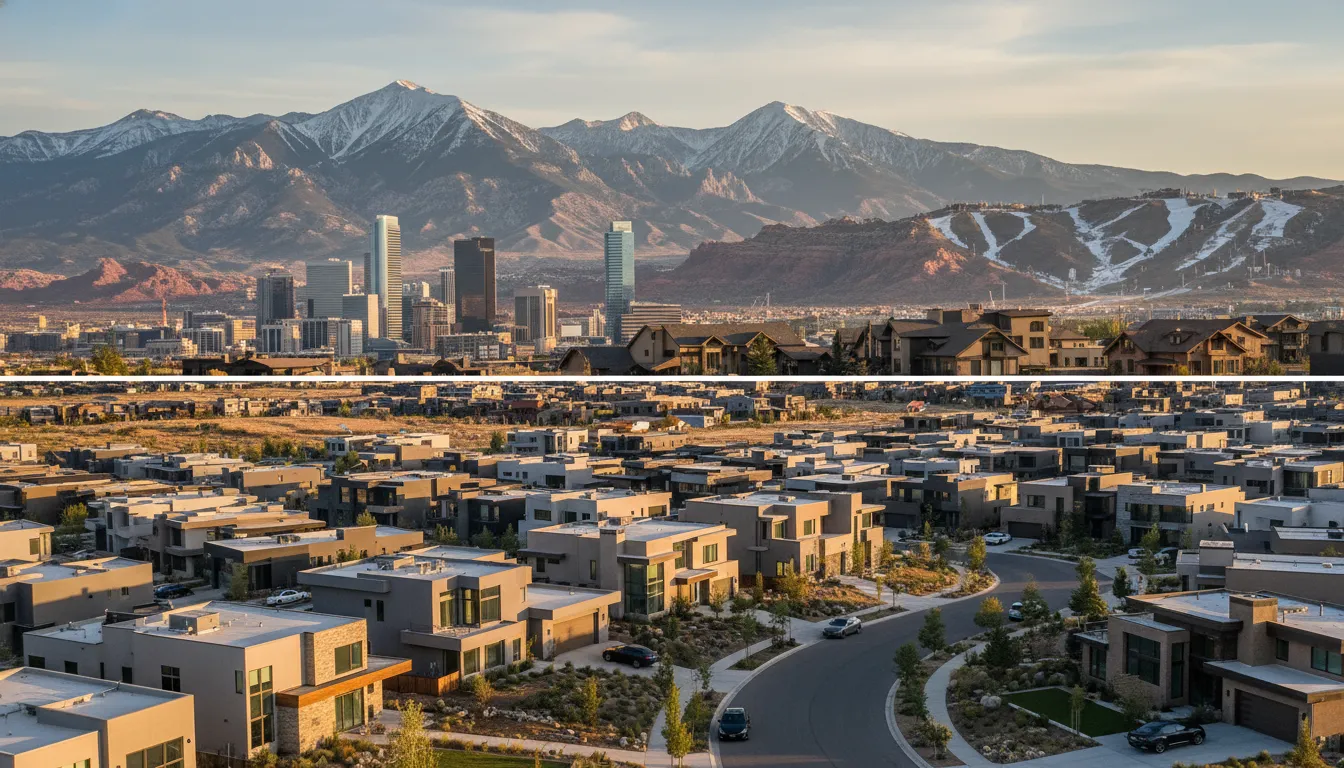
Most Expensive Places to Live in Utah: 10 High-Cost Cities Buyers Should Understand
Utah still carries a reputation for being more affordable than many coastal states, but that reputation only tells part of the story. At the state level, overall cost of living can look manageable. At the city level, housing costs can shift dramatically.
Utah still carries a reputation for being more affordable than many coastal states, but that reputation only tells part of the story. At the state level, overall cost of living can look manageable. At the city level, housing costs can shift dramatically.
That matters for anyone comparing Utah cities, planning a move, or trying to decide whether a premium location is actually worth the price. Some Utah markets are expensive because of tech access. Others are driven by resort demand, second-home ownership, limited land, or long-established wealth.
This guide breaks down the most expensive places to live in Utah, what makes them costly, and how to think about affordability before choosing a city. For broader home search options across the state, buyers can also review Utah real estate and homes for sale.
Why some Utah cities are far more expensive than others
Utah is not uniformly affordable and it is not uniformly expensive. The gap between one city and the next can be substantial.
Three factors help explain that gap:
- Cost of living index, which compares a city to the national average of 100
- Median home sale price, which shows the midpoint of actual sale activity rather than an average distorted by extreme luxury sales
- Income-to-home-price relationship, which helps show whether local wages keep pace with housing costs
A city with high prices and very high household incomes is different from a city where prices have raced ahead of local earnings. Both can be expensive, but the affordability strain is not the same.
Utah affordability is often misunderstood
Statewide numbers can make Utah look relatively balanced. The broader cost of living sits just below the national average, while housing is the category that changes the equation.
The key issue is that Utah real estate is highly split. Some markets remain comparatively attainable. Others are luxury markets with pricing that rivals well-known resort destinations in the Mountain West.
That is why buyers relocating from California, Washington, Colorado, or the Northeast can have very different reactions. A city may feel like a bargain compared with what they left. The same city may feel out of reach for a household earning a local salary.
How to read this list
This list combines the cost-of-living discussion with the housing patterns highlighted in 2025 market data. The cities below are expensive for different reasons, so rankings are best understood as a practical snapshot of Utah’s premium markets rather than a one-size-fits-all affordability score.
10 most expensive places to live in Utah
1. Park City
Park City stands in a category of its own. Its cost of living index is about 184, which means it is roughly 84 percent more expensive than the average American city. Within Park City limits, the median price for a single-family home reached about $3.96 million in early 2025.
This is not simply a local housing market. It functions as a global luxury market shaped by ski access, resort amenities, second-home demand, and limited geography. Neighborhoods inside Park City can vary widely, but even within the luxury segment the upper end has shown unusual strength.
What drives the cost:
- World-class ski resort access
- Luxury second-home and primary-home demand
- Severe land and supply limitations
- National and international buyer interest
What buyers should know: Park City prices are not representative of most of Utah. They are an outlier. Anyone comparing Park City with other parts of the state should treat it as a separate pricing universe. Readers who want a deeper look at lifestyle and housing tradeoffs can also review the pros and cons of living in Park City, Utah.
2. Hideout
Hideout is one of Utah’s least-known high-cost cities, yet median home prices have climbed above $1.6 million. Located near Jordanelle Reservoir and closely tied to the Park City orbit, Hideout captures much of the same mountain lifestyle at a lower entry point than Park City itself.
What drives the cost:
- Park City adjacency
- Reservoir and mountain views
- Luxury-focused residential development
- Appeal to second-home and affluent primary-home buyers
What buyers should know: Hideout often attracts households seeking a slight discount to Park City, but “discount” in this context still means luxury pricing. It is best understood as a spillover market created by the strength of Park City demand.
3. Emigration Canyon
Emigration Canyon offers a rare combination of canyon seclusion and fast access to downtown Salt Lake City. Median home prices have been around $1.475 million.
The geography matters as much as the homes. This is a canyon community with limited room for additional housing, irregular lots, and a very specific type of mountain-living experience.
What drives the cost:
- Scarce canyon housing supply
- Quick access to Salt Lake City employment and culture
- Custom homes in dramatic natural settings
- One-road-in, one-road-out geographic constraints
What buyers should know: Emigration Canyon does not compete with standard suburban neighborhoods. Buyers are paying for geography, privacy, and an environment that cannot easily be replicated elsewhere in Salt Lake County.
4. Alpine
Alpine combines large parcels, custom homes, a quieter semi-rural feel, and access to Utah County’s major employment areas. Median home prices sit just under $900,000, with a cost of living index around 135.
What drives the cost:
- Larger estate-style lots
- Custom homes and lower-density development
- Strong appeal to upper-income professionals and business owners
- Limited inventory with a distinct neighborhood character
What buyers should know: Alpine is expensive not just because of the homes themselves, but because of what the setting offers. Space, privacy, and lower density are a major part of the price premium.
5. Highland
Highland is one of Utah County’s most expensive non-resort cities. Its cost of living index is about 141, and median home prices are around $847,000. Median household income is also very high at about $179,000, which helps explain why demand remains steady.
What drives the cost:
- Executive-style residential appeal
- Large lots and newer homes
- Strong schools and community reputation
- Wealthy buyer pool competing for limited supply
What buyers should know: Highland shows that even high-income communities can still feel expensive. Strong local earnings do not automatically make a market affordable.
6. Draper
Draper had the highest median single-family home sale price among Utah’s larger cities in 2024 at about $960,000. Its cost of living index is near 130, and median household income runs around $131,000.
Draper sits at the Point of the Mountain, giving residents practical access to both Salt Lake County and Utah County job centers.
What drives the cost:
- Access to downtown Salt Lake City and Silicon Slopes
- Newer luxury housing stock
- Mountain views and strong schools
- Benchmark pricing influence on surrounding cities
What buyers should know: Draper is important beyond its own city limits. When prices rise sharply there, nearby cities often feel the ripple effects.
7. Holladay
Holladay is one of Salt Lake County’s classic high-end residential enclaves. Median home prices are around $760,000 and up, with many homes commonly selling over $1 million. The cost of living index is roughly 128.
What drives the cost:
- Mature neighborhoods and larger lots
- Close access to downtown Salt Lake City
- Fast routes to nearby canyons and mountain recreation
- Extremely limited new development opportunities
What buyers should know: Holladay is not flashy in the resort sense, but it is consistently premium. Buyers are paying for stability, established neighborhoods, and long-term desirability.
8. Midway
Midway sits in the Heber Valley and benefits from what can be described as resort-adjacent economics. Median home prices are pushing $700,000 and above, while broader Wasatch County single-family pricing approached $992,000 in 2024.
What drives the cost:
- Proximity to Park City
- Scenic mountain-valley setting
- Second-home and vacation-home demand
- Strong appeal to buyers seeking charm and lower density
What buyers should know: Midway’s pricing is shaped partly by its own unique appeal and partly by the pricing gravity of Park City. Buyers are often competing against non-local money.
9. South Jordan
South Jordan is among the Wasatch Front’s most sought-after suburban cities. Median home prices generally range from about $650,000 to $700,000 and above, and the cost of living index is around 124.
What drives the cost:
- Strong schools and infrastructure
- Proximity to Silicon Slopes and downtown Salt Lake City
- Master-planned communities and high amenity neighborhoods
- Consistent demand from professional households
What buyers should know: South Jordan is expensive for practical reasons. It offers the type of suburban convenience and polish many relocating households want, which keeps demand high.
10. St. George
St. George rounds out the list because it has steadily moved away from its former bargain status. Median home prices are around $564,000 to $600,000, and cost of living measures place it above both the state and national averages.
The city’s growth, climate, and recreation access have pushed prices upward over the past decade.
What drives the cost:
- Rapid population growth
- Warm-weather lifestyle appeal
- Golf, outdoor recreation, and Zion-area access
- Thin inventory at lower price points
What buyers should know: St. George may still feel affordable to some out-of-state buyers, but it no longer fits the old “cheap Utah” label. Those researching Southern Utah can compare market and lifestyle details through St. George real estate and a closer look at the cost of living in St. George, Utah.
What makes a Utah city expensive?
Across these markets, the same patterns keep showing up.
1. Resort proximity
Park City, Hideout, and Midway benefit from luxury recreation demand. Ski access, views, and vacation-home appeal push values much higher than local wage levels alone would suggest.
2. Employment access
Draper and South Jordan benefit from strong positioning near major job centers, including Silicon Slopes and downtown Salt Lake City.
3. Geographic scarcity
Emigration Canyon and Holladay illustrate how limited supply supports elevated pricing. When a city has little land left or a setting that cannot be expanded, inventory stays tight.
4. Prestige and neighborhood identity
Highland and Alpine show that community image matters. Buyers often pay a premium for larger lots, lower density, and a well-established reputation.
How to tell whether an expensive city is still a good fit
Price alone does not answer the real question. A better framework is to ask whether the city’s premium matches the household’s priorities.
Good reasons to pay the premium
- The location meaningfully reduces commute time
- The home style or lot size is hard to find elsewhere
- The lifestyle benefit is central to daily life
- The household income comfortably supports the payment
- The market serves a long-term ownership plan rather than a short test move
Reasons to reconsider
- The move is based mainly on a city name or reputation
- The budget only works at the very bottom of the market
- The buyer has not compared nearby alternatives
- The household would be heavily payment-stretched
- The city’s appeal is mostly occasional rather than everyday
Common mistakes buyers make in Utah’s premium markets
Assuming statewide affordability applies everywhere
Utah can look moderate on a statewide chart while still containing several very expensive micro-markets.
Focusing only on home price
Luxury and high-cost cities often carry higher rental costs, stronger competition, and fewer entry-level options.
Ignoring local income realities
A market can be expensive in a sustainable way for one household and highly strained for another. Income-to-price fit matters.
Falling in love with a city before studying inventory
Some cities have so little available housing that buyers end up overpaying or compromising on the home itself.
More affordable alternatives to consider in Utah
One of the biggest advantages of understanding Utah’s expensive tier is that it helps buyers calibrate the rest of the map. Many cities outside this list still offer strong livability, outdoor access, and economic opportunity at lower price points.
Examples specifically highlighted as more manageable alternatives include:
- Lehi
- Herriman
- Eagle Mountain
- Saratoga Springs
- Ogden
- Logan
For households early in the buying process, that comparison work is often more valuable than chasing the most recognizable city names first.
How to compare expensive Utah cities the smart way
- Set a real monthly budget based on housing, taxes, insurance, and expected lifestyle costs.
- Compare at least three cities in the same general region.
- Look at median pricing, not just listings, because asking prices can distort expectations.
- Check inventory at the entry point for the type of home actually needed.
- Measure commute and recreation access against daily habits, not idealized plans.
- Decide whether the premium buys a true long-term advantage.
Final takeaway
The most expensive places to live in Utah are expensive for clear reasons, not random ones. Park City operates like a global resort market. Hideout and Midway benefit from that same luxury orbit. Emigration Canyon is defined by scarcity. Draper and South Jordan command premiums because of job access and suburban demand. Holladay, Alpine, and Highland remain costly because buyers consistently value their setting, identity, and limited supply. St. George continues to rise because Southern Utah lifestyle demand has become a premium in its own right.
For buyers, the main lesson is simple: do not treat Utah as one market. It is a collection of very different markets packed into one state. Understanding where the premium tier sits can prevent expensive assumptions and lead to much smarter location decisions.
Frequently asked questions
What is the most expensive city to live in Utah?
Park City is the most expensive city on this list by a wide margin, with a cost of living far above the national average and median single-family home prices around $3.96 million in early 2025.
Is Utah still affordable compared with California?
In many areas, yes. But the answer depends heavily on the city. Some Utah markets remain much less expensive than California, while places like Park City and certain luxury enclaves can rival or exceed the pricing buyers hoped to escape.
Why is Park City so expensive?
Park City is driven by ski resort access, second-home demand, luxury buyers, limited buildable land, and a national or international buyer pool. Those factors push it beyond a typical local housing market.
Is St. George still affordable?
St. George can still feel affordable compared with some coastal metros, but it is no longer the bargain many people assume. Home prices and rents have risen significantly, and lower-priced inventory is limited.
Which expensive Utah cities are driven by job access rather than resort demand?
Draper and South Jordan are two strong examples. Their pricing is tied more to access to major employment corridors, strong schools, and suburban amenities than to resort economics.
Are there more affordable alternatives near Utah’s expensive markets?
Yes. Cities such as Lehi, Herriman, Eagle Mountain, Saratoga Springs, Ogden, and Logan were specifically identified as places where buyers may find a more manageable cost structure while still gaining quality-of-life benefits.
Where can buyers verify Utah housing and demographic data?
Buyers can supplement local market research with official data sources such as the U.S. Census Bureau and statewide information from Utah.gov.
Keep reading
More from the blog
Gas Line Installation: What Homeowners Need to Know First
Roof Timeline Guide for Buying an Older Utah Home
How to Choose Windows for a Utah Home With a Mountain View