Where to Live Around Logan, Utah: 10 Cache Valley Areas Compared for Buyers
Logan and nine neighboring Cache Valley towns differ in school district, growth, housing age and distance to Utah State University. This comparison shows who each area fits and what to check before buying.
A home search that starts with "Logan" usually ends up covering ten cities. Cache County had about 145,000 residents in the U.S. Census Bureau's July 2025 estimate, and only 55,576 of them lived inside Logan city limits. The rest are spread across a string of towns along US-91 and US-89/91, most of them within ten road miles of Utah State University.
Those towns are not interchangeable. They sit in different school districts, they are growing at very different speeds, and some have bus service while others do not. This comparison sorts the valley by direction from Logan and lists what a buyer should check in each place. For the city itself, see the pros and cons of living in Logan.
Cache Valley Areas at a Glance
| Area | Character | Typical housing | School district and high school | Road miles to USU / downtown Logan | Median sale price |
|---|---|---|---|---|---|
| Logan | County seat, university, hospital, most jobs and stores | Widest mix: older homes, condos, townhomes and many rentals | Logan City School District, Logan High | 0 to 3 | $374,619 |
| North Logan | Next door to campus on the north | Mostly established subdivisions; population up about 6% since 2020 | Cache County School District, Green Canyon High (in town) | About 3 / 4 | too few recent sales to report |
| Hyde Park | Small city between North Logan and Smithfield | Single-family lots; up about 10% since 2020 | Cache County, Green Canyon High | About 5 / 6 | Too few sales for a steady median |
| Smithfield | Second-largest city in the valley, its own main street | Older core plus newer subdivisions; up about 12% | Cache County, Sky View High (in town) | About 8 / 8 | $389,900 |
| River Heights | About 2,250 residents on Logan's south edge | Established streets, few homes for sale at any time | Cache County, Ridgeline High | About 2 / 1 | Too few sales |
| Providence | South of River Heights, at the mouth of Providence Canyon | Older town center plus newer subdivisions; up about 16% | Cache County, Ridgeline High | About 5 / 3 | $480,500 |
| Millville | About 2,500 residents, home of Ridgeline High | Larger lots, small number of sales | Cache County, Ridgeline High (in town) | About 6 / 4 | Too few sales |
| Nibley | Fastest-growing city in this group | Many homes built since 2020; population up about 22% | Cache County, Ridgeline High | About 6 / 4 | $493,650 |
| Hyrum | South-end hub with its own high school and a state park | Older town grid plus new subdivisions; up about 19% | Cache County, Mountain Crest High (in town) | About 10 / 8 | $515,000 |
| Wellsville | About 4,300 residents at the foot of the Wellsville Mountains | Small-town lots and acreage, few sales | Cache County; confirm schools by address | About 11 / 9 | Too few sales |
Population figures and growth rates are from the Census Bureau's 2020 base and July 2025 city estimates. Distances are road miles from each town center to Old Main on the USU campus and to the Logan Tabernacle downtown. Median sale prices come from MLS data for the latest full month and update automatically. Outside Logan, a month may have only ten or so closings, so one large home on acreage can move a town's median a long way. Read the prices as a rough guide and compare similar homes.
Inside Logan: Campus, Downtown and the West Side
Logan is where the valley's jobs and services are concentrated. Utah State University counted about 20,600 students on its Logan campus in fall 2025 (18,314 undergraduates and 2,257 graduate students), and the university reports a workforce of more than 12,000 across all of its campuses. Intermountain Logan Regional Hospital, a 148-bed hospital with a Level III trauma designation, is at 500 East 1400 North, about a mile and a half from Old Main.
The city's median sale price is $374,619, homes take a median of 33 days to sell, and sellers are getting 98.6% of list price. About 178 homes are on the market.
Near campus and the older core
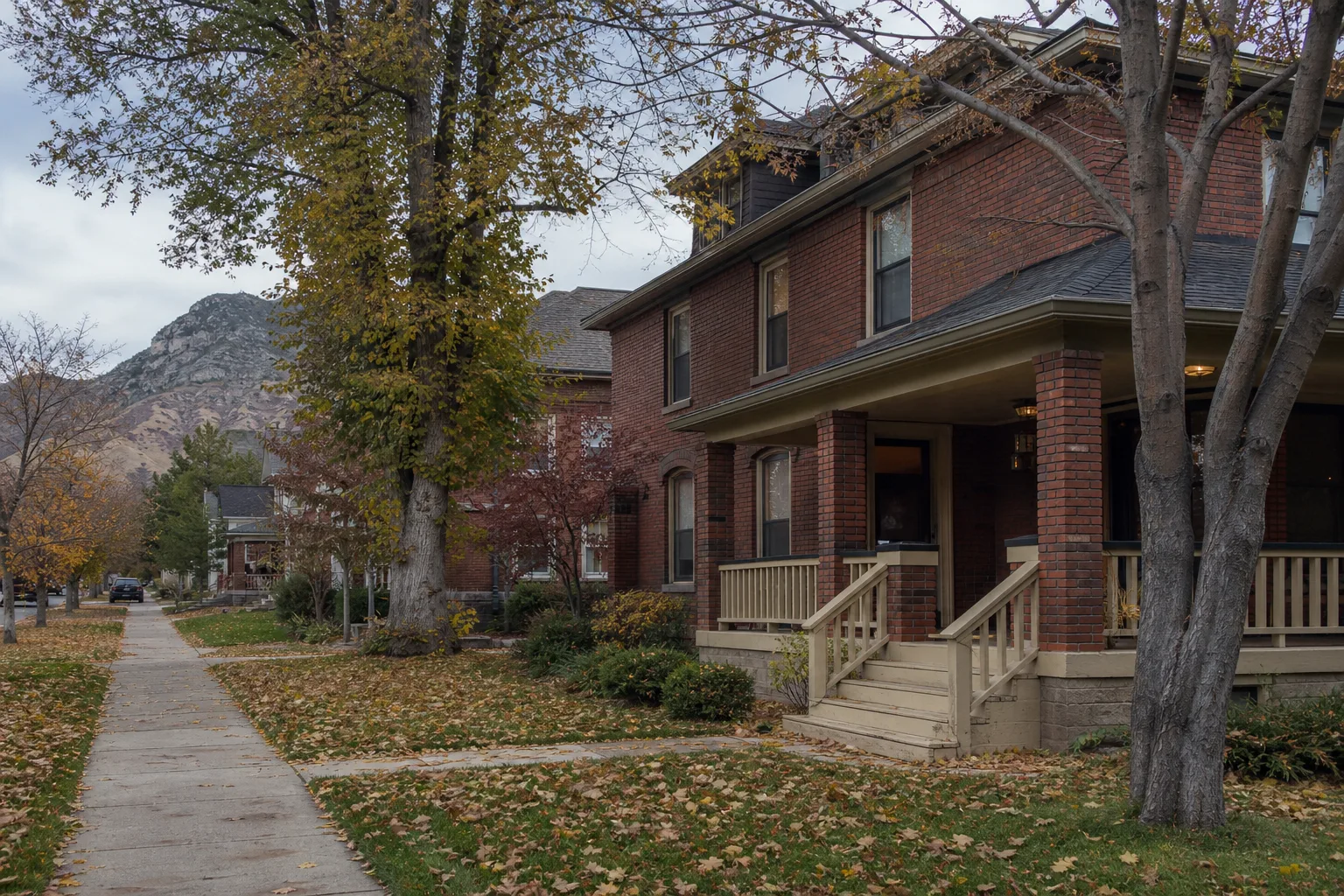
Logan was settled in 1859, and its central blocks show it. The Logan Center Street Historic District, listed on the National Register of Historic Places in 1979, covers roughly 200 North to 200 South and 200 East to 600 West. Homes here and on the streets climbing toward campus suit buyers who want to walk or bike to class, work or Main Street.
The trade-off is the rental market. Census figures for 2019 to 2023 put Logan's owner-occupied rate at 38.5%, which means about six in ten homes are rented. A house near campus may have a rental next door, and a buyer planning to rent out a home needs to know the rules first (see the checklist below).
Newer Logan
Logan also has newly built homes inside the city school district. Current listings are on the Logan new construction page. Logan City School District runs six elementary schools (Adams, Bridger, Ellis, Hillcrest, Wilson and Woodruff), Mount Logan Middle School and Logan High School.
Best fit: USU and hospital employees, buyers who want the shortest drives and the most housing types, and investors who have read the rental rules.
North: North Logan, Hyde Park and Smithfield
North Logan starts where Logan ends, about three road miles from Old Main. It has 11,608 residents, Green Canyon High School and the Cache County School District office. Growth since 2020 has been modest, about 6%, so most of what comes up for sale is in established subdivisions.
Hyde Park (5,786 residents) is the next city north. Two new district schools there, Juniper Ridge Middle School and Old Ephraim Elementary, were scheduled to open for the 2026-27 school year, and the district's plan sends Juniper Ridge students on to Green Canyon High.
Smithfield is the valley's second-largest city at 15,153 residents, about eight miles from campus on US-91. It has Sky View High School, and its population is up about 12% since 2020.
Best fit: households that want Cache County schools and a single-family neighborhood, and that work on the north side of Logan or at USU. Buyers who will drive to Brigham City or Ogden every day should note that the north end adds a trip through Logan to every commute south.
South: River Heights, Providence, Millville and Nibley
River Heights is the closest neighbor to downtown Logan, a little over a mile away, and with about 2,250 residents it has very few homes for sale in any given month. Providence (9,539 residents) continues south toward the foothills. Millville (about 2,500) is home to Ridgeline High School, which draws students from Millville, Nibley, Providence and River Heights.
Nibley has changed the most. Its population rose from 7,335 at the 2020 base to 8,975 in July 2025, about 22%, the fastest rate among the cities compared here. Maple View Middle School, at 3050 South 920 West, was scheduled to open there in August 2026. Buyers looking for a home built in the last few years will find more of them here than anywhere else south of Logan.
Best fit: buyers who commute toward Brigham City, since these towns are already on the way out of the valley. Providence sits at the mouth of Providence Canyon with foothills to the east, which suits buyers who want to be near the mountains. Nibley suits buyers who want a recent build.
South End: Hyrum and Wellsville
Hyrum (11,132 residents, up about 19% since 2020) is about eight miles from downtown Logan. It has Mountain Crest High School, South Cache Middle School and Hyrum State Park, a reservoir on the Little Bear River just south of town with a boat ramp and campground.
Wellsville (about 4,300) sits on US-89/91 where the highway leaves the valley through Sardine Canyon. That makes it the shortest drive to Brigham City of any town here and one of the longest to USU.
Best fit: buyers who want a town with its own identity, more room, and a head start on the drive to the Wasatch Front.
What to Check Before Choosing an Area
- The school district line. Logan addresses are generally in Logan City School District, and the surrounding cities are in Cache County School District, which redrew boundaries and moved sixth grade into its middle schools for the 2026-27 school year. Run the exact address through the district's boundary tools before making an offer, especially near a city limit.
- Rental rules near USU. Logan requires every owner of a rental unit to hold a landlord business license. In most zones a home may be occupied by a family plus one more person, or by no more than three individuals. The Campus Residential zone allows up to six, with no more than two per bedroom. A house advertised with five rented bedrooms may not be legal outside that zone.
- Older-home issues. In the central blocks, budget for a sewer line camera inspection, an electrical review and a close look at the foundation and roof. Homes built before 1978 come with a federal lead-based paint disclosure.
- Canal and irrigation water. Many valley lots are watered from canals, and the water shares are managed by irrigation companies, not the city. Ask whether shares transfer with the property, how water is delivered and what the yearly assessment costs. The Salt Lake Tribune reported in June 2026 that the Cache Water District and Crockett Avenue Irrigation Co. have proposed a pressurized secondary water system for Logan, North Logan and Hyde Park at a cost of almost $310 million, with construction from 2028 to 2033 if it goes ahead. The current canals run by gravity.
- New-build areas. In Nibley, Hyrum, Providence and Smithfield, ask the city what is approved on the vacant land nearby, confirm whether secondary water is available, and hire an independent inspector before closing.
- Winter air. Cache Valley is a bowl, and the Utah Department of Environmental Quality explains that inversions trap cold air and fine particle pollution (PM2.5) near the ground. The EPA listed the Logan area as out of compliance with the 24-hour PM2.5 standard in 2009 and redesignated it to attainment in May 2021. A 2023 Utah State University report cautioned that northern Utah is only a few strong inversion winters from exceeding the standard again. A bench address is not a guarantee of cleaner air. Visit in January and check the state's air monitoring readings.
- Foothill lots. On the east side of the valley, look at driveway slope, snow removal, retaining walls and drainage, and get an insurance quote early where homes meet open hillside.
- The commute south. Brigham City is about 25 road miles from downtown Logan and Ogden about 47, by way of US-89/91 through Sardine Canyon and then I-15. The canyon is a mountain road. In December 2024, for example, KSL reported traction-device restrictions in both directions after weather brought traffic to a standstill.
- Transit. Connect Public Transit, known until 2024 as Cache Valley Transit District, has run fare-free since 1992. It lists service to Logan, North Logan, Hyde Park, Smithfield, Richmond, Lewiston, River Heights, Providence, Millville, Nibley and Hyrum. Check the route and frequency for a specific address.
Recreation Is Close to Every Town
Location inside the valley changes the drive to the mountains by minutes, not hours. Logan Canyon begins at the east edge of Logan on US-89. Beaver Mountain ski area is 27 miles northeast of the city, a mile off the highway, and Garden City on Bear Lake is about 40 miles from Logan through the canyon. South-end residents have Hyrum State Park close by. For in-town stops, see the best places to see in Logan.
Matching the Area to the Buyer
- Walk or bike to USU: central Logan and the streets below campus.
- Cache County schools, short drive to campus: North Logan, Hyde Park, River Heights.
- A recently built home: Nibley first, then Hyrum, Providence and Smithfield.
- A self-contained town with its own high school: Smithfield or Hyrum.
- Daily drive to Brigham City or Ogden: Nibley, Hyrum or Wellsville.
- Rental investment: Logan, after checking the zone and occupancy limit for the exact address.
Homes for sale in every Cache Valley city are listed on Best Utah Real Estate.
Posted by Kristopher Larson
Frequently asked questions
What are the best areas to live near Logan, Utah?
It depends on the priority. Central Logan is best for walking or biking to Utah State University, North Logan and River Heights are the closest neighboring cities, Nibley has the most recently built homes, and Smithfield and Hyrum are larger towns with their own high schools. Compare school district, drive distance and housing age for each before choosing.
Which school district serves Logan and the surrounding towns?
Logan City School District serves Logan and includes Logan High School and Mount Logan Middle School. The surrounding cities, including North Logan, Hyde Park, Smithfield, River Heights, Providence, Millville, Nibley, Hyrum and Wellsville, are in Cache County School District, whose high schools are Green Canyon, Sky View, Ridgeline and Mountain Crest. Boundaries changed for the 2026-27 school year, so confirm the schools for an exact address with the district.
How much do homes cost in Logan, Utah?
The median sale price in Logan is $374,619, and homes take a median of 33 days to sell. In the smaller towns around Logan only a handful of homes close each month, so their medians move around more than the market does.
Is the bus free in Logan, Utah?
Yes. Connect Public Transit, formerly Cache Valley Transit District, has operated fare-free since service began in 1992. It serves Logan and neighboring cities including North Logan, Hyde Park, Smithfield, River Heights, Providence, Millville, Nibley and Hyrum.
How many people can rent a house together in Logan?
Under Logan's rules, most homes may be occupied by a family plus one additional person, or by no more than three individuals. The Campus Residential zone near Utah State University allows up to six people per unit with no more than two per bedroom. Every owner of a rental unit in Logan also needs a landlord business license from the city.
Does Cache Valley have winter inversions?
Yes. The valley's bowl shape traps cold air and fine particle pollution during winter high-pressure periods. The EPA redesignated the Logan area to attainment for the 24-hour PM2.5 standard in May 2021 after it had been out of compliance since 2009, but Utah State University researchers have cautioned that a few strong inversion winters could push levels over the standard again.
Logan, Utah housing market
A quick read on what homes are doing in Logan right now — pulled live from the MLS.
Keep reading
More from the blog

Pros and Cons of living in Logan, Utah
Buying Near the Jordanelle and Deer Valley East Village: What to Check First
The Point in Draper: What Buyers Nearby Should Know Before Counting on It