Best Water Flosser: Waterpik vs. Sonicare Power Flosser
Countertop vs. cordless, flossing time, pressure, tips and travel: how the Waterpik Aquarius, Cordless Advanced and Sonicare Power Flossers compare.
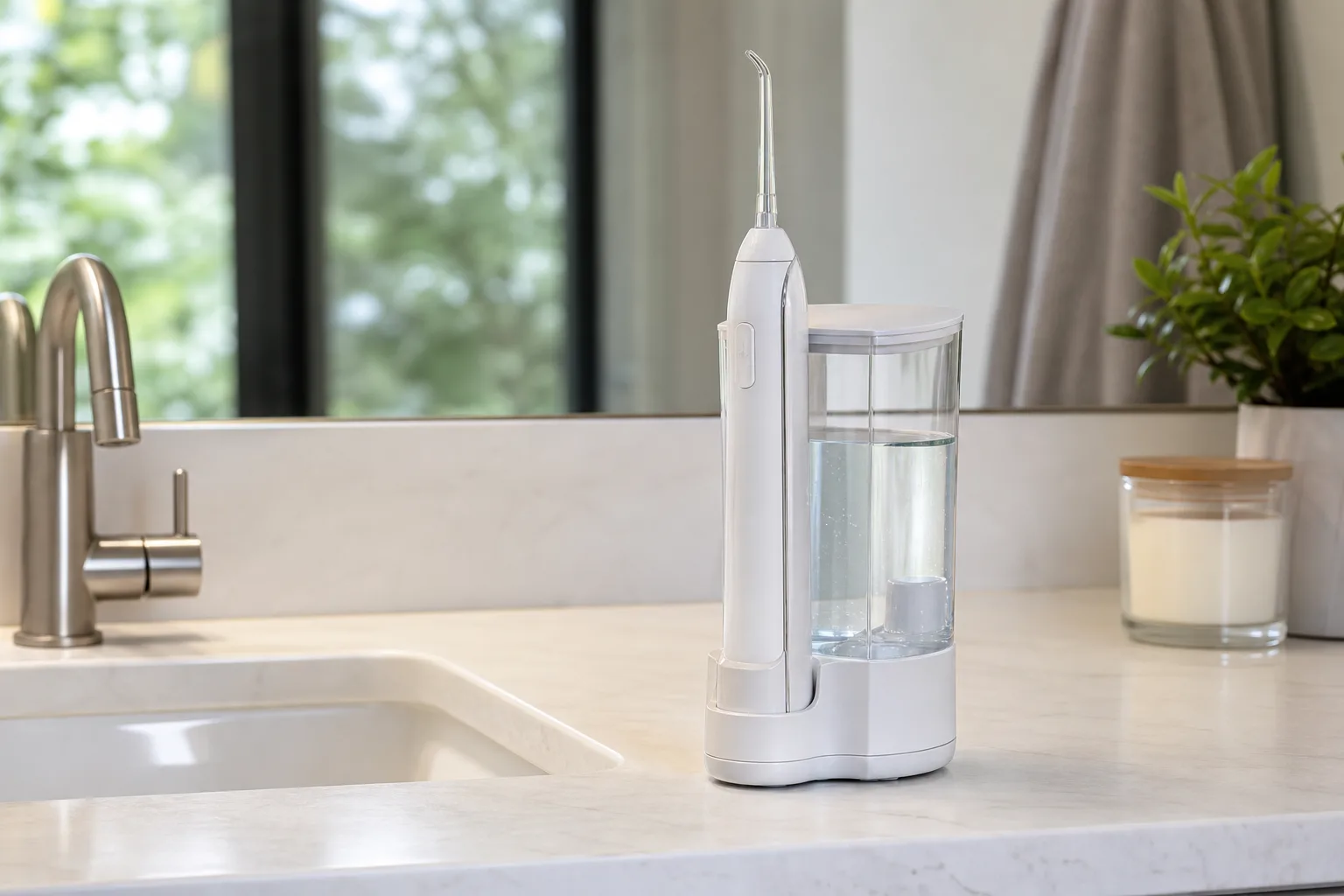
A water flosser sprays a thin, pulsing jet of water between teeth and along the gum line to flush out food and plaque. For people who hate string floss, have braces, or have crowns, bridges or implants, it's often far easier to use every day, and the daily part is what matters. Waterpik and Philips Sonicare make the two most popular lines, in both countertop and cordless versions.
The choice between countertop and cordless matters more than the brand. A countertop unit gives you a big tank and long, steady flossing time; a cordless one is portable and tidy but runs out of water in about a minute. This guide covers what to look for and which models are worth buying.
Quick verdict
- Best overall: the Waterpik Aquarius. A countertop flosser with a large tank, 10 pressure settings, an easy-to-turn nozzle, the most tip styles, cheaper replacement tips and a 3-year warranty in the U.S.
- Best cordless: the Waterpik Cordless Advanced, with the best grip and the easiest nozzle to rotate.
- Best cordless for longer sessions and travel: the Philips Sonicare Cordless Power Flosser 3000, with a bigger tank, a timer, longer battery life and USB-C charging.
- Best-looking countertop: the Philips Sonicare Countertop Power Flosser 3000, which sits flush against the wall and is quieter at low settings.
The water flossers side by side
| Water flosser | Shop | Type | Flossing time per fill | Pressure settings | Best for |
|---|---|---|---|---|---|
| Waterpik Aquarius |  View on Amazon | Countertop | About 90 seconds to over 4 minutes | 10 | Most people, braces, dental work |
| Philips Sonicare Countertop Power Flosser 3000 |  View on Amazon | Countertop | Comparable to the Aquarius | Multiple | Tight spaces, quieter use |
| Waterpik Cordless Advanced |  View on Amazon | Cordless | About 45 to 65 seconds | 3 | Small bathrooms, grip |
| Philips Sonicare Cordless Power Flosser 3000 |  View on Amazon | Cordless | About 60 to 85 seconds | 3 + pulsing Deep Clean mode | Travel, longer sessions |
Best overall
Waterpik Aquarius
The best balance of tank size, flossing time and features: 10 pressure settings, a handle pause switch, an easy-turn nozzle and the most tip styles.
- Countertop
- 10 pressure settings
- 3-year U.S. warranty
Good for
- Everyday flossing
- Braces, crowns, implants and bridges
Skip it if
- Sitting flush against the wall (the cord sticks out)
What to look for in a water flosser
Countertop or cordless
Countertop flossers plug in and hold a big tank of water, so you can floss your whole mouth without stopping to refill. The Waterpik Aquarius's tank gives anywhere from about 90 seconds to more than 4 minutes, depending on pressure, usually enough for a couple of sessions. The downsides are counter space and a hose that ties you to the base.
Cordless flossers are self-contained and rechargeable, so they're easy to use in the shower, put away or pack. But their small tanks give only about 40 to 60 seconds on most models. Once your technique is quick, that can be enough, but new users usually have to refill partway through.
The features that matter
- At least 45 seconds of flossing per fill, so you can reach every tooth without refilling.
- Two or more pressure settings. Start low and work up.
- A rotating nozzle, so you can reach the inside and back surfaces without twisting your wrist.
- A comfortable, grippy handle. Wet, smooth plastic is slippery.
- A pause control on the handle, so you can stop the water while moving between teeth without spraying the mirror.
More pressure isn't better
Dental professionals generally advise against blasting gums with very high pressure, especially if they're inflamed or bleeding. Some flossers advertise extreme numbers, like one rated at 160 PSI that empties its tank in about 20 seconds; that's more force than most mouths need. A periodontist's advice: use lower pressure until your gums are healthy, then turn it up once they are. Start on the lowest setting for the first week.
Tips and replacement costs
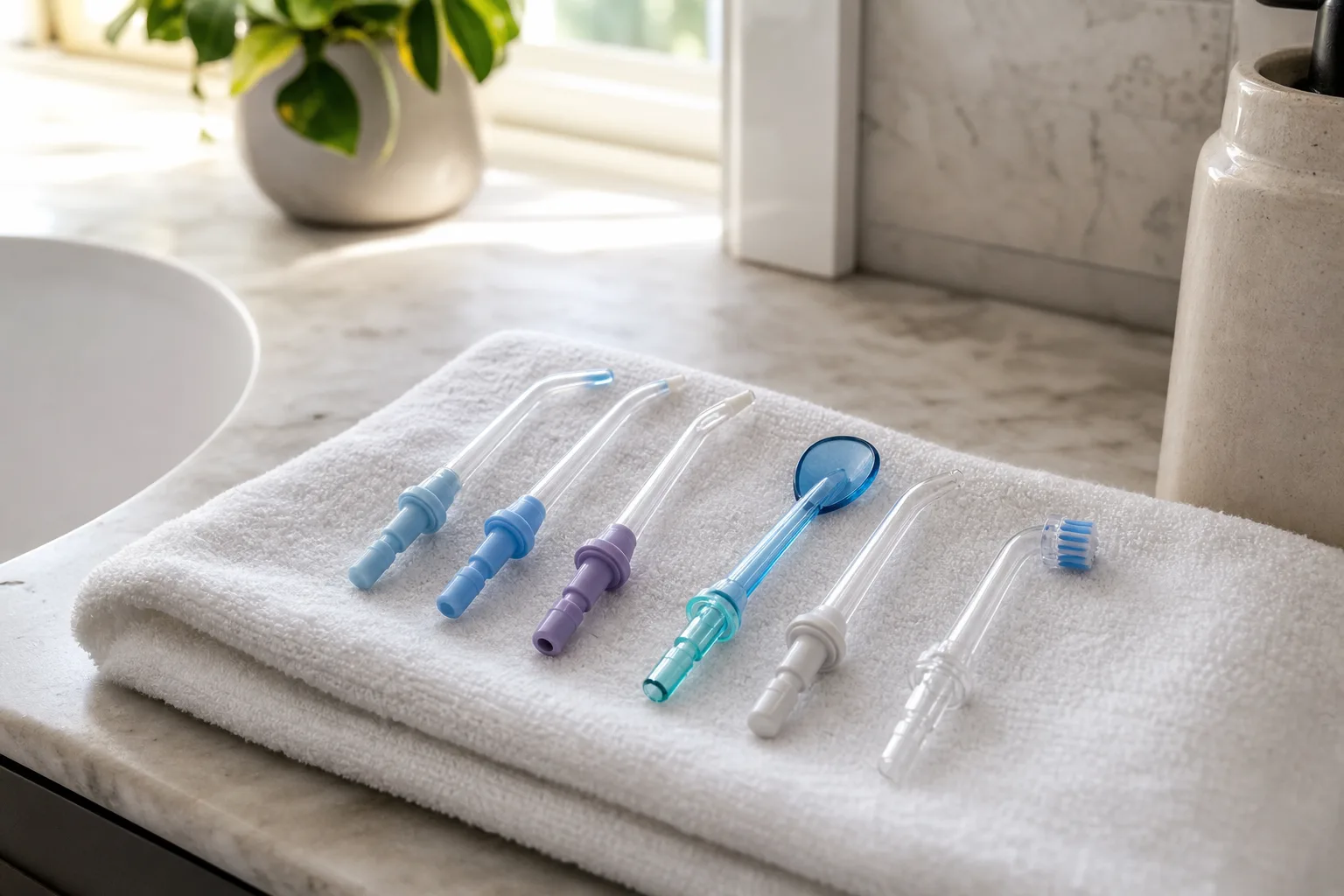
Waterpik offers the widest range of tips: standard jet tips, an orthodontic tip with bristles for braces, a plaque-seeking tip with small bristles for implants, crowns and bridges, and more. Bristled tips clean deeper than a plain jet. Waterpik tips also cost less than Sonicare's nozzles, which adds up over years, since tips should be replaced every few months. Sonicare's quad-stream nozzle sprays four small streams that can massage the gums while cleaning.
Stick with brands that sell parts
Store shelves are full of lesser-known water flossers. Many work, but replacement tips and parts can be hard to find, and reliability is a bigger question mark. Even some big-brand models have had poor parts availability or broke in use. Waterpik and Sonicare both have clinical evidence behind them, with more published research for Waterpik, and both sell replacement tips widely.
The picks in detail
Waterpik Aquarius: best overall
The Aquarius strikes the best balance of tank size, flossing time, size and features. Its 10 pressure settings cover everything from gentle to strong, a slide switch on the handle pauses the water, and the nozzle rotates with a flick of a finger. The textured pressure dial is easy to use with wet hands, it comes in several colors, and Waterpik backs it with a 3-year warranty in the U.S. It works well for everyday flossing and around braces, crowns, implants, bridges and veneers.
The one annoyance: the power cord sticks out of the back, so it can't sit flush against the wall, which matters when counter space is tight.
Best overall
Waterpik Aquarius
The best balance of tank size, flossing time and features: 10 pressure settings, a handle pause switch, an easy-turn nozzle and the most tip styles.
- Countertop
- 10 pressure settings
- 3-year U.S. warranty
Good for
- Everyday flossing
- Braces, crowns, implants and bridges
Skip it if
- Sitting flush against the wall (the cord sticks out)
Philips Sonicare Countertop Power Flosser 3000: best-looking countertop
Sonicare's countertop flosser gives comparable flossing time and cleaning to the Aquarius in a sleeker body that sits right against the wall. It's noticeably quieter on lower settings, though about as loud as the Waterpik at high pressure. In a simple paper-towel test, a Sonicare countertop flosser on maximum broke through faster than a Waterpik on maximum, a sign it isn't short on power. The trade-offs: it only comes in white, its nozzles cost more, and Waterpik's textured dial and rotating nozzle are a little easier to use.
Best-looking countertop
Philips Sonicare Countertop Power Flosser 3000
Comparable flossing time and cleaning to the Aquarius in a sleeker body that sits right against the wall, and quieter on lower settings.
- Countertop
- Flush-to-wall design
Good for
- Tight counters
- Quieter low settings
Skip it if
- Color choices (white only)
Waterpik Cordless Advanced: best cordless
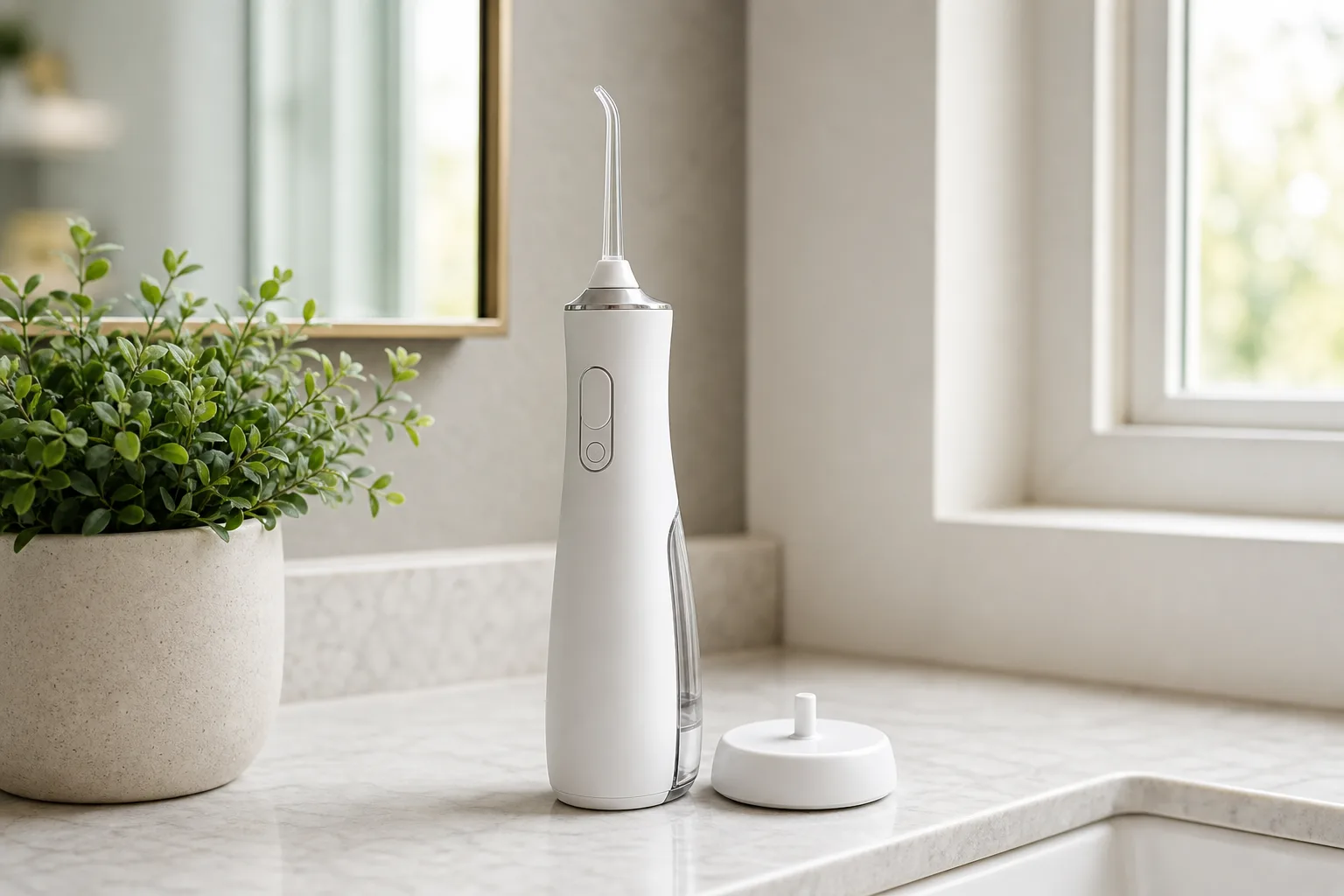
Between the two leading cordless models, the Cordless Advanced is the better one to hold and use. A large textured panel on the back and soft rubber buttons keep it secure in a wet hand, and its nozzle turns far more easily than the Sonicare's. It comes with four tips (two standard jets, an orthodontic tip and a plaque-seeking tip) plus a hard case for them, a travel pouch and a plug that seals the nozzle port so it doesn't drip in a bag. It charges on a magnetic base that works well in a bathroom.
The trade-offs: its 7-ounce tank gives about 45 to 65 seconds, it's about 70 grams heavier than the Sonicare, its battery is rated for about a week between charges, and its magnetic charger is bulkier to pack and proprietary, so don't lose it.
Best cordless
Waterpik Cordless Advanced
The better cordless to hold and use, with a textured grip, soft buttons, an easy-turn nozzle, four tips, a hard case and a travel plug.
- 7 oz tank
- 4 tips
- Magnetic charger
Good for
- A secure grip in a wet hand
- Bathrooms (magnetic charging base)
Skip it if
- Long sessions (about 45 to 65 seconds per fill)
Philips Sonicare Cordless Power Flosser 3000: best for longer sessions and travel
The Sonicare cordless has a larger 8.4-ounce tank for about 60 to 85 seconds of flossing, a lithium-ion battery rated for about two weeks, and USB-C charging, so one cable covers it on a trip. It's lighter than the Waterpik, has a built-in timer that pulses to tell you when to move on, and adds a Deep Clean mode that varies the pressure. A nozzle stores inside the tank when it's not in use. Its weaknesses are a smoother, more slippery body, plastic buttons and a stiff nozzle that can take two hands to rotate.
Best for travel
Philips Sonicare Cordless Power Flosser 3000
A larger 8.4-ounce tank, about two weeks of battery, USB-C charging, a pacing timer and a Deep Clean mode, in a lighter body.
- 8.4 oz tank
- USB-C
- Deep Clean mode
Good for
- Travel (one USB-C cable)
- Longer cordless sessions
Skip it if
- A grippy body (smooth and slippery)
Traveling with a water flosser
Most cordless flossers are bulkier than you'd expect and take up real space in a bag. For frequent travelers, a collapsible model like the Waterpik Cordless Slide, which folds down to about the size of a phone, packs best. Otherwise, the Sonicare cordless's USB-C charging and nozzle storage make it the easier of the two picks above to travel with.
Best-looking countertop
Philips Sonicare Countertop Power Flosser 3000
Comparable flossing time and cleaning to the Aquarius in a sleeker body that sits right against the wall, and quieter on lower settings.
- Countertop
- Flush-to-wall design
Good for
- Tight counters
- Quieter low settings
Skip it if
- Color choices (white only)
How to use a water flosser
- Lean over the sink and close your lips around the tip just enough to stop splashing, letting water drain out of your mouth.
- Start at the back teeth, aim the tip at the gum line at a right angle, and pause briefly between each tooth.
- Trace the gum line along the inside and outside of each arch, rotating the nozzle as you go.
- Use lukewarm water. Cold water can be uncomfortable on sensitive teeth.
- Empty the tank and let it dry after use to keep it clean, and replace tips every few months.
A water flosser works alongside brushing, not instead of it. See the Oral-B vs. Sonicare toothbrush guide for the other half of the routine.
How to choose
- Want the best all-around flosser and have the counter space? The Waterpik Aquarius.
- Need it flush against the wall or want it quieter? The Sonicare Countertop Power Flosser 3000.
- Small bathroom or want to floss in the shower? The Waterpik Cordless Advanced.
- Travel often or want a longer cordless session? The Sonicare Cordless Power Flosser 3000.
- Braces, implants or bridges? A Waterpik, for the specialized tips.
Posted by Kristopher Larson
Frequently asked questions
Is a water flosser as good as string floss?
For many people it's the better choice simply because they'll actually use it every day. Water flossers flush out food and plaque between teeth and along the gum line, and they're much easier around braces, crowns, bridges and implants. Ask your dentist or hygienist what's best for your mouth; some people use both.
Should I get a countertop or cordless water flosser?
Countertop if you have the space: the large tank gives about 90 seconds to more than 4 minutes of flossing, so you never stop to refill. Cordless if you're short on counter space, want to floss in the shower, or travel: most give only about 40 to 60 seconds per fill.
What pressure setting should I use on a water flosser?
Start on the lowest setting and work up over a week or two. If your gums bleed or are sensitive, stay at lower pressure until they're healthy. More pressure isn't automatically better, and very high-pressure flossers can be harsh on gums.
Is Waterpik or Sonicare better?
Both clean well. Waterpik has more tip styles, cheaper replacement tips, easier-to-rotate nozzles, a grippier cordless model and a 3-year warranty on the Aquarius in the U.S. Sonicare's flossers are sleeker and quieter at low settings, and its cordless model has a bigger tank, a timer, longer battery life and USB-C charging.
How often should you replace a water flosser tip?
Every three to six months for most tips, and more often for bristled orthodontic or plaque tips once the bristles wear. Replace any tip that's cracked or clogged.
Can you use a water flosser with braces?
Yes, and it's one of the easiest ways to clean around brackets and wires. Waterpik's orthodontic tip has small bristles that help loosen plaque around brackets. The Waterpik Aquarius and Cordless Advanced both work with it.
Keep reading
More from the blog
Ring Drone Cam and Rover Cam: Release Dates, Prices and What Homeowners Should Know

Best Cold Brew Coffee Maker: OXO vs. Takeya vs. County Line Kitchen
Best Portable Bluetooth Speaker: JBL Flip 7 vs. Bose SoundLink Flex vs. Soundcore