Best Baby Monitor for Your Parenting Style: VTech vs. eufy E21 vs. Nanit Pro vs. Owlet vs. Harbor
Eight baby monitors tested long term: VTech and eufy E21 for simple viewing, Owlet, Harbor and Nanit Pro for data, and two popular models to skip.
Most baby monitor rankings crown one winner, as if every parent wants the same thing at 3 a.m. Long-term testing of eight monitors, Wi-Fi and non-Wi-Fi, smart and simple, points to a different starting question: does a parent want data, or just a clear look at the baby? Buying for the wrong camp means either paying every month for analytics that never get opened, or lying awake because the screen doesn't say enough.
As an Amazon Associate, Best Utah Real Estate earns from qualifying purchases.
Quick verdict
"Just the picture" parents want a clear picture, clear sound, no app and no subscription:
- Best value, no Wi-Fi: VTech Advanced HQ Max. A large 7-inch screen, long range and a motion sensor, which most non-Wi-Fi monitors lack.
- Best overall in the simple tier: eufy Baby Monitor E21. The sharpest picture in the test, plus a switch that toggles between a local-only link and Wi-Fi with phone alerts.
Data parents want tracking, alerts and trends:
- Health concerns or a preemie: Owlet Dream Duo, built around an FDA-cleared sock that reads pulse rate and oxygen.
- Privacy and travel: Harbor, which keeps footage on the camera and keeps working when the internet drops.
- Deepest sleep analytics: Nanit Pro, the most polished app of the group, as long as the subscription gets used.
Skip: the Babysense HD S2 and the HelloBaby HB6550.
Spec comparison
| Model | Shop | Best for | Connection | Parent screen | Camera | Subscription |
|---|---|---|---|---|---|---|
| VTech Advanced HQ Max |  Buy on Amazon | Simple, reliable value | Encrypted 2.4 GHz FHSS, no Wi-Fi | 7 in IPS | 360° pan, 122° tilt, 4x zoom | None |
| eufy Baby Monitor E21 |  Buy on Amazon | Simple, with phone alerts | Hybrid: local link or Wi-Fi, with a Wi-Fi cut-off switch | 5 in, 720p | 4K, 330° pan, 60° tilt, 8x zoom | None; records to microSD |
| Owlet Dream Duo 3 |  Buy on Amazon | Health monitoring | Wi-Fi (sock needs 2.4 GHz) | Phone app | 2K, 130° lens, 4x zoom, plus Dream Sock | Optional Owlet360 for deeper trends |
| Harbor | Privacy and travel | Wi-Fi, with a direct fallback when internet is lost | 10.1 in dedicated monitor | 2K | Core features free; optional AI alerts and Sleep Insights | |
| Nanit Pro |  Buy on Amazon | Sleep analytics | Wi-Fi | Phone app, or optional 8 in display | 1080p overhead view | Free live view; sleep analytics need Insights |
The 1,000-foot range claims for non-Wi-Fi monitors are open-air figures; walls and floors cut that sharply.
What long-term testing found
Range: walls matter more than the box claim
Range was tested the practical way: each parent unit was carried out of the house and away from the nursery until the picture cut out. The VTech, the eufy E21 and the HelloBaby all held on to roughly the same spot, about halfway down the neighbor's sidewalk. The Babysense HD S2 struggled inside the house: one wall made the connection shaky, two walls made it drop in and out, and three walls lost it. Outdoors it died about 20 feet past the front door.
Picture quality varied more than the spec sheets suggest
The eufy E21 produced the sharpest image in the test, with crisp night vision. Harbor and the VTech were close behind. Nanit, despite a 1080p camera, looked noticeably softer than all three, which disappointed but wasn't a deal breaker. The two weakest were the Babysense, whose blurry, low-detail image made it hard to tell a sleeping baby from the bedding around them, and the HelloBaby, which side by side with the VTech at the same distance looked hazy and washed out.
"No Wi-Fi" doesn't automatically mean less radio output
Many parents pick non-Wi-Fi to cut radio-frequency exposure, so every camera was also measured with a professional EMF meter. At two feet, the Babysense, a non-Wi-Fi model, read roughly 36 times higher than the Nanit Wi-Fi camera. The VTech and eufy read in a similar range to each other. For every model, readings fell off sharply with distance, so a camera six feet or more from the crib, zoomed in on the mattress, reads far lower than one near the rail. That placement also keeps the cord away from the crib.
How to choose: which camp are you in?
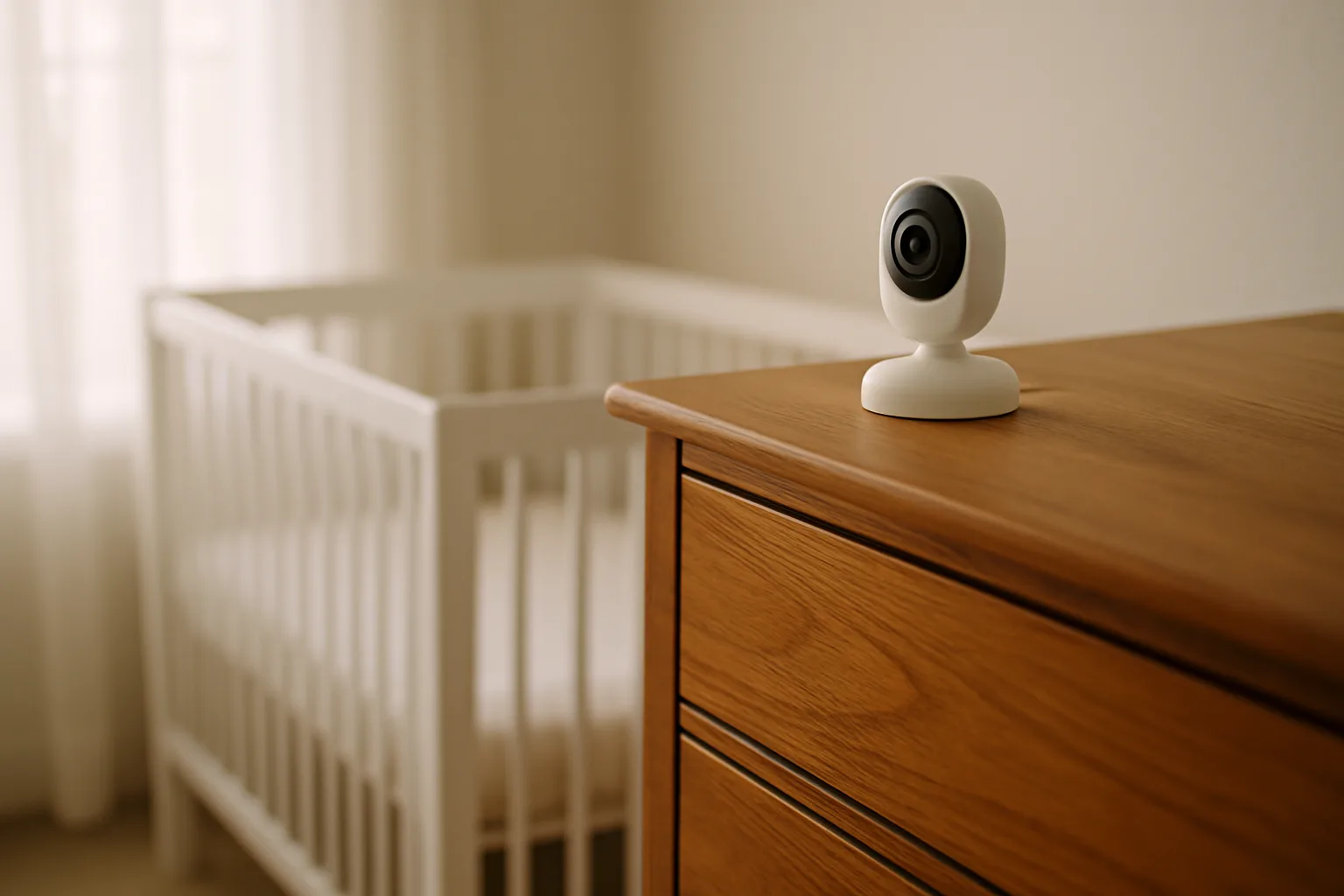
Data parents, often first-timers, want to know when the baby fell asleep, how often they stirred and whether the room was too warm. The catch: the best data usually sits behind a subscription, and every product in this camp depends on Wi-Fi. "Just the picture" parents want to glance at a screen, confirm the baby is asleep and not climbing the rail, and go back to bed, so clarity, range and battery life matter more than any app.
Neither approach is wrong. The deciding questions: will the analytics get used every week, and does the monitor need to work away from home Wi-Fi? For Wi-Fi models, a strong signal in the nursery matters; a mesh Wi-Fi system can fix a dead zone in a back bedroom.
The "just the picture" picks
VTech Advanced HQ Max: best value
The VTech was the monitor that simply worked. Its 7-inch IPS screen is large enough to read from across a bedroom, the picture was crisp next to the HelloBaby's, and its range was among the best in the test, easily covering the yard. What set it apart from the other non-Wi-Fi monitors was movement sensing. Most local monitors only wake the screen when the baby makes noise; VTech lists a motion sensor alongside the sound-activated screen and a nursery temperature readout.
On paper, the camera pans 360 degrees, tilts 122 degrees and zooms 4x from the parent unit, and the link uses encrypted 2.4 GHz FHSS with no internet, account or app. VTech rates the 5,000 mAh parent-unit battery for up to 12 hours of streaming or 18 hours of audio only. The trade-off is the obvious one: no app means no phone alerts when the parent unit is in another room.
VTech Advanced HQ MaxCheck today’s price on AmazonBuy on Amazon →
eufy Baby Monitor E21: best in the simple tier
The E21 is a hybrid. A physical switch cuts Wi-Fi for a private local link between camera and parent unit, and switching Wi-Fi back on adds the app and push notifications. In practice that meant the app in the backyard and local mode on unreliable hotel Wi-Fi. The picture was the best of all eight monitors, the parent unit was responsive, and the app was quick and clean, with alerts that buzz a phone when the baby cries and nobody is watching the screen. Range matched the VTech.
eufy lists active noise reduction, cry, temperature and loud-noise alerts, and RSA-1024/AES-128 encryption. Recordings save to a microSD card (sold separately) rather than a paid cloud, and a built-in 5,000 mAh camera battery lets it move to a travel crib without an outlet nearby.
Two caveats. It costs considerably more than the VTech, which is wasted money for parents who will never use the app. And eufy, an Anker brand, has a security history: after a security researcher showed that some eufy security cameras didn't match the company's encryption and local-storage claims, New York's attorney general reached a settlement with its U.S. distributors requiring stronger protections. eufy says the issues are fixed, and no new incidents surfaced during testing, but privacy-first buyers who want Wi-Fi flexibility may prefer Harbor.
eufy Baby Monitor E21Check today’s price on AmazonBuy on Amazon →
The data-parent picks
Owlet Dream Duo: for health concerns
Nanit and some other smart cameras offer breathing-motion tracking, but Owlet is the vitals specialist. The Dream Sock uses pulse oximetry, the same principle as a hospital finger clip, to read pulse rate and oxygen level and alert parents when readings leave preset zones. It is FDA-cleared for healthy infants, which is regulatory review rather than marketing language. For parents of preemies or babies with respiratory issues, that is the reason to buy it.
The camera in testing was solid: a crisp picture, strong night vision and clean audio, with a simple app. The current Dream Duo 3 pairs the sock with Owlet's 2K Dream Sight camera, which has a 130-degree lens, 4x zoom and room temperature and humidity alerts. Live readings and notifications work in the free app; deeper sleep and health trends need the optional Owlet360 subscription.
Owlet Dream Duo 3Check today’s price on AmazonBuy on Amazon →
Harbor: for privacy and travel
Harbor pairs a 2K camera with a dedicated 10.1-inch monitor, so a phone isn't tied up all night. Its standout in testing was resilience: when the internet dropped, the camera and monitor kept talking directly, and the local backup mode worked flawlessly through an entire trip. The picture was noticeably sharper than Nanit's side by side, and the app was clean and easy to learn. Motion detection and recording come standard, and Harbor's product page says recordings are stored only on the camera itself, with end-to-end encryption.
Harbor doesn't track breathing, and as a newer product its software isn't yet as polished as Nanit's. Core features need no subscription, though Harbor now offers AI alerts and Sleep Insights as an optional paid add-on. Harbor sells directly rather than on Amazon.
Nanit Pro: for the deepest sleep analytics
Nanit's overhead camera produced the most detailed sleep tracking in the category, and the product felt more finished than its rivals. The most useful daily numbers were simple: when the baby fell asleep, when they woke and how often they stirred, which together give a fair idea of how the next day will go. A sped-up night time-lapse shows how the baby actually settled, and Nanit's Sleep Score, available to subscribers, condenses each night into a 0–100 number with the factors behind it.
The Nanit Pro streams 1080p with two-way audio, night vision, temperature and humidity readings, and 256-bit AES encryption with two-factor authentication. Nanit also now sells the camera in a system with an 8-inch display. Its weak spots in testing were the picture, softer than Harbor, eufy or VTech, and the subscription. Live viewing and sound and motion alerts are free, but the sleep analytics that justify buying a Nanit sit in its paid Insights plans; the display bundle's listing also notes that initial setup requires a subscription. For parents who use the data to adjust naps and troubleshoot regressions, it earns its keep; otherwise it is a costly webcam.
Nanit Pro Smart Baby MonitorCheck today’s price on AmazonBuy on Amazon →
The two to skip
- Babysense HD S2: it lost signal through interior walls, delivered a weaker picture than the VTech with a narrower field of view, and gave a far higher RF reading than the Nanit Wi-Fi camera.
- HelloBaby HB6550: excellent range, matching the VTech, but the worst picture of the group by a wide margin, a build that felt flimsy, and no volume button, so changing volume means digging three levels into a menu.
Safety rules that apply to every monitor
A monitor helps parents see and hear; it does not make sleep safer by itself.
- Keep cords at least three feet from the crib. The U.S. Consumer Product Safety Commission warns that monitor cords can strangle infants and advises keeping them at least three feet from any crib, bassinet or play yard, and never placing a monitor in or on the edge of a crib. Recheck placement as the child learns to reach.
- A monitor is not SIDS prevention. The American Academy of Pediatrics' safe sleep guidance says not to use home cardiorespiratory monitors to reduce SIDS risk and that there is no evidence consumer heart-rate or oxygen devices, wearable ones included, lower it. Using one is fine, the AAP says, as long as it doesn't replace the basics: baby on the back, on a firm, flat surface, with only a fitted sheet in the crib.
Treat any Wi-Fi nursery camera like a front-door camera: a unique password, two-factor sign-in and prompt firmware updates, the same habits that apply to home security cameras.
Who should buy which
- Wants a reliable screen, no app, no fees: VTech Advanced HQ Max.
- Wants that simplicity plus phone alerts and a local-only switch: eufy Baby Monitor E21, if its security history is acceptable.
- Has a preemie or a specific health worry: Owlet Dream Duo, alongside safe sleep basics.
- Travels often or wants recordings kept on the camera: Harbor.
- Will actually use sleep data every week: Nanit Pro with an Insights plan.
Posted by Kristopher Larson
Frequently asked questions
Is a Wi-Fi or non-Wi-Fi baby monitor better?
It depends on what the parent wants from it. Non-Wi-Fi monitors such as the VTech Advanced HQ Max use a direct radio link, so they keep working when the internet is down and need no app, account or subscription. Wi-Fi monitors such as the Nanit Pro and Owlet Dream Duo add phone viewing from anywhere, sleep data and health readings. Hybrids such as the eufy E21 do both, with a switch that turns Wi-Fi off.
Do non-Wi-Fi baby monitors give off less radiation?
Not necessarily. In independent RF measurements at two feet, a popular non-Wi-Fi monitor, the Babysense HD S2, read roughly 36 times higher than the Nanit Wi-Fi camera. Readings from every camera drop sharply with distance, so mounting the camera six feet or more from the crib and using zoom matters more than the connection type.
Does the Nanit Pro require a subscription?
Live video, two-way audio and sound and motion alerts work without one. The sleep analytics Nanit is known for, including sleep tracking, video history and the nightly Sleep Score, are part of its paid Insights plans, and new cameras come with a trial. Plan terms change, so check Nanit's current plan page before buying, especially for breathing-motion alerts.
Can the Owlet Dream Sock prevent SIDS?
No. The Dream Sock is FDA-cleared to show pulse rate and oxygen readings for healthy infants, but the American Academy of Pediatrics says there is no evidence that consumer heart-rate or oxygen monitors lower SIDS risk. Using one is fine as long as it doesn't replace safe sleep basics: baby on the back, on a firm, flat surface, with only a fitted sheet in the crib.
How far should a baby monitor be from the crib?
The Consumer Product Safety Commission advises keeping monitor cords at least three feet from any part of a crib, bassinet or play yard, and never putting a monitor in or on the edge of the crib. In practice a wall mount or a dresser across the room, roughly six feet away with the camera zoomed in on the mattress, keeps cords out of reach and gives a clear view.
Which baby monitor works without internet but still has an app?
The eufy Baby Monitor E21 has a physical switch: local mode connects the camera straight to its parent unit, and Wi-Fi mode adds the app and phone alerts. Harbor works over home Wi-Fi but falls back to a direct camera-to-monitor connection when the internet drops, which also makes it useful for travel.
Keep reading
More from the blog
GE Opal 2.0 Ultra vs. Typhur vs. Kismile vs. Frigidaire: 12 Countertop Ice Makers Measured
Laser vs. Ink Tank Printer for Home: Brother HL-L2480DW vs. Epson EcoTank ET-2800 and ET-2980
PETLIBRO Luma vs. Litter-Robot 5 Pro vs. PETKIT Purobot Max Pro 2: Which Controls Odor Best?