10 Worst Places to Live in Utah and How to Avoid a Costly Move
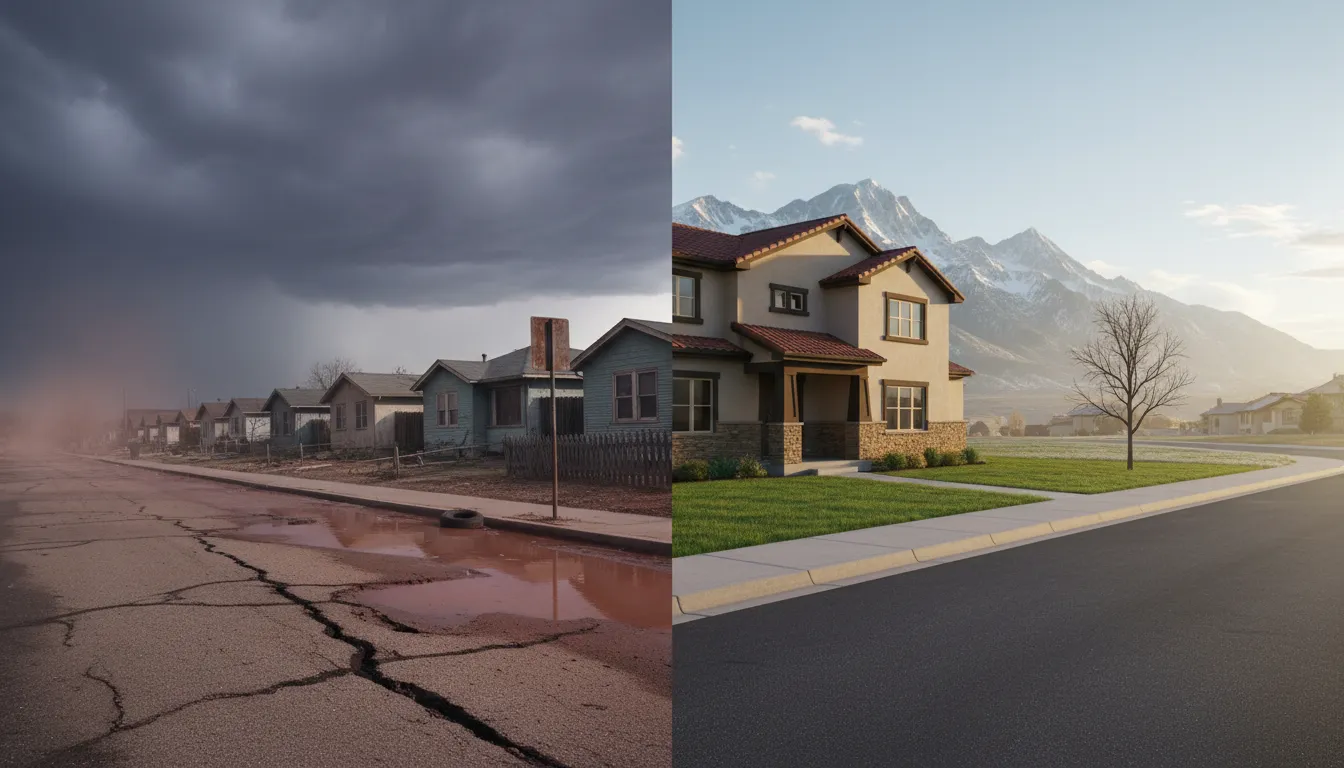
Utah offers mountain views, strong lifestyle appeal, and many desirable communities. It also has places where buyers can run into serious problems if they focus only on price, new construction, or marketing promises.
Utah offers mountain views, strong lifestyle appeal, and many desirable communities. It also has places where buyers can run into serious problems if they focus only on price, new construction, or marketing promises.
For anyone researching the worst places to live in Utah, the real question is not whether a city is simply “bad.” It is whether a location has drawbacks significant enough to hurt daily life, resale value, or long-term satisfaction.
Some Utah areas come with higher crime. Others bring difficult commutes, winter air quality issues, flood or soil concerns, thin infrastructure, or a lifestyle mismatch that is easy to miss during a short visit. Anyone planning a move should compare neighborhoods carefully, not just city names. For a broader starting point on relocation, Utah real estate resources can help narrow the search.
What makes a place one of the worst places to live in Utah?
A weak location in Utah usually falls into one or more of these categories:
- Higher crime concentrations that affect safety and property performance
- Traffic and infrastructure lag in fast-growing suburbs
- Poor winter air quality along the Wasatch Front
- Flood, landslide, wildfire, or soil risk in certain growth corridors
- Limited amenities or social fit for relocating households
- Economic stagnation in some rural markets
- Marketing that sells a future vision before the area fully functions in the present
That is why two homes at similar price points can be very different long-term decisions. One may sit in a stable area with healthy appreciation potential. The other may look like a bargain but come with hidden trade-offs.
10 Utah places that deserve extra caution
None of the locations below are automatically wrong for every buyer. The issue is that each has meaningful drawbacks that should be evaluated before making a move.
1. West Valley City
West Valley City is often presented as an affordable entry point into the Salt Lake metro area. That affordability is real, but buyers should understand why prices can be lower.
The city has long carried higher crime rates than many nearby suburbs, including elevated property crime, vehicle crime, and some violent crime categories. The biggest mistake here is treating the entire city as one uniform market.
Why buyers get caught off guard:
- Crime can vary dramatically from one neighborhood to the next
- Affordable pricing may mask block-level differences in livability
- Higher-crime pockets can underperform on appreciation
Best approach: Review address-specific and neighborhood-specific crime patterns instead of relying on the city name alone. West Valley City should be evaluated street by street.
2. Eagle Mountain
Eagle Mountain is one of the most heavily marketed new construction markets in Utah. It attracts buyers with newer homes, lower prices than much of Utah Valley, and attractive mountain scenery.
The major concern is infrastructure. Rapid growth has outpaced road capacity, and many residents rely on a limited number of routes for daily travel. Commutes toward Lehi, Saratoga Springs, and beyond can become frustrating, especially during peak hours.
Winter air quality is also worth noting. Like many Wasatch Front communities, this area can be affected by inversion conditions in January and February.
Who should be most careful:
- Anyone commuting to Salt Lake County several days per week
- Households sensitive to winter air quality
- Buyers assuming new construction automatically means convenience
Best approach: Test the actual rush-hour commute before buying. Also review historical winter air quality for the ZIP code, especially for households with respiratory concerns. Buyers comparing builder communities may also benefit from reading buying new construction homes in Utah.
3. Outer St. George and Washington City growth areas
St. George has strong appeal for retirees, remote workers, and outdoor-oriented households. The scenery is excellent, and the warm-weather lifestyle is a major draw.
But not every relocating buyer adjusts easily, especially in outer growth areas around Washington City and nearby fringe development. One challenge is lifestyle fit. Southern Utah can feel more culturally homogeneous than many people expect, and some newcomers find it harder to build social roots than they anticipated.
Another issue is infrastructure depth. Certain outer areas can feel behind the pace of development when it comes to dining variety, entertainment, specialty medical access, and everyday convenience compared with the Wasatch Front.
Who should be most careful:
- Buyers relocating from larger metro areas
- People prioritizing nightlife, dining variety, or a broad amenity base
- Anyone unsure how they will build community after moving
Best approach: Spend a normal week there, not a resort-style weekend. Grocery shopping, weekday traffic, medical access, and social fit all matter more than scenery alone. Readers comparing Southern Utah lifestyle trade-offs may also want pros and cons of living in St. George Utah.
4. Harriman and Bluffdale
These southern Salt Lake County communities attract buyers with newer housing, appealing views, and relative value compared with some northern valley locations. The hidden issue is land and hazard risk.
In parts of Harriman, hillside and foothill development can overlap with mapped concerns tied to landslide, debris flow, drainage, and wildfire exposure. In parts of Bluffdale, buyers should be aware of Jordan River floodplain issues and expansive soils that can contribute to long-term foundation stress.
Why this matters:
- Hazard risk is easy to miss during a normal showing
- Foundation problems are expensive and sometimes discovered late
- Strong appreciation does not erase physical site risk
Best approach: Check the Utah Geological Survey hazard maps and FEMA flood maps for any property under consideration. Review inspection history and foundation documentation whenever available.
5. Valley-floor Wasatch Front communities during inversion season
This is less about one city and more about a recurring regional problem. Communities along the Wasatch Front, from Provo through Salt Lake County and north toward Ogden, can experience severe winter inversion conditions.
During temperature inversions, pollution becomes trapped in valley air. Some low-elevation communities can experience unhealthy or very unhealthy air quality in winter, especially during January and February.
Why this is a major relocation issue:
- Many buyers visit in summer and never experience winter inversion
- Families with asthma or respiratory concerns may struggle more than expected
- The problem varies by elevation and valley position
Best approach: Compare historical winter AQI by ZIP code and consider slightly higher-elevation areas if air quality is a top concern. Communities on benches or higher terrain can perform differently than valley-floor neighborhoods.
6. Central and west Ogden
Ogden is more nuanced than its reputation. Some parts of the city are appealing, and certain areas have seen visible progress and investment. But buyers should not treat Ogden as one consistent market.
Central and west Ogden have historically carried more crime and quality-of-life concerns than bench areas and some northern neighboring communities. Buyers drawn in by lower prices can end up in a pocket that feels very different from the version of Ogden they had in mind.
What to know:
- Ogden has strong neighborhood variation
- East bench areas can be very different from central or western sections
- Price alone does not tell the whole story
Best approach: Study incident density around the specific address and ask local professionals where neighborhood dividing lines really are. In Ogden, micro-location matters.
7. Price and Carbon County
Many buyers looking for affordability are tempted by rural Utah. In some places that can work well. Price and the broader Carbon County area require more caution because affordability there is tied to a longer-term economic concern.
The area has historic roots in coal and energy extraction. The challenge is that this economic base has been under pressure for years, and shrinking or stagnant demand can make housing markets less resilient.
Why this matters for buyers:
- Lower prices may reflect weaker demand, not hidden value
- Population and economic trends influence exit options later
- A cheap purchase is not always a strong investment
Best approach: Review county-level population direction and the long-term health of major local industries before buying. A rural market needs more than affordability to support long-term confidence.
8. Rose Park and Glendale in Salt Lake City
These west-side Salt Lake City neighborhoods are often described as up and coming. That phrase can be misleading.
Rose Park and Glendale do offer relative affordability and proximity to downtown. They also come with elevated crime compared with some other parts of the city, plus uneven block-by-block improvement patterns. In these neighborhoods, one street may feel far more stable than the next.
The risk here is expectation mismatch:
- Some buyers expect rapid revitalization that may take much longer
- Neighborhood change can be highly uneven
- Short-term appreciation assumptions can backfire
Best approach: Review very local sales trends, visit during different times of day, and speak with actual residents if possible. “Up and coming” is not a substitute for hard neighborhood-level research. For more local context, readers may also compare nearby concerns in neighborhoods to avoid in Salt Lake City.
9. Tooele
Tooele frequently enters the conversation when buyers are priced out of Salt Lake County but still want commuting access to the metro area. On paper, the value can look compelling.
The issue is that the trade-off is bigger than many buyers expect. Tooele’s commuting relationship with the Salt Lake Valley depends heavily on crossing the mountain corridor via Interstate 80. Winter weather, closures, wind, snow, and general bottlenecks can make that route harder than a map suggests.
There is also a broader industrial and military legacy in the county that some buyers will want to understand before committing.
Who should be most careful:
- Daily commuters to Salt Lake County
- Buyers assuming the commute is simple year-round
- Anyone who may lose remote-work flexibility later
Best approach: Drive the route during winter conditions and rush hour before buying. Tooele makes more sense when the household’s work setup is stable and commute demands are limited.
10. Vineyard
Vineyard is one of Utah’s most aggressively marketed newer communities. It is often sold on a polished image of modern housing, amenities, and lakefront lifestyle.
The concern is that the present-day reality may not match the vision. Vineyard sits next to Utah Lake, which has had persistent water quality issues and harmful algae bloom events that can affect recreation and odor in warmer months. At the same time, the city’s rapid growth has put pressure on roads, schools, and services.
Traffic tied to major access corridors in the Orem and Provo area is already a challenge, and continued growth adds to that pressure.
Why Vineyard can disappoint unprepared buyers:
- The “lakefront” concept has important limitations
- Infrastructure may lag behind the development pace
- Some of the value proposition depends on future improvements, not current conditions
Best approach: Visit during late summer, not just in ideal conditions. Research current Utah Lake conditions and test commuting routes at peak times. Buyers should be sure they are comfortable with today’s reality, not only tomorrow’s plans.
Common mistakes people make when choosing where to live in Utah
Judging a city by average home price
Lower prices often signal a trade-off. That trade-off might be crime, commute burden, hazard exposure, or slower appreciation potential.
Visiting only in good weather
Winter inversions, summer heat, lake odors, and snow-affected commutes are all easier to ignore during a pleasant visit.
Assuming new construction means low risk
New homes can still be located in areas with weak infrastructure, difficult access, or future-dependent value.
Ignoring micro-neighborhood differences
In Utah, some cities vary sharply block by block. This is especially true in places like West Valley City, Ogden, Rose Park, and Glendale.
Buying the lifestyle brochure instead of the weekday routine
A place can look excellent in photos and still be a frustrating place to live on a Tuesday morning.
How to evaluate a Utah neighborhood before buying
Anyone researching the best and worst places to live in Utah should use a repeatable due diligence process.
1. Test the real commute
- Drive it during rush hour
- Test winter routes if weather is part of the equation
- Include school drop-off or downtown parking realities if relevant
2. Check winter air quality
- Compare ZIP codes, not just counties
- Review January and February historical AQI patterns
- Pay closer attention if the household includes children or anyone with respiratory issues
3. Review hazard maps
- Check floodplain exposure
- Review landslide, debris flow, and soil concerns
- Do not assume a newer subdivision was built in a risk-free area
4. Study crime at the neighborhood level
- Look beyond citywide averages
- Review a radius around the exact address
- Visit during both daytime and evening hours
5. Simulate normal life
- Visit grocery stores and daily service areas
- Try local dining and errands
- Assess whether the community fits the household’s actual lifestyle
6. Look at the area’s long-term story
- Is the local economy expanding or shrinking?
- Is appreciation based on stable fundamentals or future promises?
- Could resale become difficult if conditions change?
Are these places always bad choices?
No. Nearly every city on this list has situations where it can still make sense.
- Eagle Mountain can work for fully remote households that prioritize newer homes and can tolerate short-term infrastructure strain.
- Tooele may fit buyers who are not daily commuters.
- Vineyard may appeal to buyers comfortable betting on long-term area improvement.
- St. George can be an excellent fit for retirees and outdoor-focused households who understand the cultural and amenity trade-offs.
- Ogden has strong pockets that differ sharply from its more troubled sections.
The point is not that these places are universally unlivable. The point is that they require more due diligence than many buyers realize.
Quick checklist before moving anywhere in Utah
- Compare neighborhoods, not just city names
- Drive the commute at the time it actually matters
- Review winter air quality if considering the Wasatch Front
- Check hazard maps for hillside, floodplain, and soil issues
- Visit the area on weekdays and evenings
- Research whether the local economy is expanding or contracting
- Be skeptical of terms like “up and coming” and “lakefront lifestyle”
- Make sure the area works for current life, not just a hoped-for future
Final takeaway
The worst places to live in Utah are usually not the places with the ugliest marketing. They are the places where buyers lack full information.
Utah has many great communities, but it also has areas where crime, commute pressure, inversion, geology, infrastructure delays, or cultural fit can turn a promising move into an expensive mistake. The safest strategy is to treat every Utah move like a neighborhood-level decision, not a statewide or citywide one.
Frequently asked questions
What is the worst city to live in Utah?
There is no single answer for every buyer. Some areas stand out for different reasons. West Valley City and parts of Ogden raise neighborhood-level crime concerns. Eagle Mountain and Tooele raise commute and infrastructure issues. Vineyard raises questions about growth pressure and Utah Lake conditions. The worst choice depends on the household’s priorities and tolerance for trade-offs.
Is St. George a bad place to live?
Not at all for the right buyer. St. George can be a strong fit for retirees, remote workers, and outdoor enthusiasts. The concern is that some relocating buyers underestimate how different everyday life can feel in outer growth areas, especially if they expect big-city amenities or easy social integration.
Why do some people avoid the Wasatch Front?
A major reason is winter inversion. Valley-floor communities along the Wasatch Front can experience poor air quality during parts of winter. For some households, especially those with respiratory concerns, that can be a major quality-of-life issue.
Is new construction in Utah always a safer bet?
No. New construction can still come with hidden downsides such as overloaded roads, delayed infrastructure, poor commute patterns, or future-dependent value. Areas like Eagle Mountain and Vineyard show why buyers should evaluate the community, not just the house itself.
How should buyers research the worst neighborhoods in Utah?
The best method is to combine several checks: neighborhood-level crime review, actual commute testing, winter AQI research, hazard map review, and in-person visits at multiple times of day. Citywide averages are not enough, especially in places with strong block-by-block variation.
Are affordable Utah towns always better for first-time buyers?
Not necessarily. A lower price can come with weaker appreciation, longer commutes, higher crime, or fewer services. First-time buyers should focus on total livability and resale potential, not just monthly payment or price per square foot.
Keep reading
More from the blog
Utah Property Taxes: How Your Assessed Value Really Gets Set
Why Identical Houses Get Different Property Tax Bills
Your First Month in a New Utah Home: A Fall Settling-In Guide