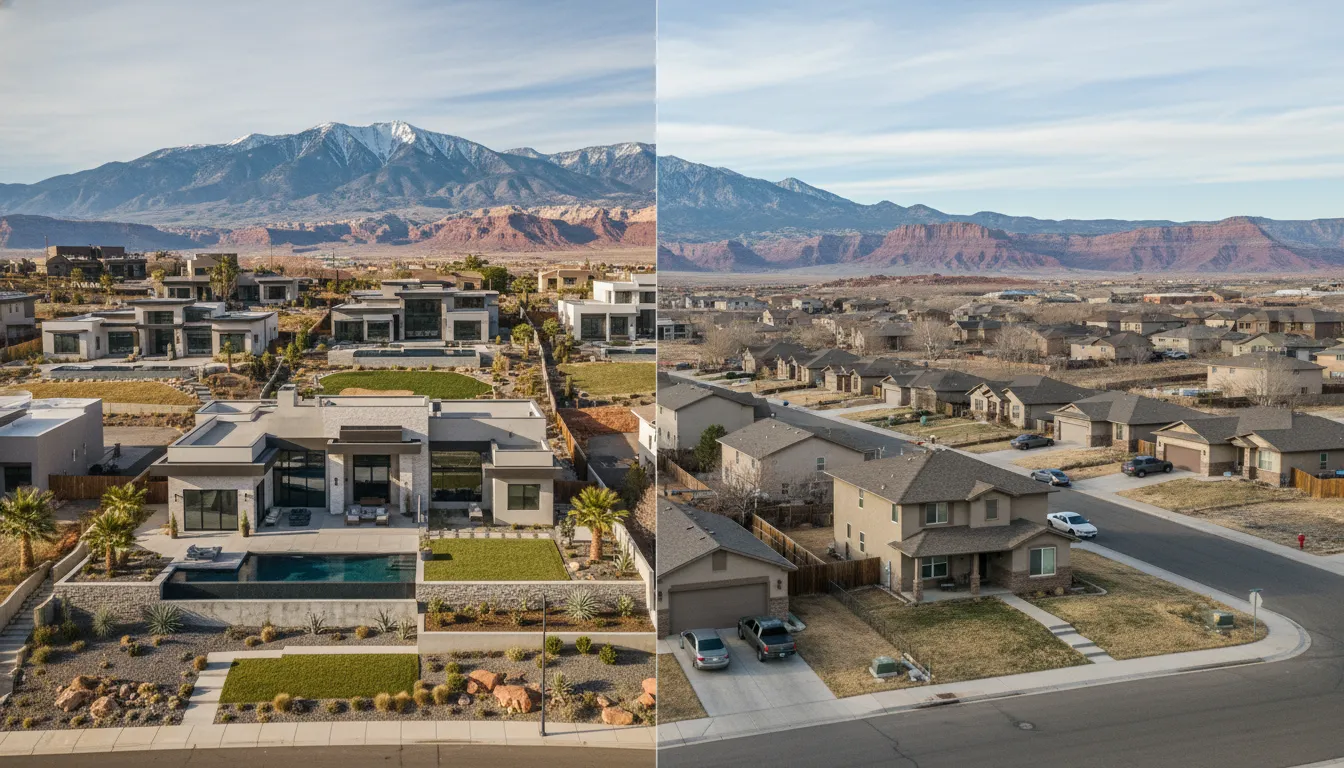
Utah Housing Market: Why Luxury Homes and Starter Homes Are Moving Differently
Utah's housing market isn't moving in one direction. Luxury and move-up buyers benefit from equity and flexibility, while first-time buyers face tighter affordability — but also more room to negotiate. Here's what the split means for buyers and sellers across every price range.

Utah's housing market is not behaving like a single, uniform market. In many areas, higher-end homes and move-up properties are holding strong, while entry-level buyers are facing a much tougher path to ownership.
That split matters for anyone buying, selling, or relocating in Utah. A first-time buyer searching under a lower price point may face affordability pressure but gain room to negotiate. A move-up buyer or downsizer with equity may have far more flexibility and less sensitivity to interest rates.
This article explains what is driving that divide, what it means in practical terms, and how buyers and sellers can respond based on their price range and goals.
For broader home search tools, market resources, and statewide listings, Utah buyers and sellers can also use Best Utah Real Estate.
What a "Split Market" Means in Utah Real Estate
A split market happens when one part of the housing market behaves very differently from another. In Utah, the clearest divide is between:
Entry-level and first-time buyer homes, where affordability is tight
Move-up, downsizing, and luxury homes, where existing homeowners often bring large amounts of equity
On paper, both groups are shopping in the same state. In reality, they are operating under very different financial conditions.
First-time buyers often depend heavily on monthly payment affordability. Higher mortgage rates, smaller down payments, student loans, car payments, and everyday living costs can limit what they qualify for and what feels comfortable.
By contrast, many move-up buyers and downsizers already own property. That means they may have substantial equity, larger down payments, or the ability to buy before selling. Those advantages can make the higher-end market more resilient. If you're weighing whether now is the right time to act, our guide on whether to buy a home in Utah in 2026 breaks down the decision by timeline and budget.
Why Higher-End Homes Can Stay Active Even When Rates Feel High
A common assumption is that all buyers pull back the same way when mortgage rates rise. Utah's market shows that this is not always true.
Buyers in the upper price ranges are often less rate-sensitive because they are not starting from scratch. Many already own homes purchased years ago, and over time they may have built significant equity. That equity can be used to lower the size of the next loan or make a stronger offer.
Reasons Luxury and Move-Up Buyers Often Have More Flexibility
More home equity from previous ownership
Larger down payments that reduce monthly payments
Higher household income in many cases
Ability to buy before selling in some situations
Clear lifestyle motivation such as downsizing or relocating within Utah
Some households have delayed a move for several years and are no longer waiting for a perfect rate environment. If the need to downsize, relocate, or secure a more suitable home is strong enough, they may move ahead despite financing costs.
This helps explain why some Utah homes near or above the upper price tiers can still attract quick interest while lower-priced homes may sit longer.
Why First-Time Buyers Feel Squeezed
Entry-level buyers in Utah face a different math problem. Even when home prices are not surging, the monthly payment may still feel high because of borrowing costs and limited cash reserves.
The Main Pressures on Starter-Home Buyers
Higher interest rates increase the monthly payment
Smaller down payments can trigger mortgage insurance
Student loan debt reduces debt-to-income flexibility
Higher car payments can take a meaningful bite out of qualifying power
Insurance, rent, childcare, and living costs compete with saving for a home
In Utah, that challenge is especially important in markets where even modest homes can still carry payments that stretch a household budget. Buyers may be able to qualify on paper, but that does not always mean the payment feels sustainable in real life.
That is why monthly payment matters more than purchase price alone. A buyer comparing two homes may focus on sale price, but the real affordability question usually comes down to the full payment, including principal, interest, taxes, insurance, and any mortgage insurance or HOA fees.
What Many Buyers Get Wrong About Waiting
One of the biggest misconceptions in the Utah housing market is the belief that waiting will automatically create a perfect buying opportunity.
Some buyers are holding out for a major price drop or a broad market crash. But buyers should be careful about relying on headlines alone, especially national headlines. Utah can behave differently from the broader U.S. market, and even within Utah, cities and price segments can move in different directions.
If rates eventually fall, more sidelined buyers may re-enter the market. That can increase competition, especially for well-priced starter homes. A lower rate may improve affordability, but it can also lead to more bidding pressure.
In other words, waiting for better rates does not guarantee an easier purchase.
A More Useful Question Than "Should Someone Wait?"
Instead of asking whether the market will become perfect, buyers often benefit more from asking:
Can the household comfortably afford the payment today?
Is there enough stability to stay in the home for several years?
Are there negotiation opportunities available right now?
Would lower future rates likely bring more buyer competition?
That framework produces a more realistic decision than trying to predict the exact bottom of the market.
What Negotiating Power Looks Like in the Entry-Level Market
Even though first-time buyers face more affordability challenges, they may have one advantage in certain Utah price ranges: more negotiating room.
When affordability pressure causes listings to sit longer, sellers may become more open to concessions. That can create opportunities that were harder to find during the most competitive periods of the market.
Common Concessions Buyers May Be Able to Request
Seller-paid closing costs
Temporary rate buydowns
Credits for repairs or updates
Price reductions when a home has lingered on the market
This is why a challenging affordability environment does not automatically mean a bad time to buy. In some segments, the structure of the deal may be more favorable even if rates are not ideal.
Buyers who want a closer look at how inventory and negotiating conditions are changing can review current statewide trends on the Utah buyer's market page.
Strategies Utah Buyers Are Using to Make the Numbers Work
When affordability is tight, creativity matters. Several financing and property strategies can help buyers improve cash flow or get into the market sooner.
1. Seller Credits and Temporary Rate Buydowns
A seller credit can reduce the buyer's upfront costs or help fund a temporary interest rate buydown. This can make the first one to three years of ownership more manageable.
A temporary buydown does not erase long-term affordability concerns, but it can provide breathing room while a buyer plans for a future refinance or income growth.
2. Adjustable-Rate Mortgages
Some buyers in higher price ranges are using adjustable-rate mortgages, often called ARMs, to secure a lower initial rate. This can improve payment affordability in the short term.
ARMs are not right for everyone. They work best when the buyer understands the future adjustment risk and has a clear exit plan, such as selling, refinancing, or paying down the loan before the rate changes.
For official mortgage education and consumer guidance, the Consumer Financial Protection Bureau offers useful homebuying resources.
3. House Hacking and ADU Income
Some Utah buyers are reducing their effective housing cost by choosing homes with income potential. A common example is buying a property with an accessory dwelling unit, or ADU, and renting part of it out.
This approach can help offset the mortgage, but buyers need to confirm local zoning, occupancy rules, and financing requirements before assuming rental income will solve the affordability equation.
4. Family Gift Funds or Early Inheritance Support
Some first-time buyers receive help from parents or grandparents for the down payment or purchase. That can make a meaningful difference, especially in higher-cost Utah markets.
Gift funds can be a legitimate tool, but buyers should expect lender documentation requirements. Tax questions should be reviewed with a qualified CPA or tax professional.
5. Starting Smaller
Buyers do not need to begin with a forever home. Many households build wealth by purchasing a condo, townhome, or modest single-family home first, then using equity growth over time to move up later.
That step-by-step approach is how many current high-equity homeowners got where they are. Understanding what your monthly mortgage payment is actually doing to your long-term net worth can help frame this strategy clearly.
Buyers comparing city-level pricing, days on market, and price-cut activity can use this statewide Utah real estate markets resource to compare different areas more realistically.
Why Age and Equity Matter So Much in Utah's Market
Utah has a younger population than the national average, but the active buyer pool still includes a large share of older households making second, third, or retirement-focused moves.
That matters because repeat buyers often bring more than income to the table. They bring equity, stronger balance sheets, and years of market gains from earlier purchases.
First-time buyers, by definition, do not have that advantage. They are competing while also trying to save a down payment, manage debt, and absorb today's ownership costs all at once.
This is one reason luxury and move-up activity can remain healthy even when headlines suggest that "buyers are struggling." Some are struggling. Others are operating from a much stronger financial base.
How Utah Sellers Should Respond to a Split Market
Sellers need to avoid assuming that all buyers will respond the same way. Pricing, presentation, and negotiation strategy should match the home's actual segment.
For Sellers in Entry-Level Price Ranges
Price carefully from the start
Expect buyers to be payment-sensitive
Consider offering closing cost help or rate buydown incentives
Understand that longer days on market may not mean the home is flawed
For Sellers in Move-Up or Luxury Ranges
Do not overprice simply because higher-end demand exists
Prepare for serious buyers who move quickly when the home fits their needs
Highlight lifestyle fit, condition, and functionality
Know that turnkey presentation still matters
Across All Price Ranges, Turnkey Matters
One theme stands out across Utah: buyers strongly prefer homes that feel move-in ready. Even when inventory is improving, many buyers do not want to take on projects right after closing.
Clean presentation, updated condition, and obvious maintenance can help a home compete whether it is priced for a first-time buyer or a downsizer.
Why Local Market Data Matters More Than National Headlines
National housing stories can be useful for context, but they should not be treated as a decision-making shortcut. Utah often has its own dynamics, and conditions can vary widely from city to city and price band to price band.
A broad headline about falling prices or surging demand may not describe what is happening in Salt Lake City, Sandy, Draper, Lehi, Bountiful, Farmington, Layton, or Saratoga Springs at a specific price point.
Buyers and sellers should focus on:
Current local inventory
Average days on market
Price reductions
Typical concessions
Competition within a specific budget range
Utah households relocating to the Wasatch Front can also browse homes and local information on the Salt Lake City real estate page.
For state demographic context that helps explain age and household trends, the U.S. Census Bureau provides official Utah data.
A Practical Framework for Utah Buyers in Today's Market
Instead of asking whether this is a good market in general, buyers can make better decisions by using a more specific checklist.
Starter-Home Buyer Checklist
Calculate the full monthly payment, not just the sale price
Review debt obligations such as student loans and auto payments
Ask whether seller credits or buydowns are realistic in the target area
Consider condos, townhomes, or homes with income potential
Make sure the payment fits long-term comfort, not just loan approval
Move-Up or Downsizing Buyer Checklist
Estimate available equity before shopping
Decide whether buying before selling is realistic
Compare the monthly payment impact of different down payment sizes
Look at lifestyle priorities, not just square footage
Act when the right home appears, since strong homes can still move fast
Common Mistakes to Avoid
Assuming All of Utah Is a Buyer's Market or Seller's Market
Conditions can be favorable to buyers in one segment and still competitive in another.
Shopping Before Understanding the Payment
Falling in love with homes before knowing a comfortable budget often leads to frustration.
Waiting for a Perfect Market
Perfect conditions rarely arrive. Lower rates could also mean stronger competition.
Ignoring Total Monthly Obligations
Car payments, student loans, insurance, and HOA fees can be just as important as the mortgage rate.
Underestimating the Value of Condition
Buyers across price points are showing a strong preference for homes that require little immediate work.
Bottom Line
Utah's housing market is not moving in one direction for every buyer. Luxury, downsizing, and move-up buyers often have the advantage of equity and flexibility. First-time buyers are more exposed to affordability pressure, but they may also find better negotiating opportunities, seller concessions, and creative paths into ownership.
The most important takeaway is simple: the real market is the one that matches the buyer's price range, city, debt profile, and monthly payment comfort. That is why local, segment-specific analysis matters far more than a one-size-fits-all headline.
Frequently asked questions
Why are luxury homes in Utah holding up better than starter homes?
Is Utah still hard for first-time home buyers?
Should buyers wait for mortgage rates to fall in Utah?
What helps first-time buyers compete in Utah?
Are Utah home prices expected to crash?
What matters more in Utah right now: price or payment?
Keep reading
More from the blog

Why Utah Homes Are So Unaffordable and What Could Lower Costs

Online Property Management Software: Scale Rentals in 2026

Why Speed-To-Lead Wins in Competitive Housing Markets