Best Food Dehydrator: Cosori vs. Nesco vs. Excalibur vs. Magic Mill
Cabinet vs. stackable, drying speed, tray space and noise: how Cosori, Nesco, Excalibur and Magic Mill food dehydrators compare, and which to buy.
A good food dehydrator turns a bag of apples into a jar of chips, a flank steak into jerky and a fridge drawer of tired greens into a powder you can stir into eggs and soups. The machines look alike online, but they don't dry alike. How the air moves, how much tray space you really get and how loud the fan is matter more than the tray count or the wattage printed on the box.
This guide compares cabinet machines from Cosori, Magic Mill and Excalibur with Nesco's stackable and cabinet models: how fast each dries, where the space goes, and which one fits which kitchen.
As an Amazon Associate, Best Utah Real Estate earns from qualifying purchases.
Quick verdict
- Best for most people: the Cosori 6-Tray Food Dehydrator. It dries as fast as bigger cabinet machines, it's very quiet, and its taller tray spacing handles bulky greens without pulling trays out.
- Best for big batches: the Cosori 10-Tray Food Dehydrator. It has the same controls and quiet fan with 16.2 square feet of drying space, for jerky and garden-harvest days.
- Best large machine with a window: the Magic Mill 10-Tray Food Dehydrator. A rear fan, 10 stainless trays and a see-through door, so you can check progress without letting the heat out.
The dehydrators side by side
| Dehydrator | Shop | Style | Trays | Power | Temperature | Timer |
|---|---|---|---|---|---|---|
| Cosori 6-Tray Food Dehydrator |  Buy on Amazon | Cabinet, rear fan, hinged door | 6 stainless, about 12 x 13 in | 600 W | 95–165°F in 1° steps | 48 hours |
| Cosori 10-Tray Food Dehydrator | 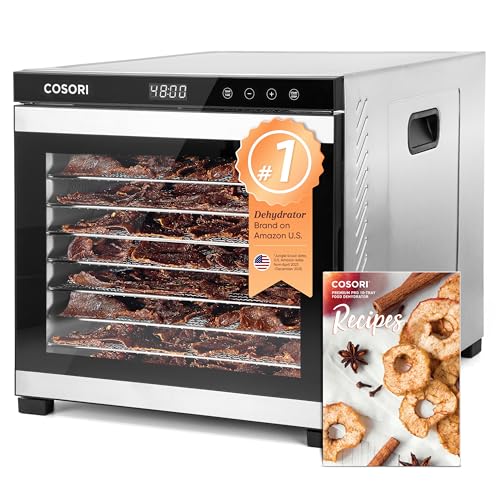 Buy on Amazon | Cabinet, rear fan, hinged door | 10 stainless, about 15 x 15.6 in | 1,000 W | 95–165°F in 1° steps | 48 hours |
| Magic Mill 10-Tray Food Dehydrator |  Buy on Amazon | Cabinet, rear fan, see-through door | 10 stainless | 700 W | 95–167°F | 48 hours plus keep-warm |
| Nesco FD-7SSD | Cabinet, interior light | 7 stainless, about 12 x 11 in | 600 W | 90–160°F in 5° steps | 24 hours | |
| Excalibur 9-tray (3900 series) | Cabinet, removable front door | 9, 14 x 14 in | 600 W | Adjustable dial | None on the basic model |
How they actually compare
Drying speed: cabinet beats stackable, wattage matters less than you'd think
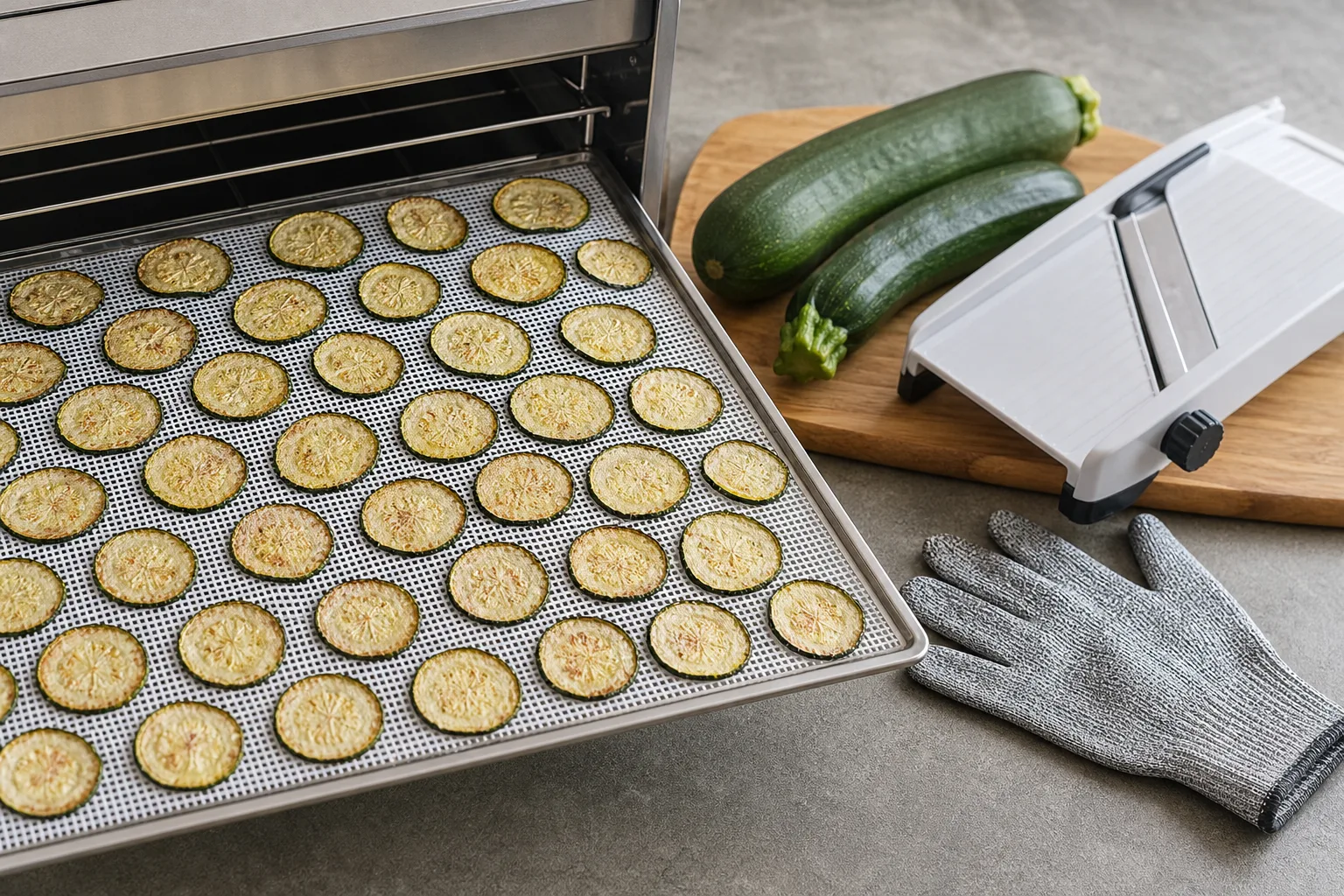
Dried side by side on identical mandoline-cut zucchini, two cabinet machines (the Cosori 6-tray and a 9-tray Excalibur) both turned out crisp, snappable chips at about the seven-hour mark. The Excalibur pulled ahead in the first couple of hours, with visible shrinking sooner, but the Cosori caught up and they finished together. A stackable Nesco with the same 600 watts was a different story: at seven hours its slices still bent instead of cracking, and they needed roughly two more hours.
The reason is airflow. In a cabinet machine the fan sits at the back and blows across every tray at once. In a stackable, air pushes up or down through the stack, so the trays closest to the fan dry first and you have to rotate them to even things out. Round stackable trays with a hole in the middle also hold less food.
Bigger wattage doesn't mean faster drying, either. The 600 W Cosori 6-tray and the 1,000 W Cosori 10-tray dry at about the same rate, because the larger machine spends its extra power on more than twice the tray area. Buy the size you need, not the highest number. As a floor, look for 500 W or more; low-power units around 250 W take much longer than the drying times you see in recipes.
Cosori vs. Nesco cabinet: closer than the specs suggest
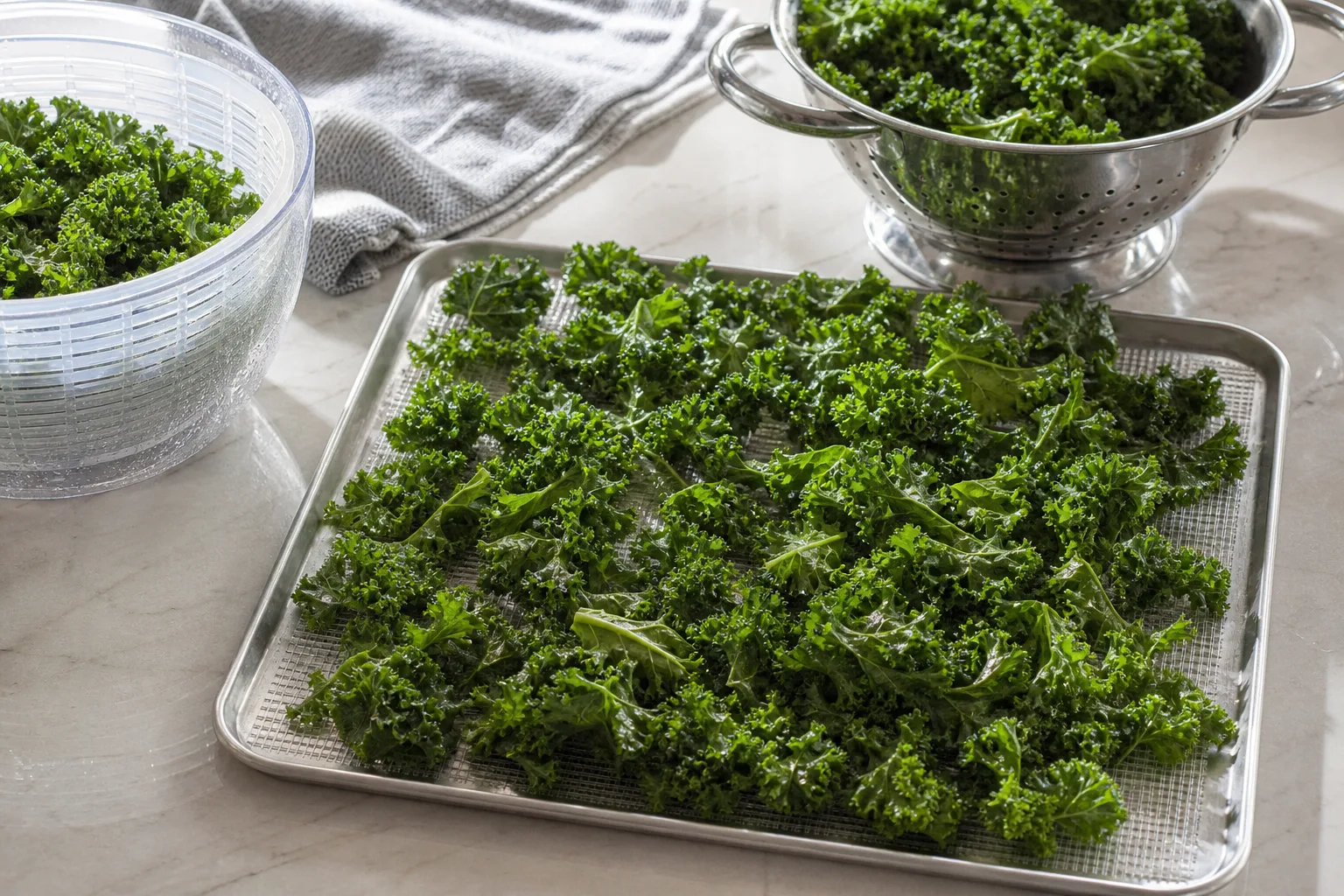
Nesco's newer FD-7SSD is a stainless cabinet machine that goes head to head with the Cosori 6-tray. Run on kale at the same low temperature, the two finished at the same time. The Cosori was a touch quicker early on. On paper the Nesco has one more tray, but the Cosori's trays are bigger (about 12 x 13 inches against 12 x 11), so total drying area is nearly identical.
The differences are in the details:
- Temperature: the Nesco runs 90–160°F in 5-degree jumps; the Cosori runs 95–165°F in single degrees.
- Timer: 24 hours on the Nesco, 48 on the Cosori. After a full 48-hour run the Cosori wants about a two-hour rest before restarting.
- Light: the Nesco has a small interior light, so you can tell whether food is still obviously wet without opening the door and losing heat. The Cosori doesn't.
- Build: the Cosori is heavier and about 2 inches deeper (roughly 17.75 vs. 15.75 inches; both are about 13.5 inches wide), but it has carrying handles and a sturdier metal hinge. The Nesco's door and hinge feel lighter.
The Nesco FD-7SSD is often low on stock, which is why it isn't linked here. If you find it in stock, it's a fair alternative.
Noise, space between trays and the mesh problem
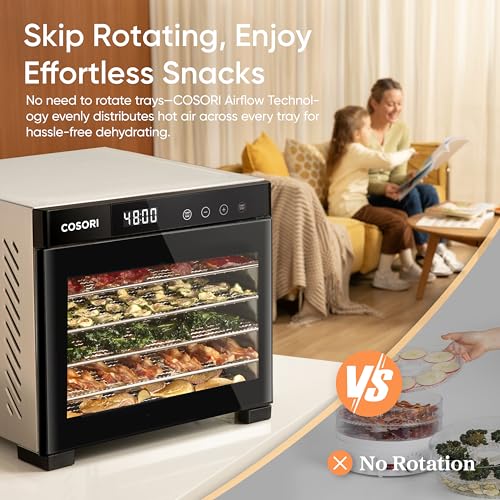
The Cosori's biggest everyday advantage is how quiet it is. It can run in a laundry room or kitchen without anyone noticing. Its trays also sit farther apart than an Excalibur's. With bulky foods like leafy greens, an Excalibur often needs every other tray pulled out to keep leaves from jamming the tray above, which leaves only four or five trays in use. A Cosori can stay fully loaded.
The trade-off is the stainless grates. Their bars are spaced widely, so small or sticky pieces fall through or cling, and you'll want a mesh liner on almost every load. Cosori (and Nesco) include just one mesh screen and one fruit-roll sheet, and the included mesh stops about half an inch short of the tray edge, which wastes space. The simple fix is to buy generic 14 x 14 inch food-grade mesh or silicone sheets and cut them to fit each tray.
Excalibur: big and proven, but the door is a nuisance
The classic 9-tray Excalibur still has the most room per tray (14 x 14 inches) and a long record of lasting for years. Its removable front door is the weak spot: you lift it off and hook it back on, which is fiddly with a tray in the other hand, and a door that isn't seated right falls off. It's also among the priciest choices, and on Amazon the 3900 series is often sold only as renewed units, so it isn't linked here.
How to choose a food dehydrator
Adjustable temperature, ideally 95 to 165°F
Older single-temperature machines were built for beef jerky. That heat is too high for herbs, most vegetables and sugary fruit, which can caramelize. Look for a dial or keypad that reaches down to about 95°F for herbs and greens and up to about 165°F for meat. Fine one-degree steps are a convenience, not a must.
Cabinet or stackable
- Stackables weigh less and some can be expanded with extra trays. But they dry less evenly, need tray rotation, and plastic trays get brittle and crack over years of heat.
- Cabinet machines blow air across every tray at once, are usually metal with metal trays, and come with more trays up front. They weigh more and take up more room.
Room to run it
Measure before you buy. A dehydrator needs about 6 inches of clear space on the top, sides and front to pull in air and push out heat and moisture. A laundry room or garage shelf keeps it off the kitchen counter during long runs.
Accessories you'll actually use
- Mesh sheets for small pieces and anything that shrinks a lot. Plan on one per tray.
- Flexible fruit-leather sheets (non-stick or silicone) for purées and very sticky food.
- Skip the hard plastic fruit-leather tray for its intended job: it tends to warp with heat. It works better on the bottom rack as a drip catcher.
- Parchment works but gets tossed after a few uses; 100% cotton fabric cut to the tray size can be washed and reused.
A timer is a reminder, not a doneness test
A timer shuts the machine off; it doesn't know whether the food is dry. Use it to remind you to check. Let a piece cool for a few minutes first, because warm food feels softer than it is. Chips and vegetables are done when they snap or crack instead of bending, and there should be no damp spot left on the liner.
The picks in detail
Cosori 6-Tray Food Dehydrator: best for most people
This is the machine to beat. It matched a 9-tray Excalibur on drying time, kept pace with Nesco's stainless cabinet, and it's one of the quietest machines here. The six dishwasher-safe stainless trays give 6.5 square feet of drying space, the tray spacing handles greens without removing trays, and the digital panel sets 95–165°F in single degrees with a 48-hour timer. The housing is stainless steel, it has carrying handles, and it shuts itself off if it overheats. It comes with one mesh screen and one fruit-roll sheet, so plan on buying more liners.
It suits snack, jerky and occasional pantry batches in a kitchen that wants a quiet machine.
Cosori 6-Tray Food DehydratorSold on Amazon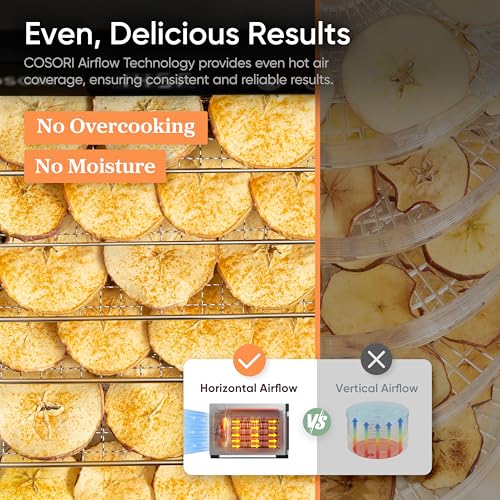
 Buy on Amazon →
Cosori 10-Tray Food Dehydrator: best for big batches
The 10-tray model keeps the same rear-fan layout, controls (95–165°F in one-degree steps, 48-hour timer) and quiet operation, but each tray is about 15 x 15.6 inches, for 16.2 square feet of drying space in all. It runs at 1,000 W, and that extra power goes into covering the larger area: a full load dries at about the same pace as a full load in the 6-tray. It's the one to get for a garden harvest, a case of apples or several pounds of jerky at once, as long as you have the counter or shelf space for a larger box.
Cosori 10-Tray Food DehydratorSold on Amazon

 Buy on Amazon →
Magic Mill 10-Tray Food Dehydrator: best large machine with a window
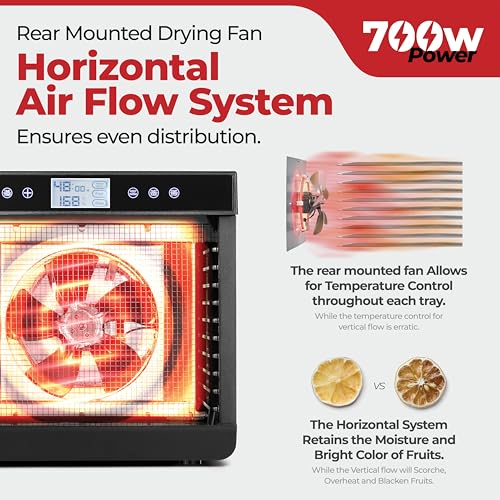
The Magic Mill has 10 stainless mesh trays, a rear-mounted fan and a transparent door, so you can see how a batch is going without opening it. It runs 95–167°F with a 48-hour timer and a keep-warm setting, includes a drip tray, and shuts off automatically if it overheats. The fan is notably quiet for a 10-tray machine, and it does an especially good job on beef jerky, vegetables and fruit. The housing is a thick plastic rather than metal, and some buyers have received units cracked in shipping, so check it over when it arrives.
Magic Mill 10-Tray Food DehydratorSold on Amazon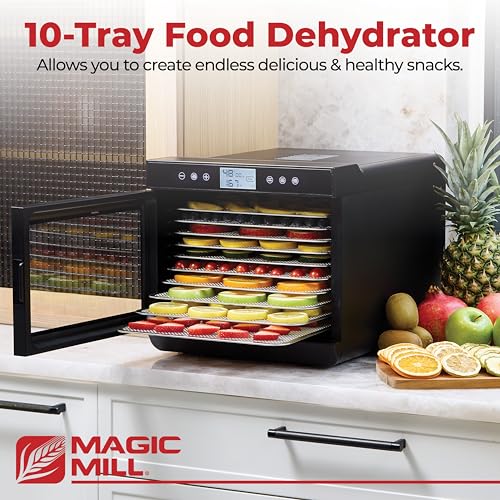

 Buy on Amazon →
Tips for better results
- Slice evenly. A mandoline gives every slice the same thickness so they finish together. Wear a cut-resistant glove; mandoline cuts are common and nasty.
- Get greens as dry as possible before they go in. Wash torn leaves, wring them gently, then run them through a salad spinner. Less water in means a shorter run.
- Dry herbs and greens low. Around 95°F preserves more nutrients but takes longer than the 125°F many charts use.
- Make jerky safely. The USDA recommends heating meat to 160°F (poultry to 165°F) before drying, then holding the dehydrator at 130 to 140°F. See the USDA's jerky guidance.
- Condition powders before storing. Grinding warms the powder. Spread it on a sheet in an oven that was preheated to its lowest setting and then turned off, leave it about 15 minutes, and let it cool before sealing it in a jar. Let a freshly ground container settle before opening it, or a cloud of fine powder will come out.
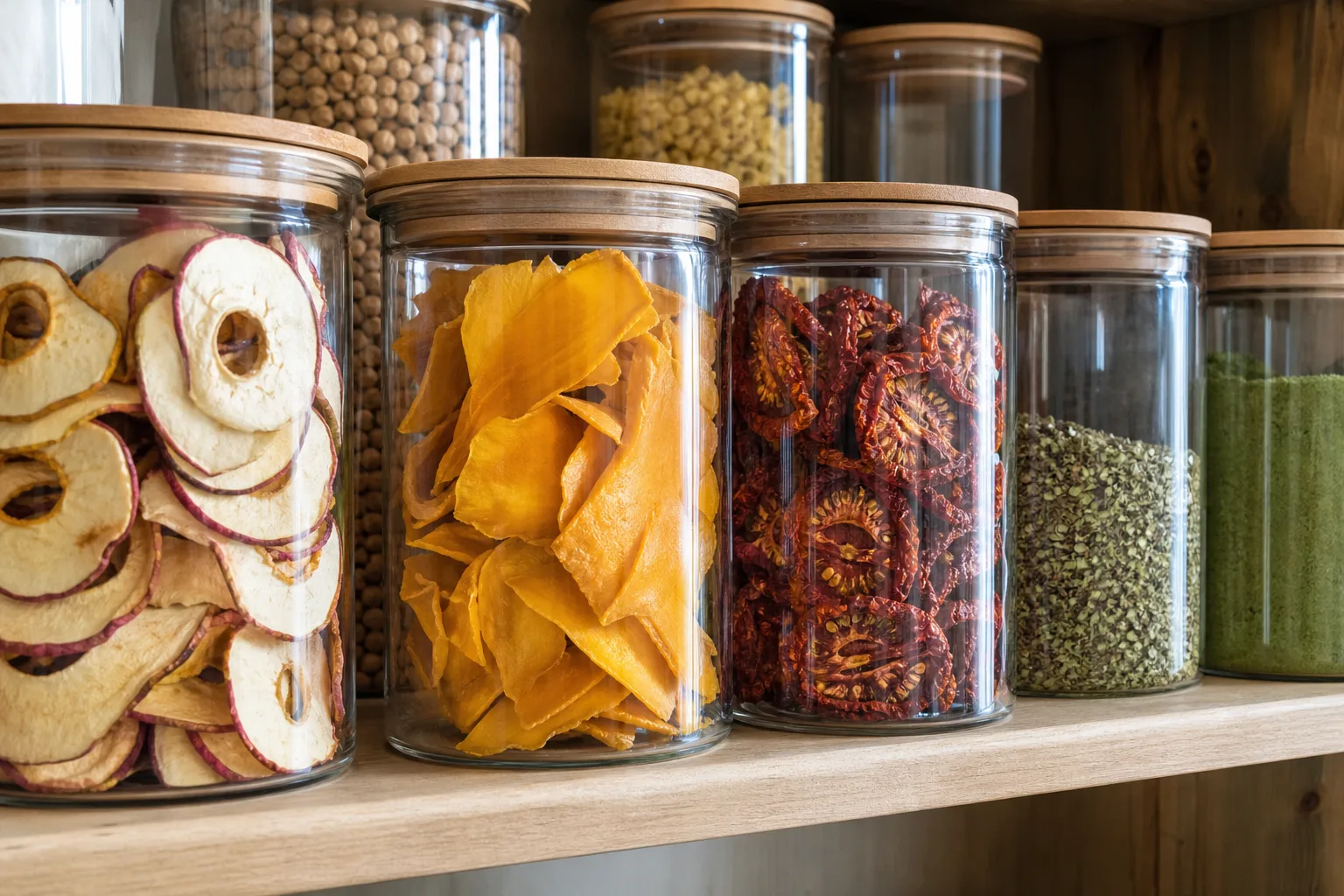
- Store airtight. Dried food keeps best in sealed jars away from light. For more on drying and storage times, the National Center for Home Food Preservation is the standard reference. Vacuum-sealed bags are the next step for long storage; see the vacuum sealer guide, and for everyday jars, the glass food storage container comparison.
Which one should you buy?
- First dehydrator, mostly snacks and jerky, want it quiet: Cosori 6-Tray.
- Preserving harvests or making big jerky batches: Cosori 10-Tray.
- Want 10 trays and a window to watch the food: Magic Mill 10-Tray.
- Short on storage space: a stackable works, but expect longer runs and plan to rotate the trays.
Already making jerky in an air fryer? The air fryer guide covers which models have a dehydrate setting, though a dedicated machine holds far more food.
Posted by Kristopher Larson
Frequently asked questions
Is a cabinet or stackable food dehydrator better?
For most kitchens, a cabinet dehydrator. Its rear fan blows across every tray at once, so food dries evenly without rotating trays, and it usually has metal trays that don't crack. Stackables weigh less and store more easily, but trays nearest the fan dry first, and a full load can take a couple of hours longer.
How many watts should a food dehydrator have?
Aim for at least 500 watts. Around 600 W is plenty for a 6- or 7-tray machine; larger 10-tray models run 700 to 1,000 W because they have more area to heat. Low-power units near 250 W work, but expect drying times well beyond what recipes list.
Does a 10-tray dehydrator dry faster than a 6-tray?
Not really. The 1,000 W Cosori 10-tray and the 600 W Cosori 6-tray dry a full load at about the same pace, because the bigger machine's extra power goes into its larger trays. Choose the size by how much you dry at once, not by speed.
What temperature should I use to dehydrate jerky?
The USDA recommends heating meat to 160°F (poultry to 165°F) before drying, then keeping the dehydrator at 130 to 140°F for the rest of the run. That's why a machine that reaches 160 to 165°F is worth having if you make jerky.
How do I know when dehydrated food is done?
Take a piece out and let it cool for a few minutes first, since warm food feels softer than it is. Vegetable and fruit chips are done when they snap or crack instead of bending, and there's no moisture left on the tray liner. A timer only turns the machine off; it can't tell you the food is dry.
Do I need mesh sheets for my dehydrator?
Usually, yes. Stainless trays have widely spaced bars, so small pieces fall through and sticky foods cling. Most machines include only one mesh screen and one fruit-roll sheet, so buy extra food-grade mesh or silicone sheets and cut them to fit each tray edge to edge.
Keep reading
More from the blog

Dyson Airwrap vs. Shark FlexStyle: Curls, Drying, Heat and Which Multi-Styler Fits Your Hair

Ring Drone Cam and Rover Cam: Release Dates, Prices and What Homeowners Should Know

Best Cold Brew Coffee Maker: OXO vs. Takeya vs. County Line Kitchen