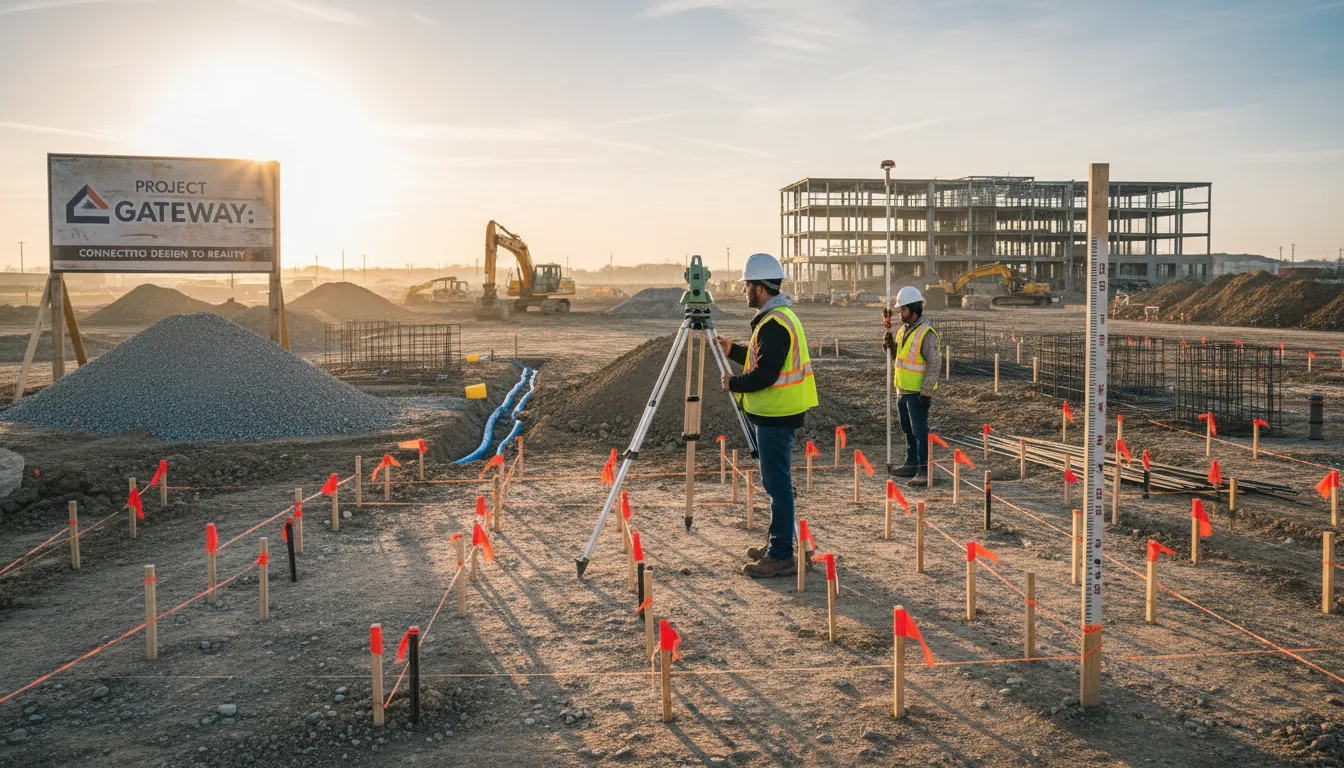
What Is Construction Staking? Purpose, Process, and When It Happens
Construction staking is the field process of translating engineered plans into points, lines, and elevations on the ground so crews can build exactly what the plans show. It connects design to construction, helping teams work efficiently, reduce rework, and avoid layout errors that can affect schedule and budget.
Construction staking is the field process of translating engineered plans into points, lines, and elevations on the ground so crews can build exactly what the plans show. It connects design to construction, helping teams work efficiently, reduce rework, and avoid layout errors that can affect schedule and budget.
If you’re planning sitework, utilities, paving, or a building foundation, construction staking is often one of the first steps that turns drawings into measurable progress. It’s especially useful on projects that start with grading and utility installation, where accurate layout supports safe, buildable results.
Construction Staking Defined
Construction staking (also called construction layout) is performed by survey professionals using specialized instruments to mark the locations and elevations needed for construction. Staking provides clear guidance for:
- Horizontal position: where a feature goes
- Vertical elevation: how high or low it should be
- Alignment and grade: direction and slope for drainage and function
Stakes, nails, hubs, lath, and paint marks are commonly used. Many sites also use digital files for GPS equipment and machine control.
Why Construction Staking Matters
Construction staking helps ensure the project is built to plan and within tolerance. When layout is accurate, crews can install improvements confidently and inspections tend to go more smoothly.
Key benefits include:
- Less rework by catching layout issues early
- Better coordination between grading, utilities, concrete, and paving
- Cleaner schedule flow by reducing stop-and-start field corrections
- Lower risk through consistent reference points and verification checks
Small mistakes can create large downstream impacts. A utility line placed off alignment may conflict with other infrastructure, fail cover requirements, or require removal and replacement. A pad elevation set incorrectly can cause drainage issues and expensive corrections later.
When Construction Staking Happens
Construction staking is typically performed in phases that match the construction sequence. It’s not a one-time activity, because stakes can be disturbed and different scopes require different layout.
Construction staking is commonly needed during:
- Control setup and site verification
- Rough grading and earthwork
- Utility installation
- Curb, paving, and sidewalks
- Building layout and foundations
- Final grading and closeout support
The Construction Staking Process
Establish survey control
Survey control is the foundation of accurate staking. A survey team will establish or verify reference points used across the site, including horizontal control and benchmarks for elevation. Strong control is especially important when multiple contractors or phases are involved.
Review plans and coordinate with the team
Before staking begins, surveyors review the current plan set and coordinate with the contractor on what is needed for upcoming work. This coordination typically covers tolerances, labeling, offsets, and whether digital layout files are required.
Calculate points, lines, and grades
Survey teams compute layout information from the plans. Depending on the scope, this may include:
- Centerlines and offsets for roads and utilities
- Curb radii and pavement edges
- Building corners and grid lines
- Finished floor elevations and spot grades
- Pipe slopes, inverts, and structure rims
Stake and verify in the field
Surveyors then place stakes or marks on-site and provide the information crews need to build. Staking often includes offsets so the layout remains available as excavation or grading begins. Verification checks are commonly performed for critical work before concrete placement or utility tie-ins.
What Gets Staked on a Typical Site
Construction staking scope depends on the project, but most sites include some combination of the following.
Grading and earthwork
- Cut/fill stakes for subgrade or finish grade
- Building pad limits and elevations
- Drainage features and detention areas
Utilities
- Alignment and offsets for water, sanitary, and storm lines
- Structures such as manholes, inlets, and valves
- Invert elevations, slopes, and cover requirements
Paving and concrete
- Curb and gutter line and grade
- Pavement edges, profiles, and transitions
- Sidewalk alignment and ramps
Building layout
- Building corners and control lines
- Foundation elements and key offsets
- Anchor bolt or column line layout when required
On development projects, this layout work is often coordinated as part of overall site delivery and land development services in Dallas, where civil plans, grading strategy, and utility construction must align in the field.
Tools Used in Construction Staking
Construction staking relies on precision instruments and, increasingly, digital workflows. Common tools include:
- Total stations for accurate layout and checks
- GNSS/GPS rovers for coordinate-based staking when conditions allow
- Digital levels for elevation transfer and benchmarks
- Machine control files for GPS-guided equipment
Technology can improve speed and consistency, but accuracy still depends on good control, current plans, and clear communication.
Common Mistakes
A few recurring issues cause most staking-related problems.
- Working from outdated plans and missing revisions
- Weak control or benchmarks that are not protected throughout the project
- Unclear stake labeling that crews interpret incorrectly
- Stakes set too close to active work, leading to frequent disturbance
- Skipping verification checks before irreversible work
- Assuming GPS is always appropriate, even when obstructions reduce accuracy
Good coordination and disciplined field practices prevent most of these issues.
Practical Checklist for Construction Staking
Use this checklist to reduce delays and minimize restaking and rework.
Before staking starts
- Confirm everyone has the latest plan set (including revisions)
- Define the staking scope by phase (grading, utilities, paving, building)
- Verify tolerances for critical work
- Ensure control points and benchmarks are established and protected
- Provide digital files if machine control will be used
During construction
- Stake based on the look-ahead schedule, not at the last minute
- Request verification for foundations, inverts, curb grades, and key elevations
- Re-stake promptly after major grading or trenching
- Communicate design changes early so staking can be updated
Closeout
- Confirm final grades and drainage elements match design intent
- Coordinate any as-built needs for record documentation
Construction Staking vs. Other Survey Work
Construction staking is different from boundary and topographic surveying. Boundary work establishes property lines. Topographic surveys capture existing site conditions. Construction staking sets the planned design on the ground so crews can build accurately.
When You Should Plan for Construction Staking
Most projects with grading, utilities, paving, or foundations benefit from construction staking. It’s especially important when slopes, elevations, and alignments affect drainage performance, constructability, or inspection outcomes.
Construction staking helps translate design intent into a buildable reality. When it’s planned in phases, supported with reliable control, and verified at critical points, it protects schedule, budget, and quality from the earliest sitework through final completion.
Keep reading
More from the blog
Gas Line Installation: What Homeowners Need to Know First
Roof Timeline Guide for Buying an Older Utah Home

How to Choose Windows for a Utah Home With a Mountain View