How to ‘Home Maintenance’ – The Utah vs. Pennsylvania Comparison
Ever found yourself failing in home maintenance and all you did was blame it on Mother Nature, as if there’s nothing you could’ve done? Well, a lot of people do.
Ever found yourself failing in home maintenance and all you did was blame it on Mother Nature, as if there’s nothing you could’ve done? Well, a lot of people do.
But what if you're the problem? Did you do your homework to see exactly what maintenance means for your climate?
Your ZIP code influences how you do home maintenance... a lot.
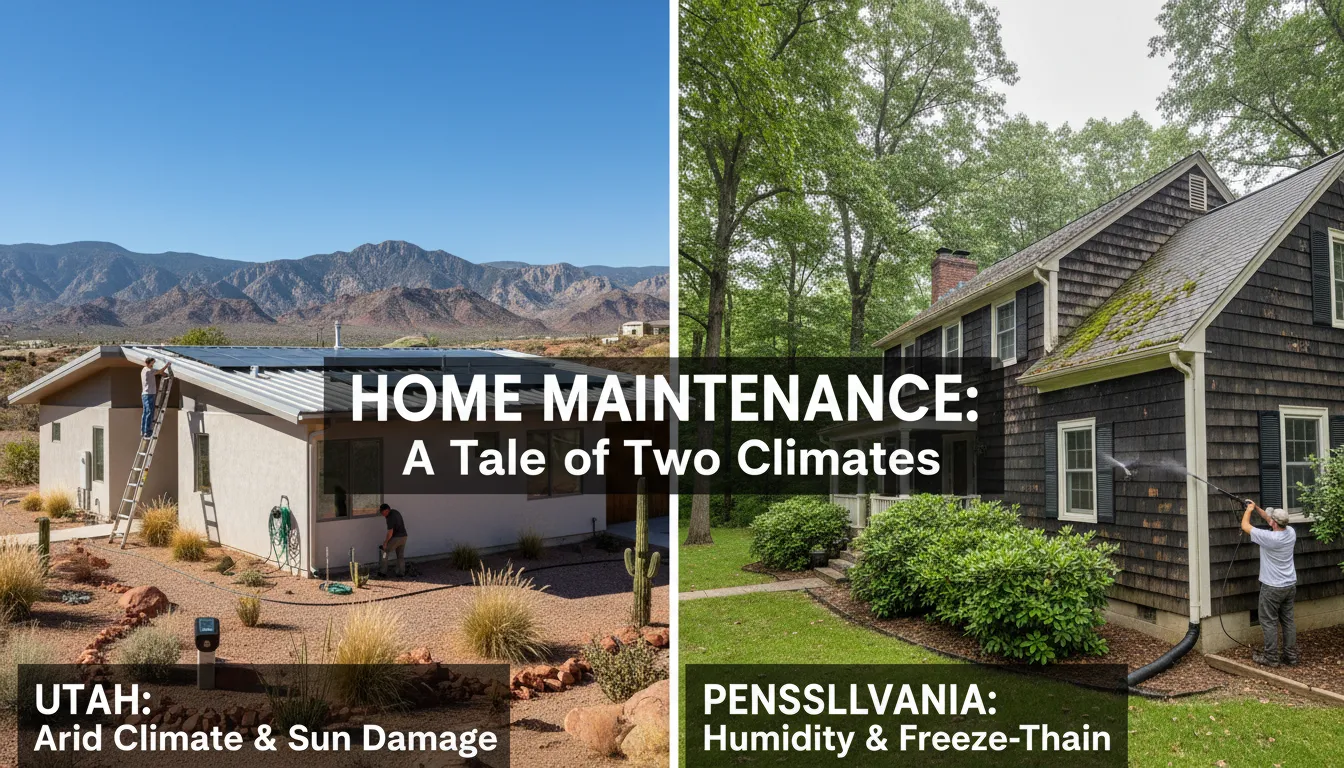
While there are lots of examples across the U.S. -- considering how diverse the terrain is -- we can use Pennsylvania and Utah for comparison.
In Utah, you've got to deal with super hot summers and low air humidity (dryness). Which also means that wooden materials (e.g., your porch or your deck) can burst into flames quite quickly. These are the perfect examples of how climate affects maintenance.
Pennsylvania? The opposite. Humidity and snow piling, followed by freeze-thaw cycles that cause cracks, even in concrete.
Basically, what works in one state won't work in the other.
So how do you know if you're doing enough to keep your home healthy?
How to Maintain Your Home in Utah's Dry Heat
If you live in Utah, you know all about its dry heat. You may even like it, but your home? Not so much if you don't maintain it properly.
Your job is to fight back against that intense sun and the thirsty air.
The paint and siding are your home's first line of defense, so don't skimp on the paint. It should be high-quality and UV-resistant, so that it reflects the sunlight instead of absorbing it. If you go with something cheap, not only will the paint fade, but it'll also crack.
And if you have a wooden deck or a fence, you should know that wood acts like a giant sponge for dry air.
What about dust? As you can imagine, it can get quite dusty here.
Native plants are always your best choice, regardless of where you live, but they're not just for looks. They'll act like a little moat and stop the dust and soil from blowing up against your siding every time there's a breeze.
If you have a pool, you know that water seems to just vanish into thin air, so you need to keep it from turning into mineral soup. Some outdoor stuff is really tricky, and pools are one of those, so you may want to hop online and search ‘pool company near me’ to save yourself some headaches.
Inside the house, you're still fighting the dry air. You might notice that your wood floors are showing little gaps or your doorframes creak like something from a horror movie. This means the wood is shrinking, so run a humidifier. This is especially important if your heater is on.
This is also healthier for you because the dry air isn't healthy for the skin or the airways.
Maintaining Your Home in Pennsylvania's Harsh Winters
In Pennsylvania, your problem isn't just the cold. The heavy, wet snow that piles up and the freeze-thaw cycles that wreak havoc on concrete are much more problematic.
This is really tough on your house, and the way you start with maintenance is at the top.
Literally.
Your roof is your frontline and, as pretty as all that snow is, it's heavy.
Suppose there's more than a foot of it there (and especially if it's wet!). You'll want to rake it off the ground. Don't bother with getting every single flake; your goal here is to just lighten the load. You also need to take care of the icicles. Again, they might look pretty, but if you see them hanging from the gutters, that's a sign of ice dams. In other words, there are ridges of ice that trap melting water and shove it right back under your shingles.
Pipes are next. Any pipe that runs through a space that's not heated (garage, crawl space, etc.) is very risky.
Water expands when it freezes, and splitting a pipe open is a piece of cake for that expansion. Wrap those pipes in insulated foam sleeves. One weekend will be enough to do it, and it will save you a world of disaster. And when the nights get insanely cold, leave the faucet dripping slowly.
This will prevent the water from fully solidifying, meaning two things:
-
You’ve got running water in the morning.
-
The pipes didn’t crack because of the expansion.
Win, win.
Also, take a walk around your house.
Winter can be very hard on the exterior, so before it gets freezing out there, disconnect and drain your garden hoses and shut off the water supply to your outdoor spigots.
Conclusion
Battling the dust in St. George? Shovelling snow in Scranton?
Wherever you are, hopefully, now you can see why home maintenance isn't something we all do the same way. One thing that everyone has in common, though, is the strategy: you need to be proactive, not reactive.
Your home is handling the elements 24/7 and, if you want it to stay in good condition, you have to take care of it properly.
Keep reading
More from the blog
Gas Line Installation: What Homeowners Need to Know First
Roof Timeline Guide for Buying an Older Utah Home
How to Choose Windows for a Utah Home With a Mountain View