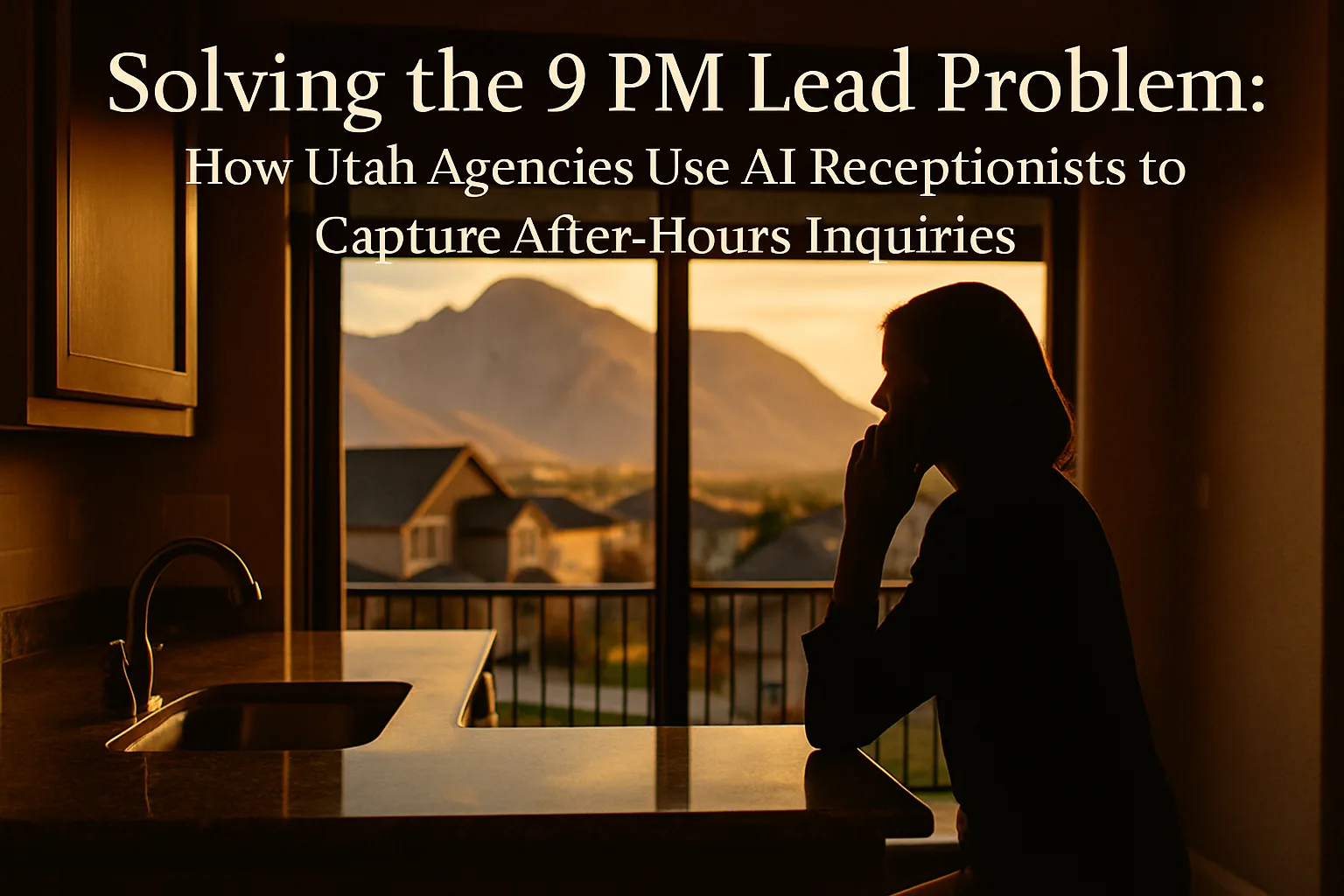
Solving the 9 PM Lead Problem: How Utah Agencies Use AI Receptionists to Capture After-Hours Inquiries
In the cutthroat business landscape of Utah, a busy day does not end when the office lights are turned off. Many local businesses, from law firms to property management, based in Salt Lake City or St. George, get the most important questions when their employees are relaxing back home.

In the cutthroat business landscape of Utah, a busy day does not end when the office lights are turned off. Many local businesses, from law firms to property management, based in Salt Lake City or St. George, get the most important questions when their employees are relaxing back home. This phenomenon, where potential leads arrive when the lights are turned off, is commonly referred to as the ‘9PM Lead Problem.’
If this problem is not addressed, it will lead to a significant gap in lead conversion, and this has been the case for several years. When a potential client reaches out after hours and is met with a voicemail or an automated message saying “we will call you back tomorrow,” the lead is not converted anymore. Because we are living in a world of instant gratification, the lead is likely going to click on the next competitor in the search results, and you will lose a potential customer/client.
To bridge this gap, several forward-thinking companies across the Beehive State are moving away from conventional answering services and towards automated intelligence. This is where the technology for the AI receptionist is taking centerstage. The implementation of AI-driven receptionists ensures that every late-night inquiry is met with an immediate, human-like interaction that qualifies the lead and schedules follow-ups in real-time. This technology does more than record information; it engages the caller and answers specific questions, effectively turning a cold midnight inquiry into a warm lead ready for the morning team.
The High Cost of the Missed Connection
The cost of a missed call is much greater than most business owners realize. Research from LeadAngel suggests that responding within the first minute of inquiry can increase conversion rates to a whopping 391%. Conversely, every 10-minute delay in response reduces the chances of qualifying that lead by 400%. To a Utah agency, a 9:00 PM lead is frequently in a state of high intent, such as a homeowner with an urgent property issue or a business owner finally sitting down to take care of his or her legal needs.
When these calls result in voicemails, the leak in the funnel becomes a tangible loss of revenue. The answering service may also face the problem of high operational expenses and/or a lack of specialized knowledge about the agency's operations if it relies on traditional human resources. The problem is remedied by an AI-powered answering service that is trained on the agency's information, providing the caller with information that is not only true but also useful, and not simply a script.
Local Market Demands and Immediate Gratification
The economy of Utah is known for its fast growth rate and tech-friendly community. Whether it is the Silicon Slopes of the tech community or the growing professional service industry, consumers demand a tech-friendly experience. They would not wait for the 9:00 AM return call when they have access to a service provider who will provide the answers instantly.
By implementing AI receptionists, Utah agencies are embracing this cultural shift. These technologies are capable of juggling various calls at once, so there is never anyone on hold. These technologies can also interface with CRMs, Salesforce, or HubSpot, to ensure that by the time an agency owner logs on to their computer the next day, information on that lead is already categorized, with an appointment on the calendar for a consultation.
Beyond Voicemail: Interactive Lead Qualification
The '9 PM Lead' challenge is more than picking up a call; it’s what occurs in the call process. The standard voicemail leaves a caller’s name and number, but doesn’t screen the lead. The use of AI receptionists employs natural language processing to understand the intent of the callers.
For example, this might mean that a local real estate agency gets a call from someone inquiring about specific zoning laws for a mountain property. The AI can be designed to recognize whether this is a serious buyer or a general inquiry, make qualifying questions about their budget or timeline, and send resources immediately. This level of engagement engenders trust. The caller feels they are heard and supported, even when the human staff is asleep, which vastly increases the stickiness of that lead.
Scalability and Operational Efficiency for Utah Firms
One of the most important reasons that Utah agencies are turning toward this technology has everything to do with efficiency in a small to medium-sized business. It would be economically impossible for many boutique agencies to maintain a 24/7 staff. However, the price of adding AI is just a small fraction of that of an individual employee.
Furthermore, information from InsideSales shows that 35-50% of the sales will be captured by the vendor that gets back to the buyer first. Utah agencies are positioning themselves to be that vendor that gets back to the buyer every time, as the front end of the communication process is being automated. That way, the humans in the team will be able to work on high-level tasks, such as closing deals, while the "9 PM" calls are handled automatically.
Conclusion: Transforming the After-Hours Experience with AI Receptionists
Solving the "9 PM Lead" problem is ultimately about reclaiming lost opportunities and respecting the consumer’s time. As Utah continues to grow as a hub for innovation, the expectation for 24/7 availability will only intensify. Agencies that rely on outdated communication methods will find their growth stunted by the very leads they worked so hard to attract through marketing.
So, what is your opinion about investing in the use of AI receptionists? Share your thoughts.
Keep reading
More from the blog

Gas Line Installation: What Homeowners Need to Know First
Roof Timeline Guide for Buying an Older Utah Home

How to Choose Windows for a Utah Home With a Mountain View