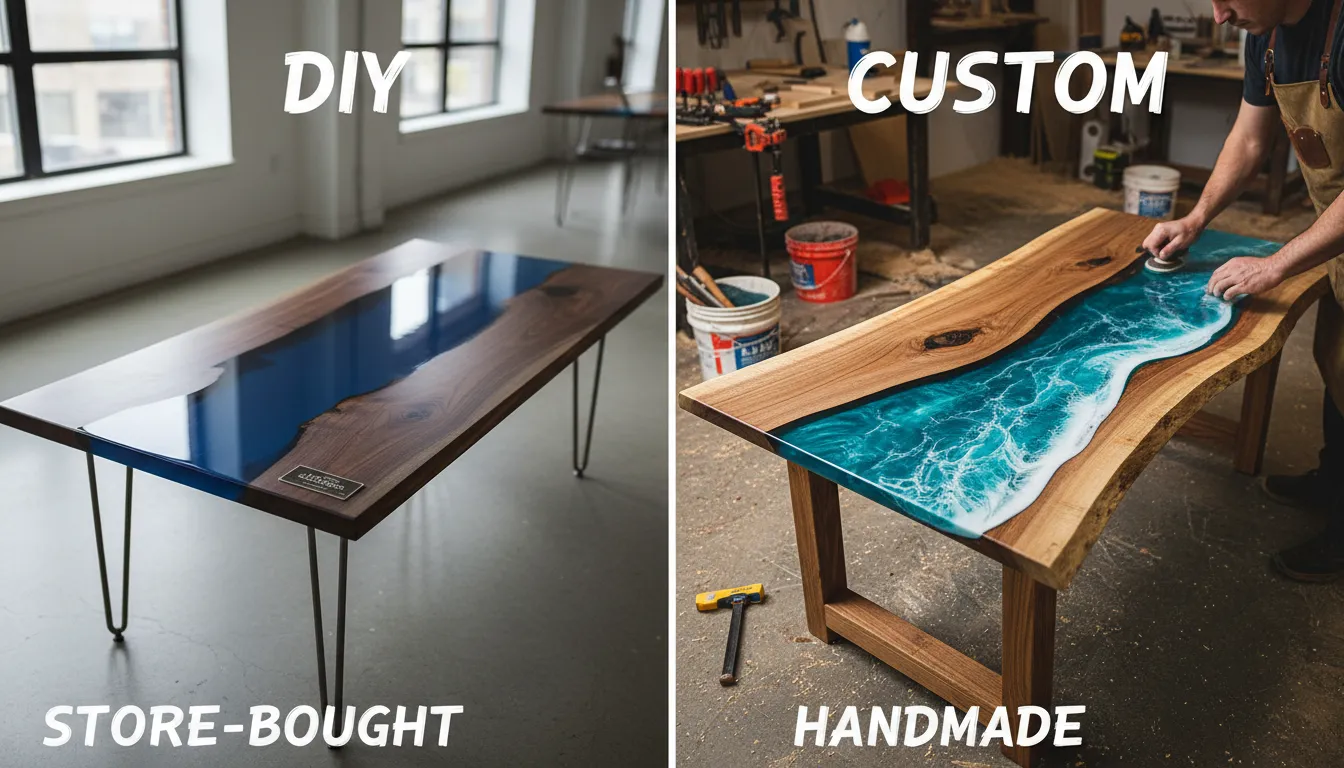
DIY or Custom? The Real Difference Between Store-Bought and Handmade Epoxy Furniture
Epoxy furniture looks confident. Smooth surfaces, flowing resin lines, dramatic slabs of wood. From the outside, it often seems like the kind of thing you either buy instantly or decide to make yourself on a weekend. In reality, that decision is rarely simple.
Epoxy furniture looks confident. Smooth surfaces, flowing resin lines, dramatic slabs of wood. From the outside, it often seems like the kind of thing you either buy instantly or decide to make yourself on a weekend. In reality, that decision is rarely simple.
People usually start with excitement. Then questions appear. Can I actually make this? Should I buy something ready-made? What if it doesn’t fit my space? Epoxy furniture invites choice, but it also exposes the limits of shortcuts.
Why Epoxy Furniture Triggers the DIY Question
Unlike traditional furniture, epoxy tables don’t feel industrial. They look handmade, even when they aren’t. That visual language pushes people toward experimentation.
Someone sees a table online, watches a few videos, and thinks: It’s just wood and resin. That thought alone fuels countless garage projects. Others browse collections, including examples of a custom epoxy table, not because they plan to buy immediately, but to understand what separates a finished piece from a poured experiment.
Epoxy furniture sits right on the line between craft and risk.
DIY Epoxy Furniture: Control Comes With Consequences
Making your own epoxy furniture can be deeply satisfying. It can also be deeply humbling.
What DIY Does Well
Creative control is real. You choose the slab, the voids, and the resin tone. You decide whether imperfections stay or get sanded away. For people who enjoy working with their hands, the process matters as much as the object.
DIY projects also teach respect for materials. Resin behaves differently every time. Wood moves. Gravity always wins.
What DIY Rarely Warns You About
Epoxy does not forgive impatience. One wrong mix ratio ruins hours of work. Temperature shifts create cracks you won’t see until weeks later. Dust settles when you least expect it.
Tools matter more than beginners expect. Flat surfaces are hard to achieve without proper leveling. Sanding takes days, not hours. Mistakes cost materials, time, and motivation.
DIY isn’t cheaper if you value predictability. It’s cheaper only if learning is the goal.
Store-Bought Epoxy Furniture: Fast Answers, Fixed Outcomes
Buying epoxy furniture from a store is appealing for obvious reasons. No resin fumes. No curing anxiety. No guesswork.
Where Store-Bought Makes Sense
If the table fills a short-term role or a secondary space, store-bought options can work. Offices, rentals, or temporary interiors often benefit from speed rather than permanence.
There’s also comfort in seeing exactly what you’ll receive. No surprises. No waiting for materials to behave.
Where It Starts to Fall Short
Most store-bought epoxy furniture is standardized. Dimensions follow shipping logic, not room proportions. Resin colors are chosen for mass appeal. Wood selection is limited.
If your space is unusual, the furniture adapts poorly. Corners feel tight. Scale feels slightly off. You may not notice at first—but over time, it shows.
Store-bought epoxy furniture solves availability, not fit.
Custom Epoxy Furniture: Less Risk, More Thought
Custom furniture isn’t about luxury. It’s about alignment.
You don’t pour resin yourself, but you influence the decisions that matter: size, thickness, edge profile, wood character, and finish tone. The process removes technical risk while keeping personal input.
Why Custom Appeals to Long-Term Thinkers
Custom epoxy furniture usually starts with the room, not the object. How light enters. How people move. How often will the surface be used?
That context changes everything. A table designed for daily use feels different from one designed for display. Thickness, resin depth, and finish durability matter more than color trends.
The Trade-Off
Custom takes time. Decisions take energy. You have to think before committing.
But that friction is also the filter. It prevents impulsive purchases and encourages clarity.
Budget Isn’t a Number — It’s a Timeline
People often compare options based on price alone. That comparison is misleading.
DIY spreads cost across time and mistakes. Store-bought compresses cost but may repeat later. Custom concentrates cost upfront but often end the cycle entirely.
The real question isn’t How much does it cost? It’s How many times will I replace it?
Skill Level vs. Stress Level
DIY demands skill or patience. Store-bought demands compromise. Custom demands decision-making.
Different people tolerate different kinds of stress. Some enjoy trial and error. Others hate uncertainty. Some want control. Others want relief.
There’s no correct answer — only honest self-assessment.
What Most Buyers Don’t Consider
Epoxy furniture is heavy. Literally and figuratively.
Once it’s in place, it’s not moving often. That permanence means mistakes linger. A table that’s slightly too large or awkwardly shaped becomes a daily reminder.
This is where rushed decisions hurt the most.
Choosing Based on Use, Not Image
Ask practical questions before aesthetic ones:
-
Will this table be used daily or occasionally?
-
Will it support weight, heat, spills, work?
-
Will it need to age well?
Epoxy furniture rewards realism more than enthusiasm.
The Quiet Advantage of Custom Work
Custom furniture isn’t exciting in the beginning. It becomes rewarding later.
When dimensions make sense. When surfaces hold up. When the table disappears into daily life instead of demanding attention.
That quiet success is often what separates satisfaction from regret.
Final Thought
DIY, store-bought, and custom epoxy furniture each serve a purpose. Problems arise only when expectations don’t match reality.
If you enjoy learning through mistakes, DIY can be fulfilling. If speed matters more than fit, store-bought is practical. If you want something that settles into your space and stays there, custom work often proves its value slowly.
If questions remain — about dimensions, materials, or whether custom even makes sense — you can always contact ThunderWood to ask before deciding.
Good furniture doesn’t rush. Neither should the decision.
Keep reading
More from the blog

Gas Line Installation: What Homeowners Need to Know First

Roof Timeline Guide for Buying an Older Utah Home

How to Choose Windows for a Utah Home With a Mountain View