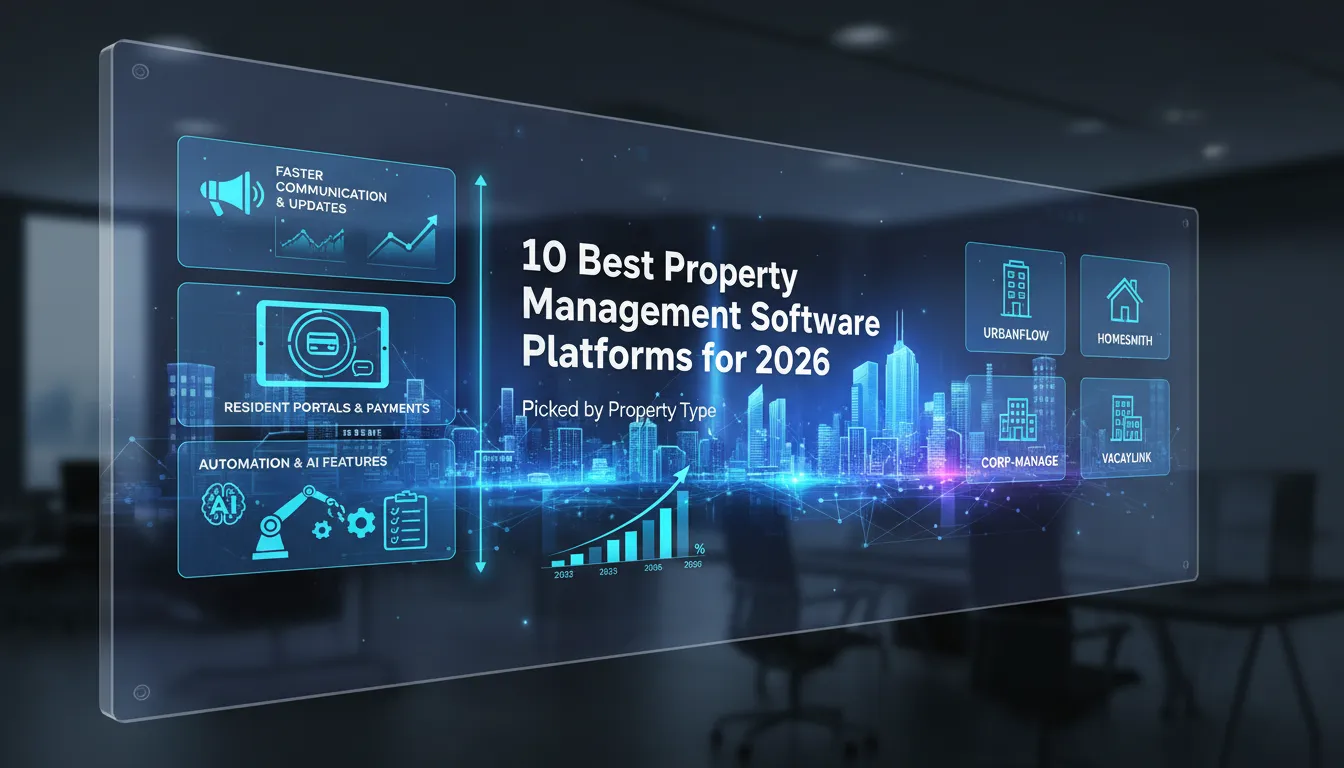
10 Best Property Management Software Platforms for 2026 - Picked by Property Type
Property management in 2026 is not just about collecting rent and tracking maintenance. Owners expect faster communication. Residents expect online payments, portals, and clear updates.
10 Best Property Management Software Platforms for 2026 - Picked by Property Type
Property management in 2026 is not just about collecting rent and tracking maintenance. Owners expect faster communication. Residents expect online payments, portals, and clear updates. Teams want automation that reduces repetitive work, not another tool that creates more clicks. And across the industry, AI features are becoming more common, which is exciting, but also something you want to evaluate with a clear head. One recent industry report even points to a big jump in AI adoption among property management professionals in a short period, which helps explain why software platforms are moving so quickly right now.
With all that change, “best property management software” is only meaningful if you define “best for what.” The needs of a multifamily operator are different from a self storage facility. Student housing has its own leasing rhythms. Affordable housing adds compliance complexity. Community associations are a whole different world from rentals.
So instead of forcing a one size fits all list, this roundup is intentionally matched to property types. The categories below reflect where each platform is commonly strongest, based on how the products position themselves and what they emphasize.
Here are the 10 best property management software picks for 2026, organized by the portfolio they fit best.
1) AppFolio (Best for Multifamily)
If you manage multifamily, you already know the operational reality. There is leasing traffic to keep moving, unit turns to coordinate, work orders that never stop, and resident expectations that keep rising. AppFolio is built for that pace, with a platform that ties together core property operations and leans heavily into workflow automation for teams that manage a lot of moving parts.
AppFolio positions its platform as a unified experience that connects key functions, and it has been vocal about using AI to reduce busywork and streamline routine tasks across operations. In practical terms, multifamily teams usually care most about having property accounting, leasing, maintenance coordination, inspections, and resident communications living in the same system so nobody has to chase information across tools. AppFolio’s core platform highlights those building blocks, including accounting and reports, marketing and leasing, work order management, inspections and unit turns, and resident portals.
Why it lands as a multifamily pick for 2026 is simple: multifamily success is often about speed and consistency. A platform that can connect teams, centralize data, and reduce manual steps matters more when you are working at scale.
2) Buildium (Best for Single-Family)
Single-family rental management tends to be deceptively complex. You might not have elevators or shared hallways, but you do have scattered addresses, higher per home maintenance coordination, and tenants who still want an experience that feels modern. Buildium has long been a strong choice for managers who want an all in one system that covers the fundamentals without feeling enterprise heavy.
Buildium emphasizes a unified platform that brings together accounting, payments, leasing, maintenance, mobile apps, and integrations. For single-family portfolios, that matters because you want one place to handle rent collection, lease workflows, maintenance requests, and reporting, while still keeping the accounting clean. Buildium also calls out purpose built accounting features like automated bank reconciliation and property specific reporting, which can be a big help when the treasurer or bookkeeper is juggling multiple properties and owners.
Another reason Buildium fits single-family well is the day to day workflow. You need leasing tools that are easy to use, communication that does not get buried, and maintenance tracking that can handle everything from HVAC emergencies to routine vendor scheduling. Buildium’s feature set is built around those core needs.
3) Yardi Voyager (Best for Commercial)
Commercial property management often lives and dies by the lease. You are tracking complex terms, escalations, CAM reconciliations, renewals, tenant obligations, and reporting structures that do not look anything like a small residential portfolio. Yardi Voyager Commercial is designed specifically for that kind of lifecycle management in commercial real estate.
Yardi describes Voyager Commercial as a comprehensive property management platform intended to manage the entire lifecycle of commercial operations, including financial, leasing, and maintenance activities within a single database. It also highlights support for multiple commercial property types, including office, industrial, retail, and more specialized facilities.
In 2026, “commercial” also increasingly means “data visibility.” Owners and asset managers want real time reporting and better forecasting. Yardi’s commercial suite messaging emphasizes leases, tenant services, maintenance requests, and financials, plus budgeting and forecasting tools. If you manage commercial assets where reporting structure and lease complexity are central to performance, Voyager remains a strong category pick.
4) Rent Manager (Best for Student Housing)
Student housing is its own universe. Leasing cycles are more seasonal. Turnover happens in waves. Roommate matching and communication can be just as important as rent collection. Rent Manager leans into that reality with student housing specific tooling.
On its student housing page, Rent Manager highlights resident portals, roommate management flexibility, and texting functionality, all of which are especially relevant when you are managing residents who live on their phones and expect fast answers. More broadly, Rent Manager positions itself as an all in one property management platform with accounting and reporting, marketing and mobile tools, and work order management capabilities.
That blend is why it fits student housing well. You can cover the operational basics, but also handle the details that make student portfolios feel uniquely busy during move in and move out. For 2026, when resident experience and communication speed keep getting more important, student housing workflows that support quick updates and flexible living arrangements are a real advantage.
5) Condo Control (Best for Community Associations)
Community associations are not the same as rentals. You are managing governance, communication, documents, amenities, and community rules, along with ongoing maintenance. Condo Control is built for that world.
Condo Control positions itself around simplifying communication and streamlining tasks like booking amenities, managing documents, and handling maintenance requests. It also highlights use cases that line up with association needs, such as enforcing rules and regulations, maximizing amenity usage, tracking maintenance requests, and managing visitors and parking.
For many communities, the “best” software is the one owners actually use. The association space lives and dies by adoption. Condo Control’s emphasis on resident facing tools like amenity booking and community engagement, paired with operational tools like document access and maintenance tracking, is why it earns a spot here for 2026.
Bonus software picks for specialized property types
Not every portfolio fits a classic “residential vs commercial” box. Some of the best software choices in 2026 are highly specialized, built for very specific operational realities. If you manage one of these categories, going with a purpose built system can save you time and headaches.
6) Campspot (Best for RV Parks)
RV parks and campgrounds have a very different operating model than long term rentals. Reservations, guest communication, seasonal marketing, and a smooth booking experience are critical. Campspot positions its product directly as campground management software designed to streamline operations, grow revenue, and create a seamless experience for operators and guests.
Campspot also calls out features tied to guest experience and marketing, including tools that support a more intuitive booking flow and guest communication. If you are running an RV park and still trying to manage bookings through a patchwork of tools, a platform built around reservations and guest operations is often the difference between “manageable” and “constant chaos.”
7) SiteLink (Best for Self Storage)
Self storage management is operationally specific. You have units, gate access considerations, move ins and move outs that can be frequent, and a strong need for reporting and integrations that match how storage businesses run.
SiteLink, part of Storable’s suite, positions itself as a flexible self storage management software designed to simplify workflows, with customizable workflows, advanced reporting, and third party integrations. It also highlights cloud based options like SiteLink Web Edition, described as a turnkey solution that includes what operators need to run a self storage business.
For 2026, this category pick is about fit. Storage operators typically want software that understands their operational rhythm, and SiteLink is built squarely for that.
8) Guesty (Best for Vacation Rentals)
Vacation rentals bring together hospitality and property management. You are managing calendars, messaging, cleaning schedules, reviews, guest screening, and multi channel listings. The complexity grows fast as soon as you manage more than a handful of properties.
Guesty positions its platform around centralized management for vacation rentals, with features like a unified inbox, multi calendar, a marketplace for integrations, direct reservations tools, and what it calls an AI suite. It also emphasizes syncing listings in real time across major channels like Airbnb, Booking.com, Vrbo, and more, which is one of the core requirements to avoid double bookings and keep operations sane.
Guesty has also published guidance specifically framed around short term rental software in 2026, positioning its product tiers for different portfolio sizes and highlighting channel management, automated messaging, task management, and more. Whether you are scaling from a small portfolio or managing a larger short term rental operation, the ability to consolidate messaging, calendars, and automation in one place is exactly what makes Guesty a strong 2026 pick for this segment.
9) HOA Central (Best for Self-Managed HOAs)
Self-managed HOAs are a unique category because the “property manager” is often a volunteer board. That changes everything. The best HOA software for a self managed community is the one that reduces administrative burden, centralizes records, and makes routine workflows feel simple rather than intimidating.
HOA Central positions itself as an all in one HOA management platform with features spanning governance and compliance (like e consent forms, architectural change requests, and violation enforcement), financial workflows (vendor management, invoice approvals, payments), and operations (visitor management, parking permits, maintenance requests). It also highlights a communication suite and resident portal style tools, which are key for reducing the endless email threads that can burn out volunteer boards.
In 2026, self management is becoming more common for smaller communities that want transparency and control without paying full service management fees. Software is what makes that possible without turning board service into a part time job. HOA Central earns the spot here because it is designed around the workflows volunteer boards actually need, not just what professional managers want.
10) MRI Software (Best for Affordable Housing)
Affordable housing adds a layer that many general property management platforms cannot handle well enough: compliance. Waiting lists, vouchers, income qualifications, reporting, and staying aligned with HUD and other program requirements can turn “basic property management” into a completely different operational challenge.
MRI Software’s affordable housing compliance software is positioned to simplify property management and compliance across a mix of affordable housing funding programs, with tools that support reporting, voucher management, waitlist management, and maintaining compliance with current HUD regulations. Third party software profiles also describe MRI Affordable Housing as a web based solution that automates compliance processes and supports multiple subsidy layers and federal and state funding programs.
If your portfolio requires affordable housing compliance, “best” is less about having a nice looking dashboard and more about being confident you can manage program requirements accurately and consistently. That is the lane MRI is built for, which is why it is the 2026 pick for this category.
How to choose the right platform from this list
If you are reading this and thinking, “Okay, but how do I actually decide,” here is the simplest approach that works.
Start with your property type and your operational reality. Multifamily, commercial, student, association, storage, short term rentals, RV parks, affordable housing all have different pain points. Choosing a tool built for your day to day world is usually more important than choosing the tool with the longest feature checklist.
Next, decide what “must work perfectly” for you. For some teams, it is accounting and reporting. For others, it is leasing and marketing. For self managed HOAs, it might be document access, dues collection, and a clean process for architectural requests and violations. For vacation rentals, it is channel management and unified messaging.
Then, make sure you are thinking about adoption. The best software in the world is useless if your team, owners, or residents will not use it. In 2026, a lot of platforms are also adding AI features, but the practical win is still the same: less repetitive work, fewer missed tasks, faster response times, and cleaner records.
Finally, get a demo and ask for examples that match your reality. Ask the vendor to show you exactly how a rent payment flows, how a maintenance request becomes a work order, how reports are generated, and how you would onboard a new staff member or board member. That is where “best” becomes real.
Keep reading
More from the blog

When a Utah HOA Stops Working: Who Pays for Roads, Walls and Common Areas

Tiny Homes in Utah: Zoning, Building Code and the 2026 Backyard ADU Law
Planning a Backyard Shed for a Utah Home: What to Check