Utah and Cyprus: Two Sun-Drenched Landscapes, One Design Philosophy
Transform your compact urban home with Mediterranean design. Discover smart tips, natural light strategies, and fresh aesthetics for modern coastal living.
At first glance, the Colorado Plateau and the eastern Mediterranean coast have little in common. Utah is landlocked, defined by canyon walls and high desert silence; Cyprus sits in a warm sea, its shoreline dissolving into fishing harbors and whitewashed hillside villages. Yet the light that falls on both places is the same relentless, mineral-clear light that exposes every surface and demands that interiors respond to it honestly. That shared quality — more than any stylistic borrowing — is why the Mediterranean design tradition translates so naturally to Utah homes, and why buyers browsing apartments for sale in Cyprus often find themselves responding to the same spatial instincts that guide good design in Salt Lake City, St. George, or Moab. The vocabulary is different; the underlying logic is the same.
Both environments impose constraints that architecture must answer. In Cyprus, thick masonry walls manage summer heat and flood interiors with reflected light. In Utah, the high desert sun is equally unforgiving — and the same logic applies: control the light, choose materials that survive it, and let the landscape do as much work as the interior. Mediterranean design, rooted in those same answers, is not a transplanted aesthetic in this context. It is, in many ways, a native one.
A Shared Color Logic: From the Aegean to the Wasatch Front
Color does more work in a small room than furniture ever could. The Mediterranean palette is built on restraint — a foundation of light neutrals carrying just enough warmth to feel inhabited, then punctuated with deliberate accents that pull the eye without cluttering the room. In Utah, that same restraint is already embedded in the landscape: the muted ochres of canyon sandstone, the bleached sage flats, the occasional deep red of iron-stained rock. The palette translates almost directly.
Key colors and materials to consider:
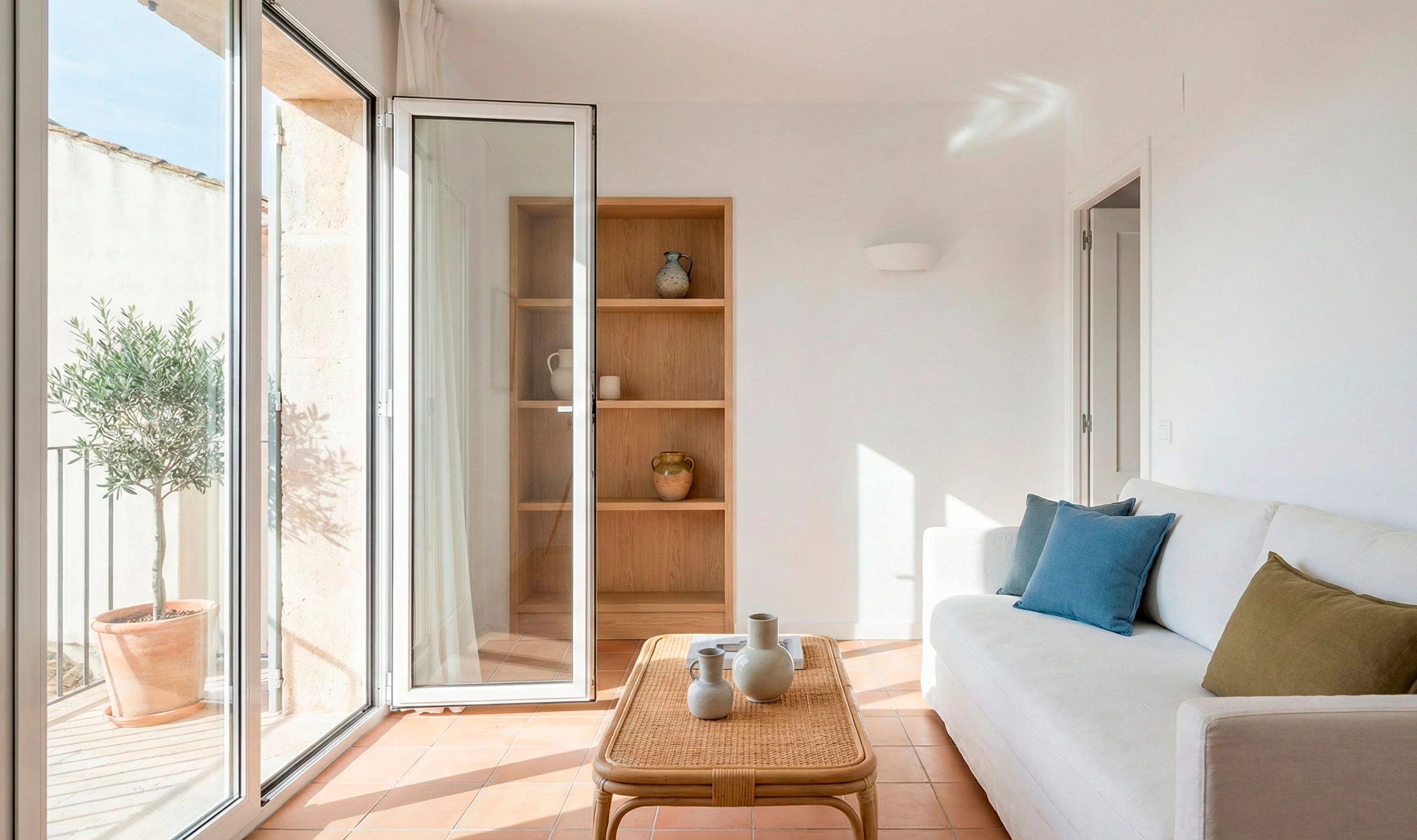
• Whitewashed walls: Off-white and warm white surfaces reflect daylight deep into a room, making walls feel further apart than they are. In Utah's intense sunlight, the effect is amplified — the same principle that kept Cycladic villages cool for centuries works equally well in a south-facing St. George apartment.
• Earthy tones: Terracotta, ochre, and sandy beige add depth without the heaviness of dark paint. For Utah interiors, these are not foreign imports — they mirror the canyon palette visible from almost every window in the state's southern towns.
• Sea and sky accents: Deep cobalt, dusty turquoise, and aged denim blue work well in textiles, ceramics, or glazed tiles. These hues evoke the Mediterranean without demanding much surface area — and in Utah, they echo the surprising blues of high-altitude sky that appears above the red rock country.
• Natural materials: Unfinished linen, raw clay, bleached wood, and handwoven cotton carry texture that painted walls cannot — and they age beautifully in light-filled rooms. Utah's craft tradition — pottery, woven textiles, reclaimed timber — maps cleanly onto these preferences.
The challenge with accent colors in a small space is restraint. A terracotta cushion and a cobalt ceramic vase can carry an entire room. Three different accent colors across six surfaces will make the same room feel cluttered and visually noisy. Choose one warm tone and one cool tone, then repeat each sparingly. The eye needs places to rest — a principle as true in a Limassol flat as in a Salt Lake City studio.
Maximizing Natural Light and Airflow
Light is the single most effective tool for expanding a small flat — more powerful than any furniture arrangement or color choice. Mediterranean homes were built around it: thick walls kept heat out, but openings were positioned to catch morning light and encourage airflow throughout the day. Utah's solar geometry is similarly uncompromising. The state receives more than 300 days of sunshine annually, and the quality of that light — sharp, directional, intensely clear — is closer to the Cypriot coast than to most American cities.
In a modern urban flat, the same principles apply even without the architecture. Start with the windows. Heavy curtains absorb light and shrink the room visually; replacing them with sheer linen panels or simple cotton voile immediately doubles the sense of space. If privacy is a concern, consider frosted film on the lower half of the glass rather than fabric that blocks the entire opening.
Mirrors are the next tool. A large mirror placed opposite or adjacent to a window does not merely reflect the room — it creates the impression of an additional light source. In a narrow corridor or a studio apartment, a floor-to-ceiling mirror on one wall can make the space feel twice as wide. The key is placement: the mirror should capture sky or natural light, not a dark wall.
Furniture arrangement matters as much as décor. Keeping a clear sightline from the entrance to the furthest window creates an immediate sense of depth. Blocking that line — with a tall bookcase, a bulky sofa, or a half-wall of shelving — compresses the perceived space. In studios and one-room flats especially, keeping floor-to-window sightlines open is worth the furniture compromise.
Smart Furniture Choices: Balancing Form and Function
Mediterranean interiors favor furniture that is modest in scale: pieces with slender legs, open frames, and honest materials like olive wood, rattan, and wrought iron. Utah's design tradition has its own version of this instinct — the preference for furniture that references the landscape rather than competing with it, pieces that feel handmade rather than manufactured. The two sensibilities align more closely than their geographic distance might suggest.
The practical shift is from statement furniture to adaptable furniture. A large sofa defines a room; a smaller linen loveseat with exposed wooden legs does the same job while leaving far more visual breathing room. A massive wardrobe fills a wall and announces itself; built-in alcove shelving in light-colored wood stores more and disappears into the architecture.
|
Furniture need |
Traditional heavy choice |
Mediterranean space-saving alternative |
|
Seating |
Oversized upholstered sofa |
Minimalist linen loveseat on tapered wooden legs |
|
Storage |
Bulky freestanding wardrobe |
Built-in alcoves with open shelving in whitewashed wood |
|
Dining |
Large fixed oak dining table |
Foldable bistro set with rattan chairs, storable when not in use |
|
Room divider |
Solid bookcase or partition wall |
Sheer curtain panel or open-frame rattan screen |
The logic is consistent before and after the table: exposed floor area signals space. A room where you can see the floor from wall to wall feels bigger than one where furniture legs are hidden behind solid bases or where pieces sit flush to the ground. Choose furniture raised on legs wherever possible, and keep the palette of wood tones consistent — mixing five different finishes in a small room creates visual clutter even when the layout is efficient.
Bringing the Outdoors Inside: Patios, Balconies, and High Desert Greenery
One of the underused assets in many Mediterranean-style homes — and in Utah properties equally — is the outdoor threshold: the balcony, covered patio, or terrace that sits between the interior and the open air. In places like Limassol or Paphos, even a narrow terrace treated as an extension of the interior effectively adds square meters to the living space. In southern Utah, where outdoor temperatures are hospitable for much of the year and the landscape itself is the view, that principle applies with even greater force.
The key is visual continuity. When the flooring inside and on the balcony share the same material — terracotta tiles, for instance, or light-toned stone-effect porcelain — the boundary between the two spaces softens. Glass or open-railing balustrades reinforce the connection; solid concrete or frosted glass walls break it.
Plants are essential to the Mediterranean interior, both inside and out. They introduce life and color without the permanence of paint, and they reinforce the sensory quality of the style. For Utah homes, the plant selection simply shifts to climate-appropriate species: drought-tolerant rosemary and lavender perform as well in St. George as they do in a Cypriot courtyard; agave and ornamental grasses bring the same textural variety as Mediterranean succulents. The scent of sage through an open window is its own form of the same experience.
To turn even a compact outdoor space into a genuine extension of the living area:
1. Select climate-appropriate potted plants — in Utah's varied zones, that might mean lavender and rosemary for the south, or compact ornamental grasses for higher elevations — species that require minimal water and maintenance.
2. Choose durable, foldable outdoor seating that can be stored flat when the space is needed for other things.
3. Use matching or complementary flooring inside and outside to visually merge the two areas — terracotta, natural stone, or a warm-toned porcelain that reads consistently in both direct sun and interior light.
4. Install warm-toned ambient lighting — string lights or low wall-mounted fixtures — to make the space usable after dark, when Utah's desert evenings are among the most temperate and star-filled in the country.
Crafting Your Everyday Desert Retreat
The Mediterranean approach to interior design has survived centuries because it solves a real human need: the need to feel at ease in one's own home. It does this not through complexity but through the deliberate removal of it — fewer objects, quieter surfaces, materials that age well and feel good to touch. In a compact Utah flat or a sun-facing apartment in a fast-growing Wasatch Front development, that philosophy is not a constraint. It is the most direct path to a home that genuinely feels good to be in.
The parallel with Cyprus is not cosmetic. Both landscapes are defined by intense light, minimal rainfall, and a built environment that learned to work with those conditions over generations. The whitewashed wall is a practical solution before it is an aesthetic one; the terracotta tile is a material that survives heat cycling and cleans easily, long before it becomes a design statement. Applied in Utah, these choices carry the same logic — and the same results.
A small space designed with Mediterranean clarity can accommodate remote work, rest, meals, and guests without feeling like a compromise. The studio that feels cramped often does so not because of its size but because of the decisions layered into it over time — the extra chair, the second rug, the curtains that block the morning light. Removing those layers, reintroducing natural materials and a coherent color palette, and treating daylight as the primary design element rather than an afterthought transforms the experience entirely.
Start with one room. Replace the curtains. Move the largest piece of furniture away from the window. Add a plant. The change is immediate — and it tends to spread naturally from there, whether you are looking out over the Great Salt Lake or the limestone coast of the eastern Mediterranean.
Keep reading
More from the blog

Gas Line Installation: What Homeowners Need to Know First
Roof Timeline Guide for Buying an Older Utah Home
How to Choose Windows for a Utah Home With a Mountain View