
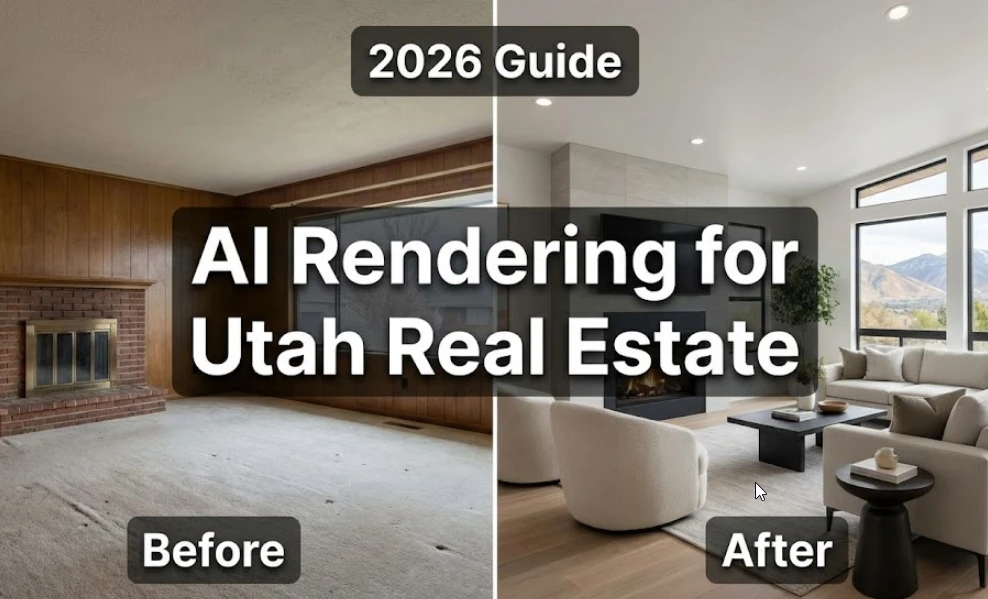
The 2026 Guide to AI Rendering in Real Estate: What It Is, How It Works, and Why It Sells Utah Homes Faster
The real estate market along the Wasatch Front has shifted dramatically in the last few years. We've moved from the frenzied, sight-unseen offers of the pandemic era to a more measured, discerning marketplace in 2026.
The real estate market along the Wasatch Front has shifted dramatically in the last few years. We've moved from the frenzied, sight-unseen offers of the pandemic era to a more measured, discerning marketplace in 2026.
Today's buyers in Utah-from the tech professionals migrating to the "Silicon Slopes" of Lehi to families looking for historic charm in the Salt Lake City Avenues-are more demanding than ever. They are digitally native, scrolling through hundreds of listings on their phones every week. In this high-speed environment, where digital marketing for real estate plays a decisive role in attracting buyer attention, a listing with dark, empty rooms or outdated decor is often scrolled past in less than a second.
The central challenge for Utah agents and sellers today is bridging the "visualization gap." How do you convince a buyer to pay top dollar for a fixer-upper in Sugar House when they can't look past the 1990s oak cabinets? How do you pre-sell a new development in Draper when it's currently just a dirt lot?
For decades, the answer was expensive physical staging or slow, costly traditional 3D modeling. In 2026, the answer is generative AI.
This guide is a deep dive into the technology that is rapidly becoming the new standard for listing presentations in Utah.
What Exactly is AI Rendering?
For busy real estate professionals, the term "AI" is often thrown around as a buzzword. It is crucial to understand what it actually means in the context of property marketing.
At its core, AI rendering in real estate is the process of using advanced artificial intelligence models to generate photorealistic images of properties based on varying inputs-ranging from rough sketches and floor plans to simple smartphone photographs of existing rooms.
Unlike traditional photo editing, which just retouches what is already there, generative AI understands architectural geometry, lighting physics, and interior design principles. It can "see" an empty room and intelligently fill it with furniture that matches the scale and perspective perfectly. It can look at a dated kitchen and conceptually replace the surfaces while keeping the structural layout intact.
This is where modern AI rendering steps in, bridging the gap between raw imagination and photorealistic reality. It transforms the process of visual marketing from a weeks-long, expensive project into a near-instantaneous task that any agent can manage from their laptop.
It is not about deceiving buyers about the state of a property; it is about revealing the property's true potential.
The Technological Leap: Traditional 3D vs. Modern Generative AI
To appreciate why AI is changing the game in 2026, we must understand what it is replacing. Until very recently, creating high-quality architectural visualizations was the domain of specialized CGI studios.
Traditional 3D rendering is a manual, labor-intensive process. A skilled artist must build the 3D model of the room "wireframe by wireframe," manually apply textures, set up virtual lighting rigs, and then wait hours for the computer to "render" the final image. It is expensive, slow, and rigid-if the client wants to change the sofa color, the whole scene often needs re-rendering.
Generative AI platforms, such as Paintit.ai and others leading the market today, function completely differently. They use vast datasets of architectural imagery to predict and generate the image almost instantly. Instead of building a model, the agent provides a photo and a prompt (e.g., "stage this room in a modern farmhouse style"), and the AI generates the result in seconds or minutes.
Here is a breakdown of the practical differences for a real estate workflow:
| Feature | Traditional 3D CGI (The Old Way) | Generative AI Rendering (The 2026 Way) |
| Speed to Delivery | Days or Weeks | Seconds or Minutes |
| Cost Per Image | High ($200 - $1,000+) | Very Low ($1 - $20, or subscription) |
| Input Required | CAD files, blueprints, detailed measurements | A simple smartphone photo or rough sketch |
| Flexibility | Difficult and costly to revise | Instant iterations (change style with one click) |
| Who Does It? | Specialized 3D Artists | Any Agent, Marketer, or Homeowner |
Why the Utah Market is Adopting AI Visuals Now
While this technology is global, its adoption in Utah is driven by specific local market dynamics. The state's unique mix of housing inventory makes AI rendering particularly valuable here.
The "Silicon Slopes" Effect
Utah's rapidly growing tech corridor, stretching from Lehi to Draper, has created a demographic of buyers who are inherently digital-first. In 2026, these buyers-many relocating from coastal tech hubs-expect high-fidelity digital experiences. A blurry photo of an empty bedroom doesn't cut it for someone used to buying everything online with rich visual data. AI rendering meets this expectation of instant, high-quality visualization.
The Challenge of Utah's Historic Housing Stock
While new construction is booming, a significant portion of Utah's desirable inventory consists of older homes in established neighborhoods like Salt Lake City's Avenues, Sugar House, or historic Ogden.
These homes have incredible character ("good bones") but often suffer from dated layouts, dark wood paneling, or 1990s kitchens that turn off modern buyers instantly. Physical staging cannot fix dated architecture. AI virtual renovation, however, can instantly show these buyers what the home could look like with a modern open-concept remodel, helping them look past the current state and see the potential equity.
Key Applications: How Utah Agents Are Using AI Rendering in 2026
The practical application of AI rendering goes beyond just "making pretty pictures." It is a strategic tool used at different stages of the listing process. Here are the three primary ways Utah agents are leveraging this technology right now.
1. Virtual Renovation for "Fixer-Uppers"
This is perhaps the most powerful application for the local market. Instead of asking buyers to "use their imagination," agents can show them the future.
-
The Problem: Selling a probate property or a dated rambler that needs $50k in updates.
-
The AI Solution: The agent takes a photo of the current dated kitchen. Using AI, they generate a photorealistic image of that same kitchen with shaker cabinets, quartz countertops, and modern lighting.
-
The Result: The listing includes both the "Current State" and "Potential Concept" photos, immediately expanding the buyer pool to those unwilling to take on a blind renovation project.
2. Pre-Construction Marketing for Developers
Utah's population growth drives constant new residential development. Selling properties "off-plan" (before they are built) is notoriously difficult because there is nothing to show.
-
The Problem: Trying to sell a $700k townhome in Herriman using only black-and-white floor plans or expensive, slow traditional CGI.
-
The AI Solution: Agents can take basic architectural sketches or crude site photos and generate fully furnished, sunlit interiors and photorealistic exteriors in minutes.
-
The Result: Developers can start pre-selling effectively months earlier, securing deposits before construction is complete.
3. Decluttering and Virtual Staging for Occupied Homes
Staging an occupied family home is disruptive and stressful for the sellers.
-
The Problem: Listing a home full of personal items, kids' toys, or heavy, outdated furniture that distracts buyers.
-
The AI Solution: Modern AI tools can digitally "surgically remove" existing furniture and clutter from a photo, leaving a clean slate, and then re-stage the room with stylish, aspirational decor that appeals to the target demographic.
-
The Result: Sellers don't have to move out or rent furniture, yet their listing photos look like a model home.
The Business Case: ROI and Speed-to-Market
For brokerages and independent agents in Utah, adopting AI rendering is a business decision based on return on investment (ROI) and efficiency. But adding new AI capabilities is not always as simple as adopting another standalone tool. Firms with established digital workflows may need to rethink how newer technologies fit into their existing systems, much like an application modernization strategy helps organizations introduce new capabilities without rebuilding their entire technology environment from scratch.
In the fast-paced market of 2026, speed is currency. Platforms like Paintit.ai allow an agent to take listing photos at 10:00 AM, generate stunning staged versions by 10:30 AM, and have the listing live on the MLS by noon.
Financial Benefits:
-
Cost Reduction: Physical staging for a standard Utah home can cost $2,000 - $5,000 for a 3-month contract. AI staging costs a tiny fraction of that, often just pennies or dollars per image depending on the platform subscription.
-
Increased Engagement: According to industry data, listings with high-quality virtual staging receive significantly more clicks on portals like UtahRealEstate.com compared to vacant listings. More clicks lead to more showings, which increases the likelihood of multiple offers.
Important Considerations: Ethics and MLS Disclosure in Utah
While the technology is powerful, it must be used responsibly to maintain trust in the real estate profession.
The golden rule of using AI rendering in 2026 is transparency. The goal is to show potential, not to misrepresent reality.
When using virtually staged or renovated images on the MLS or marketing materials, it is crucial to:
-
Never alter permanent structural features to hide defects (e.g., don't use AI to patch a hole in a wall or remove power lines outside).
-
Always disclose that the image has been digitally enhanced. Best practice in Utah is to add a clear watermark such as "Virtually Staged" or "Rendered Concept" directly onto the image, or provide a prominent disclaimer in the listing description. This manages buyer expectations before they step foot in the property.
Conclusion: The New Standard for Listing Presentation
As we move further into 2026, AI rendering is ceasing to be a "futuristic novelty" used only for luxury penthouses. It is rapidly becoming the baseline standard for professional listing presentations across all price points in Utah.
Buyers demand visual clarity. Sellers demand cost-effective marketing solutions. AI rendering delivers both. For Utah real estate professionals looking to gain a competitive edge, the question is no longer if they should adopt this technology, but how quickly they can integrate it into their workflow.
Keep reading
More from the blog

Gas Line Installation: What Homeowners Need to Know First

Roof Timeline Guide for Buying an Older Utah Home

How to Choose Windows for a Utah Home With a Mountain View